The .220 Swift is historically recognized as one of the fastest commercial centerfire cartridges in the world, utilizing a massive case capacity to launch lightweight bullets at blistering speeds.
When firing a standard 40-grain polymer-tipped load, muzzle velocities average approximately 3,850 fps from a 22-inch barrel and 3,950 fps from a 24-inch barrel.
As barrel length increases, this velocity scales to roughly 4,050 fps from a 26-inch precision barrel and can approach 4,100 fps from an extended 28-inch varmint platform.
Because the cartridge is extremely overbore and burns a large volume of slow-burning rifle powder, shorter 20-inch barrels suffer noticeable velocity penalties and severe muzzle flash.
It is critical to note that exact velocity varies by ammunition brand, bullet weight, chamber throat wear, and environmental test conditions.
Analyzing these chronograph statistics allows shooters to select the optimal barrel length for long-range predator and varmint hunting without sacrificing performance.
220 Swift Velocity Chart
| Barrel Length | Load | Bullet Weight | Muzzle Velocity | Velocity Difference |
| 20 inches | Hornady V-MAX | 40 grain | 3,750 fps | – |
| 22 inches | Hornady V-MAX | 40 grain | 3,850 fps | +100 fps |
| 24 inches | Hornady V-MAX | 40 grain | 3,950 fps | +100 fps |
| 26 inches | Hornady V-MAX | 40 grain | 4,050 fps | +100 fps |
| 28 inches | Hornady V-MAX | 40 grain | 4,100 fps | +50 fps |
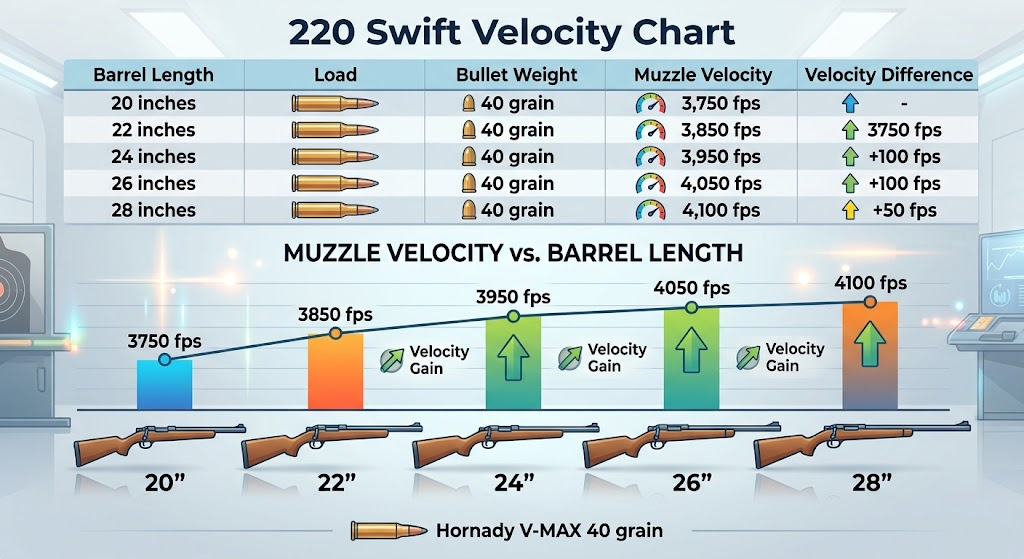
How Much Velocity Does 220 Swift Gain From Barrel Length?
Chronograph testing demonstrates that the .220 Swift is heavily dependent on barrel length to achieve its legendary speed. Because it features a semi-rimmed, high-capacity case packed with slow-burning rifle powder, the powder column requires substantial bore length to reach complete combustion.
Between 20 inches and 26 inches, the .220 Swift gains a consistent 45 to 50 fps per inch of barrel added. While shorter barrels make for a handier rifle in the field, cutting down from a traditional 26-inch varmint barrel to a 22-inch sporter profile strips away roughly 200 fps of initial muzzle velocity.
Does Barrel Length Affect 220 Swift Velocity?
Yes, barrel length drastically affects .220 Swift velocity, which directly influences its flat-shooting trajectory at long ranges.
Because of the extreme pressures and intense powder volumes involved, the .220 Swift is known for accelerated throat erosion (fire-cracking). If an older barrel has a worn throat, high-pressure gases can blow past the bullet upon ignition, causing actual chronograph velocities to drop significantly below factory specifications despite having a long 26-inch or 28-inch tube. Lot-to-lot ammunition variations and ambient temperature shifts also play a major role in velocity consistency.
220 Swift Supersonic Velocity By Barrel Length
The .220 Swift operates exclusively as a hyper-velocity supersonic cartridge, utilizing extreme speed to achieve explosive fragmentation on impact.
- 34 to 36 Grain (Ultra-Light): Specialized lightweight varmint loads push the boundaries of physics. Fired from a 26-inch barrel, these bullets can exceed a staggering 4,200 fps, dropping to roughly 4,000 fps in a 22-inch barrel.
- 40 Grain (Standard Varmint): The classic velocity benchmark. It achieves approximately 3,850 fps in a 22-inch barrel and scales up to 4,050 fps in a 26-inch precision rifle.
- 50 to 55 Grain (Heavyweight): Traditional heavier bullets are favored for bucking the wind when hunting coyotes at extended distances. A 50-grain soft point typically leaves a 26-inch barrel at roughly 3,800 fps, dropping to approximately 3,600 fps from a 20-inch barrel.
220 Swift Subsonic Velocity By Barrel Length
Because the .220 Swift’s entire ballistic identity is built around extreme hyper-velocity and flat trajectories, subsonic .220 Swift ammunition does not exist commercially.
Attempting to download a .220 Swift to travel below the speed of sound (1,125 fps at sea level) would require a microscopic powder charge inside a massive case. This introduces severe reloading hazards, including erratic ignition, extreme pressure spikes, and catastrophic squib loads where a bullet becomes lodged in the bore. Shooters requiring quiet, subsonic performance utilize entirely different cartridges, such as the .300 Blackout or a suppressed .22 LR.
220 Swift 20 Inch Barrel Velocity
A 20-inch barrel is an unusually short, compact setup for the .220 Swift, typically found on custom lightweight carbines.
- 40-Grain Load: Averages roughly 3,750 fps.
- Considerations: While 3,750 fps is still extraordinarily fast, this length sacrifices 300 fps compared to a 28-inch barrel and produces an intense muzzle blast and bright fireball due to unburnt powder escaping the muzzle.
220 Swift 22 Inch Barrel Velocity
A 22-inch barrel is a common sporter weight configuration for hunters who want to carry a lighter rifle in the field.
- 40-Grain Load: Yields approximately 3,850 fps.
- Considerations: Offers a great compromise between traditional field portability and high velocity, though it still leaves some of the cartridge’s overbore potential unutilized.
220 Swift 24 Inch Barrel Velocity
The 24-inch barrel serves as a balanced general-purpose length for modern bolt-action rifles chambered in .220 Swift.
- 40-Grain Load: Reaches approximately 3,950 fps.
- Considerations: Closely approaches the historic 4,000 fps threshold with lightweight bullets while maintaining manageable rifle balance.
220 Swift 26 Inch Barrel Velocity
The 26-inch heavy barrel is the classic benchmark configuration for the .220 Swift, popularized by vintage benchrest and heavy varmint rifles.
- 40-Grain Load: Hits the 4,050 fps mark.
- Considerations: Fully harnesses the slow-burning powder charge, maximizing flat trajectories out to 400+ yards and providing a heavy platform that dampens recoil.
220 Swift Velocity And Energy By Barrel Length
The following table calculates muzzle energy based on tested velocity averages for a standard 40-grain Hornady V-MAX load.
| Barrel Length | Bullet Weight | Velocity | Muzzle Energy |
| 20 inches | 40 grain | 3,750 fps | 1,249 ft-lbs |
| 22 inches | 40 grain | 3,850 fps | 1,316 ft-lbs |
| 24 inches | 40 grain | 3,950 fps | 1,385 ft-lbs |
| 26 inches | 40 grain | 4,050 fps | 1,456 ft-lbs |
| 28 inches | 40 grain | 4,100 fps | 1,492 ft-lbs |
Practical Applications
Muzzle velocity dictates the effective operational role of the .220 Swift:
- Long-Range Varmint Hunting: For prairie dogs and rock chucks at distances exceeding 400 yards, the flat trajectory of a 26-inch or 28-inch barrel pushing 40-grain bullets past 4,000 fps minimizes holdovers and ensures instantaneous fragmentation upon impact.
- Coyote & Predator Hunting: Heavier 50 to 55-grain bullets fired from a 24 to 26-inch barrel provide enough mass and retained energy to ethically anchor medium-sized predators while resisting crosswinds effectively.
- Mobile Field Carrying: While shorter 20 to 22-inch barrels sacrifice velocity, some hunters accept the 200 fps loss to make the rifle significantly easier to carry on long hikes or maneuver inside a vehicle.
What Is The Best Barrel Length For 220 Swift?
The chronograph data strongly points to the 24-inch to 26-inch range as the absolute best overall barrel length for the .220 Swift.
Because the .220 Swift is intensely overbore, putting a short 20 or 22-inch barrel on the rifle undermines its historical identity as a 4,000 fps powerhouse, trading vital speed for minor weight savings. A 26-inch barrel completely burns the slow powder charge, unlocking maximum velocity and energy while keeping the rifle’s balance steady for prone or bench shooting.
Pros and Cons
Short Barrel Pros (20-22 Inches)
- Easier to handle, carry, and maneuver in tight shooting blinds or vehicles.
- Lighter overall rifle weight for active hunters on the move.
Short Barrel Cons (20-24 Inches)
- Substantial velocity penalty (losing up to 250 to 300 fps compared to long barrels).
- Severe muzzle blast, concussive report, and blinding fireball in low light.
- Steeper bullet drop at extended ranges.
Long Barrel Pros (24-28 Inches)
- Fully extracts the hyper-velocity potential (4,000+ fps) of the cartridge.
- Flattest possible trajectories out to 500 yards.
- Complete powder combustion significantly reduces muzzle flash.
- Heavier barrel contours absorb heat and mitigate barrel whip.
Long Barrel Cons (24-28 Inches)
- Rifles become long, front-heavy, and cumbersome to carry through dense brush.
- Accelerated throat wear can occur faster in hot, rapid-fire string sessions.
220 Swift Velocity: What The Data Shows
Chronograph testing clearly demonstrates that the .220 Swift thrives in longer barrels. A 28-inch precision barrel yields the highest tested muzzle velocity, pushing standard 40-grain bullets to a screaming 4,100 fps and generating nearly 1,500 ft-lbs of kinetic energy.
However, by analyzing the data curve, shooters can see that a 26-inch barrel hits the practical sweet spot at 4,050 fps, offering nearly identical performance with slightly better maneuverability. Dropping down to a 20-inch barrel severely penalizes the cartridge, stripping away 350 fps of speed. Ultimately, the data proves that if you want to experience the true velocity and flat-shooting flat trajectory of the .220 Swift, a 24-inch to 26-inch barrel is mandatory.
FAQs
How fast is 220 Swift from a 22-inch barrel?
From a 22-inch barrel, a standard 40-grain polymer-tipped load averages approximately 3,850 fps.
How fast is 220 Swift from a 26-inch barrel?
A 26-inch heavy barrel successfully crosses the 4,000 fps threshold, pushing standard 40-grain bullets to roughly 4,050 fps.
How fast is 220 Swift from a 28-inch barrel?
An extended 28-inch precision barrel extracts maximum performance, yielding approximately 4,100 fps for 40-grain loads.
Does barrel length affect 220 Swift velocity?
Yes, significantly. The .220 Swift utilizes a massive case capacity packed with slow-burning powder, requiring substantial barrel length to burn completely and accelerate the bullet.
How much velocity does 220 Swift lose per inch?
Based on testing between 20 and 28 inches, the .220 Swift loses an estimated 45 to 50 fps per inch of reduced barrel length.
What is the fastest 220 Swift barrel length?
A 28-inch barrel produces the fastest standard muzzle velocity for the .220 Swift, allowing maximum time for the large propellant volume to accelerate the projectile.
What is the best barrel length for 220 Swift?
The 24-inch to 26-inch range is widely considered optimal, providing true 4,000+ fps velocities while keeping the rifle length manageable.
Does 220 Swift gain velocity from a longer barrel?
Yes. The cartridge continues to gain meaningful velocity all the way up to 28 inches.
How fast is subsonic 220 Swift?
Subsonic .220 Swift ammunition does not exist commercially. The cartridge is engineered strictly for hyper-velocity performance.
How fast is supersonic 220 Swift?
Standard supersonic .220 Swift ammunition travels anywhere between 3,600 fps (for heavy 50-grain bullets in short barrels) and over 4,200 fps (for ultra-light bullets in long barrels).
What is the velocity difference between a 20 and 26 inch 220 Swift barrel?
For a 40-grain load, the velocity difference is roughly 300 fps (3,750 fps vs. 4,050 fps), which results in a noticeable change in long-range bullet drop.