The .300 Blackout produces drastically different muzzle velocities depending on whether you fire light supersonic ammunition or heavy subsonic loads.
A standard 110-grain supersonic load achieves approximately 2,350 fps from a 16-inch barrel and roughly 2,175 fps from a 10.5-inch platform.
Heavy 220-grain subsonic ammunition is engineered to stay below the speed of sound, maintaining roughly 1,000 fps regardless of most barrel lengths.
Exact velocities shift significantly based on specific bullet weights, individual barrel profiles, chamber tolerances, and external testing conditions.
Analyzing these actual chronograph statistics allows shooters to select the perfect load to maximize kinetic energy or ensure absolute sound suppression.
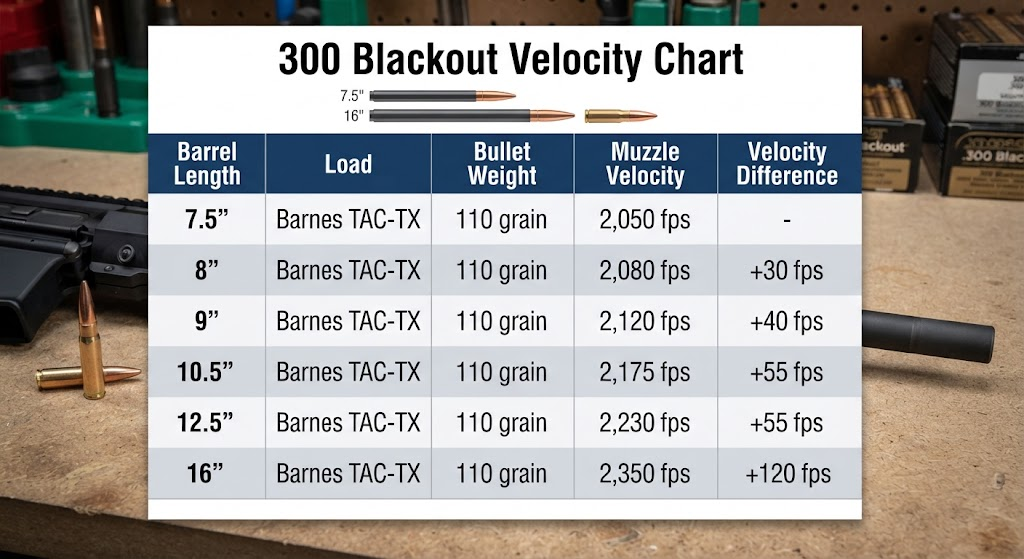
300 Blackout Velocity Chart
| Barrel Length | Load | Bullet Weight | Muzzle Velocity | Velocity Difference |
| 7.5 inches | Barnes TAC-TX | 110 grain | 2,050 fps | – |
| 8 inches | Barnes TAC-TX | 110 grain | 2,080 fps | +30 fps |
| 9 inches | Barnes TAC-TX | 110 grain | 2,120 fps | +40 fps |
| 10.5 inches | Barnes TAC-TX | 110 grain | 2,175 fps | +55 fps |
| 12.5 inches | Barnes TAC-TX | 110 grain | 2,230 fps | +55 fps |
| 16 inches | Barnes TAC-TX | 110 grain | 2,350 fps | +120 fps |
300 Blackout Muzzle Velocity
Muzzle velocity for the .300 Blackout is dictated entirely by the relationship between the powder charge and the bullet weight. Because the cartridge was originally developed to match the ballistics of the 7.62x39mm in a standard AR-15 platform, it utilizes fast-burning pistol and magnum powders (such as H110 or Lil’Gun).
This fast burn rate means the cartridge reaches peak pressure and maximum powder ignition very quickly. A 110-grain supersonic bullet will reliably exit the muzzle between 2,000 and 2,400 fps depending on the firearm, while heavy 200+ grain bullets are loaded with specific powder charges designed to prevent them from ever exceeding 1,125 fps.
300 Blackout Supersonic Velocity
Supersonic 300 Blackout ammunition is designed to break the sound barrier and deliver maximum kinetic energy for hunting and self-defense.
- 110 Grain: This is the undisputed velocity king of the .300 Blackout world. Loads like the Barnes TAC-TX and Hornady V-MAX launch at roughly 2,080 fps from an 8-inch barrel and scale up to 2,350 fps from a 16-inch barrel.
- 125 Grain: Often used for target shooting and tactical applications, 125-grain bullets (like the Speer TNT) average roughly 2,030 fps from a 9-inch barrel and max out around 2,215 fps from a 16-inch barrel.
- 150 Grain: On the heavier end of supersonic options, a 150-grain FMJ typically leaves a 16-inch barrel at approximately 1,650 to 1,700 fps, dropping closer to 1,450 fps in an 8-inch barrel.
300 Blackout Subsonic Velocity
Subsonic velocity is the primary reason the .300 Blackout exists. To remain perfectly hearing-safe when suppressed, these projectiles must travel slower than the speed of sound (approximately 1,125 fps at sea level).
Ammunition manufacturers load heavy bullets—typically between 190 and 220 grains—with small charges of fast powder to achieve a target velocity of roughly 980 to 1,050 fps. A 190-grain Hornady Sub-X might clock 989 fps out of an 8-inch barrel. Moving to a 16-inch barrel rarely pushes this specific load past 1,050 fps. Because the powder is fully burnt in the first few inches, longer barrels provide virtually no velocity gain for subsonic ammunition, and the friction of a 16-inch barrel can occasionally slow a subsonic bullet down.
How Much Velocity Does 300 Blackout Gain From Barrel Length?
While there is no strict “fps per inch” rule for all ammunition, chronograph data reveals a predictable velocity gain for supersonic loads. Between 7.5 inches and 16 inches, a 110-grain supersonic load gains approximately 25 to 35 fps for every inch of barrel added.
However, the gains suffer from severe diminishing returns. Cutting a barrel from 16 inches to 10.5 inches removes 5.5 inches of steel, but only costs the shooter roughly 175 fps. Because the cartridge reaches near-complete powder burn so early, extending the barrel to 16 inches provides only marginal velocity increases compared to cartridges like the 5.56 NATO or .308 Winchester.
Does Barrel Length Affect 300 Blackout Velocity?
Yes, barrel length directly affects .300 Blackout velocity, but its impact is heavily biased toward supersonic ammunition.
Supersonic rounds rely on expanding gases pushing the projectile through the entire length of the bore. A 16-inch barrel provides more time for this pressure to act on a 110-grain bullet, resulting in higher speeds. Conversely, subsonic rounds are loaded with fast-burning powders that reach their pressure peaks immediately. Adding extra barrel length to a subsonic round does not significantly affect its velocity because there is no remaining unburnt powder to generate additional forward pressure.
300 Blackout Velocity And Energy By Barrel Length
The following table demonstrates how muzzle velocity and kinetic energy change based on barrel length for a standard 110-grain supersonic load (Barnes TAC-TX).
| Barrel Length | Bullet Weight | Velocity | Muzzle Energy |
| 8 inches | 110 grain | 2,080 fps | 1,056 ft-lbs |
| 9 inches | 110 grain | 2,120 fps | 1,098 ft-lbs |
| 10.5 inches | 110 grain | 2,175 fps | 1,155 ft-lbs |
| 12.5 inches | 110 grain | 2,230 fps | 1,214 ft-lbs |
| 16 inches | 110 grain | 2,350 fps | 1,349 ft-lbs |
Practical Applications
Understanding .300 Blackout velocity is crucial for matching your rifle to its intended application:
- Hunting: Supersonic velocity is mandatory for reliable bullet expansion on medium game (like deer and feral hogs). A 110-grain bullet needs to impact above 1,300 fps to expand properly. A 10.5-inch or 16-inch barrel provides the necessary muzzle velocity to extend this effective expansion range out to 150-200 yards.
- Suppressed Use: For absolute sound mitigation, subsonic velocities (under 1,100 fps) are required. Since barrel length doesn’t meaningfully increase subsonic speed, an 8-inch or 9-inch barrel paired with a suppressor yields the best handling characteristics.
- Compact Platforms: Because supersonic loads only lose about 8% of their velocity when dropping from 16 inches down to 10.5 inches, shooters can field a highly maneuverable short-barreled rifle (SBR) without sacrificing lethal kinetic energy.
What Is The Best Barrel Length For 300 Blackout?
The optimal barrel length for a balanced .300 Blackout platform is between 9 and 10.5 inches.
This range offers the perfect compromise between supersonic velocity and suppressed portability. A 10.5-inch barrel pushes 110-grain loads to nearly 2,175 fps—generating over 1,150 ft-lbs of energy—while guaranteeing complete powder burn. This ensures reliable expansion for hunting or defense while preventing unburnt powder from blasting into a suppressor. When running heavy subsonic loads, the 10.5-inch barrel stabilizes the long 220-grain projectiles perfectly and provides enough gas dwell time to reliably cycle the firearm’s action.
Pros and Cons
Short Barrel Pros (8 to 10.5 inches)
- Creates a highly maneuverable platform perfect for home defense and vehicles.
- Ideal overall length when combined with a 6-inch to 8-inch suppressor.
- Minimizes velocity loss; retains over 90% of a 16-inch barrel’s kinetic energy.
- Guarantees 220-grain ammunition will stay safely subsonic.
Short Barrel Cons (8 to 10.5 inches)
- Reduced effective range for supersonic ammunition due to steeper bullet drop.
- Decreased muzzle energy compared to a 16-inch rifle.
16-Inch Barrel Pros
- Maximizes raw muzzle velocity and kinetic energy.
- Flatter trajectory for supersonic loads past 150 yards.
- Avoids NFA (National Firearms Act) restrictions associated with short-barreled rifles.
16-Inch Barrel Cons
- Front-heavy and overly long when equipped with a suppressor.
- Provides severely diminishing velocity returns for the extra 5.5 inches of steel.
- Can occasionally cause borderline subsonic loads to break the sound barrier on hot days.
300 Blackout Velocity: What The Data Shows
Chronograph data clearly establishes that the .300 Blackout is uniquely optimized for short barrels. While a 16-inch barrel achieves the absolute highest supersonic velocity at 2,350 fps, the speed gained over a 10.5-inch barrel (2,175 fps) is a mere 175 fps.
This statistical difference represents less than an 8% variance in muzzle velocity. For subsonic ammunition, the data shows almost zero correlation between longer barrels and increased speed, with 220-grain loads safely hovering around 1,000 fps across all platforms. Ultimately, while a 16-inch barrel wrings out the last ounce of kinetic energy for dedicated hunters, a 9 to 10.5-inch barrel provides the most efficient, practical, and data-supported velocity curve for the .300 Blackout cartridge.
FAQs
How fast is 300 Blackout from an 8-inch barrel?
From an 8-inch barrel, a standard 110-grain supersonic bullet averages 2,080 fps. Heavy 220-grain subsonic rounds average roughly 980 to 990 fps.
How fast is 300 Blackout from a 10.5-inch barrel?
A 10.5-inch barrel launches a 110-grain supersonic load at approximately 2,175 fps. Subsonic 220-grain rounds sit comfortably at 1,000 fps.
How fast is 300 Blackout from a 16-inch barrel?
A 16-inch barrel produces the fastest velocities, pushing 110-grain supersonic loads to 2,350 fps while keeping subsonic rounds around 1,050 fps.
Does barrel length affect 300 Blackout velocity?
Yes, but primarily for supersonic loads. Supersonic ammunition gains 25 to 35 fps per inch, while subsonic ammunition sees almost no velocity change between short and long barrels.
How much velocity does 300 Blackout lose per inch?
Based on measured chronograph data, dropping from a 16-inch barrel down to an 8-inch barrel results in an average loss of 25 to 35 fps per inch for supersonic loads.
What is the fastest 300 Blackout barrel length?
A 16-inch barrel (or longer) will yield the fastest .300 Blackout velocities because it allows the expanding gases the maximum amount of time to accelerate the bullet.
What is the best barrel length for 300 Blackout?
The 9-inch to 10.5-inch range is widely considered the best barrel length for the .300 Blackout, as it offers near-complete powder burn and optimal suppressed maneuverability.
Does 300 Blackout gain velocity from a longer barrel?
Yes, supersonic .300 Blackout gains velocity from longer barrels, but it suffers from extreme diminishing returns after the 10.5-inch mark.
How fast is subsonic 300 Blackout?
Subsonic .300 Blackout is intentionally loaded to travel below the speed of sound (1,125 fps at sea level). Factory loads typically travel between 980 fps and 1,050 fps.
How fast is supersonic 300 Blackout?
Depending on bullet weight, supersonic .300 Blackout travels anywhere from 1,650 fps (with 150-grain bullets) up to 2,350 fps (with 110-grain bullets).
What is the velocity difference between an 8 and 16 inch 300 Blackout barrel?
For a 110-grain supersonic load, the velocity difference between an 8-inch and 16-inch barrel is roughly 270 fps (2,080 fps vs. 2,350 fps). For subsonic loads, the difference is negligible.