The .22 Magnum (.22 WMR) utilizes slower-burning propellants than the standard .22 LR, requiring a longer rifle barrel to fully combust and achieve maximum velocity.
When firing a standard 40-grain jacketed hollow point, muzzle velocities average approximately 1,350 fps from a 4-inch revolver barrel and 1,850 fps from a 16-inch rifle barrel.
As barrel length increases, this velocity scales to roughly 1,880 fps from an 18-inch barrel and reaches its absolute peak of roughly 1,910 fps from a 20-inch or 22-inch barrel.
Firing the cartridge through barrels longer than 22 inches generally yields no additional speed, as internal bore friction begins to counteract the depleting gas pressure.
It is critical to note that exact velocity varies by ammunition brand, bullet weight, chamber tolerances, bore dimensions, and environmental test conditions.
Analyzing these chronograph statistics allows shooters to select the optimal barrel length for varmint hunting without sacrificing downrange kinetic energy or carrying unnecessary rifle weight.
22 Magnum Velocity Chart
| Barrel Length | Load | Bullet Weight | Muzzle Velocity | Velocity Difference |
| 4 inches | CCI Maxi-Mag | 40 grain | 1,350 fps | – |
| 16 inches | CCI Maxi-Mag | 40 grain | 1,850 fps | +500 fps |
| 18 inches | CCI Maxi-Mag | 40 grain | 1,880 fps | +30 fps |
| 20 inches | CCI Maxi-Mag | 40 grain | 1,910 fps | +30 fps |
| 22 inches | CCI Maxi-Mag | 40 grain | 1,910 fps | 0 fps |
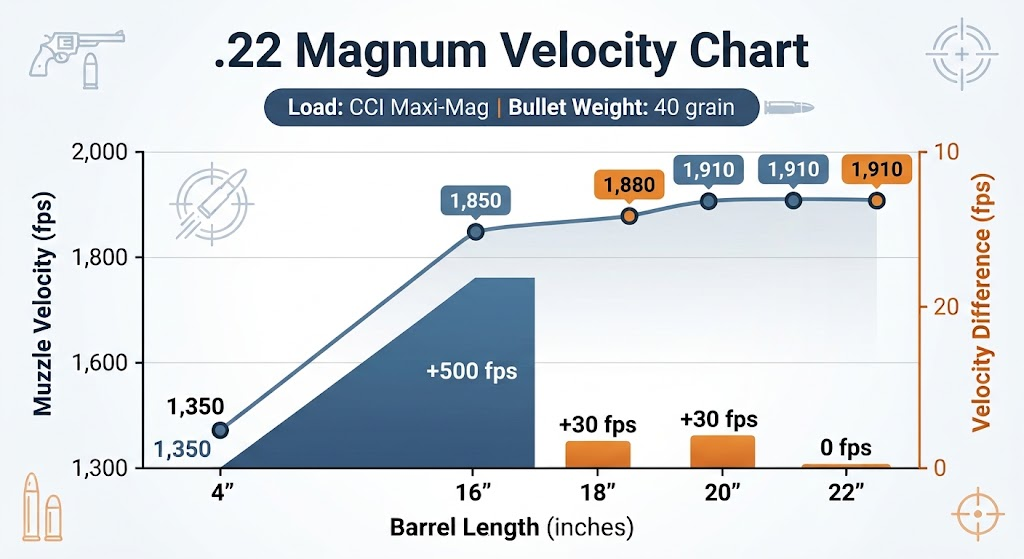
How Much Velocity Does 22 Magnum Gain From Barrel Length?
Unlike the .22 LR (which burns its tiny powder charge in the first 16 inches), the .22 Magnum utilizes a larger case capacity filled with slower-burning powder. This means the cartridge is heavily reliant on barrel length to generate its signature speed.
Moving from a 4-inch handgun barrel to a 16-inch rifle barrel yields an explosive gain of roughly 500 fps (averaging over 40 fps per inch). However, once the bullet passes the 16-inch mark, the velocity curve flattens significantly. Between 16 and 20 inches, the cartridge only gains an average of 10 to 15 fps per inch. By the time the bullet reaches 20 to 22 inches, the powder is entirely consumed, and adding further barrel length yields zero velocity increase.
Does Barrel Length Affect 22 Magnum Velocity?
Yes, barrel length drastically affects .22 Magnum velocity, creating a massive performance gap between handguns and rifles.
Because the .22 WMR was originally designed as a rifle cartridge, firing it from a 2-inch or 4-inch revolver results in a massive amount of unburnt powder violently igniting outside the muzzle. This drops a standard 40-grain bullet from its 1,910 fps rifle potential down to a sluggish 1,350 fps. If shooters record slightly different velocities from identical 20-inch rifle barrels, the discrepancy is almost always caused by ammunition lot variations, differing bore tightness, or environmental temperature shifts.
22 Magnum Supersonic Velocity By Barrel Length
The .22 Magnum is purpose-built to operate at highly supersonic speeds (well above the 1,125 fps sound barrier) to deliver explosive terminal ballistics on small predators.
- 30 Grain (Hyper-Velocity): Lightweight polymer-tipped bullets like the Hornady V-MAX or CCI VNT are designed for maximum flat trajectory. They average roughly 2,200 fps from a 20-inch barrel and roughly 1,550 fps from a 4-inch handgun.
- 40 Grain (Standard): The benchmark hunting weight (such as the CCI Maxi-Mag or Winchester Super-X). These loads consistently hit 1,910 fps in 20-inch barrels and 1,850 fps in 16-inch carbines.
- 50 Grain (Heavyweight): Designed for deeper penetration on tough animals like coyotes, heavy 50-grain loads (like Federal Game-Shok) trade speed for mass, typically exiting a 20-inch barrel around 1,530 to 1,600 fps.
22 Magnum Subsonic Velocity By Barrel Length
Because the .22 Magnum’s entire identity is based on hyper-velocity, subsonic .22 Magnum ammunition is incredibly rare and highly counterproductive.
While a few specialty loads (like the Winchester Super-X Subsonic 45-grain) are manufactured to travel around 1,060 fps, they defeat the purpose of the magnum rimfire case. Downloading a .22 Magnum to subsonic speeds perfectly replicates the exact ballistics of a standard .22 Long Rifle, but at a significantly higher cost per round. For shooters wanting to utilize a suppressor without the supersonic crack, switching to a standard .22 LR platform is the mathematically and practically superior choice.
22 Magnum 4 Inch Barrel Velocity
A 4-inch barrel is common on “kit guns,” trail revolvers, and modern rimfire pistols like the Kel-Tec PMR-30.
- 40-Grain Load: Averages approximately 1,350 fps.
- Considerations: The short barrel robs the cartridge of over 500 fps. The unburnt, slower-burning powder results in a massive fireball and a surprisingly loud muzzle report compared to a .22 LR pistol.
22 Magnum 16 Inch Barrel Velocity
The 16-inch barrel is the legal minimum for rifles and is standard on compact lever-actions and modern semi-autos.
- 40-Grain Load: Reaches approximately 1,850 fps.
- Considerations: This length extracts roughly 96% of the cartridge’s velocity potential, providing excellent kinetic energy while keeping the rifle highly maneuverable in thick woods or vehicles.
22 Magnum 18 Inch Barrel Velocity
An 18-inch barrel is an incredibly popular middle ground for bolt-action rimfire hunting rifles.
- 40-Grain Load: Averages roughly 1,880 fps.
- Considerations: Provides a nearly complete powder burn, dampening the muzzle blast slightly while giving a 30 fps bump over a 16-inch carbine.
22 Magnum 20 Inch Barrel Velocity
The 20-inch barrel is the absolute ballistic sweet spot for the .22 WMR.
- 40-Grain Load: Peaks at roughly 1,910 fps.
- Considerations: This is the length where the powder column finishes combusting. It extracts the absolute maximum speed and flattest trajectory possible from the cartridge.
22 Magnum 22 Inch Barrel Velocity
A 22-inch barrel is traditionally found on older or full-sized bolt-action varmint rifles.
- 40-Grain Load: Plateaus at approximately 1,910 fps.
- Considerations: The extra two inches of steel over a 20-inch barrel provide virtually zero extra velocity. The only advantage is a slightly longer sight radius for shooters relying on traditional iron sights.
22 Magnum Velocity And Energy By Barrel Length
The following table calculates muzzle energy based on tested velocity averages for a standard 40-grain CCI Maxi-Mag load.
| Barrel Length | Bullet Weight | Velocity | Muzzle Energy |
| 4 inches | 40 grain | 1,350 fps | 162 ft-lbs |
| 16 inches | 40 grain | 1,850 fps | 304 ft-lbs |
| 18 inches | 40 grain | 1,880 fps | 314 ft-lbs |
| 20 inches | 40 grain | 1,910 fps | 324 ft-lbs |
| 22 inches | 40 grain | 1,910 fps | 324 ft-lbs |
Practical Applications
Muzzle velocity dictates the effective operational role of a .22 Magnum setup:
- Varmint & Predator Hunting: Supersonic velocity is mandatory for explosive terminal performance on groundhogs and humane penetration on coyotes out to 125 yards. A 16 to 20-inch barrel providing 300+ ft-lbs of energy is required for this application.
- Trail & Defensive Handguns: 4-inch revolvers pushing 40-grain bullets at 1,350 fps yield about 162 ft-lbs of energy. While this is significantly weaker than a rifle, it still outpaces a .22 LR handgun and offers deep penetration for snake or pest control on the trail.
- Suppressed Use: Because standard .22 WMR is always supersonic, attaching a suppressor will eliminate the muzzle blast but will not eliminate the loud sonic crack of the bullet breaking the sound barrier in flight.
What Is The Best Barrel Length For 22 Magnum?
The chronograph data strongly points to the 18-inch to 20-inch range as the absolute best overall barrel length for the .22 Magnum.
Because the cartridge utilizes a slow-burning powder, a 16-inch barrel leaves a small amount of performance on the table. Extending the barrel to 18 or 20 inches ensures a 100% complete powder burn, driving 40-grain bullets to a peak velocity of 1,910 fps. However, selecting a barrel longer than 22 inches simply adds dead weight to your rifle without providing a single foot-per-second of extra speed. The 20-inch barrel perfectly optimizes the fast-stepping varmint round, guaranteeing the flattest trajectory possible for 150-yard shots.
Pros and Cons
Short Barrel Pros (4-16 Inches)
- 4-inch handguns are incredibly lightweight and easy to carry on the hip.
- 16-inch carbines are highly agile in thick brush and hunting blinds.
- 16-inch barrels still capture 96% of the cartridge’s velocity potential (1,850 fps).
Short Barrel Cons (4-16 Inches)
- Handguns suffer a massive 500+ fps velocity penalty.
- Severe muzzle blast and fireball from handguns due to unburnt powder.
- 16-inch barrels may exhibit slightly louder muzzle reports than 20-inch barrels.
Optimal Barrel Pros (18-22 Inches)
- Achieves the factory-advertised maximum velocities (1,910+ fps).
- Flattest possible trajectory for small targets at 100-150 yards.
- Complete powder burn minimizes muzzle flash.
- Extended iron sight radius for improved mechanical accuracy.
Over-Length Barrel Cons (24+ Inches)
- Heavy and unwieldy in the field.
- Provides absolutely zero velocity gain over a 20-inch barrel, and may even cause a slight velocity loss due to bore friction.
22 Magnum Velocity: What The Data Shows
Chronograph testing proves that the .22 Magnum is a true rifle cartridge that heavily punishes short handgun barrels. While a 20-inch barrel produces the absolute highest velocity—launching a 40-grain bullet at 1,910 fps—the speed gained over a compact 16-inch carbine (1,850 fps) is a relatively minor 60 fps.
By analyzing the data curve, shooters can clearly see that dropping down to a 4-inch pistol barrel strips a massive 560 fps from the load, completely dropping muzzle energy from a rifle-class 324 ft-lbs down to a handgun-class 162 ft-lbs. Conversely, stretching the barrel past 22 inches provides negative returns. Ultimately, the data proves that a 18-inch or 20-inch barrel is the undisputed king for extracting maximum hunting performance and trajectory from the .22 Magnum cartridge.
FAQs
How fast is 22 Magnum from a 4-inch barrel?
From a 4-inch handgun barrel, a standard 40-grain .22 WMR load averages approximately 1,350 fps. Lightweight 30-grain loads will average closer to 1,550 fps.
How fast is 22 Magnum from a 16-inch barrel?
A 16-inch carbine barrel pushes a standard 40-grain bullet to roughly 1,850 fps, capturing the vast majority of the cartridge’s potential energy.
How fast is 22 Magnum from a 20-inch barrel?
A 20-inch barrel extracts peak velocity, pushing standard 40-grain loads to their maximum of approximately 1,910 fps.
Does barrel length affect 22 Magnum velocity?
Yes, drastically. The slower-burning powder requires at least 16 to 18 inches to fully burn. Shorter pistol barrels lose massive amounts of speed and energy.
How much velocity does 22 Magnum lose per inch?
Between 16 inches and 4 inches, the cartridge loses a massive 40 to 45 fps per inch. Between 20 inches and 16 inches, the loss is much smaller, averaging 10 to 15 fps per inch.
What is the fastest 22 Magnum barrel length?
Chronograph testing universally shows that 20-inch and 22-inch barrels produce the absolute fastest velocities for the .22 WMR cartridge.
What is the best barrel length for 22 Magnum?
The 18-inch to 20-inch range is widely regarded as optimal. It extracts peak velocity, fully combusts the powder, and keeps the rifle perfectly balanced for field carry.
Does 22 Magnum gain velocity from a longer barrel?
It gains velocity up to roughly 20 to 22 inches. Once the barrel exceeds 22 inches, the .22 Magnum stops gaining speed and will eventually slow down due to bore friction.
How fast is subsonic 22 Magnum?
While exceptionally rare, specialty subsonic .22 Magnum ammunition is intentionally loaded to travel around 1,050 to 1,060 fps to avoid the supersonic crack.
How fast is supersonic 22 Magnum?
Standard supersonic .22 Magnum ammunition travels anywhere from 1,350 fps (in handguns) up to a blistering 2,200 fps (in rifles firing lightweight 30-grain bullets).
What is the velocity difference between a 4 and 16 inch 22 Magnum barrel?
For a standard 40-grain load, the velocity difference is a massive 500 fps (1,350 fps vs. 1,850 fps). This represents a nearly 87% increase in kinetic energy when switching from a handgun to a rifle.