The .50 BMG requires exceptionally long barrels to fully combust its massive powder charges, with a 750-grain match load averaging approximately 2,380 fps from a 20-inch barrel and 2,530 fps from a 24-inch barrel.
Stepping up to a standard 29-inch military barrel pushes the velocity to 2,680 fps, while 33-inch and 36-inch precision barrels achieve 2,740 fps and 2,780 fps, respectively.
Conversely, specialized heavy subsonic ammunition shows minimal variation, generally staying safely below the speed of sound around 1,020 fps regardless of barrel length.
It is critical to note that exact velocity varies by ammunition lot, bullet weight, individual barrel profile, chamber tolerances, and environmental test conditions.
Analyzing these chronograph statistics allows shooters to choose the ideal barrel length to maximize extreme-range trajectory or prioritize portable maneuverability.
50 BMG Velocity Chart
| Barrel Length | Load | Bullet Weight | Muzzle Velocity | Velocity Difference |
| 20 inches | Hornady A-Max | 750 grain | 2,380 fps | – |
| 24 inches | Hornady A-Max | 750 grain | 2,530 fps | +150 fps |
| 29 inches | Hornady A-Max | 750 grain | 2,680 fps | +150 fps |
| 33 inches | Hornady A-Max | 750 grain | 2,740 fps | +60 fps |
| 36 inches | Hornady A-Max | 750 grain | 2,780 fps | +40 fps |
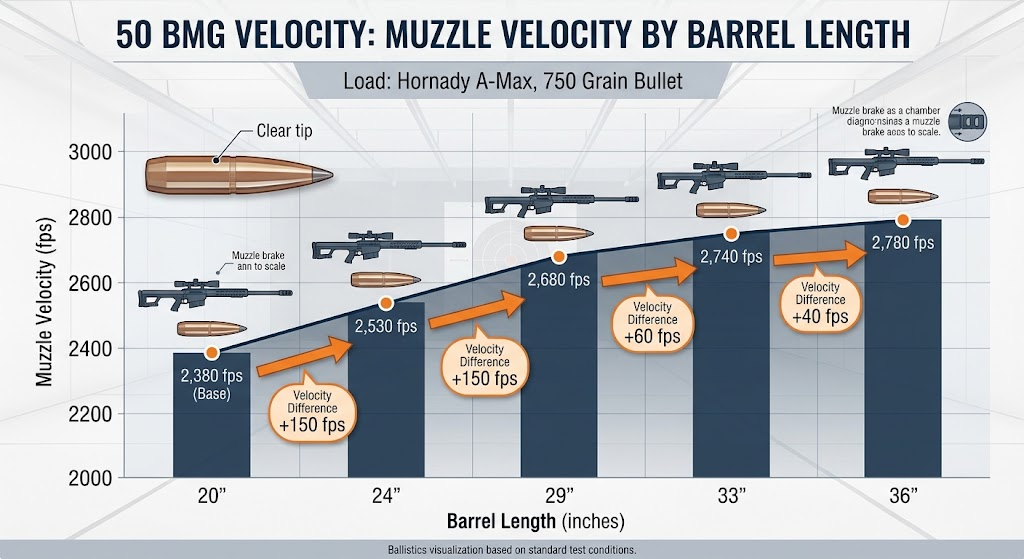
How Much Velocity Does 50 BMG Gain From Barrel Length?
Chronograph data reveals that the .50 BMG is incredibly sensitive to barrel length due to its massive case capacity. Between 20 and 29 inches, the cartridge gains a staggering average of 30 to 35 fps per inch of barrel added.
Once the barrel reaches 29 inches, the velocity gains begin to gradually flatten out. According to ballistics testing, adding length between 28 and 34 inches yields an average velocity gain of roughly 19 to 21 fps per inch. Moving from a 33-inch to a 36-inch precision barrel provides diminishing returns, typically adding only 11 to 14 fps per inch.
Does Barrel Length Affect 50 BMG Velocity?
Yes, barrel length drastically affects .50 BMG muzzle velocity. The cartridge was originally designed to be fired from the M2 Machine Gun, which utilizes a massive 45-inch barrel to produce over 2,820 fps with a standard 750-grain bullet.
Because civilian and anti-materiel rifles use much shorter barrels, they naturally sacrifice speed. Dropping from a 29-inch Barrett M82A1 barrel down to a 20-inch compact barrel strips roughly 300 fps from the muzzle velocity. This massive loss in speed exponentially increases bullet drop and wind drift at distances past 1,000 yards. If two rifles with identical barrel lengths produce varying velocities, the discrepancy is almost always caused by chamber tightness, environmental temperatures, or ammunition lot variations.
50 BMG Supersonic Velocity By Barrel Length
The .50 BMG is fundamentally designed to launch heavy projectiles at supersonic velocities to engage targets at extreme distances.
- 661 Grain (M33 Ball): The standard military ball round is slightly lighter and faster. It averages 2,450 fps from a 20-inch barrel, 2,750 fps from a 29-inch barrel, and 2,850 fps from a 36-inch barrel.
- 750 Grain: The 750-grain Hornady A-Max is the gold standard for long-range precision. It pushes roughly 2,380 fps from a 20-inch barrel and climbs to 2,740 fps in a 33-inch barrel.
- 800+ Grain: Extremely heavy solid brass or monolithic solids trade raw velocity for higher ballistic coefficients, generally leaving a 29-inch barrel between 2,550 and 2,600 fps.
50 BMG Subsonic Velocity By Barrel Length
While highly unconventional, specialty ammunition manufacturers do produce subsonic .50 BMG loads. These are designed to eliminate the deafening supersonic crack when fired through massive suppressors.
Because they must remain below the speed of sound (approximately 1,125 fps at sea level), they utilize exceptionally heavy bullets (often 700 to 800 grains) paired with drastically reduced powder charges. A subsonic load will generally hover between 1,000 and 1,050 fps. Since the reduced powder charge burns instantly, longer barrels offer absolutely no velocity gain for subsonic ammunition. It is also important to note that these low-pressure rounds will almost never cycle the action of a semi-automatic .50 BMG rifle.
50 BMG 20 Inch Barrel Velocity
A 20-inch barrel is incredibly short for this caliber, typically found on compact single-shot platforms like the Serbu RN-50.
- 750-Grain Load: Averages approximately 2,380 fps.
- Considerations: While it sacrifices nearly 300 fps compared to a standard 29-inch barrel, it still produces over 9,400 ft-lbs of energy. However, the unburnt powder creates an absolutely massive muzzle blast and fireball.
50 BMG 29 Inch Barrel Velocity
The 29-inch barrel is the universally accepted standard for the .50 BMG, popularized by the Barrett M82A1 and M107 platforms.
- 750-Grain Load: Yields roughly 2,680 fps.
- Considerations: This is the sweet spot for the cartridge, capturing approximately 95% of the .50 BMG’s true velocity potential while remaining short enough to be man-portable in the field.
50 BMG 33 Inch Barrel Velocity
A 33-inch barrel is commonly found on dedicated bolt-action platforms like the Barrett M99 or Armalite AR-50.
- 750-Grain Load: Achieves approximately 2,740 fps.
- Considerations: The extra four inches over a standard Barrett adds about 60 fps, providing a flatter trajectory for shooters dedicated to engaging targets past 1,500 yards.
50 BMG 36 Inch Barrel Velocity
The 36-inch barrel is typically reserved for extreme long-range precision rifles like the McMillan TAC-50.
- 750-Grain Load: Maxes out around 2,780 fps.
- Considerations: This length wrings out the absolute maximum practical velocity for civilian shooters, ensuring the bullet remains supersonic out past 2,500 yards.
50 BMG Velocity And Energy By Barrel Length
The following table calculates muzzle energy based on tested velocity averages for a standard 750-grain Hornady A-Max match load.
| Barrel Length | Bullet Weight | Velocity | Muzzle Energy |
| 20 inches | 750 grain | 2,380 fps | 9,433 ft-lbs |
| 24 inches | 750 grain | 2,530 fps | 10,659 ft-lbs |
| 29 inches | 750 grain | 2,680 fps | 11,961 ft-lbs |
| 33 inches | 750 grain | 2,740 fps | 12,503 ft-lbs |
| 36 inches | 750 grain | 2,780 fps | 12,871 ft-lbs |
Practical Applications
Understanding .50 BMG velocity dictates how the platform should be deployed:
- Anti-Materiel & Military Use: The standard 29-inch barrel provides the perfect balance, allowing the rifle to be carried in the field while retaining enough kinetic energy to penetrate engine blocks and light armor at 1,000 yards.
- Extreme Long Range (ELR) Target Shooting: For engaging targets at 2,000+ yards, wind drift is the primary enemy. Pushing a 750-grain bullet as fast as possible requires a 33-inch or 36-inch barrel to minimize time-in-flight and wind deflection.
- Compact Recreational Shooting: 20-inch and 24-inch barrels are primarily designed for range recreation, as the massive velocity loss limits their precision capabilities at extended distances.
What Is The Best Barrel Length For 50 BMG?
What barrel length gets the best balance of velocity and practicality for the .50 BMG? The data strongly points to the 29-inch barrel.
Because the .50 BMG requires immense case capacity to generate its legendary power, stripping the barrel down to 20 inches wastes roughly 300 fps of velocity as unburnt powder blasts out of the muzzle. Conversely, extending the barrel to 36 inches makes the rifle incredibly unwieldy and heavy, only netting a marginal 100 fps gain over the 29-inch setup. The 29-inch barrel perfectly optimizes the powder column, launching 750-grain bullets at 2,680 fps while keeping the rifle’s overall length manageable for real-world application.
Pros and Cons
Short Barrel Pros (20-24 Inches)
- Superior maneuverability for transport and vehicle deployment.
- Noticeably lighter overall rifle weight.
- Still produces over 9,400 ft-lbs of muzzle energy (more than enough for any target inside 800 yards).
Short Barrel Cons (20-24 Inches)
- Drastic velocity loss (up to 300 fps compared to standard barrels).
- Extremely concussive muzzle blast and blinding fireball due to unburnt powder.
- Steeper bullet drop and severe wind drift at 1,000+ yards.
Long Barrel Pros (29-36 Inches)
- Achieves the absolute maximum velocity and kinetic energy.
- Extends the supersonic range of the bullet well past 2,000 yards.
- Provides a complete powder burn, slightly reducing the concussive muzzle blast.
- Heavier barrel profiles soak up recoil efficiently.
Long Barrel Cons (29-36 Inches)
- Extremely long, front-heavy, and cumbersome to transport.
- Offers heavily diminishing returns; gaining only 11-14 fps per inch past 33 inches.
50 BMG Velocity Barrel Length: What The Data Shows
The chronograph data definitively proves that the .50 BMG thrives in long barrels. A 36-inch precision barrel yields the highest civilian tested velocities, pushing a 750-grain match bullet to nearly 2,780 fps and generating an earth-shattering 12,871 ft-lbs of muzzle energy.
However, by analyzing the data curve, shooters can see that the velocity gains drop off significantly after the 29-inch mark. Dropping from a 36-inch barrel down to a 29-inch barrel sacrifices exactly 100 fps—a highly acceptable tradeoff for shedding 7 inches of unwieldy steel. Conversely, dropping from 29 inches down to 20 inches severely handicaps the cartridge, resulting in a 300 fps loss. Ultimately, while 36-inch barrels dominate the ELR competition circuit, the 29-inch barrel remains the undisputed king of practical .50 BMG ballistics.
FAQs
How fast is 50 BMG from a 20-inch barrel?
From a 20-inch barrel, a 750-grain match load averages approximately 2,380 fps, while a 661-grain M33 ball load averages roughly 2,450 fps.
How fast is 50 BMG from a 29-inch barrel?
A standard 29-inch Barrett barrel pushes a 750-grain bullet to approximately 2,680 fps, generating nearly 12,000 ft-lbs of kinetic energy.
How fast is 50 BMG from a 36-inch barrel?
A 36-inch barrel wrings out maximum performance, yielding 2,780 fps for 750-grain loads and 2,850 fps for 661-grain M33 ball ammunition.
Does barrel length affect 50 BMG velocity?
Yes, drastically. The cartridge utilizes a massive powder charge that requires significant barrel length to achieve full combustion. Shorter barrels heavily handicap its speed.
How much velocity does 50 BMG lose per inch?
Based on testing, the .50 BMG loses roughly 19 to 21 fps per inch between 34 and 28 inches. However, dropping from 29 inches down to 20 inches results in a steeper loss of roughly 30 to 35 fps per inch.
What is the fastest 50 BMG barrel length?
The original M2 Browning Machine gun features a 45-inch barrel, which produces the fastest velocities (2,910 fps for M33 ball). For civilian rifles, 36-inch barrels are generally the longest and fastest commercially available.
What is the best barrel length for 50 BMG?
The 29-inch barrel is widely considered optimal. It captures 95% of the cartridge’s velocity potential while keeping the rifle short enough for practical transport and field use.
Does 50 BMG gain velocity from a longer barrel?
Yes, it continues to gain velocity even up to 45 inches, though the returns diminish (dropping to roughly 11-14 fps per inch) after the 33-inch mark.
How fast is subsonic 50 BMG?
Subsonic .50 BMG ammunition utilizes extremely heavy 700 to 800-grain solid bullets loaded with tiny powder charges to travel between 1,000 and 1,050 fps, avoiding the supersonic crack.
How fast is supersonic 50 BMG?
Standard supersonic .50 BMG ammunition travels anywhere between 2,380 fps and 2,910 fps, depending entirely on bullet weight and barrel length.
What is the velocity difference between a 20 and 36 inch 50 BMG barrel?
For a 750-grain match load, the velocity difference is a massive 400 fps (2,380 fps vs. 2,780 fps). This velocity gap represents a loss of over 3,400 ft-lbs of kinetic energy.