A .22 LR (Long Rifle) Trajectory Chart is a fundamental ballistic reference tool that illustrates the pronounced vertical arc and rapid bullet drop inherent in this iconic rimfire cartridge. Because .22 LR projectiles are subsonic or transonic and possess low ballistic coefficients, they are deeply affected by gravity and atmospheric drag even at relatively short distances. By diligently studying these precise ballistic values, target shooters and small game hunters can master their rifle’s flight path, calculate the necessary holdovers for precise shot placement, and understand the practical engagement limitations of this rimfire round. Reviewing this trajectory data is essential for achieving accuracy, as it transforms a simple “guess” into a calculated shot.
Table of Contents [Click to open]
.22 LR Trajectory Chart
| Bullet Weight | Velocity | 25 Yard Drop | 50 Yard Drop | 75 Yard Drop | 100 Yard Drop | 125 Yard Drop | 150 Yard Drop | Recommended Zero | Max Point Blank |
| 36 Grain | 1260 FPS (HV) | +0.2 | Zero | -2.5 | -7.0 | -13.5 | -22.5 | 50 Yards | 65 Yards |
| 40 Grain | 1200 FPS (HV) | +0.3 | Zero | -2.8 | -7.8 | -15.0 | -25.0 | 50 Yards | 62 Yards |
| 40 Grain | 1070 FPS (Sub) | +0.4 | Zero | -3.5 | -10.5 | -20.5 | -34.0 | 50 Yards | 55 Yards |
| 40 Grain | 1150 FPS | +0.3 | Zero | -3.0 | -8.5 | -16.5 | -27.5 | 50 Yards | 60 Yards |
Note: Data assumes a 50-yard zero and standard scope height. Values are in inches. Subsonic velocities will experience significantly more drop at distances beyond 50 yards.
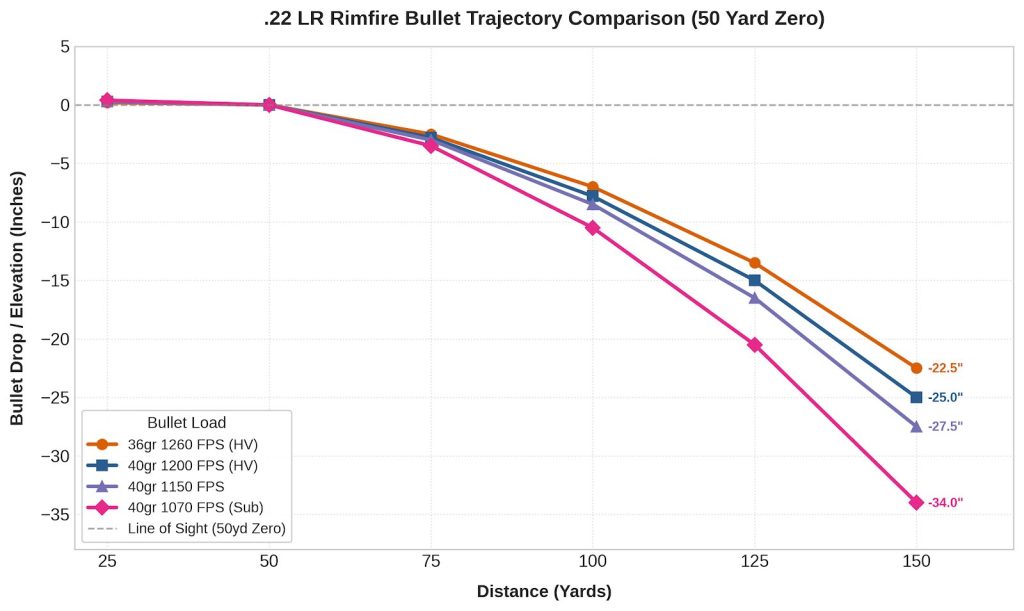
This trajectory chart provides .22 LR shooters with the necessary data to compensate for the significant gravity arc of the round. Always verify your specific ammunition at the range, as subtle variations in barrel length and environmental conditions will influence your actual point of impact.
Understanding The .22 LR Trajectory Chart
The data in this table is vital for any shooter carrying a .22 LR, as this cartridge operates under very different ballistic physics than high-velocity centerfire rounds. Mastering this chart will allow you to maintain accuracy across the practical range of your rifle.
Trajectory Analysis
Bullet drop for the .22 LR is extreme once you move past the 50-yard mark. When you look at the 50-yard zero column, you will notice that the bullet begins to fall off sharply as soon as it travels beyond that distance.
For example, a high-velocity 40-grain load drops nearly 8 inches at 100 yards and a staggering 25 inches at 150 yards. This illustrates that if you are shooting at a target at 100 yards, you must hold your aim significantly above the target to land a hit.
Subsonic loads drop even faster, often falling over 30 inches by the time they reach 150 yards. This is why the .22 LR is universally recognized as a short-range cartridge; it is simply not designed to be a precision tool at long distances.
Velocity Analysis
Muzzle velocity for the .22 LR usually ranges from 1,000 to 1,300 FPS. High-velocity (HV) loads are the most popular, providing the flattest trajectory, while subsonic loads are favored for their extreme accuracy and reduced noise levels.
Because the .22 LR is a rimfire cartridge, it does not have the massive powder capacity required to overcome air resistance at long distances. Velocity is lost quickly, which means the bullet spends a relatively long time in the air, giving gravity more time to pull it toward the earth.
If you are struggling with excessive bullet drop, switching to high-velocity ammunition is the best way to flatten your trajectory. However, always test for accuracy, as some rifles prefer lower-velocity match ammo over high-velocity options.
Ballistic Coefficient Analysis
The ballistic coefficient (BC) measures how well a bullet resists air resistance. Most .22 LR bullets have very low BCs (typically between 0.100 and 0.140) because they are small, lead-based projectiles that lack the sleek shape of modern long-range bullets.
These low BC numbers are the primary reason the .22 LR drops so rapidly. The bullet simply lacks the aerodynamic efficiency to maintain speed. This also makes the .22 LR highly susceptible to wind drift, meaning that even a light breeze will push the bullet off-target.
Sectional density for .22 LR is adequate for tiny pests, but the round lacks the penetration potential of larger centerfire cartridges. Precision at distance is primarily limited by the bullet’s inability to maintain its velocity and trajectory profile.
Best Hunting Loads Based On The Chart
Target shooters should rely on standard high-velocity 40-grain loads. They offer a predictable flight path and are widely available, making them the most practical choice for training and informal target shooting.
Small game hunters needing maximum lethality should look at high-velocity hollow points. While they have a steeper trajectory than match ammo, they provide the necessary terminal effect for squirrels and other small game at ranges under 50 yards.
For precision match shooters who prioritize accuracy above all else, subsonic match ammo is the gold standard. Although it has the steepest trajectory, it is the most consistent and accurate load for shooting groups at 50 yards or less.
Key Takeaways From The Chart
The trajectory chart confirms that the .22 LR is a short-range specialist. It is not designed for distance, and trying to stretch it past 100 yards is a challenge that requires significant mathematical holdover.
The 50-yard zero is the standard recommendation. It provides a simple reference point that covers the majority of the cartridge’s practical applications.
Maximum point-blank range is typically 55 to 65 yards. By keeping your shots within this window, you can hunt or target shoot with the confidence that your bullet will impact near your line of sight without complex adjustments.
Factors That Affect .22 LR Trajectory
- Bullet Weight: 40-grain bullets are the standard and offer the best stability, while lighter 36-grain bullets may have a slightly flatter initial flight but can be more inconsistent.
- Muzzle Velocity: High-velocity loads flatten the trajectory. Subsonic loads are generally more accurate but drop significantly more at distance.
- Ballistic Coefficient: Small changes in pellet/bullet design make a big difference in how well the projectile resists air resistance.
- Zero Distance: A 50-yard zero is the standard for .22 LR. Attempting to zero at 100 yards would cause the bullet to arc significantly high at 50 yards.
- Wind: The .22 LR is arguably the most wind-sensitive cartridge in existence. Even a 5 mph crosswind can push your bullet several inches off-target at 100 yards.
Frequently Asked Questions
What Is A .22 LR Trajectory Chart
It is a reference tool showing how much the bullet drops at various distances, allowing you to hold over for accurate hits.
What Is The Maximum Effective Range Of A .22 LR
The practical maximum range for small game or precision target work is about 75–100 yards.
How Much Does A .22 LR Drop At 100 Yards
Depending on the load, you can expect 7 to 10 inches of drop when zeroed at 50 yards.
Is The .22 LR Accurate At Long Range
It is capable, but the massive bullet drop and sensitivity to wind make long-range shots (over 100 yards) very difficult.
What Is The Best Zero For .22 LR
A 50-yard zero is widely recommended for most .22 LR rifles.
Does Barrel Length Affect .22 LR Ballistics
Yes, shorter barrels (around 16 inches) often provide the best velocity consistency for .22 LR.
What Is The Best .22 LR Hunting Load
High-velocity hollow points are standard for small game due to their combination of trajectory and terminal effect.
How Does Bullet Weight Change The .22 LR Trajectory
40-grain bullets are the standard for accuracy and trajectory predictability.
What Is The .22 LR Ballistic Coefficient
Most .22 LR bullets have BCs between 0.100 and 0.140.
Can You Use .22 LR For Long Range Target Shooting
It is a popular and challenging discipline, but you must be prepared to account for significant bullet drop and wind.
One follow-up question: Are you using your .22 LR primarily for plinking at the range or for small game hunting?