The .22 LR High Velocity cartridge utilizes a specialized powder charge to push lightweight bullets past the sound barrier for improved hunting performance.
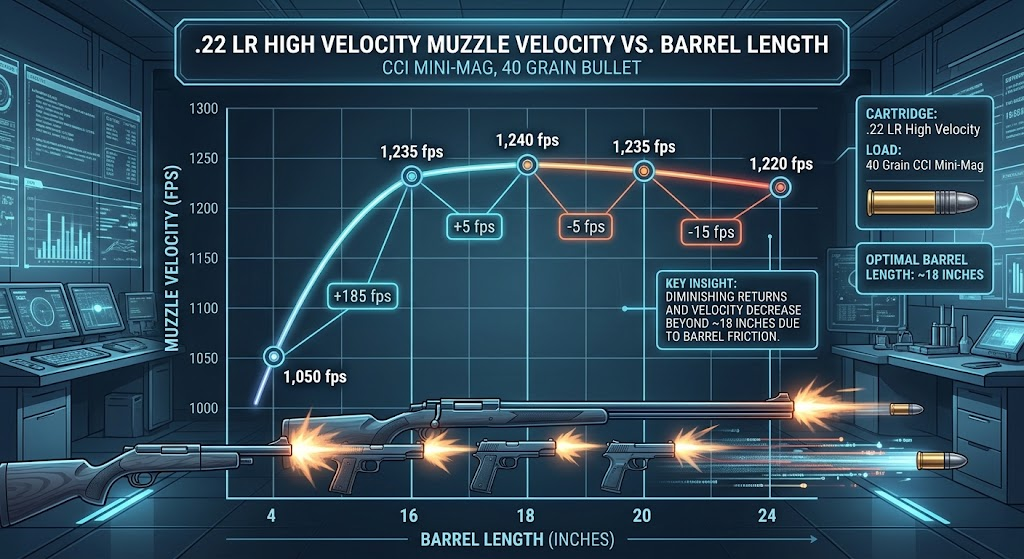
When firing standard 40-grain high-velocity ammunition, muzzle velocities average approximately 1,050 fps from a 4-inch pistol barrel and 1,235 fps from a standard 16-inch rifle barrel.
Maximum velocity is typically reached around the 16 to 18-inch mark, peaking at roughly 1,240 fps before friction from longer 20-inch or 24-inch barrels begins to slow the projectile.
While standard-velocity .22 LR remains subsonic, high-velocity loads intentionally break the sound barrier to deliver enhanced kinetic energy on small game.
It is critical to note that exact velocity varies by ammunition brand, bullet weight, bore friction, chamber dimensions, and environmental test conditions.
Analyzing these chronograph statistics allows shooters to select the optimal barrel length for hunting or precision plinking without sacrificing downrange energy.
22 LR High Velocity Chart
| Barrel Length | Load | Bullet Weight | Muzzle Velocity | Velocity Difference |
| 4 inches | CCI Mini-Mag | 40 grain | 1,050 fps | – |
| 16 inches | CCI Mini-Mag | 40 grain | 1,235 fps | +185 fps |
| 18 inches | CCI Mini-Mag | 40 grain | 1,240 fps | +5 fps |
| 20 inches | CCI Mini-Mag | 40 grain | 1,235 fps | -5 fps |
| 24 inches | CCI Mini-Mag | 40 grain | 1,220 fps | -15 fps |
How Much Velocity Does 22 LR High Velocity Gain From Barrel Length?
Unlike centerfire rifle cartridges that gain velocity as barrels get longer, the .22 LR High Velocity operates on a very limited powder charge. Moving from a 4-inch pistol barrel to a 16-inch carbine barrel yields massive gains, averaging roughly 15 fps per inch.
However, chronograph data reveals that this gain completely stalls between 16 and 18 inches, which is where the powder column finishes combusting. Pushing the tiny bullet through additional barrel length past 18 inches actually induces negative velocity gains. The friction of the rifling grabs the bullet without any expanding gas left to push it, causing a 24-inch barrel to shoot roughly 15 to 20 fps slower than a 16-inch barrel.
Does Barrel Length Affect 22 LR High Velocity?
Yes, barrel length drastically affects .22 LR High Velocity ammunition, but the relationship is a bell curve rather than a straight line.
Cutting a barrel from 16 inches down to a 4-inch pistol length strips roughly 185 fps from the muzzle velocity, turning a supersonic rifle round into a subsonic handgun round. Conversely, extending the barrel to 24 inches also reduces velocity. If shooters record wildly different velocities from the same barrel length, the discrepancy is almost always caused by ammunition lot variations, rimfire primer inconsistencies, or differences in bore tightness (such as specialized match chambers).
22 LR Supersonic Velocity By Barrel Length
High Velocity (HV) .22 LR ammunition is purpose-built to break the sound barrier (roughly 1,125 fps at sea level) when fired from a rifle.
- 40 Grain (Standard HV): The benchmark load, such as the CCI Mini-Mag, averages roughly 1,235 to 1,240 fps from a 16 to 18-inch barrel.
- 36 Grain (Hollow Point): Slightly lighter hollow points are loaded with identical powder charges to increase speed. They typically reach 1,260 fps from a 16-inch barrel to ensure violent expansion on small varmints.
- 32 Grain (Hyper-Velocity): Specialty loads like the CCI Stinger utilize slightly longer casings and lighter bullets to push velocities to a blistering 1,640 fps out of a 16-inch barrel.
22 LR Subsonic Velocity By Barrel Length
It is vital to distinguish High Velocity .22 LR from Standard Velocity or Subsonic .22 LR.
Standard velocity ammunition is loaded to intentionally stay below the speed of sound. A standard 40-grain subsonic load will clock roughly 1,070 fps out of a 16-inch barrel. Firing High Velocity ammunition through a suppressor will still result in a loud supersonic “crack” as the bullet breaks the sound barrier in flight. To achieve true hearing-safe performance, shooters must switch from High Velocity loads to dedicated Subsonic loads, regardless of whether they are using a 4-inch pistol or a 16-inch rifle.
22 LR 4 Inch Barrel Velocity
A 4-inch barrel is standard for popular target and trail pistols like the Ruger Mark IV or Browning Buck Mark.
- 40-Grain HV Load: Averages approximately 1,050 fps.
- Considerations: Even though it is labeled “High Velocity,” the short barrel does not provide enough time for the powder to accelerate the bullet past the sound barrier. It generally remains subsonic and safe to suppress without the sonic crack.
22 LR 16 Inch Barrel Velocity
The 16-inch barrel is the legal minimum for rifles in the US and the absolute most popular length for platforms like the Ruger 10/22.
- 40-Grain HV Load: Reaches approximately 1,235 fps.
- Considerations: This length extracts roughly 99% of the cartridge’s velocity potential, providing a supersonic trajectory and maximizing kinetic energy for squirrel or rabbit hunting.
22 LR 18 Inch Barrel Velocity
An 18-inch barrel is commonly found on bolt-action rimfire rifles like the CZ 457.
- 40-Grain HV Load: Peaks at roughly 1,240 fps.
- Considerations: This is the absolute ballistic apex for the .22 LR High Velocity cartridge. It provides complete powder combustion and peak speed before bore friction can take effect.
22 LR 24 Inch Barrel Velocity
A 24-inch barrel is traditionally used on vintage target rifles and heavy benchrest setups.
- 40-Grain HV Load: Drops to approximately 1,220 fps.
- Considerations: The extra length provides a much longer sight radius for iron sights and adds weight for stability, but it actually robs the bullet of kinetic energy due to internal bore friction.
22 LR High Velocity And Energy By Barrel Length
The following table calculates muzzle energy based on tested velocity averages for a standard 40-grain CCI Mini-Mag High Velocity load.
| Barrel Length | Bullet Weight | Velocity | Muzzle Energy |
| 4 inches | 40 grain | 1,050 fps | 98 ft-lbs |
| 16 inches | 40 grain | 1,235 fps | 135 ft-lbs |
| 18 inches | 40 grain | 1,240 fps | 137 ft-lbs |
| 20 inches | 40 grain | 1,235 fps | 135 ft-lbs |
| 24 inches | 40 grain | 1,220 fps | 132 ft-lbs |
Practical Applications
Understanding how barrel length affects High Velocity .22 LR determines your firearm choice:
- Small Game Hunting: Supersonic velocity is critical for humane kills on small game, as it causes 36-grain hollow points to expand reliably. A 16-inch or 18-inch barrel provides the necessary 1,200+ fps impact velocities.
- Suppressed Handguns: Because a 4-inch pistol keeps High Velocity ammunition hovering around 1,050 fps, shooters can often use cheap, bulk HV ammo in their suppressed pistols without generating a supersonic crack.
- Iron Sight Target Shooting: Older target rifles use 24-inch or even 28-inch barrels not for velocity, but to maximize the distance between the front and rear iron sights, greatly increasing mechanical aiming precision despite the slight speed penalty.
What Is The Best Barrel Length For 22 LR High Velocity?
The data definitively proves that the 16-inch to 18-inch range is the optimal barrel length for the .22 LR High Velocity cartridge.
Because the tiny rimfire case holds very little powder, the expanding gases run out of pushing power shortly after the 16-inch mark. A 16-inch barrel pushes 40-grain bullets to 1,235 fps, wringing out the maximum kinetic energy while keeping the rifle light and maneuverable. If a shooter opts for a 20-inch or 24-inch barrel, they are simply carrying around extra steel that actively slows their bullet down via friction. For any application utilizing modern optics, the 16-inch barrel is mathematically and practically superior.
Pros and Cons
Short Barrel Pros (4-10 Inches)
- Superior agility for handguns and short-barreled rifles (SBRs).
- Naturally reduces “High Velocity” ammunition to subsonic speeds, making it quiet when suppressed.
- Extremely lightweight to carry on the trail.
Short Barrel Cons (4-10 Inches)
- Drastic velocity loss (dropping below 1,100 fps).
- Fails to provide enough speed for hollow points to reliably expand on game.
- Reduced kinetic energy (under 100 ft-lbs).
Optimal Barrel Pros (16-18 Inches)
- Achieves absolute peak muzzle velocity and downrange energy.
- Guarantees supersonic flight for flat trajectories out to 75 yards.
- Perfectly balances rifle weight and handling characteristics.
Over-Length Barrel Cons (20-24+ Inches)
- Actively slows the bullet down due to bore friction.
- Adds unnecessary weight to a low-recoil rifle.
- Only beneficial for shooters requiring an extended iron sight radius.
22 LR High Velocity: What The Data Shows
Chronograph data exposes a unique ballistic reality for the .22 LR High Velocity: longer is not always faster. While an 18-inch barrel produces the absolute peak tested velocity (roughly 1,240 fps), the speed difference compared to a standard 16-inch carbine (1,235 fps) is completely imperceptible.
By analyzing the data curve, shooters can see that moving past 18 inches actively damages the cartridge’s performance, with 24-inch barrels dropping speeds back down to 1,220 fps. Conversely, dropping down to a 4-inch pistol barrel strips nearly 190 fps from the load, completely negating the “High Velocity” label and dropping muzzle energy below 100 ft-lbs. Ultimately, the data proves that a 16-inch or 18-inch barrel is the undisputed king for extracting maximum performance from .22 LR High Velocity ammunition.
FAQs
How fast is 22 LR High Velocity from a 4-inch barrel?
From a 4-inch pistol barrel, standard 40-grain High Velocity ammunition averages roughly 1,050 fps, usually remaining subsonic.
How fast is 22 LR High Velocity from a 16-inch barrel?
A standard 16-inch rifle barrel pushes 40-grain HV loads to approximately 1,235 fps, ensuring supersonic flight.
How fast is 22 LR High Velocity from a 24-inch barrel?
Due to bore friction, a 24-inch barrel slows the bullet down slightly compared to shorter rifles, averaging roughly 1,220 fps.
Does barrel length affect 22 LR High Velocity?
Yes. It gains speed rapidly up to 16 inches, peaks around 18 inches, and then loses speed in any barrel longer than 18 inches.
How much velocity does 22 LR High Velocity lose per inch?
When cutting from 16 inches down to 4 inches, it loses an average of 15 fps per inch. When increasing from 18 inches to 24 inches, it loses roughly 2 to 3 fps per inch due to friction.
What is the fastest 22 LR High Velocity barrel length?
Chronograph testing universally shows that 16-inch to 18-inch barrels produce the absolute fastest velocities for the .22 LR cartridge.
What is the best barrel length for 22 LR High Velocity?
The 16-inch barrel is widely considered optimal. It extracts peak velocity, fully combusts the powder, and keeps the rifle highly maneuverable.
Does 22 LR High Velocity gain velocity from a longer barrel?
No. Once the barrel exceeds 18 inches, the .22 LR stops gaining velocity and actually begins to slow down.
How fast is subsonic 22 LR?
Dedicated subsonic or standard velocity .22 LR ammunition is loaded to travel around 1,050 to 1,070 fps out of a rifle to avoid the supersonic crack.
How fast is supersonic 22 LR?
High Velocity .22 LR travels between 1,235 and 1,260 fps, while Hyper-Velocity loads (like the Stinger) can exceed 1,600 fps.
What is the velocity difference between a 4 and 16 inch 22 LR barrel?
For a standard 40-grain High Velocity load, the velocity difference is roughly 185 fps (1,050 fps vs. 1,235 fps), representing a nearly 40% increase in kinetic energy for the rifle.