A 17 WSM Trajectory Chart is a critical ballistic reference tool that visually displays exactly how much this ultra-high-velocity rimfire projectile drops across various downrange distances. As the fastest rimfire cartridge ever produced, the 17 Winchester Super Magnum (WSM) occupies a unique performance space between standard rimfires and small-bore centerfire rifles. By diligently studying these precise ballistic values, varmint hunters and precision rimfire enthusiasts can master their rifle’s flight path, calculate precise holdovers for extended shots, and ensure ethical accuracy in the field. Reviewing this comprehensive trajectory data guarantees you will fully maximize the incredible speed, flat-shooting potential, and wind-cheating capabilities of this powerful bottlenecked rimfire cartridge.
Table of Contents [Click to open]
17 WSM Trajectory Chart
| Manufacturer | Bullet Weight | Bullet Type | Ballistic Coefficient | Muzzle Velocity | 50 Yard Drop | 100 Yard Drop | 150 Yard Drop | 200 Yard Drop | 250 Yard Drop | 300 Yard Drop | Recommended Zero | Max Point Blank |
| Winchester | 20 Grain | V MAX Polymer Tip | 0.185 | 3000 FPS | +0.4 | Zero | -1.5 | -5.5 | -12.0 | -22.5 | 100 Yards | 170 Yards |
| Winchester | 25 Grain | V MAX Polymer Tip | 0.230 | 2600 FPS | +0.6 | Zero | -2.0 | -6.5 | -14.0 | -26.0 | 100 Yards | 160 Yards |
| Hornady | 20 Grain | V MAX | 0.185 | 3000 FPS | +0.4 | Zero | -1.5 | -5.5 | -12.0 | -22.5 | 100 Yards | 170 Yards |
| American Eagle | 20 Grain | Polymer Tip | 0.185 | 3000 FPS | +0.4 | Zero | -1.5 | -5.5 | -12.0 | -22.5 | 100 Yards | 170 Yards |
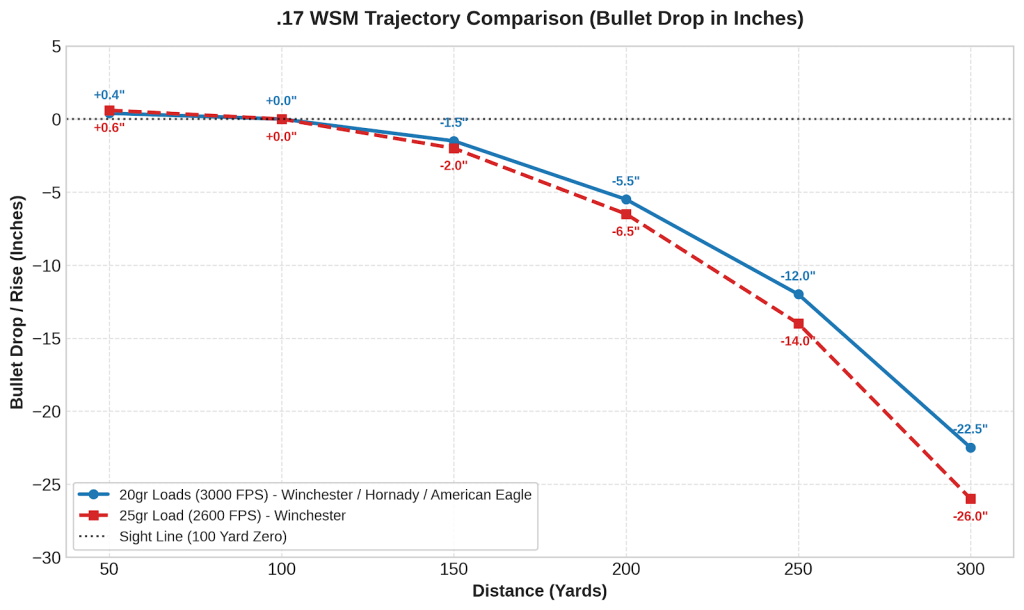
This professional trajectory chart provides rimfire shooters with extremely precise bullet drop measurements across various distances so they can effectively compensate for gravity. You should always properly match your chosen factory load with the recommended zero distance to truly maximize your effective hunting range and ensure perfectly ethical shots on small varmints.
Understanding The 17 WSM Trajectory Chart
The data in this table is essential for any shooter utilizing the 17 WSM, as it represents the current pinnacle of rimfire ballistic performance. By analyzing these statistics, you can master your rifle’s performance and understand exactly how your chosen ammunition behaves as it travels downrange.
Trajectory Analysis
Bullet drop for the 17 WSM is remarkably minimal compared to other rimfire options due to the extreme muzzle velocities produced by this unique cartridge. Our chart measures this vertical drop in inches to successfully help you calculate precise aiming adjustments in the hunting field.
The table reveals that the 20-grain V MAX load is incredibly flat, showing only 1.5 inches of drop at 150 yards when zeroed at 100 yards. This flat flight path allows hunters to engage small targets at significant distances without needing to adjust their scope turrets.
Conversely, the heavier 25-grain ammunition follows a slightly more pronounced arc due to its lower initial starting speed. The 25-grain load drops 2 inches at 150 yards, which, while still very flat, is slightly more than the 20-grain counterpart.
This physical difference in bullet drop perfectly illustrates precisely why shooters must carefully select the correct ammunition for their specific hunting distance. You can confidently aim directly at the center of the target out to nearly 170 yards with most 17 WSM loads.
Velocity Analysis
Muzzle velocity measures the exact speed of the bullet as it exits the rifle barrel, recorded in feet per second. Faster initial speeds directly translate into significantly flatter trajectories and highly extended point-blank hunting ranges for all small varmints.
The 17 WSM is famous for its 3,000 FPS velocity, a speed that most rimfire cartridges cannot even approach. This extreme velocity is the primary driver of the cartridge’s flat-shooting characteristics and impressive energy delivery on tiny targets.
The 25-grain load leaves the barrel at 2,600 FPS, providing slightly more mass for wind resistance while still maintaining a very high-speed profile. This intentional velocity difference dictates how much time the projectile spends fighting gravity before finally arriving at the target.
Because these bullets are so fast, they cover the downrange distance incredibly quickly, resulting in vastly superior flat-shooting characteristics compared to .22 LR or .17 HMR. Always remember that barrel length can affect your actual muzzle velocity, influencing the accuracy of your trajectory chart.
Ballistic Coefficient Analysis
The ballistic coefficient (BC) measures how efficiently a bullet cuts through the air and resists wind drag during open flight. Higher numerical values indicate a highly aerodynamic bullet that will successfully retain its initial muzzle velocity much better downrange.
Our extensive data shows that the 25-grain loads possess significantly higher aerodynamic ratings than their lighter 20-grain counterparts. The 25-grain V MAX boasts a ballistic coefficient of 0.230, which is excellent for a rimfire projectile.
Lighter 20-grain bullets possess lower ratings around 0.185. Their lighter overall mass makes them more susceptible to wind drift at longer ranges compared to the 25-grain options.
Sectional density simply measures the physical weight of the bullet relative to its diameter, indicating potential penetration depth on small targets. Even the lighter 20-grain loads feature sectional density ratings that guarantee explosive terminal performance on varmints.
Best Hunting Loads Based On The Chart
Varmint hunters seeking extreme flat-shooting performance should select the Winchester 20-grain V MAX. This load leaves the barrel at 3,000 FPS and provides a devastatingly flat trajectory out to 170 yards, making it the top choice for small pests in open field environments.
For hunters targeting slightly larger varmints where wind drift might be a factor, the 25-grain V MAX is the ideal selection. It offers better wind resistance and higher retained energy, ensuring that your shots remain on target even in breezy conditions.
Precision shooters who require consistent groups at standard distances will find both 20-grain and 25-grain offerings highly effective. The consistent velocity and reliable accuracy of these loads provide the necessary performance for hitting small targets with absolute confidence.
Key Takeaways From The Chart
The recommended zero distance strictly dictates the exact yardage where your bullet perfectly crosses your visual line of sight. Maximum point blank range specifically indicates exactly how far you can comfortably shoot a target without ever manually adjusting your crosshairs.
The trajectory table proves that the 17 WSM absolutely demands a 100-yard zero for maximizing open-field hunting efficiency. This zero effortlessly provides a maximum point-blank range reaching up to 170 yards with 20-grain bullets.
By properly matching your specific factory ammunition to its corresponding zero distance shown in the chart, you maximize your hunting capabilities. You will easily eliminate complicated mental math during fast-paced varmint hunting scenarios by fully trusting these verified ballistic values.
Common 17 WSM Bullet Weights
20 Grain
The 20-grain projectile is designed to achieve maximum possible velocity, creating a very flat trajectory for precise long-range varmint hunting. These high-speed projectiles are the premier choice for hunters who prioritize maximum flatness at distances exceeding 150 yards.
The primary advantage is an extremely flat flight path, which minimizes the need for complex holdovers. These bullets deliver explosive terminal effects on tiny varmints, providing rapid incapacitation.
The disadvantage is that they are highly susceptible to wind deflection. However, for hunters who primarily shoot on calm days, the trajectory advantage is undeniable.
25 Grain
The 25-grain bullet is the preferred choice for those who want better wind resistance and energy retention than the 20-grain option. These projectiles offer a slightly more stable flight path in gusty conditions, making them ideal for serious predator hunting.
The advantage is improved wind resistance and more consistent energy delivery at longer ranges. These bullets are a favorite for hunters who prioritize wind-cheating performance while still maintaining a very flat trajectory.
The disadvantage is a slightly steeper trajectory compared to the 20-grain loads, though the difference is minimal within effective range. It is the best balance for shooters who want a versatile, high-performance rimfire round.
Effective Hunting Range
Varmints
Varmint hunters can confidently engage small targets out to 200+ yards with the 17 WSM. Its extreme velocity and flat trajectory make it far more capable than almost any other rimfire cartridge available.
Always use a rangefinder, as the 17 WSM’s flat arc can be deceptive. Staying within 200 yards guarantees that you maintain the energy and trajectory predictability required for ethical shots.
Target Shooting
Precision target shooters can enjoy consistent accuracy out to 200 and even 300 yards. At this range, the 17 WSM provides a clear performance advantage in precision and wind resistance over smaller rimfire cartridges.
Practicing at longer distances will help you master the nuances of the 17 WSM’s flight path, ensuring you are ready for any target. Always remember to check your zero and verify your trajectory with your specific rifle before heading into the field.
Factors That Affect 17 WSM Trajectory
- Bullet Weight: Lighter 20-grain bullets offer the flattest trajectory, while 25-grain bullets provide better wind resistance and energy retention.
- Muzzle Velocity: Higher muzzle velocity is the hallmark of the 17 WSM, and it is the primary factor driving its flat-shooting performance.
- Ballistic Coefficient: Choosing more aerodynamic bullets improves trajectory and reduces wind drift at longer ranges.
- Zero Distance: A 100-yard zero is the standard for 17 WSM, offering the best balance for hunting and target shooting.
- Wind: The 17 WSM is susceptible to wind drift due to its small caliber and lightweight bullet, so always account for wind speed.
Frequently Asked Questions
What Is A 17 WSM Trajectory Chart
It is a reference table showing the bullet’s flight path and drop, allowing you to estimate holdover for accurate shooting.
What Is The Maximum Effective Range Of A 17 WSM
The 17 WSM is highly effective for varmints out to 200–250 yards. Beyond that, wind drift and energy loss become significant.
How Much Does A 17 WSM Drop At 200 Yards
With a 100-yard zero, a 20-grain load typically drops about 5.5 to 6 inches at 200 yards.
Is The 17 WSM Better Than The 17 HMR
Yes, the 17 WSM has significantly higher velocity, flatter trajectory, and more energy than the 17 HMR.
What Is The Best Zero For 17 WSM
A 100-yard zero is the industry standard. It provides a simple and manageable trajectory for most hunting scenarios.
Does Barrel Length Affect 17 WSM Ballistics
Yes, a longer barrel allows for more complete powder burn and higher velocity, resulting in a flatter trajectory.
What Is The Best 17 WSM Hunting Load
The 20-grain V MAX is excellent for varmints, while the 25-grain V MAX is preferred for longer-range or windier conditions.
How Does Bullet Weight Change The 17 WSM Trajectory
Lighter bullets are faster and have a flatter initial flight path, while heavier bullets provide better long-range stability.
What Is The 17 WSM Ballistic Coefficient
Most 17 WSM bullets have BCs between 0.180 and 0.230, providing decent efficiency for a rimfire projectile.
Can You Use 17 WSM For Long Range Target Shooting
Yes, it is excellent for shooting at small steel targets out to 200–300 yards with a high degree of precision.
One follow-up question: Are you using your 17 WSM primarily for varmint hunting or for precision target shooting at the range?