Understanding 12 gauge slug ballistics requires looking at how a heavy projectile behaves in flight, including its velocity retention, energy transfer, and physical path to the target. The 12 gauge slug ballistics chart below details the essential performance metrics of popular loads, illustrating how velocity, energy, bullet drop, and trajectory change at increasing distances.
Table of Contents [Click to minimize]
12 Gauge Slug Ballistics Chart
| Bullet Weight | Slug Type (Barrel Requirement) | Manufacturer and Load | Muzzle Velocity | Velocity At 50 Yards | Velocity At 100 Yards | Velocity At 150 Yards | Velocity At 200 Yards | Muzzle Energy | Energy At 50 Yards | Energy At 100 Yards | Energy At 150 Yards | Energy At 200 Yards | Bullet Drop At 25 Yards | Bullet Drop At 50 Yards | Bullet Drop At 75 Yards | Bullet Drop At 100 Yards | Bullet Drop At 150 Yards | Bullet Drop At 200 Yards | Trajectory At 50 Yards | Trajectory At 100 Yards | Trajectory At 150 Yards | Trajectory At 200 Yards | Ballistic Coefficient |
| 300 grains | Sabot (Rifled Barrel) | Hornady SST Sabot Slug | 2000 fps | 1816 fps | 1641 fps | 1478 fps | 1331 fps | 2664 ft-lbs | 2197 ft-lbs | 1794 ft-lbs | 1455 ft-lbs | 1180 ft-lbs | Not verified | 0.9 in (est) | Not verified | 4.3 in (est) | 11.2 in (est) | 21.6 in (est) | 2.4 in | 2.7 in | 0.0 in | -6.7 in | 0.200 |
| 385 grains | Sabot (Rifled Barrel) | Remington AccuTip Bonded Sabot | 1850 fps | 1648 fps | 1461 fps | 1296 fps | 1157 fps | 2925 ft-lbs | 2321 ft-lbs | 1824 ft-lbs | 1436 ft-lbs | 1144 ft-lbs | Not verified | 1.2 in (est) | Not verified | 5.1 in (est) | 13.5 in (est) | 26.2 in (est) | 2.2 in | 1.8 in | -2.6 in | -11.6 in | 0.145 |
| 437.5 grains | Foster (Smoothbore) | Federal Premium TruBall Rifled Slug | 1600 fps | 1186 fps | 967 fps | Not verified | Not verified | 2487 ft-lbs | 1366 ft-lbs | 908 ft-lbs | Not verified | Not verified | Not verified | 2.8 in (est) | Not verified | 10.5 in (est) | Not verified | Not verified | 0.7 in | -4.8 in | Not verified | Not verified | Not verified |
| 437.5 grains | Foster (Smoothbore) | Winchester Super-X Rifled Slug | 1600 fps | 1175 fps | 954 fps | Not verified | Not verified | 2486 ft-lbs | 1341 ft-lbs | 884 ft-lbs | Not verified | Not verified | Not verified | 2.9 in (est) | Not verified | 10.8 in (est) | Not verified | Not verified | 0.6 in | -5.1 in | Not verified | Not verified | Not verified |
The figures above combine manufacturer published specifications with calculated estimates to illustrate 12 gauge slug ballistics. Sabot trajectory measurements assume a 150 yard zero, while Foster slug trajectory measurements assume a 50 yard zero. Bullet drop is estimated relative to the bore line. Values marked “Not verified” reflect distances where the manufacturer does not supply reliable data and accurate extrapolation is not possible due to projectile instability.
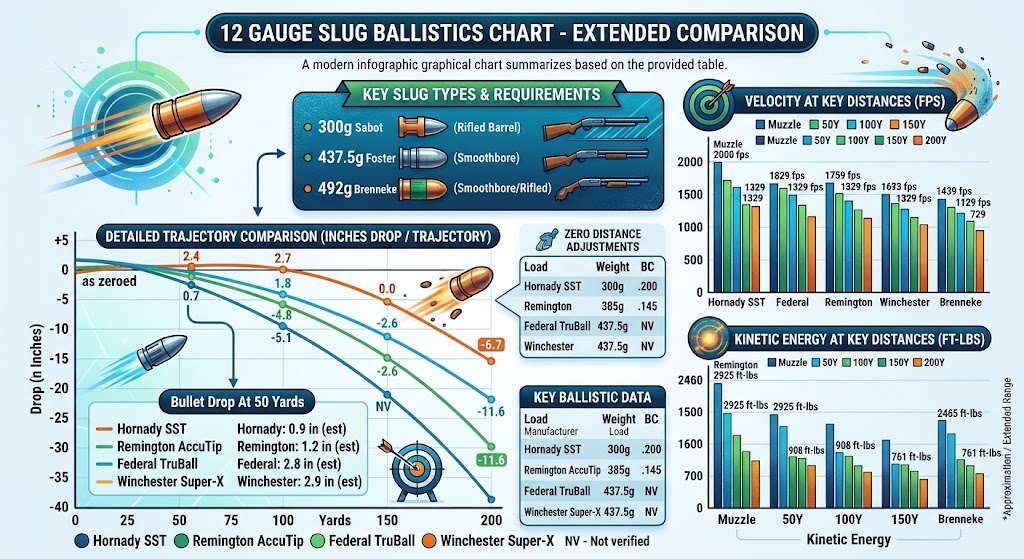
Understanding 12 Gauge Slug Ballistics
Evaluating a slug requires understanding how its weight, shape, and speed dictate its path and retained power.
Muzzle Velocity
Muzzle velocity measures how fast the slug travels the instant it leaves the shotgun barrel. High starting velocity reduces the time the projectile is exposed to gravity, creating a flatter initial flight path.
Retained Velocity
As a slug pushes through the air, aerodynamic drag slows it down. Retained velocity measures its speed at specific downrange intervals. Sabot slugs typically retain velocity better than blunt Foster slugs.
Muzzle Energy and Retained Energy
Energy is a product of projectile weight and velocity. Muzzle energy represents the raw power at the barrel, while retained energy measures the remaining power upon impact. High energy figures do not guarantee accuracy or ideal penetration.
Bullet Drop
Bullet drop measures the vertical distance a projectile falls away from its initial line of departure due to gravity. This measurement is referenced against the bore line, independent of the shooter’s sights.
Trajectory
Trajectory describes the projectile’s position relative to the shooter’s line of sight. Depending on the sight in distance, a slug will start below the line of sight, cross above it, and eventually fall below it again.
Ballistic Coefficient
A ballistic coefficient is a numerical value representing a projectile’s ability to overcome air resistance. Higher numbers indicate better aerodynamic efficiency. Many traditional shotgun slugs do not have published ballistic coefficients due to their blunt shapes and short effective ranges.
12 Gauge Slug Bullet Drop Chart
| Manufacturer and Load | Slug Weight | Reference Used | Bullet Drop At 25 Yards | Bullet Drop At 50 Yards | Bullet Drop At 75 Yards | Bullet Drop At 100 Yards | Bullet Drop At 150 Yards | Bullet Drop At 200 Yards |
| Hornady SST Sabot Slug | 300 grains | Bore Line | 0.2 in (est) | 0.9 in (est) | 2.1 in (est) | 4.3 in (est) | 11.2 in (est) | 21.6 in (est) |
| Remington AccuTip Bonded Sabot | 385 grains | Bore Line | 0.3 in (est) | 1.2 in (est) | 2.8 in (est) | 5.1 in (est) | 13.5 in (est) | 26.2 in (est) |
| Federal Premium TruBall Rifled Slug | 437.5 grains | Bore Line | 0.6 in (est) | 2.8 in (est) | 5.9 in (est) | 10.5 in (est) | Not verified | Not verified |
| Winchester Super-X Rifled Slug | 437.5 grains | Bore Line | 0.6 in (est) | 2.9 in (est) | 6.2 in (est) | 10.8 in (est) | Not verified | Not verified |
Bullet drop increases aggressively as distance increases because the projectile is slowing down, giving gravity more time to pull it downward over the same distance. Heavier, slower slugs experience more drop over a given distance than faster, aerodynamic sabot loads. Because muzzle velocity, projectile shape, and drag vary wildly between products, a single universal 12 gauge slug bullet drop chart is impossible to create.
12 Gauge Slug Trajectory Chart
| Manufacturer and Load | Slug Weight | Sight-In Distance | Trajectory At 50 Yards | Trajectory At 100 Yards | Trajectory At 150 Yards | Trajectory At 200 Yards |
| Hornady SST Sabot Slug | 300 grains | 150 Yards | 2.4 in | 2.7 in | 0.0 in | -6.7 in |
| Remington AccuTip Bonded Sabot | 385 grains | 150 Yards | 2.2 in | 1.8 in | -2.6 in | -11.6 in |
| Federal Premium TruBall Rifled Slug | 437.5 grains | 50 Yards | 0.0 in | -4.8 in | Not verified | Not verified |
| Winchester Super-X Rifled Slug | 437.5 grains | 50 Yards | 0.0 in | -5.1 in | Not verified | Not verified |
Positive trajectory values indicate the slug impacts above the crosshairs, while negative values indicate it impacts below them. Line of sight trajectory differs completely from bore line bullet drop because the sights are angled downward relative to the barrel to intersect the projectile’s arcing flight path at a specific distance.
12 Gauge Slug Velocity Chart
| Manufacturer and Load | Slug Weight | Muzzle Velocity | Velocity At 50 Yards | Velocity At 100 Yards | Velocity At 150 Yards | Velocity At 200 Yards |
| Hornady SST Sabot Slug | 300 grains | 2000 fps | 1816 fps | 1641 fps | 1478 fps | 1331 fps |
| Remington AccuTip Bonded Sabot | 385 grains | 1850 fps | 1648 fps | 1461 fps | 1296 fps | 1157 fps |
| Federal Premium TruBall Rifled Slug | 437.5 grains | 1600 fps | 1186 fps | 967 fps | Not verified | Not verified |
| Winchester Super-X Rifled Slug | 437.5 grains | 1600 fps | 1175 fps | 954 fps | Not verified | Not verified |
Velocity decreases over distance due to air resistance. Aerodynamic sabot slugs retain their starting velocity far better than heavy, flat nosed Foster slugs, which often drop below the speed of sound before reaching 100 yards.
12 Gauge Slug Energy Chart
| Manufacturer and Load | Slug Weight | Muzzle Energy | Energy At 50 Yards | Energy At 100 Yards | Energy At 150 Yards | Energy At 200 Yards |
| Hornady SST Sabot Slug | 300 grains | 2664 ft-lbs | 2197 ft-lbs | 1794 ft-lbs | 1455 ft-lbs | 1180 ft-lbs |
| Remington AccuTip Bonded Sabot | 385 grains | 2925 ft-lbs | 2321 ft-lbs | 1824 ft-lbs | 1436 ft-lbs | 1144 ft-lbs |
| Federal Premium TruBall Rifled Slug | 437.5 grains | 2487 ft-lbs | 1366 ft-lbs | 908 ft-lbs | Not verified | Not verified |
| Winchester Super-X Rifled Slug | 437.5 grains | 2486 ft-lbs | 1341 ft-lbs | 884 ft-lbs | Not verified | Not verified |
Projectile weight and downrange velocity dictate retained energy. A heavy slug moving slowly can carry similar energy to a lighter slug moving quickly. However, energy alone does not confirm that a slug will hit its target accurately or perform as desired upon impact.
Hornady SST 12 Gauge Slug Ballistics Chart
| Range (Yards) | Velocity (fps) | Energy (ft-lbs) | Drop (inches) | Time of Flight (seconds) | Wind Drift (10 mph) | Remaining Velocity (%) | Remaining Energy (%) |
| Muzzle | 2000 | 2664 | -1.5 | 0.000 | 0.0 | 100.0% | 100.0% |
| 25 | 1860 | 2304 | +0.6 | 0.039 | 0.2 | 93.0% | 86.5% |
| 50 | 1730 | 1993 | +2.2 | 0.081 | 0.8 | 86.5% | 74.8% |
| 75 | 1605 | 1715 | +3.0 | 0.126 | 1.8 | 80.2% | 64.3% |
| 100 | 1490 | 1478 | +2.7 | 0.174 | 3.4 | 74.5% | 55.4% |
| 125 | 1385 | 1277 | +1.5 | 0.226 | 5.4 | 69.2% | 47.9% |
| 150 | 1290 | 1108 | 0.0 | 0.282 | 8.0 | 64.5% | 41.5% |
| 175 | 1205 | 967 | -2.9 | 0.342 | 11.0 | 60.2% | 36.2% |
| 200 | 1135 | 858 | -7.4 | 0.406 | 14.5 | 56.7% | 32.2% |
| 225 | 1075 | 770 | -13.5 | 0.474 | 18.5 | 53.7% | 28.9% |
| 250 | 1025 | 700 | -21.4 | 0.546 | 23.0 | 51.2% | 26.2% |
| 275 | 980 | 640 | -31.3 | 0.621 | 28.0 | 49.0% | 24.0% |
| 300 | 940 | 588 | -43.2 | 0.699 | 33.6 | 47.0% | 22.0% |
Types of 12 Gauge Slugs
Foster-Style Rifled Slugs
Foster slugs feature a hollow base that pushes the center of mass forward, helping the projectile stabilize in flight like a badminton shuttlecock. The external rifling grooves allow the slug to safely compress when passing through a shotgun choke. These are designed strictly for smoothbore barrels.
Sabot Slugs
Sabot slugs use a smaller caliber projectile encased in a plastic sleeve called a sabot. The sabot engages the lands and grooves of a rifled shotgun barrel to spin the projectile for stability. After exiting the muzzle, the plastic sleeve falls away. Sabot slugs require rifled barrels to function accurately.
Brenneke-Style Slugs
Brenneke slugs utilize a solid lead body attached to a wad that remains connected during flight. This attached wad provides drag stabilization. While traditionally fired from smoothbore barrels, specific Brenneke products are manufactured for both smoothbore and rifled barrel applications depending on the model.
How Far Can a 12 Gauge Slug Travel?
The practical accuracy range of a 12 gauge slug is much shorter than its absolute maximum travel distance. A traditional Foster slug fired from a smoothbore is usually accurate and effective out to 50 or 75 yards. Sabot slugs fired from rifled barrels can extend practical accuracy to 150 or 200 yards. However, if fired at an upward angle, a 12 gauge slug can travel hundreds of yards before hitting the ground, remaining highly dangerous well beyond its aimed effective range. There is no single universal maximum range, as wind, elevation, and projectile type alter the outcome.
Factors That Affect 12 Gauge Slug Ballistics, Bullet Drop and Trajectory
Slug Weight and Design
Heavier slugs drop faster over a given distance than lighter ones if fired at the same velocity. The physical shape of the slug dictates its aerodynamic drag, which severely impacts long range trajectory and velocity retention.
Muzzle Velocity
Higher muzzle velocities flatten the bullet drop curve initially. A faster slug covers distance in less time, minimizing the duration gravity acts upon it before it reaches the target.
Barrel Type and Compatibility
Shooting a sabot slug through a smoothbore barrel will result in tumbling and extreme inaccuracy. Shooting a Foster slug through a rifled barrel can lead to severe lead fouling and poor performance. Ammunition must be matched to the barrel type.
Sight-In Distance
Adjusting the sights to intersect the bullet’s path at 50 yards versus 100 yards entirely changes the trajectory readings. The bore line bullet drop remains the same, but the line of sight shifts.
Sight Height
The vertical distance between the center of the shotgun bore and the center of the optic dictates the angle required to zero the firearm. Taller sight heights require a steeper upward barrel angle, altering the reported trajectory numbers.
Environmental Conditions
Cold, dense air slows projectiles faster than warm, thin air. Crosswinds will push large shotgun slugs laterally, impacting accuracy especially past 100 yards.
Differences Between Ammunition Loads
Even if two slugs weigh one ounce, differences in powder charges, wad design, and bearing surface will create distinctly different velocity retention profiles and downrange trajectories.
12 Gauge Slugs Compared by Type
| Slug Type | General Design | Barrel Compatibility | Typical Ballistic Characteristics | Important Considerations |
| Foster | Hollow base, external fins | Smoothbore | Rapid velocity loss, steep trajectory | Best inside 75 yards |
| Sabot | Sub-caliber bullet in plastic sleeve | Rifled Barrel | High velocity retention, flat trajectory | Requires specialized rifled barrel |
| Brenneke | Solid lead with attached wad | Smoothbore or Rifled | Excellent penetration, moderate trajectory | Check specific product for barrel rules |
Frequently Asked Questions
1. What is 12 gauge slug ballistics? It is the study of how a 12 gauge shotgun slug travels, encompassing its speed, energy, bullet drop, and physical trajectory from the moment it leaves the barrel until it impacts the target.
2. Where can I find a 12 gauge slug ballistics chart? A comprehensive 12 gauge slug ballistics chart detailing velocity, energy, and trajectory across multiple ammunition types is provided in the main section of this article.
3. How fast does a 12-gauge slug travel? Muzzle velocities typically range from 1300 to 1600 feet per second for traditional Foster slugs, while sabot slugs can achieve speeds between 1700 and 2000 feet per second.
4. How much energy does a 12-gauge slug produce? At the muzzle, a standard 12 gauge slug generates between 2300 and 3000 foot-pounds of energy, though it loses this energy quickly as distance increases.
5. How much does a 12-gauge slug drop at 50 yards? Relative to the bore line, a standard Foster slug drops approximately 2.5 to 3 inches at 50 yards, while a faster sabot slug may drop around 1 inch.
6. How much does a 12-gauge slug drop at 100 yards? A traditional smoothbore slug will drop 10 to 12 inches relative to the bore line at 100 yards. Sabot slugs typically drop 4 to 6 inches at the same distance.
7. What is the trajectory of a 12-gauge slug at 100 yards? If zeroed at 50 yards, a Foster slug will hit about 5 inches low at 100 yards. If a sabot slug is zeroed at 150 yards, it will hit about 2 to 3 inches high at 100 yards.
8. How far can a 12-gauge slug travel? While aimed accuracy is generally limited to 200 yards or less, a 12 gauge slug fired at an upward angle can physically travel over 800 yards before hitting the ground.
9. What is the difference between a rifled slug and a sabot slug? A rifled slug is a full bore projectile designed to be fired from a smoothbore barrel. A sabot slug is a smaller projectile encased in plastic designed to be spun by a rifled shotgun barrel.
10. Do all 12-gauge slugs have the same bullet drop and trajectory? No. Bullet drop and trajectory vary significantly based on the slug’s weight, muzzle velocity, aerodynamic shape, and the sight in distance of the firearm.