The main pros of the Ruger AR 556 300 Blackout are its highly reliable pistol-length gas system, cold hammer-forged barrel, and excellent out-of-the-box value, while the main cons are its gritty mil-spec trigger, lack of ambidextrous controls, and basic furniture that can feel somewhat loose. Introduced to give budget-conscious shooters a turnkey entry into the .30-caliber AR market, this direct-impingement semi-automatic rifle perfectly bridges the gap between tactical utility and midwestern brush hunting. While it consistently delivers solid combat accuracy that makes short work of feral hogs and home defense scenarios, it requires aftermarket upgrades to become a true precision rig. Because it pairs a free-floated M-LOK handguard with a cartridge that effectively mirrors 7.62×39mm terminal ballistics using standard AR-15 components, it serves as an outstanding, hard-hitting utility carbine that transitions seamlessly from supersonic hunting to suppressed subsonic plinking.
Table of Contents [Click to open]
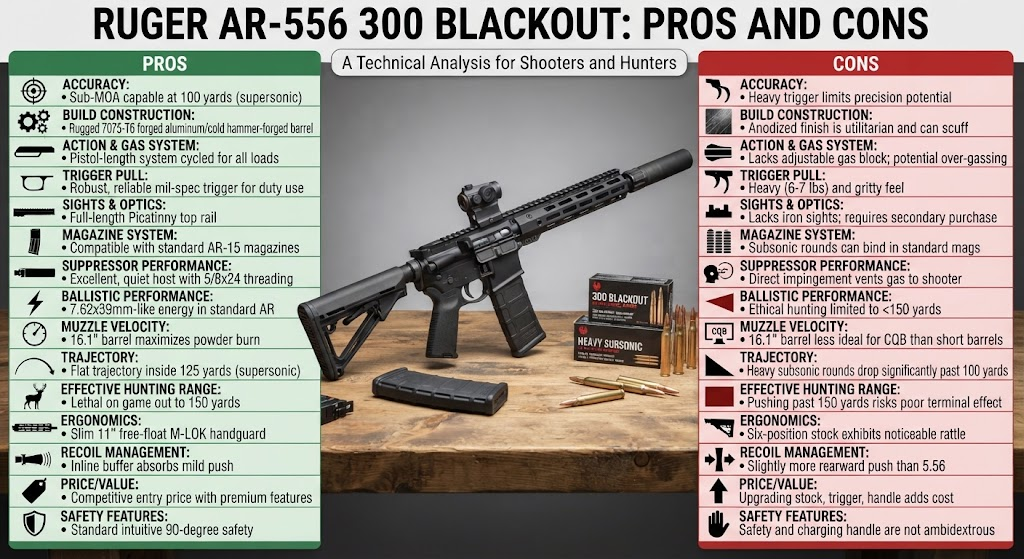
Ruger AR 556 300 Blackout Pros And Cons
| Feature | Pros | Cons |
| Accuracy | Consistently capable of 1.5 to 2 MOA groups at 100 yards with quality supersonic ammo. | The heavy factory trigger limits the shooter’s ability to extract maximum mechanical precision. |
| Build construction | Features rugged 7075-T6 forged aluminum receivers and a cold hammer-forged steel barrel. | The standard hard-coat anodized finish is utilitarian and can show scuffs under heavy field use. |
| Action and gas system | The pistol-length gas system is perfectly tuned to cycle both supersonic and subsonic loads reliably. | Lacks an adjustable gas block, which can lead to over-gassing when running certain suppressors. |
| Trigger pull | The single-stage mil-spec trigger is robust, highly reliable, and safe for hard duty use. | Pull weight is notoriously heavy and gritty, frequently breaking between 6 and 7 pounds. |
| Sights and optics | Comes factory-equipped with a full-length Picatinny top rail for red dots or magnified optics. | Completely lacks iron sights out of the box, requiring an immediate secondary purchase. |
| Magazine system | Fully compatible with ubiquitous, cheap standard 5.56 NATO AR-15 magazines. | Heavy 220-grain subsonic bullets can occasionally bind in standard 5.56 mags without dedicated 300 BLK followers. |
| Suppressor performance | The 16.1-inch barrel is factory threaded 5/8×24, making it an excellent and quiet suppressor host. | Direct impingement actions will vent hot gas and carbon back into the shooter’s face when suppressed. |
| Ballistic performance | Delivers 7.62×39mm-like kinetic energy in a standard AR platform with just a barrel change. | The 300 Blackout cartridge restricts ethical hunting to short-range engagements under 150 yards. |
| Muzzle velocity | The 16.1-inch barrel maximizes powder burn, squeezing every foot-per-second out of the cartridge. | Many shooters prefer shorter 9-inch barrels for this caliber to optimize compactness for CQB. |
| Trajectory | Flat enough for a simple point-and-shoot zero inside 125 yards with 110-grain supersonic loads. | Heavy subsonic rounds drop like a rock past 100 yards, requiring steep optic holdovers. |
| Effective hunting range | Highly lethal on medium game and feral hogs out to 150 yards in the hands of a skilled marksman. | Pushing it past 150 yards with subsonic rounds risks poor terminal expansion and wounding game. |
| Ergonomics | The slim 11-inch aluminum free-float M-LOK handguard is comfortable and easy to grip. | The basic six-position adjustable synthetic stock exhibits a noticeable rattle on the buffer tube. |
| Recoil management | The inline AR buffer system absorbs the mild push of the 300 Blackout cartridge beautifully. | Produces slightly more rearward push than a standard 5.56 NATO AR-15. |
| Price/value | Offers a free-floated handguard and a premium hammer-forged barrel at a highly competitive entry-level price. | Upgrading the basic mil-spec trigger, charging handle, and stock adds significantly to the final cost. |
| Safety features | Incorporates a standard mil-spec 90-degree safety selector that is intuitive and positive. | The safety and charging handle are strictly set up for right-handed shooters and are not ambidextrous. |
Accuracy And Barrel
Ruger sets itself apart in the entry-level AR market by utilizing cold hammer-forged 4140 chrome-moly steel barrels. The 16.1-inch barrel on this rifle features a 1:7-inch right-hand twist rate, which is aggressive enough to perfectly stabilize massive 220-grain subsonic projectiles while remaining highly accurate with lighter 110-grain supersonic hunting loads. Out of the box, most shooters can expect 1.5 to 2 MOA groups at 100 yards. The barrel is capped with a standard 5/8×24 threaded muzzle and a factory-installed flash hider, protecting a precision-machined crown.
Build Construction And Furniture
Built on industry-standard 7075-T6 forged aluminum upper and lower receivers, the Ruger AR 556 is tough and dependable. Ruger elevates the platform above standard M4 clones by ditching the plastic clamshell handguards in favor of an 11-inch free-float aluminum handguard featuring M-LOK attachment slots. This keeps accessories away from the hot barrel and prevents sling tension from shifting your point of impact. The furniture, however, is decidedly basic; the standard A2 pistol grip and the six-position M4-style buttstock function fine but feel slightly cheap and rattle during movement.
Action, Gas System, And Reliability
The beating heart of any 300 Blackout AR-15 is its gas system. Because the cartridge is designed to shoot both high-pressure supersonic rounds and low-pressure subsonic rounds, improper gas porting leads to constant jamming. Ruger wisely utilized a pistol-length gas system for this rifle. This ensures that the gas port is close enough to the chamber to tap high-pressure gas before the bullet exits the barrel, guaranteeing that the bolt cycles flawlessly regardless of whether you are shooting blazing-fast 110-grain V-MAX or slow, heavy 220-grain subsonics.
Magazine Compatibility
One of the greatest engineering triumphs of the 300 Blackout cartridge is that it utilizes the exact same bolt carrier group and magazines as a standard 5.56 NATO AR-15. The Ruger AR 556 ships with a 30-round Magpul PMAG, and you can freely use any GI aluminum or polymer 5.56 magazine you already own. However, when loading extra-long, blunt-nosed 220-grain subsonic bullets, standard 5.56 magazines can sometimes cause the rounds to bind on the internal ribs. For dedicated heavy subsonic use, purchasing specialized 300 Blackout-pattern PMAGs is highly recommended.
Trigger System
As an entry-level duty and hunting rifle, the Ruger AR 556 comes equipped with a standard mil-spec single-stage trigger. While it is incredibly safe, durable, and practically immune to light primer strikes, it is not a precision instrument. The trigger typically breaks between 6 and 7 pounds, featuring a noticeable amount of gritty creep before the wall. Shooters looking to squeeze sub-MOA accuracy out of the hammer-forged barrel will almost certainly want to drop in an aftermarket cassette trigger from companies like CMC, Geissele, or Timney.
Suppressor Performance
The 300 Blackout was explicitly designed for suppressed tactical use, and the Ruger AR 556 is a superb host platform. By unthreading the factory flash hider and attaching a .30-caliber suppressor, you can shoot heavy subsonic ammunition at hearing-safe levels—often sounding no louder than a pneumatic staple gun. However, because this rifle utilizes a direct-impingement gas system without an adjustable gas block, firing suppressed supersonic ammunition will force excess gas and carbon back down the charging handle channel and into the shooter’s face.
Hunting And Ballistic Performance
By chambering the AR 556 in 300 Blackout, Ruger effectively gives hunters the terminal ballistics of the legendary 7.62×39mm (AK-47) cartridge inside a familiar, ergonomic AR-15 platform. When loaded with 110-grain or 125-grain expanding copper bullets, it punches deep, wide wound channels through feral hogs, whitetail deer, and coyotes. The rifle is lightweight and fast-handling, making it a devastating tool in thick midwestern timber or southern swamps, provided the hunter keeps their shots inside a strict 150-yard envelope.
Recoil Management
The inline recoil buffer system of the AR-15 was originally designed for the 5.56 NATO round, but it handles the .30-caliber Blackout cartridge beautifully. Recoil is incredibly mild—a soft, straight rearward push that results in very little muzzle flip. This allows shooters to track their targets through the optic and deliver rapid, highly accurate follow-up shots on running game or multiple steel targets.
Price And Value
The Ruger AR 556 line is famous for aggressively undercutting the competition while delivering superior barrel quality and free-floated handguards. It represents one of the best out-of-the-box values for anyone looking to enter the 300 Blackout ecosystem without building a rifle from scratch. While you may eventually spend money upgrading the trigger and the rattling stock, the core components (receivers, bolt carrier group, and barrel) are built to last a lifetime.
Main Drawbacks
The primary disadvantages of this rifle are its mil-spec limitations and the inherent ballistics of the cartridge. The heavy trigger limits precision, and the lack of an adjustable gas block means it is not perfectly tuned for dedicated 100% suppressed use. Furthermore, the 300 Blackout cartridge bleeds velocity very quickly; it is not a flat-shooting prairie rifle. It is a specialized short-range hammer.
Final Verdict
Is the Ruger AR 556 300 Blackout good?
Yes, it is a highly reliable, rugged, and affordable modern sporting rifle that perfectly utilizes the versatile 300 Blackout cartridge.
This rifle is best suited for feral hog eradicators, thick-woods deer hunters, home defenders, and shooters looking for a highly capable, out-of-the-box suppressor host that feeds from standard AR-15 magazines.
However, long-range target shooters, open-plains hunters, or buyers who demand crisp match-grade triggers and ambidextrous controls straight from the factory would be much better served by building a custom rifle or purchasing a premium tier AR-15.
Frequently Asked Questions (FAQs)
1. Is the barrel on the Ruger AR 556 300 Blackout threaded?
Yes, the 16.1-inch cold hammer-forged barrel is factory threaded with a 5/8×24 thread pitch and comes equipped with a removable flash hider, making it perfectly ready for a .30-caliber suppressor.
2. Can I shoot 5.56 NATO or .223 Remington out of this rifle?
Absolutely not. This specific model is chambered exclusively for the 300 AAC Blackout cartridge. Attempting to chamber and fire a 5.56 NATO cartridge will result in a catastrophic and highly dangerous failure.
3. Do I need special magazines for the 300 Blackout?
No, the 300 Blackout cartridge is designed to feed from standard 5.56 NATO AR-15 magazines. However, if you shoot heavy 200+ grain subsonic bullets, specialized 300 Blackout magazines (like the Magpul 300 BLK PMAG) are recommended to prevent the bullets from binding on the internal ribs.
4. What kind of gas system does this rifle use?
Ruger utilizes a pistol-length direct-impingement gas system. This short gas system provides the higher pressures necessary to reliably cycle the bolt when firing low-pressure subsonic ammunition.
5. Does the rifle come with iron sights?
No. The Ruger AR 556 free-float models feature a flat-top Picatinny receiver and an M-LOK handguard, but they do not include flip-up iron sights or an optic in the box.
6. What is the twist rate of the barrel?
The rifle features a 1:7-inch right-hand twist rate, which is fast enough to perfectly stabilize long, heavy 220-grain subsonic bullets as well as lighter supersonic hunting rounds.
7. Can I change the handguard or stock?
Yes. The rifle is built to standard AR-15 mil-spec dimensions. You can easily swap the stock on the mil-spec buffer tube, replace the pistol grip, or upgrade the trigger with standard AR-15 aftermarket parts.
8. Is the 300 Blackout powerful enough for deer hunting?
Yes, but strictly at close to medium ranges. When using high-quality 110-grain to 125-grain supersonic hunting ammunition, it provides excellent terminal performance on deer and hogs out to approximately 150 yards.
9. Why does the gas blow back in my face when I use a suppressor?
Because the AR 556 uses a direct-impingement gas system without an adjustable gas block, attaching a suppressor significantly increases the system’s backpressure. This forces excess gas and carbon to vent out of the ejection port and charging handle gap.
10. How much does the rifle weigh?
The Ruger AR 556 300 Blackout is quite maneuverable, weighing roughly 6.5 pounds unloaded, making it an excellent, lightweight option for carrying through dense woods or swamps.