The main pros of the classic Ruger 44 Magnum Carbine are its incredibly lightweight and fast-handling design, lightning-fast semi-automatic follow-up shots, and devastating close-range stopping power, while the main cons are its strict inability to shoot unjacketed lead bullets, complex disassembly process, and the high cost of acquiring one on the used market. Originally introduced in 1961 as the “Deerstalker,” this iconic semi-automatic rifle looks strikingly similar to a Ruger 10/22 but packs the massive punch of a .44 Magnum revolver cartridge. While it consistently drops whitetail deer and feral hogs in their tracks inside 100 yards, its gas-operated system is notoriously sensitive to ammunition selection. Because it pairs traditional walnut and blued steel aesthetics with a recoil-absorbing gas system, it remains a highly sought-after collector’s item and the ultimate midwestern brush gun.
Table of Contents [Click to open]
Ruger 44 Magnum Carbine Pros And Cons
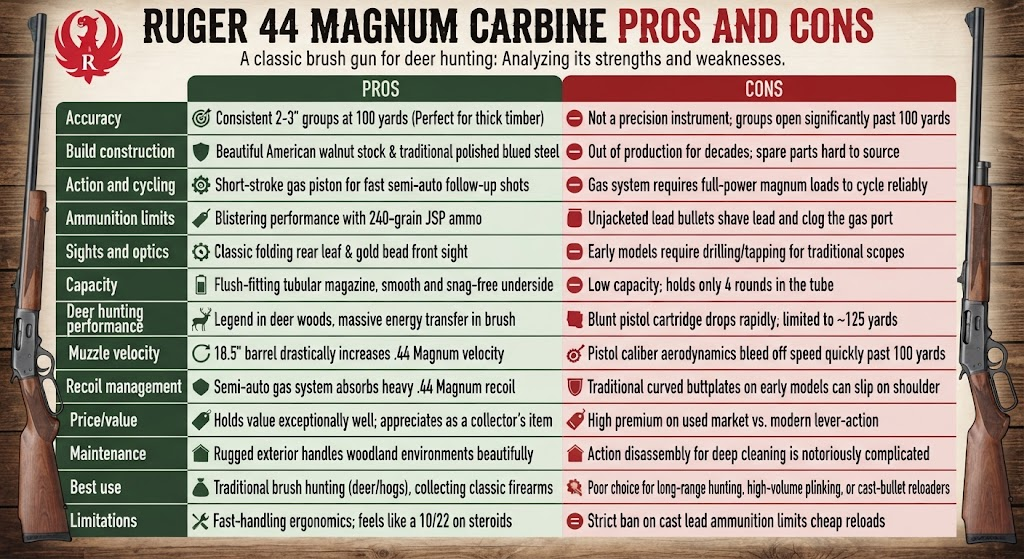
| Feature | Pros | Cons |
| Accuracy | Consistently shoots 2 to 3-inch groups at 100 yards, which is perfect for thick timber. | Not a precision instrument; groups open up significantly past 100 yards. |
| Build construction | Features a beautiful American walnut stock and traditional polished blued steel. | Out of production for decades, meaning spare parts can be difficult to source. |
| Action and cycling | The short-stroke gas piston provides incredibly fast semi-automatic follow-up shots. | The gas system requires full-power magnum loads to cycle reliably. |
| Ammunition limits | Blistering performance with standard 240-grain jacketed soft point (JSP) ammunition. | Firing unjacketed lead bullets will instantly shave lead and permanently clog the gas port. |
| Sights and optics | Standard folding rear leaf and gold bead front sight are classic and rugged. | Early production models require drilling and tapping to mount a traditional rifle scope. |
| Capacity | The flush-fitting tubular magazine keeps the rifle’s underside smooth and snag-free. | Holds only 4 rounds in the tube, which is low capacity by modern semi-auto standards. |
| Deer hunting performance | An absolute legend in the deer woods, providing massive energy transfer in thick brush. | The blunt pistol cartridge drops rapidly, limiting ethical shots to roughly 125 yards. |
| Muzzle velocity | The 18.5-inch barrel drastically increases the velocity of the .44 Magnum cartridge. | Pistol caliber aerodynamics bleed off speed very quickly as distance increases. |
| Recoil management | The semi-automatic gas system absorbs a tremendous amount of the .44 Magnum’s heavy recoil. | Traditional curved buttplates on early models can slip on the shoulder. |
| Price/value | Holds its value exceptionally well and continues to appreciate as a collector’s item. | You will pay a premium on the used market compared to buying a modern lever-action. |
| Maintenance | The exterior is rugged and handles woodland environments beautifully. | Disassembling the action for a deep cleaning is notoriously complicated and frustrating. |
| Best use | Traditional brush hunting for deer and hogs, and collecting classic American firearms. | A poor choice for long-range hunting, high-volume plinking, or cast-bullet reloaders. |
| Limitations | Unbeatable fast-handling ergonomics that feel like a 10/22 on steroids. | The strict ban on cast lead ammunition limits your ability to shoot cheap reloads. |
Accuracy
The Ruger 44 Carbine provides perfectly acceptable hunting accuracy for its intended short-range role. Because it fires a fat, heavy pistol bullet, it is not designed to shoot sub-MOA groups. Most shooters using quality factory 240-grain ammunition can expect 2 to 3-inch groups at 100 yards. This practical accuracy is more than enough to hit the vital zone of a deer or black bear in heavy timber, but shooters shouldn’t expect to win any benchrest competitions with it.
Build Construction And Aesthetics
Ruger designed the 44 Carbine to be a rugged, handsome field gun. It features a solid machined steel receiver, an 18.5-inch barrel, and a classic American walnut stock. It shares an almost identical profile with the ubiquitous Ruger 10/22—in fact, the 44 Carbine actually predates the 10/22 by a few years and served as its design inspiration. Tipping the scales at a mere 5.75 to 6 pounds, it is incredibly lightweight and a joy to carry all day through dense swamps or steep ridges.
Action, Gas System, And Ammunition
The rifle operates via a short-stroke gas piston system. While this provides exceptionally fast semi-automatic cycling, it is the source of the rifle’s biggest quirk: you must only shoot fully jacketed bullets. If you shoot bare cast lead bullets (which are very common in .44 Magnum revolver ammunition), the hot gases will shave lead off the bullet as it passes the gas port. This molten lead will quickly plug the gas port solid, turning your semi-auto into a single-shot rifle and requiring a professional gunsmith to drill out the blockage. Furthermore, the rifle prefers full-power magnum loads to cycle the heavy bolt reliably.
Sights And Optics Mounting
Out of the box, the carbine features a traditional folding leaf rear sight and a brass bead front sight. Early models (manufactured in the 1960s) featured a solid top receiver that was not drilled for scope mounts, forcing hunters to either use iron sights or pay a gunsmith to tap the receiver. Later production models featured integrated scope bases, making it much easier to mount a low-power variable optic (LPVO) or a fixed 4x scope, which perfectly complements the rifle’s effective range.
Brush Hunting Performance
For midwestern deer hunters or southern hog eradicators, the Ruger 44 Carbine is a legendary tool. The .44 Magnum is a proven man-stopper and medium game cartridge. When fired from an 18.5-inch barrel, the heavy, flat-nosed jacketed bullets punch massive wound channels through feral hogs and whitetail deer, often dropping them in their tracks. The short, lightweight profile of the rifle makes it incredibly fast to shoulder, allowing hunters to easily track moving game through tight trees.
Velocity And Energy
A major benefit of firing a pistol cartridge from a carbine is the substantial velocity boost. Firing a standard 240-grain .44 Magnum bullet from this rifle yields roughly 300 to 400 feet per second more velocity than firing it from a standard 4-inch revolver. This increased speed translates directly into more kinetic energy upon impact, stretching the muzzle energy well past 1,500 foot-pounds and turning a powerful handgun round into a formidable brush-busting rifle cartridge.
Recoil Management
While the .44 Magnum produces severe recoil in a handgun and noticeable kick in a lever-action rifle, the Ruger 44 Carbine is remarkably pleasant to shoot. The semi-automatic gas system bleeds off pressure and spreads the recoil impulse out over a longer duration. This mechanical absorption, combined with the weight of the rifle, tames the .44 Magnum into a gentle push, allowing for incredibly fast and accurate follow-up shots if you miss your first attempt.
Price And Value
Because Ruger stopped producing the original Model 44 Carbine in 1985 (and its rotary-magazine successor, the Deerfield, in 2006), these rifles are highly sought after by collectors and nostalgic hunters. You cannot buy one new. On the used market, prices frequently hover between $800 and $1,500 depending on the production year and condition. While expensive, they hold their value flawlessly, making them a safe investment for classic firearms enthusiasts.
Main Drawbacks
The most notable disadvantages of the Ruger 44 Carbine are its strict ammunition diet and its complex maintenance. Accidentally shooting a box of lead-cast cowboy loads will ruin your hunting trip and require intensive cleaning. Additionally, unlike an AR-15 or a 10/22, field stripping the Model 44 is a tedious chore that requires tools and patience. Finally, the 4-round tubular magazine capacity is quite low for a semi-automatic rifle.
Final Verdict
Is the Ruger 44 Magnum Carbine good?
Yes, it is a phenomenal, legendary hunting rifle that perfectly balances lightweight ergonomics with massive short-range stopping power.
This carbine is best suited for traditional whitetail deer hunters in thick woods, feral hog hunters who need fast follow-up shots, and firearms collectors looking for a classic piece of Ruger history.
However, high-volume range plinkers, handloaders who prefer casting their own cheap lead bullets, or hunters who frequently shoot past 150 yards would be much better served by a modern lever-action rifle or a bolt-action in a bottleneck caliber.
Frequently Asked Questions (FAQs)
1. Does Ruger still manufacture the 44 Magnum Carbine?
No. Ruger manufactured the original tubular-magazine Model 44 from 1961 to 1985. They later introduced the modernized 99/44 “Deerfield Carbine” (which used a rotary magazine and a Mini-14 style action) in 2000, but discontinued it in 2006 due to high manufacturing costs.
2. Can I shoot cast lead bullets in the Ruger 44 Carbine?
Absolutely not. You must strictly shoot jacketed ammunition (JHP or JSP). Unjacketed lead bullets will shave off in the barrel and permanently clog the gas port that cycles the action.
3. What is the magazine capacity of the original Ruger 44 Carbine?
The original Model 44 features a tubular magazine hidden inside the wooden forend that holds 4 rounds of .44 Magnum, giving the rifle a total capacity of 4+1.
4. What is the difference between the original Model 44 and the Deerfield Carbine?
The original Model 44 (1961-1985) features a tubular magazine loaded from the bottom, similar to a shotgun. The later Model 99/44 Deerfield Carbine (2000-2006) features an exposed rotating bolt handle (like a Mini-14) and feeds from a removable 4-round rotary magazine.
5. Does the Ruger 44 Carbine kick hard?
No. Thanks to the gas-operated semi-automatic action, the felt recoil is remarkably mild and significantly softer than firing a .44 Magnum from a lightweight lever-action rifle or a revolver.
6. Can I mount a scope on the Ruger 44 Carbine?
It depends on the manufacturing year. Early production models require a gunsmith to drill and tap the receiver for scope mounts. Later production models feature factory-integrated scope bases on the receiver.
7. How far can I effectively hunt deer with this rifle?
The .44 Magnum cartridge has the aerodynamics of a flying brick. While the rifle adds velocity, the bullet still drops rapidly past 100 yards. It is highly recommended to keep ethical hunting shots on game inside 125 yards.
8. What kind of ammunition does the rifle cycle best?
The gas system requires sufficient pressure to cycle the heavy bolt. It runs best on full-power, standard 240-grain Jacketed Soft Point (JSP) or Jacketed Hollow Point (JHP) factory hunting ammunition.
9. Is the Ruger 44 Carbine hard to clean?
Yes. Compared to modern firearms, disassembling the Model 44 to clean the gas piston and the trigger group is a complex, multi-step process that requires punches and screwdrivers.
10. Can I shoot .44 Special ammunition in this carbine?
While a .44 Magnum chamber will safely fit a .44 Special cartridge, it is highly discouraged. The lower-pressure .44 Special rounds generally do not generate enough gas pressure to reliably cycle the semi-automatic action, turning the gun into a single-shot straight-pull rifle.