The effective range of the .50 BMG (Browning Machine Gun) extends out to 2,000 yards (1.14 miles) and beyond for anti-materiel and extreme long-range precision target applications. Developed in the wake of World War I from a request by General John Pershing, it pairs a massive 650-grain to 800-grain projectile with immense powder capacity to shatter records and neutralize targets at extreme distances. The practical accurate range depends heavily on your rifle platform, optics, barrel length, and environmental conditions. While the absolute maximum projectile flight spans over 4.5 miles, your true effective range is governed by the bullet’s transition from supersonic to transonic flight.
Table of Contents [Click to minimize]
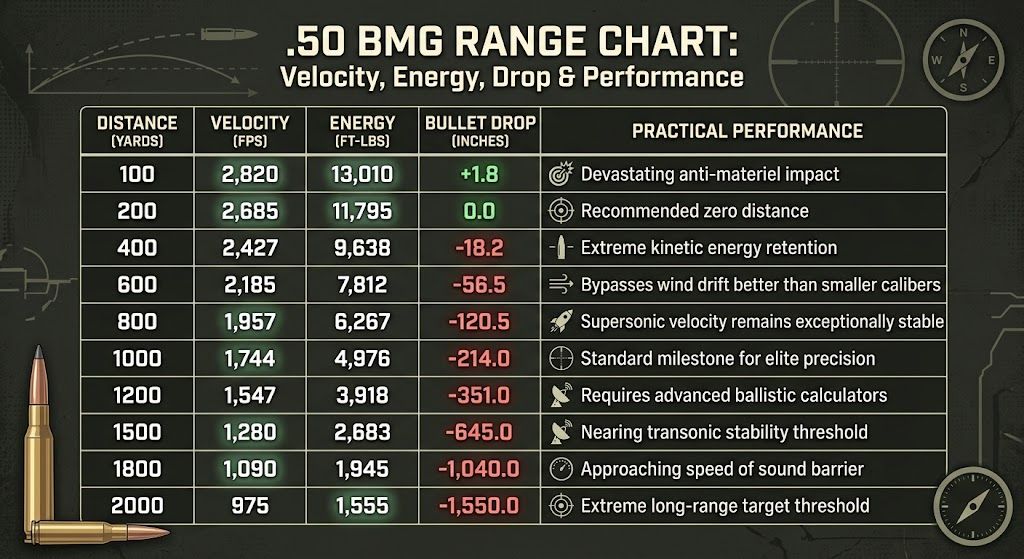
.50 BMG Range Chart
| Distance | Velocity (fps) | Energy (ft-lbs) | Bullet Drop (inches) | Practical Performance |
| 100 yards | 2,820 | 13,010 | +1.8 | Devastating anti-materiel impact |
| 200 yards | 2,685 | 11,795 | 0.0 | Recommended zero distance |
| 400 yards | 2,427 | 9,638 | -18.2 | Extreme kinetic energy retention |
| 600 yards | 2,185 | 7,812 | -56.5 | Bypasses wind drift better than smaller calibers |
| 800 yards | 1,957 | 6,267 | -120.5 | Supersonic velocity remains exceptionally stable |
| 1000 yards | 1,744 | 4,976 | -214.0 | Standard milestone for elite precision |
| 1200 yards | 1,547 | 3,918 | -351.0 | Requires advanced ballistic calculators |
| 1500 yards | 1,280 | 2,683 | -645.0 | Nearing transonic stability threshold |
| 1800 yards | 1,090 | 1,945 | -1,040.0 | Approaching speed of sound barrier |
| 2000 yards | 975 | 1,555 | -1,550.0 | Extreme long-range target threshold |
The data in the .50 BMG range chart above is based on the Hornady 750-grain A-MAX Match factory load. These figures reflect a standard 29-inch heavy match test barrel, a muzzle velocity of 2,820 fps, a 1.050 G1 Ballistic Coefficient (BC), and a standard 200-yard zero with a 1.5-inch sight height. Your exact .50 BMG ballistics will vary depending on atmospheric density, Coriolis effect, spin drift, and altitude.
What Is The Effective Range Of .50 BMG?
The effective range of the .50 BMG is legendary, frequently serving as the benchmark for military sniping and anti-materiel engagements.
- Effective Target Range: 2,000+ yards. Because of its massive ballistic coefficient, a high-BC match bullet remains supersonic well past 1,500 to 1,800 yards. This allows it to punch through the transonic zone smoothly and maintain sub-MOA precision on massive steel targets.
- Effective Anti-Materiel / Tactical Range: 1,500 to 2,000 yards. The cartridge was originally designed to disable light vehicles, radar installations, and communications equipment, a task it handles effortlessly within this envelope.
- Maximum Projectile Range: Fired at an optimal 30-to-35-degree angle, a .50 BMG projectile can travel over 4.5 to 5 miles (approx. 7,500+ yards). It carries lethal energy and mass for miles, making specialized range safety fans mandatory for any civilian shooting range.
.50 BMG Velocity And Downrange Energy
The .50 BMG generates kinetic energy that dwarfs standard rifle cartridges, often matching the muzzle energy of small cannon rounds.
Using the Hornady 750-grain A-MAX Match (BC: 1.050, 29-inch barrel, 2,820 fps muzzle velocity), the cartridge produces a staggering 13,248 ft-lbs of muzzle energy.
- At 500 yards: Velocity is 2,060 fps; Energy is 6,930 ft-lbs.
- At 1,000 yards: Velocity is 1,744 fps; Energy is 4,976 ft-lbs. (At 1,000 yards, the .50 BMG retains more energy than a .44 Magnum or .308 Winchester produces right at the muzzle).
- At 1,500 yards: Velocity is 1,280 fps; Energy is 2,683 ft-lbs.
By comparison, military solid-bronze or armor-piercing incendiary (API) rounds trade a fraction of that BC for specialized barrier-penetrating tips, but they maintain similarly violent downrange performance.
.50 BMG Bullet Drop At Distance
Because the .50 BMG launches heavy, high-BC bullets at near 3,000 fps, its trajectory is remarkably flat over short-to-medium distances, but gravity takes over massively at extreme ranges.
Using the 750-grain A-MAX load zeroed at 200 yards:
- 500 Yards: -36.1 inches
- 1,000 Yards: -214.0 inches (roughly 17.8 feet of drop)
- 1,500 Yards: -645.0 inches (over 53 feet of drop)
- 2,000 Yards: -1,550.0 inches (nearly 130 feet of drop)
Shooting at 2,000 yards requires a massive scope base with 40 to 100 MOA of built-in elevation, alongside specialized ballistic software to account for air temperature, barometric pressure, and earth rotation (Coriolis effect).
.50 BMG Range By Barrel Length
The .50 BMG is an exceptionally overbore cartridge, requiring long, heavy barrels to burn its massive charges of slow-burning powder safely and efficiently.
- 29-inch to 32-inch Match Barrels: Delivers the maximum factory velocity (2,800 to 2,900 fps). Maximizes effective range to the 2,000+ yard mark.
- 24-inch to 26-inch Compact Barrels: Loses roughly 100 to 150 fps. While popular for carbine-style .50 BMG bolt-action rifles to save weight, the velocity loss causes the bullet to drop into the transonic zone slightly earlier, pulling the effective precision limit inward by about 150 to 200 yards.
- Muzzle Brakes: Almost all .50 BMG rifles require massive, highly efficient muzzle brakes. Without a brake, recoil exceeds 50+ foot-pounds, making accurate follow-up shots impossible.
.50 BMG Long-Range Performance And Ballistics
The true defining feature of the .50 BMG is its ability to ignore crosswinds that would push smaller calibers completely off target.
Using the 750-grain A-MAX (1.050 G1 BC) in a 10 mph full-value crosswind:
- 500 Yards: Only ~6.1 inches of wind drift.
- 1,000 Yards: ~26.4 inches of wind drift.
- 1,500 Yards: ~69.5 inches of wind drift.
- 2,000 Yards: ~145.0 inches of wind drift.
Its extraordinarily high ballistic coefficient allows it to cut through the air like a dart, making it the pioneer of modern extreme long-range shooting.
.50 BMG vs .338 Lapua Magnum Range
When comparing .50 BMG vs .338 Lapua Magnum, the .338 Lapua is a dedicated anti-personnel and long-range match cartridge, whereas the .50 BMG is a heavy-duty anti-materiel platform.
- The .338 Lapua Magnum typically fires a 250-grain to 300-grain bullet at roughly 2,700 fps, maxing out its effective target range around 1,500 yards with far less rifle weight and recoil.
- The .50 BMG fires a projectile nearly three times as heavy, carrying vastly superior kinetic energy, maintaining stability past 2,000 yards, and offering true anti-materiel capabilities that the .338 Lapua cannot match.
Comparison Table
| Category | .50 BMG | .338 Lapua Magnum | .308 Winchester |
| Bullet Weight | 750 grains | 250 grains | 168 grains |
| Muzzle Velocity | 2,820 fps | 2,950 fps | 2,700 fps |
| Muzzle Energy | 13,248 ft-lbs | 4,830 ft-lbs | 2,719 ft-lbs |
| 1,000-Yard Energy | 4,976 ft-lbs | 1,815 ft-lbs | 623 ft-lbs |
| Bullet Drop (1,000 Yds) | -214.0″ | -295.0″ | -364.0″ |
| Wind Drift (1,000 Yds/10mph) | 26.4″ | 38.2″ | 95.0″ |
| Effective Target Range | 2,000+ yards | 1,500 yards | 1,000 yards |
| Primary Application | Anti-Materiel / ELR | Long-Range Sniper | Precision / Hunting |
Data baseline: 29-inch barrel for .50 BMG, 27-inch for .338 Lapua, 24-inch for .308 Win.
Pros and Cons
.50 BMG Pros
- Unmatched kinetic energy and barrier-penetrating anti-materiel capability.
- Exceptional ballistic coefficients allow bullets to slice through crosswinds at extreme distances (2,000+ yards).
- Proven military reliability and historical pedigree dating back a century.
- Massive selection of match-grade ammunition and specialized extreme long-range rifles.
.50 BMG Cons
- Extremely heavy rifle platforms (often weighing 25 to 35+ pounds).
- Prohibitively expensive ammunition (frequently $4 to $10+ per round).
- Severe concussive blast and muzzle report require specialized double-ear protection and open spaces.
- Banned or restricted in certain states and jurisdictions.
.50 BMG Range: How Far Can It Really Shoot?
When breaking down .50 BMG ballistics, here is the final verdict on its practical capabilities:
- General Shooting: Inside 500 yards, the .50 BMG is an absolute sledgehammer with manageable drop, though overkill for standard targets.
- 1,000 Yards: A walk in the park. High-end match loads make 1,000-yard targets look effortless, retaining nearly 5,000 ft-lbs of energy upon impact.
- 1,500 to 2,000 Yards: The true sweet spot for extreme long-range precision shooters. The bullet remains supersonic, predictable, and remarkably accurate against large steel plates.
- Beyond 2,000 Yards: Highly dependent on expert environmental reading, custom handloaded ammunition, and specialized optics. While professional snipers have stretched the platform past 2,500 yards in combat, consistency drops rapidly as the projectile dips below the speed of sound.
FAQs
What is the effective range of .50 BMG?
The effective range extends past 2,000 yards for precision target shooting and anti-materiel tactical applications.
How far can a .50 BMG shoot accurately?
From a custom match-grade heavy rifle, the .50 BMG can maintain sub-MOA to 1.5-MOA accuracy out to 2,000 yards and beyond under favorable weather conditions.
What is the maximum range of .50 BMG?
Fired at an optimal 30-to-35-degree angle, a .50 BMG bullet will travel between 4.5 and 5 miles before returning to earth.
Is .50 BMG used for hunting?
Generally no. While it possesses overwhelming kinetic energy, it is overwhelmingly heavy, illegal for game hunting in most jurisdictions, and excessively destructive to edible meat. It is strictly a military, tactical, and extreme long-range target cartridge.
How much does a .50 BMG drop at 1,000 yards?
With a 200-yard zero, a standard 750-grain match load drops approximately 214 inches (nearly 18 feet) at 1,000 yards.
How much does a .50 BMG drop at 2,000 yards?
At 2,000 yards, the bullet drops approximately 1,550 inches (about 129 feet), requiring massive scope elevation adjustments.
Does barrel length affect .50 BMG range?
Yes. Shorter barrels (under 26 inches) bleed off crucial muzzle velocity, causing the bullet to drop into the transonic zone earlier and shortening your maximum precision range by a few hundred yards.