The effective range of the .308 Winchester extends to 1,000 yards for target shooting and 400 to 500 yards for hunting large game. Born from the 7.62x51mm NATO military cartridge, it offers an incredible balance of downrange kinetic energy, extensive barrel life, and manageable recoil. The practical accurate range you experience ultimately depends on your factory load, bullet weight, rifle barrel length, and intended target. While the absolute maximum projectile flight spans several miles, your true effective range is governed by the bullet’s minimum expansion velocity and retained energy.
Table of Contents [Click to minimize]
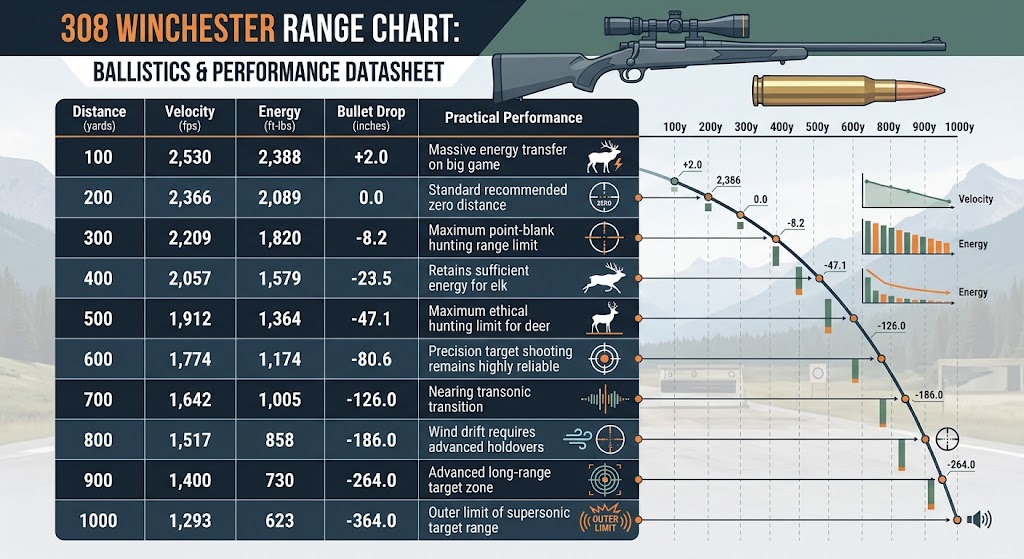
308 Winchester Range Chart
| Distance | Velocity (fps) | Energy (ft-lbs) | Bullet Drop (inches) | Practical Performance |
| 100 yards | 2,530 | 2,388 | +2.0 | Massive energy transfer on big game |
| 200 yards | 2,366 | 2,089 | 0.0 | Standard recommended zero distance |
| 300 yards | 2,209 | 1,820 | -8.2 | Maximum point-blank hunting range limit |
| 400 yards | 2,057 | 1,579 | -23.5 | Retains sufficient energy for elk |
| 500 yards | 1,912 | 1,364 | -47.1 | Maximum ethical hunting limit for deer |
| 600 yards | 1,774 | 1,174 | -80.6 | Precision target shooting remains highly reliable |
| 700 yards | 1,642 | 1,005 | -126.0 | Nearing transonic transition |
| 800 yards | 1,517 | 858 | -186.0 | Wind drift requires advanced holdovers |
| 900 yards | 1,400 | 730 | -264.0 | Advanced long-range target zone |
| 1000 yards | 1,293 | 623 | -364.0 | Outer limit of supersonic target range |
The data in the 308 Winchester range chart above is based on the Hornady 168-grain ELD Match factory load.These figures reflect a standard 24-inch test barrel, a muzzle velocity of 2,700 fps, a .523 G1 Ballistic Coefficient (BC), and a standard 200-yard zero with a 1.5-inch sight height. Your exact .308 Winchester ballistics will vary dramatically if you use lighter 150-grain hunting loads or shoot from a shorter 16-inch barrel.
What Is The Effective Range Of 308 Winchester?
The effective range of the .308 Winchester is strictly divided by your target and application. Just because the bullet can reach a distance does not mean it will perform ethically on an animal at that range.
- Effective Target Range: 800 to 1,000 yards. Depending on your load, heavy match bullets will remain supersonic out to 1,000 yards. Once a bullet drops into the transonic zone (roughly 1,125 fps), it destabilizes and loses accuracy.
- Effective Hunting Range (Elk & Moose): 400 yards. Large, tough game generally requires roughly 1,500 ft-lbs of kinetic energy for an ethical, deep-penetrating kill. The .308 drops below this threshold just after 400 yards.
- Effective Hunting Range (Deer): 500 to 600 yards. Mathematically, the cartridge retains the 1,000 ft-lbs necessary for deer-sized game out to roughly 700 yards. However, guaranteeing a vital hit and achieving reliable bullet expansion under field conditions limits most hunters to 500 yards.
- Maximum Projectile Range: Fired at an optimal 30-to-35-degree angle, a .308 Winchester projectile can travel well over 2.5 miles. It carries zero practical accuracy at this extreme but remains incredibly dangerous.
308 Winchester Velocity And Downrange Energy
The .308 Winchester achieves its legendary stopping power through heavy, large-diameter (.308 caliber) bullets rather than blistering speed.
To understand its capability, let’s compare two different bullet weights:
Using a classic hunting load, the Hornady 150-grain SST (BC: .415, 24-inch barrel, 2,820 fps muzzle velocity):
- At 200 yards: Velocity is 2,367 fps; Energy is 1,866 ft-lbs.
- At 400 yards: Velocity is 1,960 fps; Energy is 1,280 ft-lbs.
- At 500 yards: Velocity is 1,775 fps; Energy is 1,049 ft-lbs.
Using the heavier Hornady 178-grain ELD-X Precision Hunter (BC: .552, 24-inch barrel, 2,600 fps muzzle velocity):
- At 200 yards: Velocity is 2,291 fps; Energy is 2,074 ft-lbs.
- At 400 yards: Velocity is 2,004 fps; Energy is 1,587 ft-lbs.
- At 500 yards: Velocity is 1,868 fps; Energy is 1,379 ft-lbs.
The 150-grain bullet starts 220 fps faster, but its lower ballistic coefficient causes it to shed speed rapidly. By 400 yards, the heavier 178-grain bullet retains significantly more kinetic energy, making it vastly superior for long-range hunting.
308 Winchester Bullet Drop At Distance
Because it fires heavy bullets at moderate velocities, the .308 Winchester does not shoot as flat as magnums or modern 6.5mm cartridges. Range estimation is critical past 300 yards.
Using the 168-grain ELD Match load (2,700 fps) zeroed at 200 yards:
- 300 Yards:-8.2 inches
- 400 Yards:-23.5 inches
- 500 Yards:-47.1 inches
Compare that to the heavier, slower 178-grain ELD-X (2,600 fps) zeroed at 200 yards:
- 300 Yards:-8.8 inches
- 400 Yards:-25.2 inches
- 500 Yards:-50.2 inches
While the trajectory is slightly arched, it is incredibly predictable, which is why military and police snipers relied on the .308 trajectory for decades.
308 Winchester Range By Barrel Length
The .308 Winchester is highly efficient, utilizing a relatively small powder column compared to its bore diameter. Because of this, it performs exceptionally well in shorter barrels.
Based on live chronograph testing, shortening a .308 Winchester barrel results in a velocity loss of roughly 20 to 25 fps per inch.
Using a standard 168-grain match load:
- 24-inch barrel:2,700 fps (Baseline maximum velocity)
- 20-inch barrel: ~2,600 fps (Optimal balance of mobility and speed)
- 18-inch barrel: ~2,550 fps (Common for semi-auto AR-10s)
- 16-inch barrel: ~2,500 fps (Ideal for suppressed tactical rifles)
Dropping to a 16-inch barrel reduces muzzle velocity by roughly 200 fps. This will pull your maximum supersonic target range inward from roughly 1,000 yards down to about 800 yards, and slightly reduce your ethical hunting range.
308 Winchester Range For Hunting
The .308 Winchester is one of the most prolific hunting cartridges in history. Its practical hunting range is determined strictly by retained energy and reliable bullet expansion.
- Deer and Black Bear: The practical hunting range is 400 to 500 yards. A high-quality expanding bullet like the 165-grain or 178-grain ELD-X hits with devastating force out to 500 yards. Beyond 500 yards, bullet velocity often drops below the 1,800 fps threshold required for reliable terminal expansion.
- Elk and Moose: The ethical limit is 300 to 400 yards. To cleanly harvest heavy game and penetrate thick shoulder bones, you must retain 1,500 ft-lbs of kinetic energy. The .308 crosses this minimum threshold right around 400 yards.
(Note: Always verify local hunting regulations, and never take a shot beyond your own proven mechanical accuracy in field conditions).
308 Winchester Range For Long-Range Shooting
For precision target shooters, the .308 Winchester is the gold standard for learning wind calls and elevation holds.
Firing the 168-grain ELD Match (.523 G1 BC) in a 10 mph full-value crosswind:
- 300 Yards: ~6.5 inches of wind drift.
- 500 Yards: ~19.5 inches of wind drift.
- 800 Yards: ~55.0 inches of wind drift.
- 1,000 Yards: ~95.0 inches of wind drift.
While it gets pushed by the wind more than modern 6mm or 6.5mm cartridges, the .308 is highly consistent. Heavy 175-grain and 178-grain match bullets are specifically designed to remain stable as they pass through the transonic barrier, allowing for consistent impacts out to 1,000 yards.
308 Winchester vs 5.56 Range
When comparing the .308 Winchester vs 5.56 NATO, the .308 delivers massively more kinetic energy and effectively doubles your long-range target capability. While the 5.56 NATO is an excellent 0–400 yard cartridge with minimal recoil, its light bullets (55 to 77 grains) shed energy rapidly and get pushed around heavily by the wind. The .308 pushes a bullet more than twice as heavy, allowing it to maintain supersonic speeds past 1,000 yards and hit targets with over four times the kinetic energy at 500 yards.
308 Winchester vs 6.5 Creedmoor Range
This is the modern heavyweight debate. Both fit in the same short-action receivers, but they accomplish distance differently. The .308 Winchester hits harder inside 300 yards because it fires a heavier, wider bullet. However, the 6.5 Creedmoor was designed specifically for extreme long-range efficiency. Because the 6.5 Creedmoor uses long, aerodynamic, high-BC bullets, it shoots flatter, bucks the wind significantly better, and actually overtakes the .308 Winchester in retained kinetic energy past 500 yards—all while producing roughly 20% less felt recoil.
Comparison Table
| Category | 308 Winchester | 6.5 Creedmoor | 5.56 NATO |
| Bullet Weight | 168 grains | 140 grains | 77 grains |
| Muzzle Velocity | 2,700 fps | 2,710 fps | 2,750 fps |
| Muzzle Energy | 2,719 ft-lbs | 2,283 ft-lbs | 1,293 ft-lbs |
| 300-Yard Energy | 1,820 ft-lbs | 1,570 ft-lbs | 680 ft-lbs |
| 500-Yard Energy | 1,364 ft-lbs | 1,180 ft-lbs | 400 ft-lbs |
| Bullet Drop (500 Yds) | -47.1″ | -44.4″ | -62.5″ |
| Wind Drift (500 Yds/10mph) | 19.5″ | 16.5″ | 25.1″ |
| Effective Target Range | 1,000 yards | 1,200+ yards | 600-800 yards |
| Hunting Range (Deer) | 500 yards | 500 yards | 200 yards |
Data baseline: 24-inch test barrels used. Loads used: 308 Win (Hornady 168gr ELD-M), 6.5 Creedmoor (Hornady 140gr ELD-M), 5.56 NATO (77gr Match approximation).
Pros and Cons
308 Winchester Pros
- Incredible barrel life (often 5,000 to 10,000 rounds before accuracy degrades).
- Massive availability of ammunition; you can find it at almost any sporting goods store globally.
- Highly efficient in short barrels (16 to 18 inches), making it perfect for suppressed tactical rifles.
- Delivers devastating hydrostatic shock on large game within 300 yards.
308 Winchester Cons
- Rainbow-like trajectory past 400 yards compared to modern cartridges like the 6.5 Creedmoor.
- Heavier recoil than 6mm or 6.5mm precision cartridges.
- Susceptible to wind drift at extreme long ranges (800 to 1,000 yards) due to lower ballistic coefficients.
308 Winchester Range: How Far Can It Really Shoot?
When breaking down the 308 Winchester ballistics, here is the final verdict on its practical capabilities:
- General Shooting: Inside 300 yards, it is devastatingly effective. With a 200-yard zero, you experience just 8 inches of drop at 300 yards, allowing for rapid, point-blank holdovers in the field.
- Hunting: It is a 400-yard elk cartridge and a 500-yard deer cartridge. Pushing it further risks the bullet falling below the 1,800 fps threshold required for proper expansion.
- 500 Yards: Highly effective. The bullet retains nearly 1,400 ft-lbs of energy and drops a predictable 47 to 50 inches.
- 800 Yards: The wind becomes your biggest enemy. You must compensate for heavy bullet drop and significant wind drift, though the projectile easily remains lethal.
- 1000 Yards: The absolute limit for precision target shooting with standard factory match loads. The bullet approaches the speed of sound and drops over 360 inches (30 feet).
- Shorter vs Longer Barrels: If you prefer a 16-inch barrel for hunting with a suppressor, you will sacrifice about 200 fps. This reduces your maximum ethical hunting range by about 75 yards but keeps the rifle incredibly maneuverable in thick brush.
FAQs
What is the effective range of 308 Winchester?
The effective hunting range is up to 400 yards for large game (elk) and 500 yards for medium game (deer). For precision target shooting, it is effective out to 1,000 yards.
How far can a 308 Winchester shoot accurately?
From a quality bolt-action rifle, a .308 Winchester shooting modern match-grade ammunition remains mechanically stable and accurate out to 1,000 yards before it drops into the transonic zone.
What is the maximum range of 308 Winchester?
Fired at an optimal 30-degree upward angle, a heavy .308 bullet will physically travel over 2.5 miles before hitting the ground, though it completely loses its accuracy and practical utility long before that distance.
Is 308 Winchester good at 500 yards?
Yes. At 500 yards, a modern 168-grain .308 Winchester match load retains roughly 1,360 ft-lbs of energy and drops roughly 47 inches (with a 200-yard zero). It remains highly lethal and consistently accurate.
Is 308 Winchester good at 1000 yards?
Yes, but it is challenging. Heavy 175-grain and 178-grain bullets will just barely stay supersonic at 1,000 yards, making it an excellent cartridge for teaching shooters how to read the wind and manage heavy elevation holdovers.
How far is 308 Winchester effective for hunting deer?
Under perfect conditions, the .308 Winchester retains enough kinetic energy and velocity to ethically harvest a deer out to roughly 500 to 600 yards, though field accuracy limitations restrict most hunters to 400 yards.
What is the 308 Winchester range at 300 yards?
At 300 yards, a standard 168-grain load retains approximately 1,820 ft-lbs of energy and drops just 8.2 inches (with a 200-yard zero).
What is the 308 Winchester range at 500 yards?
At 500 yards, a standard load retains enough energy to cleanly kill a deer, but the bullet will drop between 47 and 50 inches, requiring a competent shooter to dial their scope or use a reticle holdover.
How much does 308 Winchester drop at 500 yards?
With a 200-yard zero, a fast 150-grain load drops approximately 45 inches, while a heavier 178-grain load drops roughly 50 inches at 500 yards.
Does barrel length affect 308 Winchester range?
Yes, but less than magnum cartridges. You lose roughly 20 to 25 fps per inch removed. Dropping from a 24-inch to a 16-inch barrel strips away roughly 200 fps, slightly reducing its flat-shooting capability and long-range terminal performance.
What is the best barrel length for 308 Winchester?
A 20-inch barrel provides the optimal maximum velocity for long-range target shooting while remaining maneuverable. A 16-inch or 18-inch barrel is ideal if you plan to hunt with a suppressor or navigate dense tactical environments.
How does 308 Winchester range compare with 5.56?
The .308 Winchester completely overpowers the 5.56 NATO. It pushes heavier bullets that resist wind drift better and delivers roughly three to four times the kinetic energy at extended distances.
How does 308 Winchester range compare with 6.5 Creedmoor?
The 6.5 Creedmoor is superior for extreme long-range target shooting (past 600 yards) because it uses aerodynamic bullets that cheat the wind and shoot flatter. However, the .308 Winchester hits with a wider diameter bullet and slightly more energy inside 300 yards, making it an exceptional close-to-mid-range hunting cartridge.