A bullet drop chart 308 150 grain provides the precise trajectory data needed for accurate target shooting and hunting at various distances. Your actual bullet drop depends heavily on the specific ammunition load, bullet weight, muzzle velocity, ballistic coefficient, your chosen zero distance, and environmental conditions. Lighter 150-grain projectiles generally fly faster and flatter at closer ranges compared to heavier alternatives. Reviewing this ballistic data ensures you can make the correct optic adjustments before taking a critical shot.
Bullet Drop Chart 308 150 Grain
| Distance (Yards) | Velocity (fps) | Energy (ft-lbs) | Bullet Drop (Inches) | Drop (MOA) | Drop (MIL) |
| 100 | 2613 | 2274 | 0.0 | 0.0 | 0.0 |
| 200 | 2415 | 1943 | -3.6 | 1.7 | 0.5 |
| 300 | 2227 | 1651 | -13.5 | 4.3 | 1.3 |
| 400 | 2047 | 1396 | -31.1 | 7.4 | 2.2 |
| 500 | 1877 | 1173 | -57.8 | 11.0 | 3.2 |
| 600 | 1717 | 981 | -95.5 | 15.2 | 4.4 |
| 700 | 1570 | 821 | -146.8 | 20.0 | 5.8 |
| 800 | 1438 | 689 | -214.3 | 25.6 | 7.4 |
The parameters for the table above are based on standard ballistic data for the popular Hornady 150-grain SST load. This provides an excellent baseline for hunters and shooters using standard 150-grain polymer-tipped ammunition.
Ballistic Parameters:
- Ammunition Load: Hornady Custom 150-grain SST
- Bullet Weight & Type: 150-grain Super Shock Tip (Polymer Tip)
- Muzzle Velocity: 2820 feet per second (fps)
- Ballistic Coefficient (G1): 0.415
- Zero Distance: 100 Yards
- Sight Height: 1.5 inches above bore
- Test Barrel Length: 24 inches
- Environmental Assumptions: Sea level altitude, 59 degrees Fahrenheit
Note: Velocity and energy figures are sourced from standard manufacturer ballistic charts for this load. Drop figures and extended data out to 800 yards are calculated using a 0.415 ballistic coefficient under standard atmospheric conditions.
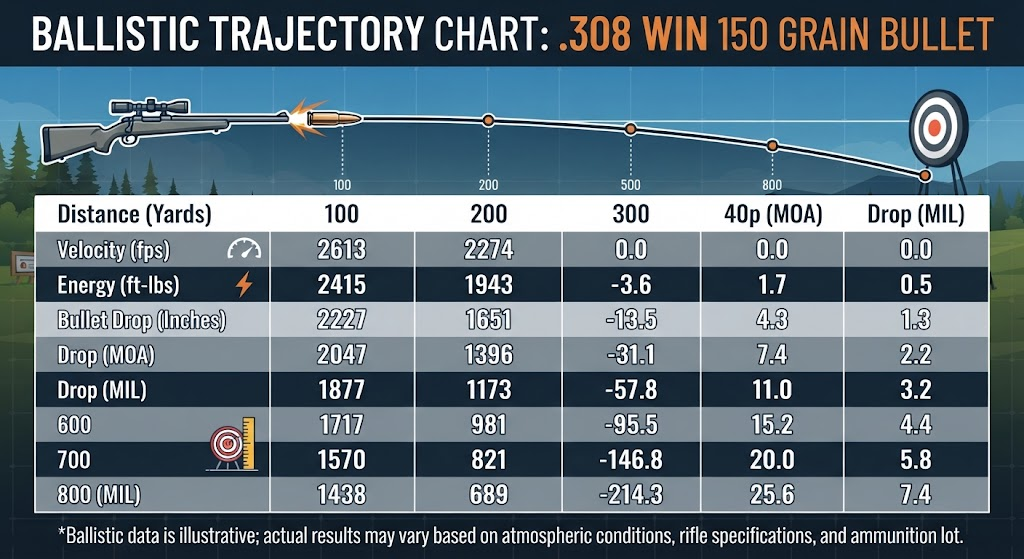
Understanding The .308 150 Grain Bullet Drop Chart
.308 Bullet Drop At 100 Yards
At 100 yards, the 150-grain bullet reaches its zero distance. It crosses your line of sight perfectly, resulting in zero bullet drop. Traveling at a swift 2613 fps, the projectile retains 2274 foot-pounds of energy. This zeroing distance is ideal for hunting, providing a clean mathematical baseline for longer shots.
.308 Bullet Drop At 200 Yards
At 200 yards, the lighter 150-grain bullet demonstrates its flat-shooting capabilities. It drops only 3.6 inches below the line of sight. You will need a minor adjustment of 1.7 MOA or 0.5 MIL to strike the center. The bullet still carries nearly 1950 foot-pounds of energy, easily taking down deer or hogs with a proper hit.
.308 Bullet Drop At 300 Yards
When the bullet reaches 300 yards, the drop becomes more noticeable at 13.5 inches. Shooters must dial 4.3 MOA or hold over 1.3 MIL on their reticle. The velocity sits at 2227 fps, and the energy remains strong at 1651 foot-pounds. This is a very common distance for western hunters, where the 150-grain .308 performs exceptionally well.
.308 Bullet Drop At 400 Yards
At 400 yards, the trajectory arcs significantly. The 150-grain projectile drops 31.1 inches, requiring an elevation correction of 7.4 MOA or 2.2 MIL. Kinetic energy drops to roughly 1400 foot-pounds. This distance demands precise rangefinding and an understanding of wind drift, as lighter bullets get pushed around by crosswinds more easily than heavier match bullets.
.308 Bullet Drop At 500 Yards
Crossing the 500-yard mark, the bullet drops 57.8 inches. A shooter needs to dial 11.0 MOA or 3.2 MIL. Importantly, the kinetic energy dips to 1173 foot-pounds. Many hunters consider this the absolute maximum ethical range for a 150-grain .308 on medium game, as you want at least 1000 foot-pounds of energy for a clean harvest.
.308 Bullet Drop At 600 Yards
At 600 yards, the projectile falls 95.5 inches below the original line of sight. You will need to dial 15.2 MOA or 4.4 MIL. The velocity drops to 1717 fps, and energy falls below 1000 foot-pounds. While hitting steel targets at this range is entirely possible with good dope, it is generally outside the recommended envelope for hunting with this specific bullet weight.
Frequently Asked Questions
How does 150-grain .308 bullet drop compare to 168-grain .308 drop?
A 150-grain bullet leaves the barrel at a higher velocity than a 168-grain bullet. Because of this speed advantage, the 150-grain bullet flies flatter and has less drop out to about 400 yards. However, lighter bullets usually have lower ballistic coefficients. Past 500 yards, the heavier 168-grain bullet retains its momentum better, resists wind drift more effectively, and eventually overtakes the 150-grain bullet in trajectory performance.
What is the maximum effective hunting range for a 150-grain .308?
For most medium game like whitetail deer, a projectile needs to deliver at least 1000 foot-pounds of kinetic energy upon impact. Looking at the bullet drop chart, a standard 150-grain .308 falls below this threshold just after 500 yards. Therefore, 400 to 500 yards is generally considered the maximum ethical hunting range for this specific load.
Should I zero my 150-grain .308 at 100 or 200 yards?
A 100-yard zero is the standard recommendation because it makes calculating your drop chart mathematically straightforward. However, because a 150-grain bullet is fast and flat, many hunters prefer a 200-yard zero. With a 200-yard zero, the bullet will strike about 1.5 to 2 inches high at 100 yards, allowing a hunter to aim dead center on a deer out to 250 yards without needing to adjust their scope.
Does barrel length affect my 150-grain bullet drop chart?
Yes, barrel length directly impacts muzzle velocity. The chart provided assumes a standard 24-inch test barrel. If you shoot a rifle with an 18-inch or 20-inch barrel, your muzzle velocity will be lower. A lower starting speed means your bullet will experience gravity for a longer period before reaching the target, resulting in more bullet drop at every distance.