A 45 caliber muzzleloader fires a long, heavy bullet from a small bore, and the modern loads in this chart shoot flat enough for shots past 200 yards. Four published loads lead the page, from the 200 grain Hornady SST-ML at 2,325 fps to the 280 grain ELD-X at 3,326 ft-lb of muzzle energy. The longest table here runs to 450 yards, and the charge tables show what every step up in powder buys.
Table of Contents [Click to minimize]
45 Cal Muzzleloader Ballistics: Velocity, Energy and Drop to 250 Yards
| Brand | Load | Item | Bullet Wt (gr) | BC (G1) | Powder Charge | Zero | Vel. Muzzle (fps) | Vel. 50 yd (fps) | Vel. 100 yd (fps) | Vel. 150 yd (fps) | Vel. 200 yd (fps) | Vel. 250 yd (fps) | Energy Muzzle (ft-lb) | Energy 50 yd (ft-lb) | Energy 100 yd (ft-lb) | Energy 150 yd (ft-lb) | Energy 200 yd (ft-lb) | Energy 250 yd (ft-lb) | Traj. Muzzle (in) | Traj. 50 yd (in) | Traj. 100 yd (in) | Traj. 150 yd (in) | Traj. 200 yd (in) | Traj. 250 yd (in) |
|---|---|---|---|---|---|---|---|---|---|---|---|---|---|---|---|---|---|---|---|---|---|---|---|---|
| Hornady | SST-ML Low Drag Sabot | 67132 | 200 | 0.265 | 150 gr | 3 in high at 100 yd | 2325 | 2171 | 2022 | 1880 | 1744 | 1616 | 2400 | 2092 | 1815 | 1569 | 1351 | 1160 | -1.5 | 2.0 | 3.0 | 2.0 | -1.0 | -7.1 |
| Traditions | ELD-X | A2016B | 280 | 0.315 | 100 gr Blackhorn 209 | 100 yd | 2060 | 1945 | 1834 | 1727 | 1626 | 1529 | 2638 | 2351 | 2090 | 1855 | 1643 | 1454 | -1.5 | 0.4 | 0 | -3 | -8.9 | -18.1 |
| Traditions | ELD-X | A2016B | 280 | 0.315 | 120 gr Blackhorn 209 | 100 yd | 2314 | 2190 | 2071 | 1955 | 1844 | 1738 | 3326 | 2981 | 2666 | 2377 | 2115 | 1877 | -1.5 | 0.2 | 0 | -2.2 | -6.6 | -8.8 |
| PowerBelt | ELR AeroTip | AC1600AT | 285 | 0.333 | 105 gr by weight Blackhorn 209 | 200 yd | 2300 | 2183 | 2069 | 1959 | 1852 | – | 3288 | 2962 | 2661 | 2385 | 2133 | – | -1.8 | 1.6 | 3.2 | 2.7 | 0 | – |
The PowerBelt row has no 250 yard figures because its published table jumps from 200 yards to 300 yards. The 300 yard and longer figures appear in the long range table below.
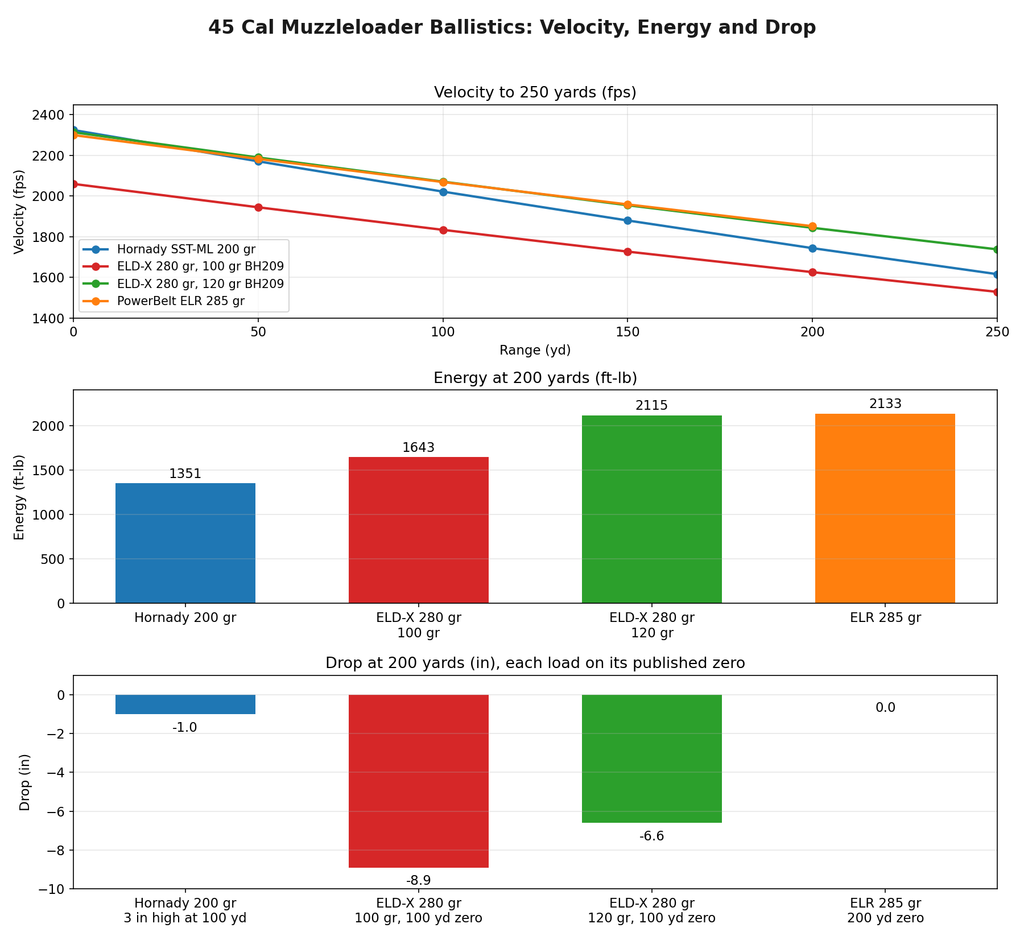
The curves above follow the four loads in the main chart. The PowerBelt ELR line ends at 200 yards here because its published table jumps to 300 yards after that point.
Charge Weight Drives the Whole Chart
Powder charge is the biggest lever in muzzleloader ballistics. The 175 grain Dead Center climbs from 1,944 fps on 80 grains of Blackhorn 209 to 2,359 fps on 120 grains, a gain of 415 fps, and the 200 grain Parker Hydra-Con rises from 1,893 fps to 2,338 fps across the same three steps. Every bullet in the charge tables gains speed at every step up.
The Hardest Hitting Load in the Chart
The 280 grain ELD-X on 120 grains of Blackhorn 209 posts the highest muzzle energy in the main chart at 3,326 ft-lb, and it stays in front on energy at every distance to 250 yards, holding 1,877 ft-lb there. The PowerBelt ELR on its standard 105 grain charge starts at 3,288 ft-lb and passes the ELD-X on energy at 200 yards, with 2,133 ft-lb against 2,115 ft-lb.
Long Range Belongs to the ELR
The PowerBelt ELR is the only load here with a published table past 250 yards, running to 450 yards on a 200 yard zero. It still carries 1,652 fps and 1,696 ft-lb at 300 yards, 1,470 fps and 1,343 ft-lb at 400 yards, and 1,387 fps with 1,197 ft-lb at 450 yards. Its drop at 450 yards is 58.4 inches below the line of sight.
Saboted Bullets Against Full Bore Bullets
Two bullet styles fill a 45 caliber bore. Saboted bullets put a smaller bullet, 0.357 or 0.40 inches, inside a plastic sabot, while full bore bullets like the ELR and the Fury Star Tip fill the bore themselves. On 100 grains of Blackhorn 209 the saboted 175 grain Dead Center is fastest at 2,189 fps, while the full bore 285 grain ELR is slowest at 1,989 fps but carries the highest ballistic coefficient.
The Hornady Factory Load
Hornady publishes one 45 caliber muzzleloader load, the 200 grain SST-ML Low Drag Sabot, item 67132, developed in a stock T/C Omega with a 150 grain charge. It starts at 2,325 fps with 2,400 ft-lb, still carries 2,022 fps at 100 yards and 1,616 fps at 250 yards. The rifle is sighted 3 inches high at 100 yards, so the bullet sits 1.0 inch low at 200 yards and 7.1 inches low at 250 yards.
The Bullet Left Out of the Downrange Tables
One 200 grain bullet appears only in the muzzle only listing. Its published downrange velocities fall from 1,894 fps at the muzzle to 1,167 fps at 50 yards and 926 fps at 100 yards, a loss no 0.265 ballistic coefficient can produce, and the trajectory falls 35.8 inches at 200 yards. The bullet’s own stated coefficient implies about 1,755 fps at 50 yards, so the downrange figures were left out and only its muzzle figures, which check out, are listed.
45 Cal Muzzleloader Ballistics at Long Range: The PowerBelt ELR to 450 Yards
| Range (yd) | Velocity (fps) | Energy (ft-lb) | Drop (in) |
|---|---|---|---|
| 200 | 1852 | 2133 | 0 |
| 300 | 1652 | 1696 | -13.4 |
| 350 | 1558 | 1509 | -24.7 |
| 400 | 1470 | 1343 | -39.5 |
| 450 | 1387 | 1197 | -58.4 |
Some older listings call this bullet 280 grains. The table above uses the current 285 grain weight, which matches the published energy figures.
Bullet Drop on a 100 Yard Zero
| Load | Powder Charge | Drop 50 yd (in) | Drop 100 yd (in) | Drop 150 yd (in) | Drop 200 yd (in) | Drop 250 yd (in) |
|—|—|—|—|—|—|
| ELD-X 280 gr | 100 gr Blackhorn 209 | 0.4 | 0 | -3 | -8.9 | -18.1 |
| ELD-X 280 gr | 120 gr Blackhorn 209 | 0.2 | 0 | -2.2 | -6.6 | -8.8 |
Both rows use a 100 yard zero, so each bullet sits exactly on the line of sight at 100 yards. The heavier charge drops less at every distance past the zero.
Muzzle Velocity by Powder Charge: Blackhorn 209
| Bullet | Bullet Diameter / Sabot | Blackhorn 209 80 gr (fps) | Blackhorn 209 100 gr (fps) | Blackhorn 209 120 gr (fps) |
|—|—|—|—|
| Precision Rifle Dead Center 175 gr | .357 in bullet in .45 sabot | 1944 | 2189 | 2359 |
| Parker Hydra-Con 200 gr | .40 in bullet in .45 sabot | 1893 | 2129 | 2338 |
| Fury Star Tip MZ 250 gr | .45 in full bore | 1825 | 2118 | – |
| PowerBelt ELR 285 gr | .45 in full bore | 1709 | 1989 | – |
| Fury Star Tip MZ 2P 300 gr | .45 in full bore | 1774 | 2012 | – |
Charges are measured by volume with a standard black powder measure. The 120 grain column is blank for the three heaviest bullets because no load is listed there.
Muzzle Velocity by Powder Charge: Triple Seven
| Bullet | Triple Seven Pellets 2 (fps) | Triple Seven Pellets 3 (fps) | Triple Seven Loose 80 gr 2F (fps) | Triple Seven Loose 100 gr 2F (fps) |
|—|—|—|—|
| Precision Rifle Dead Center 175 gr | 2004 | 2362 | 2003 | 2166 |
| Parker Hydra-Con 200 gr | 1902 | 2294 | 1901 | 2089 |
| Fury Star Tip MZ 250 gr | 1664 | – | 1721 | 1883 |
| PowerBelt ELR 285 gr | 1746 | 2147 | 1630 | 1751 |
| Fury Star Tip MZ 2P 300 gr | 1619 | 1968 | 1652 | – |
The pellet columns count 50 grain preformed pellets, so two pellets make a 100 grain charge and three pellets make a 150 grain charge. The loose powder columns are weighed charges of Triple Seven 2F.
Muzzle Velocity by Powder Charge: Pyrodex
| Bullet | Pyrodex RS 80 gr (fps) | Pyrodex RS 100 gr (fps) | Pyrodex P 80 gr (fps) |
|—|—|—|
| Precision Rifle Dead Center 175 gr | 1859 | 2014 | 1938 |
| Parker Hydra-Con 200 gr | 1785 | 1948 | 1807 |
| Fury Star Tip MZ 250 gr | 1624 | – | 1659 |
| PowerBelt ELR 285 gr | 1500 | – | 1595 |
| Fury Star Tip MZ 2P 300 gr | 1527 | – | – |
Pyrodex RS is the rifle granulation and Pyrodex P is the finer pistol granulation. The 100 grain Pyrodex P column is left out because only one bullet lists a figure there.
Saboted Bullets and Full Bore Bullets
| Bullet | Bullet Diameter / Sabot | Type | Muzzle Velocity, 100 gr Blackhorn 209 (fps) |
|—|—|—|
| Precision Rifle Dead Center 175 gr | .357 in bullet in .45 sabot | Saboted | 2189 |
| Parker Hydra-Con 200 gr | .40 in bullet in .45 sabot | Saboted | 2129 |
| Fury Star Tip MZ 250 gr | .45 in full bore | Full bore | 2118 |
| PowerBelt ELR 285 gr | .45 in full bore | Full bore | 1989 |
| Fury Star Tip MZ 2P 300 gr | .45 in full bore | Full bore | 2012 |
The table compares all five bullets on the same charge, 100 grains of Blackhorn 209 by volume. The saboted bullets start faster, while the full bore bullets keep more of their speed downrange.
Muzzleloader Loads With Muzzle Figures Only
| Brand | Load | Powder Charge | Muzzle Velocity (fps) | Muzzle Energy (ft-lb) |
|—|—|—|—|
| Traditions | Smackdown 200 gr | 100 gr Pyrodex RS | 1894 | 1593 |
| Traditions | Smackdown 200 gr | 100 gr Pyrodex pellets | 1976 | 1734 |
| Traditions | Smackdown 200 gr | 100 gr Triple Seven | 2056 | 1877 |
| PowerBelt | ELR AeroTip 285 gr | Maximum recommended charge | 2560 | 4147 |
The three Smackdown rows carry muzzle velocity and energy only, because their published downrange figures were left out for the reason given above. The PowerBelt ELR row on the maximum recommended charge reaches 2,560 fps and 4,147 ft-lb.
| Brand | Load | Powder Charge | Muzzle Velocity (fps) |
|—|—|—|
| CVA Endura | PowerBelt ELR 285 gr | VihtaVuori N120 50 gr by weight | 2343 |
| CVA Endura | PowerBelt ELR 285 gr | VihtaVuori N120 55 gr by weight | 2444 |
| CVA Endura | PowerBelt ELR 285 gr | IMR 4198 55 gr by weight | 2406 |
| CVA Endura | PowerBelt ELR 285 gr | IMR 4198 63 gr by weight | 2530 |
| CVA Endura | PowerBelt ELR 285 gr | Blackhorn 209 98 gr by weight | 2293 |
| CVA Endura | PowerBelt ELR 285 gr | Blackhorn 209 112 gr by weight | 2430 |
| Traditional | Patched round ball .440 | 40 gr Pyrodex RS | 1426 |
| Traditional | Patched round ball .440 | 50 gr Pyrodex RS | 1574 |
| Traditional | Patched round ball .440 | 60 gr Pyrodex RS | 1772 |
The smokeless powder loads in this listing suit only rifles built for smokeless powder. The round ball rows are traditional patched round ball loads, with muzzle velocity only.
Frequently Asked Questions
What muzzle velocity does a 45 caliber muzzleloader produce?
Across the loads in this article, muzzle velocity runs from 1,426 fps for a patched round ball on 40 grains of Pyrodex to 2,560 fps for the PowerBelt ELR on the maximum recommended charge.
Which 45 caliber muzzleloader load hits hardest at the muzzle?
The PowerBelt ELR 285 grain bullet on the maximum recommended charge, with 4,147 ft-lb at the muzzle. Inside the main chart, the hardest hitter is the 280 grain ELD-X on 120 grains of Blackhorn 209, at 3,326 ft-lb.
How flat does a 45 caliber muzzleloader shoot at 200 yards?
On a 100 yard zero, the 280 grain ELD-X on 120 grains of Blackhorn 209 falls 6.6 inches at 200 yards, the flattest path on that zero in the chart. The PowerBelt ELR sits exactly on its 200 yard zero at that distance.
How much energy is left at 200 yards?
At 200 yards the PowerBelt ELR still carries 2,133 ft-lb, the most in the main chart. The 280 grain ELD-X on the heavy charge holds 2,115 ft-lb there.
What powder charges do the loads in the chart use?
The main chart covers a 150 grain charge for the Hornady load, 100 and 120 grains of Blackhorn 209 for the ELD-X, and 105 grains by weight of Blackhorn 209 for the ELR. The charge tables add 80, 100 and 120 grain Blackhorn 209 loads, Triple Seven pellets and loose powder, and Pyrodex charges from 40 to 100 grains.
Is Blackhorn 209 faster than Triple Seven?
On the same bullets, Blackhorn 209 runs faster than Triple Seven loose powder in the published tables. The 175 grain Dead Center reaches 2,359 fps on 120 grains of Blackhorn 209, against 2,204 fps on 100 grains of Triple Seven 3F.
What is the PowerBelt ELR bullet?
It is a full bore 285 grain bullet with a ballistic coefficient of 0.333, built for long range muzzleloading in rifles with a 1:24 twist or faster. Its published table runs to 450 yards on a 200 yard zero.
Why does the ELR table use a 200 yard zero?
The published table for the ELR is built on a 200 yard zero, with the bullet crossing 3.2 inches high at 100 yards and falling 13.4 inches low at 300 yards. A 200 yard zero suits a bullet meant for shots past 200 yards.
Does a heavier muzzleloader bullet always hit harder at 200 yards?
No. The 280 grain ELD-X leads on muzzle energy in the main chart at 3,326 ft-lb, yet at 200 yards the 285 grain ELR holds slightly more energy, 2,133 ft-lb against 2,115 ft-lb, because it keeps its speed better.
Why is one 200 grain bullet missing from the downrange tables?
One 200 grain bullet’s published downrange figures fall far faster than the bullet’s own stated ballistic coefficient of 0.265 allows, so those figures were left out of the tables. Its muzzle velocity and energy, which check out, appear in the muzzle only listing.