A 6.5 Grendel ballistic chart detailing performance by the inch provides AR 15 shooters with the exact velocity and trajectory data they need. By comparing how different barrel lengths alter muzzle speed and bullet drop from 50 yards all the way out to 1000 yards, hunters and precision shooters can choose the perfect rifle configuration for their specific downrange goals.
Table of Contents [Click to minimize]
6.5 Grendel Ballistics by Barrel Length
| Barrel Length | Ammunition | Muzzle Vel | 50 Yds | 100 Yds | 200 Yds | 300 Yds | 400 Yds | 500 Yds | 600 Yds | 700 Yds | 800 Yds | 900 Yds | 1000 Yds |
| 24 Inches | 123 gr ELD Match | 2620 fps | 2540 fps | 2465 fps | 2320 fps | 2175 fps | 2035 fps | 1900 fps | 1770 fps | 1645 fps | 1530 fps | 1420 fps | 1320 fps |
| 20 Inches | 123 gr ELD Match | 2568 fps | 2490 fps | 2415 fps | 2270 fps | 2125 fps | 1990 fps | 1855 fps | 1725 fps | 1605 fps | 1490 fps | 1385 fps | 1290 fps |
| 18 Inches | 123 gr ELD Match | 2500 fps | 2420 fps | 2345 fps | 2200 fps | 2060 fps | 1925 fps | 1795 fps | 1670 fps | 1550 fps | 1440 fps | 1335 fps | 1245 fps |
| 16 Inches | 123 gr ELD Match | 2438 fps | 2360 fps | 2285 fps | 2145 fps | 2005 fps | 1875 fps | 1745 fps | 1625 fps | 1510 fps | 1400 fps | 1300 fps | 1210 fps |
| 12.5 Inches | 123 gr ELD Match | 2330 fps | 2250 fps | 2175 fps | 2035 fps | 1900 fps | 1770 fps | 1645 fps | 1525 fps | 1415 fps | 1315 fps | 1220 fps | 1135 fps |
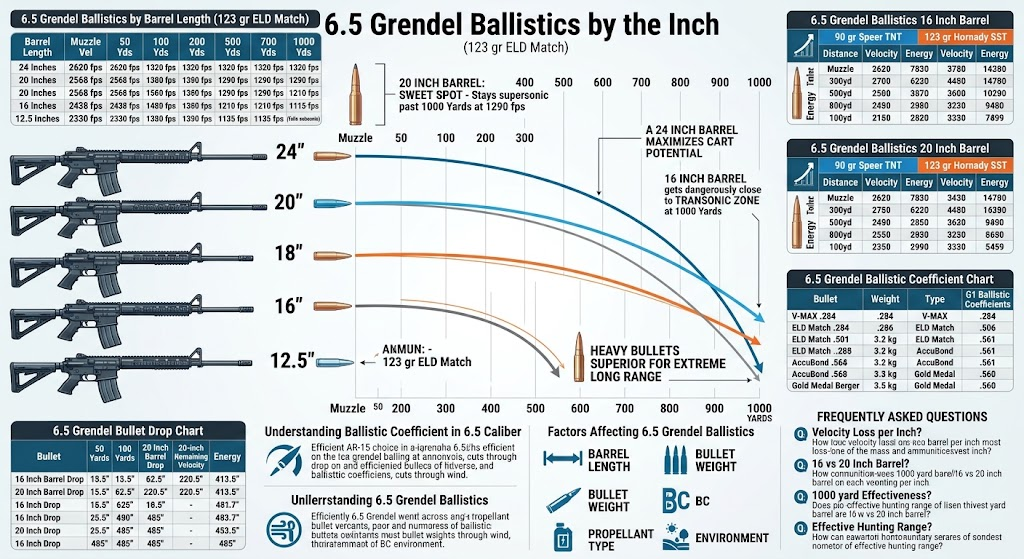
Analyzing Velocity by the Inch Out to 1000 Yards
- A 24 inch barrel maximizes the cartridge potential, allowing the 123 grain bullet to remain comfortably supersonic at 1000 yards with a remaining velocity of 1320 fps.
- Reducing the barrel to 20 inches drops initial speed to 2568 fps, but the projectile still holds an impressive 1290 fps at the 1000 yard mark.
- Dropping to a 16 inch barrel strips away initial speed, bringing the bullet dangerously close to the transonic zone at 1000 yards by registering 1210 fps.
- A compact 12.5 inch barrel sacrifices considerable downrange power, bleeding down to 1135 fps and falling subsonic just before reaching 1000 yards.
- Velocity at 500 yards remains highly lethal for medium game across most barrel lengths, though the 24 inch barrel delivers noticeably more impact force than the shorter configurations.
6.5 Grendel Ballistics 16 Inch Barrel
| Distance | 90 gr Speer TNT Velocity | 90 gr Speer TNT Energy | 123 gr Hornady SST Velocity | 123 gr Hornady SST Energy |
| Muzzle | 2750 fps | 1511 ft-lbs | 2440 fps | 1626 ft-lbs |
| 50 Yards | 2600 fps | 1351 ft-lbs | 2360 fps | 1521 ft-lbs |
| 100 Yards | 2450 fps | 1200 ft-lbs | 2285 fps | 1426 ft-lbs |
| 200 Yards | 2170 fps | 941 ft-lbs | 2145 fps | 1257 ft-lbs |
| 300 Yards | 1910 fps | 729 ft-lbs | 2005 fps | 1098 ft-lbs |
| 400 Yards | 1665 fps | 554 ft-lbs | 1875 fps | 960 ft-lbs |
| 500 Yards | 1445 fps | 417 ft-lbs | 1745 fps | 831 ft-lbs |
| 600 Yards | 1250 fps | 312 ft-lbs | 1625 fps | 721 ft-lbs |
| 700 Yards | 1090 fps | 237 ft-lbs | 1510 fps | 623 ft-lbs |
| 800 Yards | 970 fps | 188 ft-lbs | 1400 fps | 535 ft-lbs |
| 900 Yards | 885 fps | 156 ft-lbs | 1300 fps | 461 ft-lbs |
| 1000 Yards | 820 fps | 134 ft-lbs | 1210 fps | 400 ft-lbs |
Performance of the 16 Inch Barrel at Distance
- Lightweight 90 grain varmint bullets achieve impressive muzzle speeds of 2750 fps but bleed off energy rapidly, dropping to a mere 134 foot pounds at 1000 yards.
- The standard 123 grain hunting loads launch at 2440 fps and easily retain over 830 foot pounds of energy at 500 yards, making them effective for mid range hunting.
- Due to the shorter barrel length and lower ballistic coefficient, the 90 grain projectile falls well below the supersonic threshold before reaching 700 yards.
- Heavy 123 grain bullets see a noticeable speed penalty at the muzzle but utilize their superior aerodynamics to retain 400 foot pounds of kinetic energy at 1000 yards.
6.5 Grendel Ballistics 20 Inch Barrel
| Distance | 90 gr Speer TNT Velocity | 90 gr Speer TNT Energy | 123 gr Hornady SST Velocity | 123 gr Hornady SST Energy |
| Muzzle | 2880 fps | 1657 ft-lbs | 2568 fps | 1801 ft-lbs |
| 50 Yards | 2725 fps | 1484 ft-lbs | 2490 fps | 1693 ft-lbs |
| 100 Yards | 2570 fps | 1320 ft-lbs | 2415 fps | 1593 ft-lbs |
| 200 Yards | 2280 fps | 1039 ft-lbs | 2270 fps | 1408 ft-lbs |
| 300 Yards | 2010 fps | 807 ft-lbs | 2125 fps | 1233 ft-lbs |
| 400 Yards | 1755 fps | 615 ft-lbs | 1990 fps | 1081 ft-lbs |
| 500 Yards | 1525 fps | 465 ft-lbs | 1855 fps | 940 ft-lbs |
| 600 Yards | 1320 fps | 348 ft-lbs | 1725 fps | 813 ft-lbs |
| 700 Yards | 1145 fps | 262 ft-lbs | 1605 fps | 704 ft-lbs |
| 800 Yards | 1010 fps | 204 ft-lbs | 1490 fps | 606 ft-lbs |
| 900 Yards | 915 fps | 167 ft-lbs | 1385 fps | 524 ft-lbs |
| 1000 Yards | 845 fps | 143 ft-lbs | 1290 fps | 454 ft-lbs |
Performance of the 20 Inch Barrel at Distance
- The 20 inch barrel is widely considered the sweet spot for 6.5 Grendel, allowing the 123 grain SST to stay supersonic at 1290 fps all the way to 1000 yards.
- A 90 grain bullet screams out of the 20 inch tube at 2880 fps, though its low ballistic coefficient still causes it to go subsonic before 800 yards.
- Heavy 123 grain match loads fired from the 20 inch barrel maintain 454 foot pounds of energy at 1000 yards, assisting with long range steel target engagements.
- At 500 yards, the 123 grain bullet delivers 940 foot pounds of kinetic energy, proving highly efficient for intermediate distance hunting applications.
6.5 Grendel Bullet Drop Chart
| Distance | 16 Inch Barrel Drop | 20 Inch Barrel Drop | 20 Inch Remaining Velocity | 20 Inch Remaining Energy |
| 50 Yards | -0.1 inches | -0.2 inches | 2490 fps | 1693 ft-lbs |
| 100 Yards | 0.0 inches | 0.0 inches | 2415 fps | 1593 ft-lbs |
| 200 Yards | -5.1 inches | -4.5 inches | 2270 fps | 1408 ft-lbs |
| 300 Yards | -17.8 inches | -15.5 inches | 2125 fps | 1233 ft-lbs |
| 400 Yards | -39.5 inches | -34.5 inches | 1990 fps | 1081 ft-lbs |
| 500 Yards | -72.0 inches | -62.5 inches | 1855 fps | 940 ft-lbs |
| 600 Yards | -117.5 inches | -101.5 inches | 1725 fps | 813 ft-lbs |
| 700 Yards | -178.5 inches | -153.5 inches | 1605 fps | 704 ft-lbs |
| 800 Yards | -257.5 inches | -220.5 inches | 1490 fps | 606 ft-lbs |
| 900 Yards | -358.5 inches | -306.0 inches | 1385 fps | 524 ft-lbs |
| 1000 Yards | -485.0 inches | -413.5 inches | 1290 fps | 454 ft-lbs |
Evaluating the Flight Path Out to 1000 Yards
- A standard 123 grain bullet zeroed at 100 yards will drop just 15.5 inches at 300 yards when fired from a 20 inch barrel, making holdovers relatively simple.
- Pushing the distance to 500 yards results in 62.5 inches of bullet drop, requiring precise dial adjustments on the rifle scope.
- As the bullet stretches to 800 yards, the drop accelerates rapidly to 220.5 inches due to the natural decay of velocity.
- At the extreme range of 1000 yards, the bullet drops a massive 413.5 inches, demanding high quality optics with ample internal elevation travel.
- The 16 inch barrel experiences significantly more drop at 1000 yards compared to the 20 inch barrel, falling 485 inches total due to its slower starting speed.
6.5 Grendel Ballistic Coefficient Chart
| Bullet Manufacturer | Bullet Model | Bullet Weight | Projectile Type | G1 Ballistic Coefficient |
| Hornady | V MAX | 95 gr | Polymer Tip | .284 |
| Barnes | TTSX | 100 gr | Copper Tip | .358 |
| Hornady | SST | 123 gr | Polymer Tip | .510 |
| Hornady | ELD Match | 123 gr | Polymer Tip | .506 |
| Nosler | AccuBond | 129 gr | Polymer Tip | .561 |
| Federal | Gold Medal Berger | 130 gr | Hollow Point Boat Tail | .560 |
Understanding Ballistic Coefficient in 6.5 Caliber
- Lightweight varmint bullets like the 95 grain V MAX feature a lower .284 BC, limiting their effectiveness in heavy crosswinds past 400 yards.
- The 123 grain SST and ELD Match bullets offer incredible efficiency for the AR 15 platform, boasting BC ratings over .500 which helps them survive the 1000 yard flight.
- Heavier 129 grain and 130 grain bullets produce the highest aerodynamic ratings, reaching a .560 BC or better.
- A higher ballistic coefficient allows these heavy bullets to cut through the wind and preserve kinetic energy out to 1000 yards, making them ideal for precision rifle competition.
Factors That Affect 6.5 Grendel Ballistics
Barrel length directly dictates the initial speed of the projectile. Gaining extra length by the inch gives the gunpowder more time to fully ignite and push the bullet forward. A 20 inch barrel generates higher pressure and speed than a 16 inch barrel, which translates to a flatter downrange trajectory and heavier impact energy at 1000 yards.
Bullet weight completely changes the flight characteristics of the cartridge. Lightweight bullets leave the muzzle incredibly fast but lose momentum quickly due to wind drag, often falling subsonic well before the 1000 yard line. Heavy bullets start much slower but carry their momentum for hundreds of yards, making them far superior for extreme long range target shooting.
Propellant type and powder charge act as the primary engine for the bullet. Factory ammunition utilizes specially blended powders to maximize the performance of the AR 15 gas system. Reloaders must carefully select powders with the correct burn rate to achieve maximum velocity without causing pressure spikes or cycling malfunctions.
Ballistic coefficient determines how well the bullet fights atmospheric drag. The sleek, elongated profile of 6.5mm bullets naturally provides a high BC. This extreme aerodynamic efficiency allows the Grendel to outperform larger caliber cartridges at extended ranges because it sheds velocity at a much slower rate during its 1000 yard journey.
Environmental variables such as altitude, temperature, and humidity constantly alter the bullet flight path. Thin air at high mountain elevations produces less drag, allowing the bullet to fly flatter and stay supersonic further than it would at sea level. Shooters must always verify their ballistic charts in the actual environment where they plan to shoot long distance.
Frequently Asked Questions
What is a 6.5 Grendel ballistics by the inch chart?
A chart breaking down ballistics by the inch shows exactly how much muzzle velocity and downrange energy you gain or lose for every inch of barrel length added or removed from the rifle.
How much velocity does a 6.5 Grendel lose per inch of barrel?
On average the 6.5 Grendel loses between 20 and 30 feet per second for every inch of barrel length you remove, though this varies slightly depending on the bullet weight and powder type.
What is the effective range of a 16 inch 6.5 Grendel?
A 16 inch barrel pushes a 123 grain bullet fast enough to remain highly accurate out to 800 yards, with ethical hunting energy maintained out to roughly 300 to 400 yards.
Is a 20 inch barrel better for the 6.5 Grendel?
A 20 inch barrel is widely considered optimal because it provides complete powder burn and maximum practical velocity, helping the bullet stay supersonic all the way to the 1000 yard mark.
How much does a 6.5 Grendel drop at 500 yards?
When utilizing a 20 inch barrel and a 100 yard zero, a standard 123 grain bullet will drop approximately 62.5 inches at the 500 yard mark.
How much does a 6.5 Grendel drop at 1000 yards?
Fired from a 20 inch barrel with a 100 yard zero, a 123 grain bullet will experience massive bullet drop, falling roughly 413.5 inches by the time it reaches 1000 yards.
What is the muzzle velocity of a 123 grain 6.5 Grendel bullet?
Out of a 20 inch barrel, factory 123 grain ammunition generally achieves a muzzle velocity of 2568 feet per second.
Can the 6.5 Grendel shoot effectively at 1000 yards?
Yes, when fired from a 20 inch or 24 inch barrel, heavy match grade bullets have the high ballistic coefficients required to stay stable and strike targets accurately at 1000 yards.
How does bullet weight affect 6.5 Grendel velocity?
Lighter 90 grain bullets can reach speeds over 2800 feet per second, while heavier 130 grain bullets max out around 2400 feet per second at the muzzle due to their increased mass.
Should I buy a 16 inch or 20 inch 6.5 Grendel?
Choose a 16 inch barrel if your primary goal is hunting in dense brush or building a lightweight rifle. Choose a 20 inch barrel if you prioritize maximum velocity, long range target shooting, and flatter trajectories out to 1000 yards.