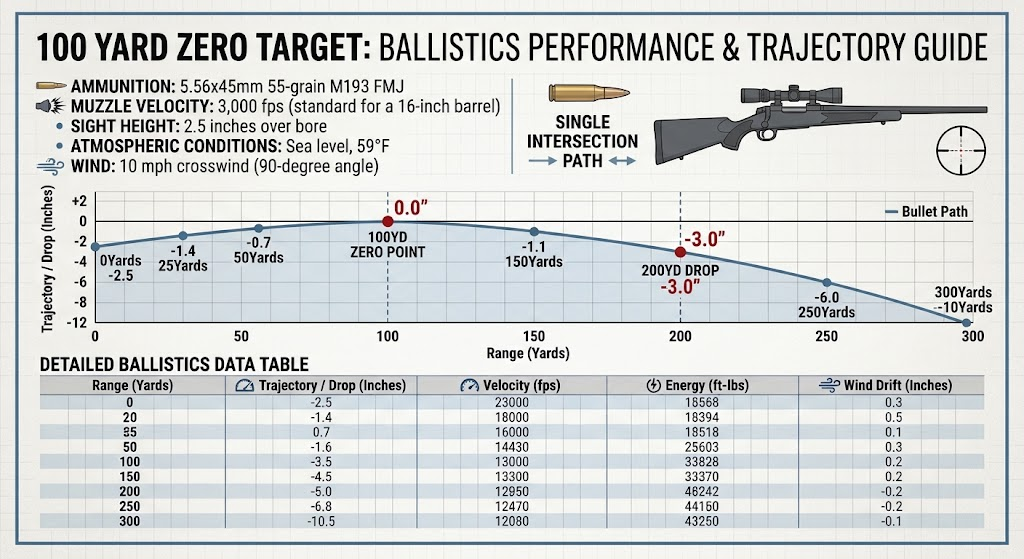
The 100-yard zero is the gold standard for precision rifle shooting, hunting, and scoped AR-15 platforms. By establishing a zero where the bullet never rises above the crosshairs, shooters can confidently dial or hold over for all long-range impacts. This complete guide breaks down 100-yard targets, short-range offsets, and MRAD systems.
Table of Contents
[Click to minimize]
100 Yard Zero Target
A 100-yard zero ensures the bullet’s flight path perfectly intersects the optic’s line of sight at exactly 100 yards.
Unlike 36-yard or 50-yard zeros, a 100-yard zero typically features only one intersection point, as the bullet reaches the crosshairs and immediately begins to drop.
Because the projectile never travels above the point of aim, shooters will never have to aim under a target at extended distances.
It is highly favored for precision bolt-action rifles, Low Power Variable Optics (LPVOs), and magnified scopes with built-in drop reticles.
While it offers precision at 100 yards, engaging targets at 200 or 300 yards will require significant holdovers or elevation turret adjustments.
Ammunition: 5.56x45mm 55-grain M193 FMJ
Muzzle Velocity: 3,000 fps (standard for a 16-inch barrel)
Many shooters are restricted to indoor 25-yard ranges but still want to set up their rifles for a 100-yard trajectory.
You can achieve this by calculating the height over bore and accounting for the bullet’s climb during the first 25 yards of flight.
At 25 yards, a bullet fired from a standard AR-15 is still traveling upward and has not yet met the optic’s line of sight.
For a 2.5-inch optic height, the point of impact at 25 yards must be exactly 1.4 inches below the point of aim to ensure a true 100-yard zero.
Using a specialized 100-yard zero at 25 yards target allows you to aim at the main bullseye while your group safely forms in a designated lower circle.
Failing to offset at 25 yards (meaning you zero directly on the bullseye) will cause your rifle to shoot significantly high at 100 yards.
Target Distance: 25 Yards
Zero Distance Goal: 100 Yards
Ammunition / Load
Sight Height (Over Bore)
Muzzle Velocity (fps)
Required Point of Impact (POI) Offset at 25 Yards
5.56x45mm 55-grain M193
1.5 inches (Standard Iron Sights)
3,000
-0.7 inches (Low)
5.56x45mm 55-grain M193
2.5 inches (Standard AR-15 Optic)
3,000
-1.4 inches (Low)
5.56x45mm 55-grain M193
3.5 inches (Tall / NVG Mount)
3,000
-2.2 inches (Low)
100 Yard Zero at 50 Yards
Setting your 100-yard zero at a 50-yard target is much more reliable than doing it at 25 yards because angular errors are minimized.
At 50 yards, the bullet is much closer to crossing the optic’s line of sight, meaning the required offset is much smaller.
For a standard AR-15 running a red dot or LPVO, your rounds should impact approximately 0.7 inches below the center point of aim at 50 yards.
This offset acts as a perfect preliminary zero before fine-tuning at the actual 100-yard line.
Keep in mind that different ammunition velocities and bullet weights begin to show minor trajectory differences at 50 yards, so always confirm with your defensive or match ammunition.
Precision rifle shooters rely entirely on a 100-yard zero paired with MRAD (Milliradian) optics to calculate extreme long-range shots.
A 100-yard zero provides a clean “zero baseline,” meaning all data dialed into the scope for 200, 500, or 1,000 yards will be an upward elevation adjustment.
An MRAD 100-yard zero target utilizes a specific grid mapped to 0.1 MRAD squares, which equals roughly 0.36 inches at 100 yards.
This specialized target completely eliminates math conversions; one grid square on the paper equals exactly one click on the optic’s turret.
If your bullet strikes three squares directly below the bullseye, you simply dial up 0.3 MRAD to achieve a perfect center zero.
Ammunition: .308 Winchester 175-grain Sierra MatchKing
Muzzle Velocity: 2,600 fps
Sight Height: 2.0 inches over bore
Atmospheric Conditions: Sea level, 59°F
Range (Yards)
Trajectory (Inches)
Elevation Hold / Dial (MRAD)
Velocity (fps)
Energy (ft-lbs)
100
0.0
0.0
2,427
2,289
200
-4.5
+0.6
2,261
1,987
300
-15.5
+1.4
2,101
1,716
400
-34.0
+2.4
1,948
1,475
500
-61.5
+3.4
1,803
1,263
Frequently Asked Questions
1. What is a 100-yard zero?
A 100-yard zero calibrates a rifle’s optic so the bullet perfectly impacts the exact center of the crosshairs at a distance of 100 yards, ensuring all longer shots require an upward hold.
Yes. By aiming at the center of a target placed at 25 yards and adjusting your optic so the bullet hits roughly 1.4 inches low, you will mimic a 100-yard trajectory.
3. Why do snipers and precision shooters use a 100-yard zero?
Precision shooters use it because it creates a flat baseline. Since the bullet never arcs above the crosshairs, shooters only have to calculate drop and dial upward for long-range targets.
4. Does a 100-yard zero work for an AR-15?
Absolutely. It is the preferred zero for AR-15s equipped with LPVOs (Low Power Variable Optics) or magnifiers, as it aligns perfectly with most standard bullet drop compensator (BDC) reticles.
5. How low should my bullet hit at 50 yards for a 100-yard zero?
For a standard AR-15 with a 2.5-inch optic height, your rounds should hit approximately 0.7 inches below your point of aim at 50 yards.
6. What is the difference between a 100-yard zero and a 50-yard zero?
A 50-yard zero creates an arc that rises above the line of sight and drops back down at 200 yards, whereas a 100-yard zero meets the line of sight and immediately begins to drop.
7. How does sight height affect my 25-yard offset for a 100-yard zero?
It changes it drastically. A low iron sight (1.5 inches) requires a 0.7-inch low offset at 25 yards, while a tall night vision mount (3.5 inches) requires a 2.2-inch low offset.
8. What is an MRAD 100-yard zero target?
It is a specialized paper target printed with a 0.1 MRAD grid. This allows precision shooters to make scope adjustments based purely on grid squares instead of converting inches to MOA.
9. Do I ever have to aim under my target with a 100-yard zero?
No, this is the primary benefit of the 100-yard zero. The bullet never travels above your point of aim, so you will always hold dead-on or hold high for drop.
10. Will a 100-yard zero work for a .22LR rifle?
While possible, it is not recommended. A .22LR bullet drops significantly past 50 yards, meaning a 100-yard zero would force the bullet to arc incredibly high at 50 yards just to reach the 100-yard mark.