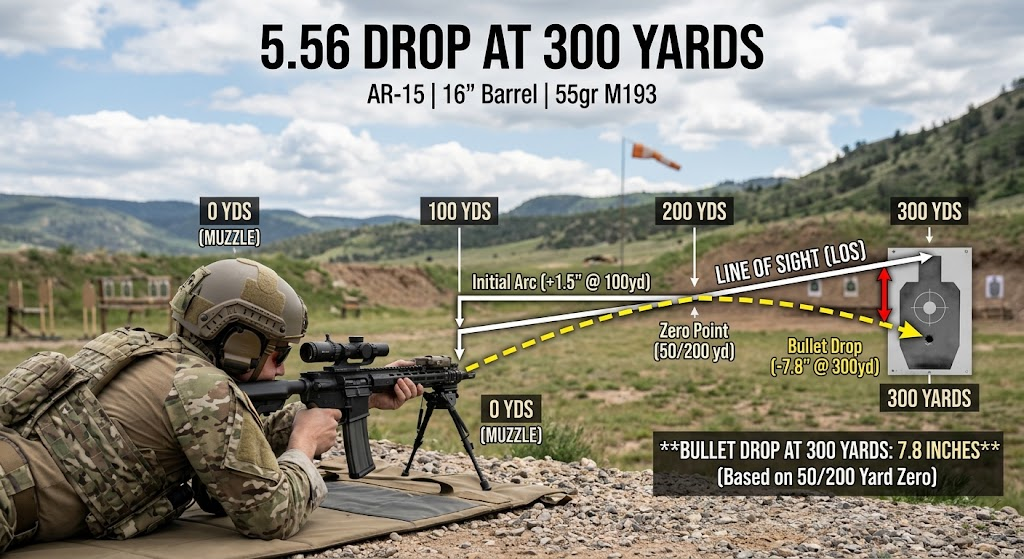
With a standard 100-yard zero, a typical 55-grain 5.56x45mm bullet drops approximately 12 to 13 inches at 300 yards. However, if you are using the popular 50/200-yard battle zero, the apparent drop at 300 yards is significantly less and measures roughly 7 to 8 inches below your line of sight.
The exact drop you experience at 300 yards depends entirely on three variables: your initial zero distance, your barrel length, and the specific weight of your ammunition.
5.56x45mm Bullet Drop Chart (55gr M193)
This table illustrates the flight path of a standard 55-grain FMJ (M193) bullet fired from a 16-inch barrel at roughly 3,100 feet per second (fps). The numbers represent inches above (+) or below (-) the line of sight.
| Distance | 100-Yard Zero | 50/200-Yard Zero | 36/300-Yard Zero |
| 50 Yards | -0.2 inches | 0.0 inches (Zero) | +0.9 inches |
| 100 Yards | 0.0 inches (Zero) | +1.5 inches | +3.8 inches |
| 150 Yards | -1.1 inches | +1.4 inches | +4.6 inches |
| 200 Yards | -3.7 inches | 0.0 inches (Zero) | +3.5 inches |
| 250 Yards | -7.5 inches | -3.1 inches | +0.7 inches |
| 300 Yards | -12.8 inches | -7.8 inches | -4.0 inches |
| 400 Yards | -29.5 inches | -23.0 inches | -19.5 inches |
Note: Ballistic data assumes standard atmospheric conditions at sea level. Your specific optic height over bore (usually 2.6 inches for an AR-15) influences these numbers slightly.
Key Factors Influencing 5.56 Drop
While the chart provides a baseline, real-world ballistics change based on your specific rifle setup and ammunition choices.
1. Ammunition Weight and Velocity
The 5.56mm NATO cartridge is primarily available in three common military loadings, each flying slightly differently at 300 yards:
- M193 (55-grain): The lightest and fastest common round. Because it leaves the muzzle at a high velocity, it shoots very flat out to 300 yards before shedding speed and dropping rapidly.
- M855 (62-grain “Green Tip”): Heavier and slightly slower. It carries more kinetic energy out to 300 yards and bucks the wind better, but will drop about 1 to 2 inches more than the 55-grain round at the 300-yard mark.
- Mk262 (77-grain OTM): A heavy, precision round. While it has the most pronounced arc and drop, it retains the most velocity and energy at 300+ yards, making it the preferred choice for long-range accuracy.
2. Barrel Length
The 5.56 cartridge relies heavily on velocity for its flat trajectory. A longer barrel provides more time for the expanding gases to push the bullet, increasing muzzle velocity.
- 20-inch barrels: Yield maximum velocity (~3,250 fps for 55gr). Produces the flattest trajectory and least drop at 300 yards.
- 16-inch barrels: The civilian standard. Loses about 100 to 150 fps compared to a 20-inch barrel, resulting in a slightly steeper drop.
- 10.5 to 11.5-inch barrels (SBRs/Pistols): Suffer severe velocity loss (dropping down to ~2,700 fps). A bullet fired from a short barrel will drop considerably more at 300 yards, often exceeding 16 inches of drop with a 100-yard zero.
3. Your Zero Distance
How you zero your optic dictates the parabolic arc the bullet takes relative to your line of sight.
- The 100-Yard Zero: The bullet never travels above your line of sight. It peaks exactly at 100 yards and then drops steadily, requiring you to hold roughly 12 inches high to hit a target at 300 yards.
- The 50/200-Yard Zero: The bullet crosses your line of sight at 50 yards, arcs up to 1.5 inches high at 100 yards, and falls back to zero at 200 yards. This keeps all shots within a tight 2-inch vertical window from 0 to 200 yards, requiring only a slight holdover at 300.
- The 36-Yard Zero: Pushes the bullet in a high arc, crossing the line of sight at 36 yards and again near 300 yards. While it requires almost no holdover at 300 yards, the bullet will strike nearly 5 inches high at 150 yards, requiring hold-unders for mid-range targets.
Frequently Asked Questions
What is the best zero for shooting 5.56 at 300 yards?
If your primary goal is hitting center mass on man-sized steel targets out to 300 yards with minimal thought, the 50/200-yard zero is widely considered the best practical choice. It allows you to aim dead-center on targets from 0 to 250 yards, and aim at the upper chest or neck area for a 300-yard hit.
Is 5.56 still lethal at 300 yards?
Yes, but terminal performance changes. The 5.56 relies on high velocity (typically over 2,500 fps) to yaw and fragment inside soft tissue. At 300 yards, standard 55gr and 62gr bullets have usually slowed below this fragmentation threshold. They will still penetrate deeply and cause lethal wounds, but they act more like traditional pistol hollow points or ice picks rather than causing explosive fragmentation.
How much does wind affect a 5.56 at 300 yards?
Wind drift is often a bigger challenge than bullet drop. A standard 10 mph full-value crosswind will push a 55-grain bullet approximately 10 to 11 inches left or right at 300 yards. Heavier bullets, like the 77-grain Mk262, will drift slightly less due to better ballistic coefficients.
Do I need a magnified optic for 300 yards?
While iron sights and red dots are highly capable of hitting steel targets at 300 yards (especially with a 50/200 or 36-yard zero), target identification and precision shot placement become difficult with the naked eye. A Low Power Variable Optic (LPVO) in the 1-4x or 1-6x range is ideal for reliably engaging targets at this distance.