308 muzzle energy refers to the kinetic energy generated by a .308 Winchester bullet the exact moment it exits a rifle barrel. This ballistic measurement varies based on bullet weight, muzzle velocity, ammunition load, barrel length, and the specific firearm used. Standard published factory ammunition for the .308 Winchester typically produces between 2,500 and 2,800 foot-pounds of muzzle energy. This reliable kinetic transfer makes the cartridge highly effective for precision target shooting, tactical applications, and medium to large game hunting.
308 Muzzle Energy
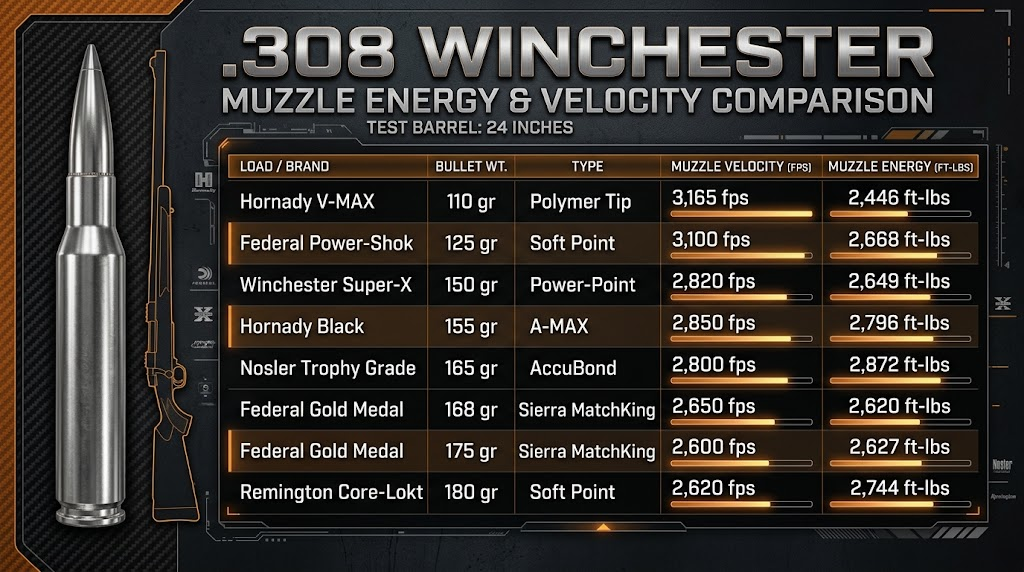
The following table displays representative .308 Winchester muzzle energy figures across common factory loads, measured in 24-inch test barrels.
| .308 Winchester Load | Bullet Weight | Bullet Type | Muzzle Velocity | Muzzle Energy | Test Barrel Length | Manufacturer |
| Hornady V-MAX | 110 grain | Polymer Tip | 3,165 fps | 2,446 ft-lbs | 24 inches | Hornady |
| Federal Power-Shok | 125 grain | Soft Point | 3,100 fps | 2,668 ft-lbs | 24 inches | Federal Premium |
| Winchester Super-X | 150 grain | Power-Point | 2,820 fps | 2,649 ft-lbs | 24 inches | Winchester |
| Hornady Black | 155 grain | A-MAX | 2,850 fps | 2,796 ft-lbs | 24 inches | Hornady |
| Nosler Trophy Grade | 165 grain | AccuBond | 2,800 fps | 2,872 ft-lbs | 24 inches | Nosler |
| Federal Gold Medal Match | 168 grain | Sierra MatchKing | 2,650 fps | 2,620 ft-lbs | 24 inches | Federal Premium |
| Federal Gold Medal Match | 175 grain | Sierra MatchKing | 2,600 fps | 2,627 ft-lbs | 24 inches | Federal Premium |
| Remington Core-Lokt | 180 grain | Soft Point | 2,620 fps | 2,744 ft-lbs | 24 inches | Remington |
308 Muzzle Energy: 2,446 to 2,872 foot-pounds – Actual muzzle energy varies by bullet weight, ammunition load, barrel length, and manufacturer.
What Is 308 Muzzle Energy?
Muzzle energy is the measurement of the kinetic energy a bullet possesses the instant it leaves the muzzle of a firearm. For the .308 Winchester, this energy determines the projectile’s potential to do work upon impact, which translates to terminal ballistics and stopping power.
Muzzle energy is calculated using the standard ballistic formula:
Muzzle Energy = (Bullet Weight × Velocity²) ÷ 450,240
In this formula:
- Bullet Weight is measured in grains.
- Velocity is measured in feet per second (fps).
- 450,240 is a constant derived from the acceleration of gravity and the conversion of grains to pounds.
- Muzzle Energy is expressed in foot-pounds (ft-lbs).
To convert foot-pounds to Joules, you multiply the foot-pounds by 1.3558. A .308 Winchester load producing 2,650 ft-lbs of energy yields approximately 3,593 Joules.
308 Muzzle Energy by Bullet Weight
Bullet weight directly impacts muzzle velocity, and the interplay between these two variables determines the final energy output. Because velocity is squared in the muzzle energy formula, a faster, slightly lighter bullet will often generate more energy than a heavier, slower bullet.
| Bullet Weight | Example Load | Muzzle Velocity | Muzzle Energy | Manufacturer | Notes |
| 110 grain | Hornady V-MAX | 3,165 fps | 2,446 ft-lbs | Hornady | High velocity, lower mass results in lower overall energy |
| 150 grain | Winchester Super-X | 2,820 fps | 2,649 ft-lbs | Winchester | Standard hunting weight balancing velocity and mass |
| 165 grain | Nosler Trophy Grade | 2,800 fps | 2,872 ft-lbs | Nosler | Highly efficient weight for maximizing muzzle energy |
| 180 grain | Remington Core-Lokt | 2,620 fps | 2,744 ft-lbs | Remington | Heavy mass, but lower velocity slightly reduces initial energy |
308 Muzzle Energy by Barrel Length
Barrel length significantly affects .308 Winchester velocity and muzzle energy. A longer barrel provides more time for the expanding propellant gases to push the bullet, increasing its velocity. Conversely, firing a .308 Winchester from a short-barreled rifle reduces the velocity, which exponentially decreases the muzzle energy.
| Barrel Length | Bullet Weight | Muzzle Velocity | Muzzle Energy | Ammunition |
| 24 inches | 168 grain | 2,650 fps | 2,620 ft-lbs | Federal Gold Medal Match |
| 20 inches | 168 grain | 2,550 fps | 2,425 ft-lbs | Federal Gold Medal Match (Approximate) |
| 16 inches | 168 grain | 2,450 fps | 2,239 ft-lbs | Federal Gold Medal Match (Approximate) |
Results will vary depending on the specific ammunition, firearm, chamber tolerances, and atmospheric testing conditions. There is no single fixed muzzle energy figure for a specific barrel length.
308 Muzzle Energy by Distance
As a .308 Winchester bullet travels downrange, aerodynamic drag slows it down. Because velocity decreases over distance, kinetic energy also decreases. The rate of this energy loss depends on the bullet’s ballistic coefficient.
The table below illustrates how .308 muzzle energy translates to downrange energy using the Federal Gold Medal Match 168-grain Sierra MatchKing load.
| Distance | Bullet Weight | Velocity | Remaining Energy | Load |
| Muzzle (0 yards) | 168 grain | 2,650 fps | 2,620 ft-lbs | Federal Gold Medal Match 168gr |
| 100 yards | 168 grain | 2,460 fps | 2,258 ft-lbs | Federal Gold Medal Match 168gr |
| 200 yards | 168 grain | 2,278 fps | 1,936 ft-lbs | Federal Gold Medal Match 168gr |
| 300 yards | 168 grain | 2,104 fps | 1,651 ft-lbs | Federal Gold Medal Match 168gr |
| 400 yards | 168 grain | 1,938 fps | 1,401 ft-lbs | Federal Gold Medal Match 168gr |
| 500 yards | 168 grain | 1,781 fps | 1,183 ft-lbs | Federal Gold Medal Match 168gr |
308 Muzzle Energy vs 30 06
The .308 Winchester was designed to replicate the ballistics of the heavier .30-06 Springfield in a shorter case. While their muzzle energy overlaps with lighter bullets, the .30-06 possesses more case capacity, allowing it to push heavier bullets faster.
| Specification | .308 Winchester | .30-06 Springfield |
| Common bullet weights | 110 to 180 grains | 150 to 220 grains |
| Typical muzzle velocity | 2,600 to 2,820 fps (150gr) | 2,800 to 3,000 fps (150gr) |
| Typical muzzle energy | 2,500 to 2,850 ft-lbs | 2,800 to 3,000 ft-lbs |
| Case length | 2.015 inches | 2.494 inches |
| Overall cartridge length | 2.800 inches | 3.340 inches |
| Typical applications | Short-action hunting, tactical, target | Long-action hunting, heavy game |
308 Muzzle Energy vs 223
The .308 Winchester produces more than double the muzzle energy of the .223 Remington. A standard .223 Remington 55-grain bullet leaves the muzzle at approximately 3,240 fps, generating around 1,282 foot-pounds of energy. In contrast, a .308 Winchester 150-grain bullet yields roughly 2,649 foot-pounds of energy. The .223 Remington is utilized for varmint hunting, target practice, and tactical use due to its mild recoil, whereas the .308 Winchester is preferred for medium to large game and long-range energy retention. The higher energy of the .308 results in substantially heavier recoil.
308 Muzzle Energy vs 300 Win Mag
While both cartridges fire a .308-caliber bullet, the .300 Winchester Magnum features a significantly larger casing that holds far more gunpowder. A representative 180-grain .308 Winchester load produces about 2,620 fps and 2,744 foot-pounds of muzzle energy. The same 180-grain bullet fired from a .300 Winchester Magnum travels at 2,960 fps, yielding roughly 3,501 foot-pounds of muzzle energy. The .300 Winchester Magnum carries more energy at 400 yards than the .308 Winchester does at 100 yards, making the Magnum vastly superior for extended long-range hunting.
308 Muzzle Energy vs Other Common Rifle Cartridges
The following table compares the .308 Winchester’s baseline ballistics against other popular rifle cartridges using common factory loads.
| Cartridge | Representative Load | Barrel Length | Muzzle Velocity | Muzzle Energy |
| .308 Winchester | Federal 150gr Fusion | 24 inches | 2,820 fps | 2,649 ft-lbs |
| .30-06 Springfield | Federal 150gr Fusion | 24 inches | 2,900 fps | 2,801 ft-lbs |
| .223 Remington | Federal 55gr FMJ | 24 inches | 3,240 fps | 1,282 ft-lbs |
| 6.5 Creedmoor | Hornady 143gr ELD-X | 24 inches | 2,700 fps | 2,315 ft-lbs |
| 7.62x51mm NATO | M80 Ball 149gr FMJ | 22 inches | 2,750 fps | 2,502 ft-lbs |
| .300 Winchester Magnum | Federal 180gr Power-Shok | 24 inches | 2,960 fps | 3,501 ft-lbs |
Highest 308 Muzzle Energy
Ammunition manufacturers occasionally engineer specialized loads with proprietary powder blends to maximize velocity and energy safely within standardized pressure limits.
| Load | Bullet Weight | Muzzle Velocity | Muzzle Energy | Manufacturer |
| Hornady Superformance SST | 150 grain | 3,000 fps | 2,998 ft-lbs | Hornady |
| Nosler Trophy Grade AccuBond | 165 grain | 2,800 fps | 2,872 ft-lbs | Nosler |
| Hornady Superformance CX | 165 grain | 2,770 fps | 2,811 ft-lbs | Hornady |
Highest Published 308 Muzzle Energy in This Comparison: Hornady Superformance SST 150 grain – This load achieves 2,998 foot-pounds of energy by utilizing specialized propellant blends to reach 3,000 feet per second.
308 Muzzle Energy and Recoil
Muzzle energy and recoil are related but distinct measurements. While muzzle energy quantifies the kinetic output of the bullet, recoil (specifically free recoil energy) measures the rearward physical force exerted onto the shooter.
A high-energy .308 load generally results in heavier recoil, but felt recoil is dictated by multiple factors beyond just muzzle energy:
- Bullet weight: Heavier bullets pushed at high velocities create more rearward thrust.
- Velocity: Faster bullets increase recoil force.
- Firearm weight: A heavy rifle absorbs more recoil energy, reducing the impact on the shooter’s shoulder.
- Powder charge: The mass and velocity of escaping expanding gases contribute to the total recoil.
- Stock design: The geometry of the rifle stock changes how recoil forces are transferred to the shooter.
- Firearm configuration: Muzzle brakes and suppressors significantly mitigate felt recoil despite high muzzle energy.
Factors That Affect 308 Muzzle Energy
Multiple environmental and mechanical variables dictate the true kinetic output of a .308 Winchester cartridge:
- Bullet weight: Affects the mass variable in the energy equation.
- Muzzle velocity: The most critical factor, as velocity is squared when calculating energy.
- Barrel length: Longer barrels typically increase velocity; shorter barrels reduce it.
- Ammunition load: Factory powder charges vary heavily between target loads, hunting rounds, and reduced-recoil options.
- Bullet construction: Bearing surface and bullet material can alter barrel friction and velocity.
- Powder characteristics: Burn rates and temperature stability change how effectively a bullet accelerates.
- Firearm design: Chamber dimensions, headspace, and rifling twist rates cause minor velocity variations.
- Temperature: Cold weather can slow powder burn rates, lowering velocity.
- Altitude: Does not affect muzzle energy natively, but thinner air at high altitude helps the bullet retain energy downrange.
- Chronograph methodology: Optical vs. radar chronographs may present slight variances in recorded velocity.
- Manufacturer testing conditions: Published 308 ballistics are usually gathered in strict laboratory conditions using tight-chambered 24-inch test barrels.
How Much Energy Does a 308 Have?
A standard .308 Winchester factory load produces between 2,500 and 2,800 foot-pounds of muzzle energy (roughly 3,389 to 3,796 Joules). There is no single universal .308 energy figure because the energy depends entirely on the weight of the bullet and the speed at which it leaves the barrel. A 165-grain hunting load designed for maximum velocity will generate close to 2,850 foot-pounds of energy, while a 168-grain match load engineered for moderate recoil and strict accuracy will output around 2,620 foot-pounds.
308 Muzzle Energy FAQs
What is the muzzle energy of a .308?
The muzzle energy of a .308 Winchester typically ranges from 2,500 to 2,800 foot-pounds, depending on the bullet weight, powder charge, and barrel length.
How much muzzle energy does a 308 have?
A standard .308 Winchester generates roughly 2,650 foot-pounds of energy at the muzzle when firing a 150-grain or 168-grain bullet from a 24-inch barrel.
What is the muzzle energy of a 150 grain 308?
A 150-grain .308 Winchester bullet usually produces between 2,600 and 2,700 foot-pounds of muzzle energy. A standard velocity of 2,820 fps yields 2,649 ft-lbs.
What is the muzzle energy of a 165 grain 308?
A 165-grain .308 Winchester bullet typically generates between 2,650 and 2,870 foot-pounds of muzzle energy, depending heavily on the specific load.
What is the muzzle energy of a 168 grain 308?
A 168-grain .308 Winchester match bullet fired at 2,650 fps produces 2,620 foot-pounds of muzzle energy.
What is the muzzle energy of a 175 grain 308?
A 175-grain .308 Winchester bullet traveling at 2,600 fps generates roughly 2,627 foot-pounds of muzzle energy.
What is the muzzle energy of a 180 grain 308?
A heavy 180-grain .308 Winchester load typically travels at 2,620 fps, producing about 2,744 foot-pounds of muzzle energy.
How much muzzle energy does a .308 have at 100 yards?
At 100 yards, a .308 Winchester retains roughly 2,200 to 2,350 foot-pounds of energy. A standard 168-grain match load retains approximately 2,258 foot-pounds at 100 yards.
Does barrel length affect .308 muzzle energy?
Yes. Shorter barrels produce less muzzle velocity, which mathematically results in less muzzle energy. A 16-inch barrel will generate less energy than a 24-inch barrel using the exact same ammunition.
Is .308 more powerful than .223?
Yes. The .308 Winchester produces roughly 2,600 foot-pounds of muzzle energy, which is more than double the 1,280 foot-pounds generated by a standard .223 Remington.
Is .308 more powerful than .30-06?
No. The .30-06 Springfield has a larger case capacity and pushes bullets faster, generating about 100 to 200 more foot-pounds of muzzle energy than the .308 Winchester with equivalent bullet weights.
Is .308 the same as 7.62 NATO?
They are nearly identical in dimension, but not exactly the same. The commercial .308 Winchester is generally loaded to slightly higher maximum pressures than the military 7.62x51mm NATO cartridge, resulting in marginally higher muzzle energy for the .308 Winchester.
How is .308 muzzle energy calculated?
It is calculated by multiplying the bullet weight in grains by the square of the muzzle velocity in feet per second, and then dividing that number by the constant 450,240.