When comparing .50 Action Express vs 9mm, the most obvious difference is the massive gap in physical size, terminal power, and intended application. While the 9mm is a compact, widely adopted cartridge designed for standard military use and civilian self-defense, the .50 Action Express is a massive magnum cartridge built primarily for hunting and novelty shooting in large handguns like the Desert Eagle. The .50 Action Express delivers over four times the muzzle energy of a standard 9mm load, but it comes at the cost of extreme recoil, low magazine capacity, and heavy firearm weight.
.50 Action Express vs 9mm: Main Difference
| Specification | .50 Action Express | 9mm |
| Cartridge designation | .50 Action Express | 9mm Luger |
| Other names | .50 AE, 12.7×33mm | 9×19mm Parabellum, 9mm NATO |
| Bullet diameter | 0.500 inches (12.7 mm) | 0.355 inches (9.01 mm) |
| Case length | 32.64 mm (1.285 in) | 19.15 mm (0.754 in) |
| Overall cartridge length | 40.89 mm (1.610 in) | 29.69 mm (1.169 in) |
| Typical bullet weights | 300 grain, 325 grain | 115 grain, 124 grain, 147 grain |
| Standard pressure | 36,000 PSI | 35,000 PSI |
| Maximum pressure / applicable specification | SAAMI | SAAMI (US) or CIP (Europe) |
| Typical muzzle velocity | 1,400 to 1,500 fps (300gr) | 1,120 to 1,200 fps (115gr) |
| Typical muzzle energy | 1,400 to 1,600 ft-lbs | 320 to 360 ft-lbs |
| Common bullet types | JHP, Soft Point, FMJ | FMJ, JHP |
| Military standard | No | Yes (NATO standardized) |
| Common firearms | Magnum Research Desert Eagle | Glock 19, Sig P320, S&W M&P |
| Typical use | Handgun hunting, novelty | Self-defense, duty carry, target |
| Compatibility | .50 AE firearms only | 9mm firearms only |
| Availability | Specialty retail, limited | Universally available globally |
Winner: 9mm – It is infinitely more practical for daily use, offering high magazine capacity, manageable recoil, and drastically lower ammunition costs for the average shooter.
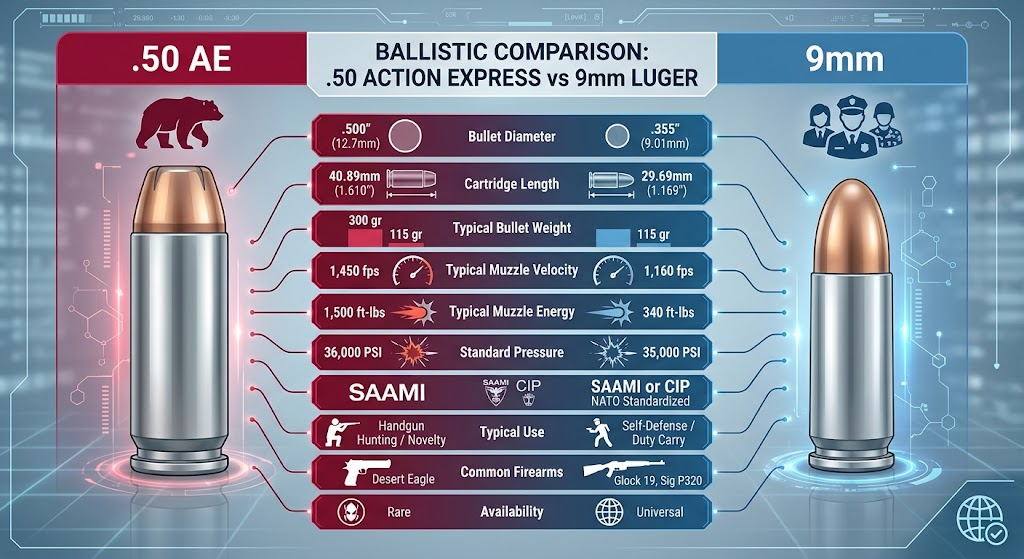
What Is .50 Action Express?
The .50 Action Express (.50 AE) was designed in 1988 by Evan Whildin of Action Arms. It is a massive magnum handgun cartridge developed specifically for the Magnum Research Desert Eagle semi-automatic pistol. Dimensionally, the cartridge features a 32.64mm case and fires a half-inch diameter (0.500 in) bullet. One of its unique design elements is a rebated rim, meaning the rim is turned down to the same diameter as a .44 Magnum. This allows Desert Eagle owners to switch between .44 Magnum and .50 AE simply by swapping the barrel and magazine, without changing the slide or bolt.
Operating at a standard pressure of 36,000 PSI, the .50 Action Express pushes a heavy 300-grain bullet at velocities approaching 1,500 feet per second. This results in incredible muzzle energy, often exceeding 1,500 foot-pounds, making it a viable commercial option for handgun hunting against medium to large game.
What Is 9mm?
The 9mm, fully designated as the 9mm Luger or 9×19mm Parabellum, was designed by Georg Luger in 1901. It has since become the most popular and widely produced handgun cartridge in the world. It features a 19.15mm case and a 0.355-inch diameter bullet. Available in a wide variety of bullet weights, 115-grain and 124-grain loads are the most common commercial offerings.
Under the Sporting Arms and Ammunition Manufacturers’ Institute (SAAMI) guidelines, standard 9mm Luger pressure is set at a maximum average of 35,000 PSI. This standard pressure produces a typical velocity of around 1,150 fps, generating roughly 335 foot-pounds of muzzle energy. Its moderate recoil and compact size make it the standard choice for military organizations, law enforcement, and civilian self-defense.
.50 Action Express vs 9mm Pressure
When comparing .50 Action Express vs 9mm pressure, the numbers are surprisingly close despite the massive difference in the size of the cartridges. Both are tested and standardized by SAAMI in the United States.
| Specification | .50 Action Express | 9mm |
| Pressure standard | SAAMI | SAAMI |
| Published pressure specification | Maximum Average Pressure (MAP) | Maximum Average Pressure (MAP) |
| Pressure in PSI | 36,000 PSI | 35,000 PSI |
| Pressure in bar or MPa | 2,482 bar / 248.2 MPa | 2,413 bar / 241.3 MPa |
The reason the .50 AE produces so much more power is not due to vastly higher chamber pressure, but rather its enormous case capacity and larger bore diameter, where a larger volume of expanding gas can push against the massive base of the .50 caliber bullet.
.50 Action Express vs 9mm Velocity
The velocity and muzzle energy of both cartridges depend heavily on bullet weight and test barrel length. Below is a comparison of representative published ammunition loads.
| Cartridge | Bullet Weight | Muzzle Velocity | Test Barrel Length | Muzzle Energy |
| Hornady Custom .50 AE XTP | 300 Grain | 1,475 fps | 6 inches | 1,449 ft-lbs |
| Federal Fusion .50 AE Soft Point | 300 Grain | 1,500 fps | 6 inches | 1,500 ft-lbs |
| Winchester 9mm Luger FMJ | 115 Grain | 1,190 fps | 4 inches | 362 ft-lbs |
| Federal Premium 9mm HST JHP | 124 Grain | 1,150 fps | 4 inches | 364 ft-lbs |
The .50 Action Express yields dramatically higher muzzle energy because it pushes a bullet nearly three times heavier than a standard 9mm projectile at significantly faster velocities.
.50 Action Express vs 9mm Dimensions
The physical dimensions of the two cartridges illustrate exactly where they diverge in scale and intended function.
- Bullet diameter: 0.500 in (12.7 mm) for .50 AE vs 0.355 in (9.01 mm) for 9mm.
- Case length: 32.64 mm for .50 AE vs 19.15 mm for 9mm.
- Overall cartridge length: 40.89 mm for .50 AE vs 29.69 mm for 9mm.
- Case dimensions: The .50 AE uses a massive straight-walled case (0.543 in base), while the 9mm uses a slightly tapered case (0.391 in base).
- Rim dimensions: The .50 AE features a rebated rim measuring 0.440 in. The 9mm features a standard rimless design measuring 0.392 in.
The size difference is so extreme that a standard 9mm cartridge can easily drop entirely inside an empty .50 Action Express casing.
.50 Action Express vs 9mm Bullet Weight
Bullet weight dictates how a cartridge behaves in flight and upon impact, affecting velocity, muzzle energy, and trajectory.
The .50 Action Express relies on brute force and massive weight. The most common commercial bullet weight is 300 grains, with 325-grain options available for deep penetration on heavy game. The 9mm relies on lighter, faster bullets ranging from 115 grains to 147 grains.
| Ammunition Type | Typical Bullet Weight | Impact on Ballistics |
| Hornady Custom .50 AE | 300 Grain | Extreme terminal energy, heavy recoil, deep penetration |
| Magnum Research .50 AE | 300 Grain | High velocity magnum performance for handgun hunting |
| Standard 9mm Luger | 115 Grain | High velocity, flat trajectory, low recoil |
| Subsonic 9mm Luger | 147 Grain | Lower velocity, deeper penetration, ideal for suppressors |
.50 Action Express vs 9mm Compatibility
Can .50 Action Express and 9mm ammunition be used interchangeably? Absolutely not.
The two cartridges are entirely different in every physical dimension. A .50 AE cartridge is far too long and wide to fit into a 9mm chamber, and a 9mm cartridge would simply fall through the barrel of a .50 AE firearm. You must strictly follow the firearm manufacturer’s specifications and only load the specific ammunition designation stamped on the barrel of your gun.
.50 Action Express vs 9mm Ballistics
When analyzing ballistics between the two, the .50 Action Express overpowers the 9mm in almost every metric except recoil management and follow-up shot speed.
- Muzzle velocity: The .50 AE pushes 300 grains at roughly 1,500 fps. Standard 9mm pushes 115 grains at roughly 1,150 fps.
- Muzzle energy: The .50 AE generates around 1,500 ft-lbs of energy. The 9mm produces around 350 ft-lbs.
- Trajectory: The .50 AE maintains a relatively flat trajectory out to 50 yards for hunting applications, whereas the 9mm is generally optimized for defensive engagements inside 25 yards.
- Recoil: The recoil of the .50 Action Express is violent and requires a very heavy firearm to safely manage. The 9mm produces a mild, highly controllable recoil impulse suitable for all shooters.
.50 Action Express vs 9mm for Military Use
The 9mm is the official standardized handgun cartridge for NATO and is utilized by militaries globally due to its balance of capacity, low recoil, and acceptable terminal ballistics.
The .50 Action Express has absolutely no military application. The ammunition is far too heavy for soldiers to carry in quantity, the recoil prevents accurate rapid fire, and the massive cartridge size severely limits pistol magazine capacity (usually to just 7 rounds).
.50 Action Express vs 9mm for Civilian Use
For civilian use, standard 9mm Luger is the most popular choice for concealed carry, home defense, and recreational target shooting.
Civilians typically purchase the .50 Action Express for specialized handgun hunting (such as feral hogs or whitetail deer) or as a recreational novelty. Firing a .50-caliber Desert Eagle is an exciting range experience, but the firearm’s heavy weight and the cartridge’s over-penetration risks make it a poor choice for everyday concealed carry or urban home defense.
.50 Action Express vs 9mm Pros and Cons
.50 Action Express Pros and Cons
Pros:
- Produces devastating muzzle energy suitable for handgun hunting.
- Large caliber creates a massive permanent wound channel.
- The rebated rim allows easy caliber conversions in the Desert Eagle platform.
Cons:
- Extreme recoil makes accurate follow-up shots difficult.
- Ammunition is highly expensive and difficult to find in local stores.
- Firearms chambered for it are incredibly heavy and bulky.
9mm Pros and Cons
Pros:
- Universal compatibility and massive global availability.
- Low recoil allows for fast, accurate shooting.
- Small cartridge size allows for high magazine capacities (15 to 17 rounds in standard handguns).
- Ammunition is highly affordable for regular training.
Cons:
- Produces significantly less terminal energy than magnum hunting calibers.
- Not suitable for hunting medium to large game.
.50 Action Express vs 9mm Cost
When evaluating price, the 9mm is a standard bulk commodity, while the .50 Action Express is a low-production specialty magnum round.
| Ammunition | Bullet Weight | Quantity | Price | Cost Per Round |
| Blazer Brass 9mm FMJ | 115 Grain | 50 Rounds | $14.99 | $0.30 |
| Federal Premium 9mm HST | 124 Grain | 20 Rounds | $25.99 | $1.30 |
| Hornady Custom .50 AE XTP | 300 Grain | 20 Rounds | $55.00 | $2.75 |
| Magnum Research .50 AE JHP | 300 Grain | 20 Rounds | $49.99 | $2.50 |
Note: Ammunition prices fluctuate based on market conditions, bulk purchasing, and shipping costs.
.50 Action Express vs 9mm FAQs
What is the main difference between .50 Action Express and 9mm?
The main difference is their physical size and power. The .50 Action Express is a massive magnum cartridge built for handgun hunting and novelty shooting, while the 9mm is a compact cartridge designed for military duty and civilian self-defense.
Is .50 Action Express the same as 9mm?
No. They are entirely different in caliber, case length, overall size, and intended application.
Is .50 Action Express more powerful than 9mm?
Yes. The .50 Action Express delivers roughly 1,500 ft-lbs of muzzle energy, which is over four times the energy of a standard 9mm round (typically 350 ft-lbs).
Is .50 Action Express higher pressure?
Technically yes, but only slightly. Standard .50 Action Express pressure is 36,000 PSI, which is very close to the standard 35,000 PSI of the 9mm Luger. The power difference comes from the larger case capacity, not extreme pressure.
Can you shoot .50 Action Express in a 9mm pistol?
No. A .50 caliber bullet physically cannot fit into a 9mm chamber or barrel.
Can you shoot 9mm in a .50 Action Express firearm?
No. The 9mm cartridge is far too small and will not chamber, feed, or fire safely in a .50 AE firearm.
What bullet weight does .50 Action Express use?
The most common commercial bullet weight for the .50 Action Express is 300 grains.
What is the velocity of .50 Action Express?
Typical muzzle velocity for a 300-grain .50 Action Express bullet out of a 6-inch barrel is between 1,400 and 1,500 feet per second.
Which has more muzzle energy, .50 Action Express or 9mm?
The .50 Action Express produces dramatically more muzzle energy than the 9mm due to its massive 300-grain bullet and large powder charge.
Why is .50 Action Express called Action Express?
The cartridge gets its name from Action Arms, the company where its designer, Evan Whildin, worked when he developed the round in 1988 for the Magnum Research Desert Eagle platform.