9mm muzzle energy measures the kinetic energy a bullet possesses as it exits the barrel of a firearm, quantified in foot-pounds or joules. This metric is determined by combining the mass of the bullet and its velocity upon departure. The resulting 9mm energy varies significantly depending on the specific cartridge dimensions, bullet weight, powder charge, ammunition load, and barrel length used during testing.
9mm Muzzle Energy
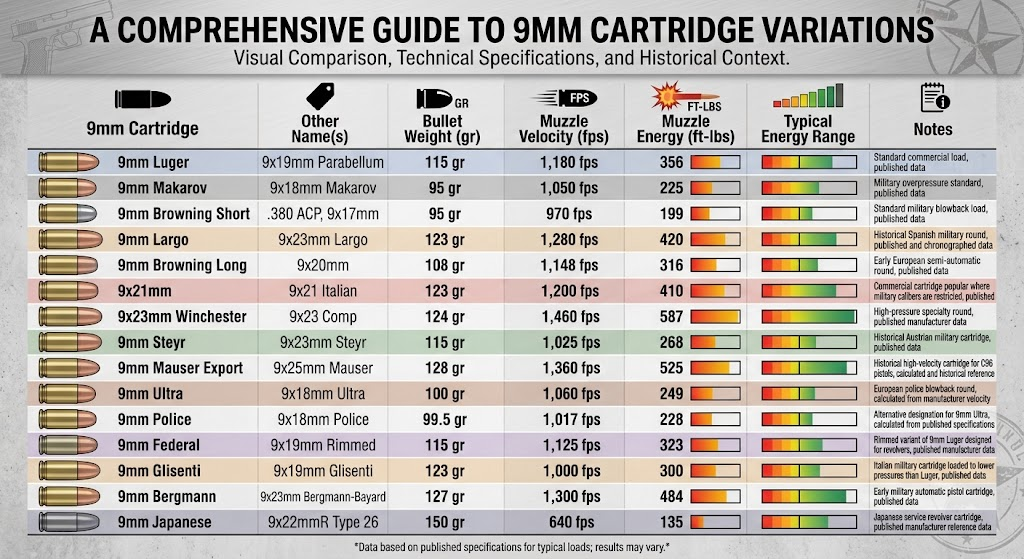
| 9mm Cartridge | Other Name(s) | Bullet Weight | Muzzle Velocity | Muzzle Energy | Typical Energy Range | Notes |
| 9mm Luger | 9x19mm Parabellum | 115 gr | 1,180 fps | 356 ft-lbs | 320 to 400 ft-lbs | Standard commercial load, published data |
| 9mm NATO | 9x19mm NATO | 124 gr | 1,200 fps | 396 ft-lbs | 380 to 410 ft-lbs | Military overpressure standard, published data |
| 9mm Makarov | 9x18mm Makarov | 95 gr | 1,050 fps | 225 ft-lbs | 200 to 240 ft-lbs | Standard military blowback load, published data |
| 9mm Browning Short | .380 ACP, 9x17mm | 95 gr | 970 fps | 199 ft-lbs | 180 to 210 ft-lbs | Compact pocket pistol cartridge, published data |
| 9mm Largo | 9x23mm Largo | 123 gr | 1,280 fps | 420 ft-lbs | 350 to 430 ft-lbs | Historical Spanish military round, published and chronographed data |
| 9mm Browning Long | 9x20mm | 108 gr | 1,148 fps | 316 ft-lbs | 290 to 320 ft-lbs | Early European semi-automatic round, published data |
| 9x21mm | 9×21 Italian | 123 gr | 1,200 fps | 410 ft-lbs | 380 to 430 ft-lbs | Commercial cartridge popular where military calibers are restricted, published data |
| 9x23mm Winchester | 9×23 Comp | 124 gr | 1,460 fps | 587 ft-lbs | 550 to 710 ft-lbs | High-pressure specialty round, published manufacturer data |
| 9mm Steyr | 9x23mm Steyr | 115 gr | 1,025 fps | 268 ft-lbs | 250 to 280 ft-lbs | Historical Austrian military cartridge, published data |
| 9mm Mauser Export | 9x25mm Mauser | 128 gr | 1,360 fps | 525 ft-lbs | 500 to 540 ft-lbs | Historical high-velocity cartridge for C96 pistols, calculated and historical reference data |
| 9mm Ultra | 9x18mm Ultra | 100 gr | 1,060 fps | 249 ft-lbs | 230 to 260 ft-lbs | European police blowback round, calculated from manufacturer velocity |
| 9mm Police | 9x18mm Police | 99.5 gr | 1,017 fps | 228 ft-lbs | 210 to 240 ft-lbs | Alternative designation for 9mm Ultra, calculated from published specifications |
| 9mm Federal | 9x19mm Rimmed | 115 gr | 1,125 fps | 323 ft-lbs | 310 to 340 ft-lbs | Rimmed variant of 9mm Luger designed for revolvers, published manufacturer data |
| 9mm Glisenti | 9x19mm Glisenti | 123 gr | 1,000 fps | 300 ft-lbs | 280 to 310 ft-lbs | Italian military cartridge loaded to lower pressures than Luger, published data |
| 9mm Bergmann | 9x23mm Bergmann-Bayard | 127 gr | 1,300 fps | 484 ft-lbs | 450 to 500 ft-lbs | Early military automatic pistol cartridge, published data |
| 9mm Japanese | 9x22mmR Type 26 | 150 gr | 640 fps | 135 ft-lbs | 120 to 150 ft-lbs | Japanese service revolver cartridge, published manufacturer reference data |
Highest 9mm Muzzle Energy: 9x23mm Winchester – This specialized high-pressure cartridge generates up to 587 foot-pounds of energy or higher depending on the specific load, significantly exceeding standard pistol calibers due to its robust case design and high velocity.
What Is 9mm Muzzle Energy?
Muzzle energy represents the amount of kinetic energy a projectile carries at the exact moment it leaves the muzzle of a firearm. In ballistics, it is calculated using the bullet weight and muzzle velocity through a standard physics formula where energy equals mass multiplied by velocity squared, divided by a constant to convert units into foot-pounds. Two distinct ammunition loads utilizing the exact same 9mm cartridge designation can yield very different muzzle energy figures due to variations in propellant weight, burn rate, primer type, and bullet construction.
9mm Muzzle Energy by Bullet Weight
Bullet weight plays a direct role in determining total 9mm bullet energy. Heavier projectiles generally travel at lower velocities, whereas lighter projectiles achieve higher speeds. Depending on how velocity offsets mass, total kinetic energy shifts across different loads.
| Bullet Weight | Typical Muzzle Velocity | Representative Muzzle Energy | Notes |
| 90 grain | 1,350 to 1,500 fps | 364 to 450 ft-lbs | Ultra-light monolithic or specialized defensive loads |
| 115 grain | 1,125 to 1,180 fps | 323 to 356 ft-lbs | Standard target and practice load velocity |
| 124 grain | 1,150 to 1,200 fps | 364 to 396 ft-lbs | Standard military and defensive load standard |
| 135 grain | 1,050 to 1,100 fps | 331 to 362 ft-lbs | Mid-weight defensive and subsonic option |
| 147 grain | 980 to 1,000 fps | 310 to 326 ft-lbs | Heavy subsonic load favored for suppressed use |
9mm Muzzle Energy by Cartridge
Not all cartridges bearing the 9mm moniker share the same performance profile. The term 9mm most frequently refers to the 9mm Luger, but historical and regional variants differ greatly in case dimensions and pressure limits. Cartridges like the 9mm Makarov or 9mm Browning Short operate at lower pressures suitable for blowback pistols, resulting in lower 9mm kinetic energy. Conversely, high-pressure cartridges like the 9x23mm Winchester or 9mm Largo operate at elevated pressures designed for locked-breech firearms, yielding substantially higher energy outputs. Different 9mm cartridges are dimensionally unique and strictly non-interchangeable. Attempting to chamber an incorrect cartridge can cause catastrophic firearm failure.
9mm Muzzle Energy vs Velocity
Velocity has an exponential effect on kinetic energy because velocity is squared in the energy equation. While doubling the bullet weight doubles the muzzle energy, doubling the velocity quadruples the muzzle energy. This mathematical relationship explains why a relatively small increase in velocity produced by a hot load or a lighter bullet can generate a meaningful increase in overall 9mm ballistics performance.
9mm Muzzle Energy by Barrel Length
Barrel length directly influences muzzle velocity, which subsequently dictates muzzle energy. As expanding propellant gases push a bullet down the bore, the projectile accelerates. Longer barrels allow more complete powder burn and longer acceleration time, resulting in higher velocities. Shorter barrels found in subcompact concealed carry handguns produce lower velocities and reduced muzzle energy. This effect varies considerably depending on the specific ammunition powder burn rate, firearm action, and barrel rifling design. Consequently, muzzle energy is not a fixed universal figure across every barrel length.
9mm Muzzle Energy vs Other Common Calibers
Handgun calibers differ widely in their baseline ballistics, balancing bullet diameter, mass, and velocity.
| Caliber | Representative Bullet Weight | Muzzle Velocity | Typical Muzzle Energy | Notes |
| .380 ACP | 95 grain | 970 fps | 199 ft-lbs | Compact blowback defense caliber |
| 9mm Luger | 124 grain | 1,150 fps | 364 ft-lbs | Standard service and defense round |
| .38 Special | 158 grain | 855 fps | 256 ft-lbs | Traditional revolver cartridge |
| .40 S&W | 180 grain | 990 fps | 392 ft-lbs | Medium-bore law enforcement caliber |
| .45 ACP | 230 grain | 850 fps | 368 ft-lbs | Heavy slow-moving service cartridge |
| 10mm Auto | 180 grain | 1,200 fps | 575 ft-lbs | High-velocity heavy semi-automatic caliber |
Factors That Affect 9mm Muzzle Energy
Multiple physical and environmental variables influence the final energy reading of a cartridge:
- Bullet weight: Heavier or lighter projectiles alter mass variables in kinetic calculations.
- Muzzle velocity: Speed at exit dictates energy output exponentially.
- Ammunition load: Standard pressure, plus-P, and specialty loads change powder dynamics.
- Powder charge: The quantity and burn rate of propellant generate the expanding gases driving the bullet.
- Barrel length: Longer bores provide extended acceleration time for expanding gases.
- Firearm type: Revolver cylinder gaps or semi-automatic action mechanics can cause minor velocity variations.
- Ammunition manufacturer: Different factories load propellant to varying pressure specifications.
- Bullet construction: Full metal jacket, hollow point, and solid copper monolithic designs affect friction and weight retention.
- Temperature and testing conditions: Ambient temperature can alter powder burn rates and recorded velocities.
- Chronograph and test methodology: Equipment calibration, light sensors, and distance from the muzzle affect recorded velocity data.
9mm Muzzle Energy FAQs
What is the muzzle energy of a 9mm?
Standard 9mm Luger ammunition typically produces between 320 and 400 foot-pounds of muzzle energy depending on the specific load and bullet weight.
How much muzzle energy does a 9mm Luger have?
A standard 124-grain 9mm Luger load produces approximately 364 foot-pounds of muzzle energy.
What is the muzzle energy of a 115 grain 9mm?
A standard 115-grain 9mm load typically generates between 320 and 356 foot-pounds of muzzle energy.
What is the muzzle energy of a 124 grain 9mm?
A standard 124-grain 9mm load generally produces between 364 and 396 foot-pounds of muzzle energy.
What is the muzzle energy of a 147 grain 9mm?
A standard 147-grain 9mm load usually yields between 310 and 326 foot-pounds of muzzle energy.
Is 9mm muzzle energy the same for every load?
No, muzzle energy varies widely based on bullet weight, powder composition, manufacturer specifications, and pressure ratings such as standard pressure versus plus-P loads.
Does barrel length affect 9mm muzzle energy?
Yes, shorter barrels reduce acceleration time and lower muzzle velocity, resulting in decreased muzzle energy compared to longer test barrels.
Which 9mm cartridge has the highest muzzle energy?
Specialized high-pressure cartridges like the 9x23mm Winchester achieve the highest muzzle energy figures among 9mm-bore rounds, frequently exceeding 550 to 700 foot-pounds.
How does 9mm muzzle energy compare with .45 ACP?
Standard 9mm and standard .45 ACP loads produce very comparable muzzle energy figures, usually ranging between 350 and 400 foot-pounds, though they achieve this through different combinations of bullet weight and velocity.
How does 9mm muzzle energy compare with .40 S&W?
Standard .40 S&W loads often produce slightly higher average muzzle energy than standard pressure 9mm loads, typically ranging from 380 to 420 foot-pounds.
How is 9mm muzzle energy calculated?
Muzzle energy is calculated by multiplying the bullet weight in grains by the square of the muzzle velocity in feet per second, then dividing the result by a constant of 450,240 to yield foot-pounds.