The best .223 Remington twist rate for most shooters is 1:8, as it offers the greatest versatility for a wide range of ammunition.
While the ideal twist depends on a projectile’s weight, length, and velocity, the 1:8 easily stabilizes everything from 50-grain target loads to heavy 77-grain match bullets.
Slower twist rates like 1:12 are precision-tailored for lightweight 40-grain to 55-grain varmint projectiles but will cause heavier bullets to tumble.
The traditional 1:9 twist rate excels with standard 55-grain and 62-grain ammunition, though it typically struggles with projectiles 75 grains or heavier.
Conversely, a fast 1:7 twist rate is explicitly required to effectively stabilize long, heavy 75-grain and 77-grain projectiles for maximum downrange accuracy.
Table of Contents [Click to open]
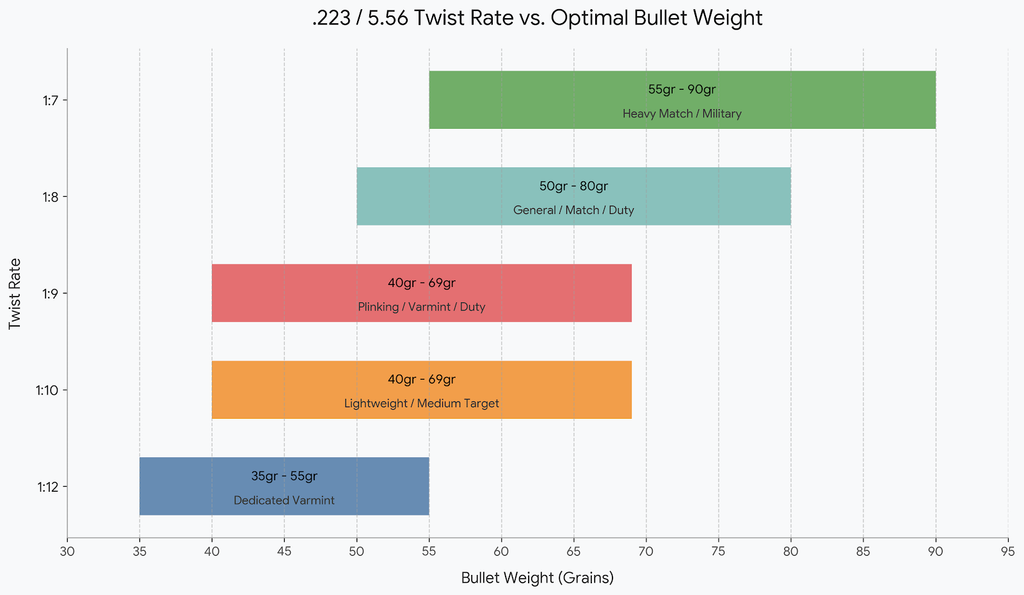
223 Twist Rate Chart
| Twist Rate | Common Bullet Weights | Typical Bullet Use | Stability/Compatibility |
| 1:7 | 55gr to 90gr | Heavy Match / Military | Best for long, heavy bullets (77gr+); can over-spin very light, thin-jacketed varmint bullets. |
| 1:8 | 50gr to 80gr | General / Match / Duty | Most versatile AR-15 twist; effectively stabilizes both standard 55gr and heavy 77gr bullets. |
| 1:9 | 40gr to 69gr | Plinking / Varmint / Duty | Excellent for 55gr and 62gr standard loads; struggles to stabilize bullets 75gr and heavier. |
| 1:10 | 40gr to 69gr | Lightweight / Medium Target | Common in bolt-action rifles; great for lightweight varmint to medium target loads. |
| 1:12 | 35gr to 55gr | Dedicated Varmint | Ideal for short, light bullets; will generally not stabilize 62gr or heavier projectiles. |
Understanding the 223 Twist Rate Chart
Rifling twist rate refers to the distance it takes for the rifling inside the barrel to complete one full 360-degree rotation. Here is what the numbers mean:
- 1:7 Twist: One complete rifling rotation in 7 inches of barrel length.
- 1:8 Twist: One complete rifling rotation in 8 inches of barrel length.
- 1:9 Twist: One complete rifling rotation in 9 inches of barrel length.
- 1:10 Twist: One complete rifling rotation in 10 inches of barrel length.
- 1:12 Twist: One complete rifling rotation in 12 inches of barrel length.
Why faster twists are expressed with smaller numbers:
Because the bullet completes its full rotation in a shorter distance (e.g., 7 inches versus 12 inches), the rifling is cut at a steeper angle. This steeper angle forces the bullet to spin faster, generating a higher Revolutions Per Minute (RPM) as it exits the muzzle.
How twist rate affects bullet stability:
Bullets require gyroscopic stability to fly straight and resist tumbling end-over-end. A heavier, longer bullet requires a faster spin (smaller twist rate number) to remain stable in flight. Conversely, a short, lightweight bullet requires less spin. Over-spinning a highly fragile, lightweight bullet in a fast twist rate can cause the thin copper jacket to disintegrate mid-air from centrifugal force.
Bullet Weight Comparison
| Bullet Weight | Recommended Twist | 1:7 | 1:8 | 1:9 | 1:12 |
| 40 grain | 1:12 or 1:9 | Marginal | Good | Excellent | Excellent |
| 50 grain | 1:9 or 1:12 | Good | Excellent | Excellent | Excellent |
| 55 grain | 1:9 (or 1:8) | Excellent | Excellent | Excellent | Excellent |
| 60 grain | 1:9 or 1:8 | Excellent | Excellent | Excellent | Marginal |
| 62 grain | 1:8 or 1:9 | Excellent | Excellent | Excellent | Unstable |
| 69 grain | 1:8 or 1:9 | Excellent | Excellent | Excellent | Unstable |
| 75 grain | 1:7 or 1:8 | Excellent | Excellent | Marginal | Unstable |
| 77 grain | 1:7 or 1:8 | Excellent | Excellent | Unstable | Unstable |
| 80 grain | 1:7 | Excellent | Marginal | Unstable | Unstable |
What Is The Best Twist Rate For 223?
There is no single “best” twist rate for 223; the ideal choice depends entirely on the ammunition you intend to shoot. A 1:8 twist is widely considered the most versatile “Goldilocks” twist rate for modern shooters, as it successfully stabilizes the vast majority of commercial ammunition ranging from 50 grains up to 77 grains. However, specialized shooting disciplines may require a different twist rate.
223 1:7 Twist Rate
The 1:7 twist is the military standard for the M4 and M16 platforms. It was primarily adopted to stabilize the exceptionally long M856 tracer round and the steel-core 62-grain M855 penetrator. This twist rate is aggressive and best suited for long, heavy projectiles in the 69-grain to 80-grain range. While it can shoot standard 55-grain ammunition beautifully, it can over-spin 40-grain varmint bullets to the point of mid-air disintegration.
223 1:8 Twist Rate
The 223 twist rate 1:8 is the modern sweet spot for civilian AR-15s and precision bolt-action rifles. It generates enough RPM to perfectly stabilize heavy match bullets like the 77-grain Sierra MatchKing (SMK), but is relaxed enough to shoot 50-grain and 55-grain target loads without over-spinning them. If you want a do-it-all rifle, 1:8 is the premium choice.
223 1:9 Twist Rate
For decades, the 1:9 twist was the standard civilian AR-15 twist rate. The 223 twist rate 1:9 excels with 55-grain FMJ and 62-grain loads, which make up 90% of bulk ammunition on the market. It is an excellent twist rate for general plinking and predator hunting. Its main limitation is that it generally fails to reliably stabilize match-grade bullets weighing 75 grains or more.
223 1:12 Twist Rate
The 223 twist rate 1:12 is a classic, historically used in the original M16 and highly popular in dedicated bolt-action varmint rifles. This slow twist rate is precision-tailored for short, lightweight bullets in the 35-grain to 55-grain range. It allows these lightweight bullets to achieve maximum velocity without the risk of over-spinning, but it will cause anything heavier than 60 grains to tumble (keyhole) onto the target.
223 Twist Rate For 55 Grain Bullets
The 223 twist rate for 55 grain bullets is incredibly forgiving. A 1:9 twist is traditionally considered the most perfectly optimized rate for 55-grain FMJ, ensuring excellent stability without excess RPM. However, 55-grain bullets will shoot exceptionally well out of a 1:8, 1:7, or 1:12 barrel.
223 Twist Rate For 62 Grain Bullets
The best 223 twist rate for 62 grain ammunition is typically a 1:9 or a 1:8. It is important to note that military 62-grain M855 (Green Tip) has a steel penetrator, making the bullet physically longer than a standard 62-grain lead-core bullet. A 1:9 twist stabilizes it easily, while military rifles use a 1:7 to ensure absolute stability in all arctic weather conditions.
223 Twist Rate For 69 Grain Bullets
The ideal 223 twist rate for 69 grain match bullets (such as the 69gr Sierra MatchKing) is a 1:8 or 1:9. The 69-grain projectile is essentially the maximum weight threshold that a standard 1:9 barrel can consistently stabilize. A 1:8 barrel will handle it effortlessly and is highly recommended for 69-grain match shooting.
223 Twist Rate For 75 Grain Bullets
The recommended 223 twist rate for 75 grain bullets is 1:8 or 1:7. Depending on the bullet’s aerodynamic profile (such as polymer-tipped bullets which are exceptionally long), a 1:9 barrel will likely struggle to stabilize a 75-grain bullet, leading to tumbling and drastic accuracy loss.
223 Twist Rate For 77 Grain Bullets
The preferred 223 twist rate for 77 grain ammunition, such as the renowned Mk262 military match load, is definitively 1:7 or 1:8. These projectiles are long and heavy, demanding the fast rotational speeds of a 1:7 or 1:8 barrel to maintain gyroscopic stability at long distances. A 1:9 or 1:12 barrel will fail to stabilize a 77-grain bullet.
223 Twist Rate And Bullet Stability
While shooters heavily rely on the 223 twist rate by bullet weight, bullet length matters more than bullet weight.
Twist rate requirements are dictated by the projectile’s length-to-diameter ratio. A solid copper bullet (like a Barnes TSX) is less dense than lead. Therefore, a 62-grain copper bullet must be physically longer than a 62-grain lead bullet to achieve the same weight. Because it is longer, the 62-grain copper bullet may require a faster twist rate (like 1:8) compared to a standard 62-grain lead bullet that stabilizes fine in a 1:9.
Bullet design features, such as boat tails, polymer tips, and jacket construction, all push the aerodynamic center of pressure forward, requiring a faster spin to keep the heavy base from overtaking the tip in flight.
223 vs 5.56 Twist Rates
The .223 Remington and 5.56x45mm NATO have identical external dimensions, but their twist rates often differ based on the rifle’s intended use. Bolt-action rifles chambered strictly in .223 Remington often feature 1:12 or 1:9 twists, prioritizing lightweight varmint hunting. Conversely, modern 5.56 NATO AR-15 barrels typically feature 1:7 or 1:8 twists to match the military requirements for heavy, long-range combat projectiles. Twist rate is a barrel specification, not a cartridge specification.
Barrel Length and Twist Rate
Barrel length does not change your twist rate; a 1:8 twist is 1:8 whether the barrel is 10 inches or 20 inches. However, barrel length determines muzzle velocity. A bullet fired from a 20-inch barrel travels much faster than one fired from a 10-inch barrel, resulting in a higher RPM upon exiting the muzzle. Therefore, ultra-short barrels sometimes benefit from a slightly faster twist rate (like 1:7) to compensate for the lost velocity and ensure adequate rotational speed for stability.
Stability Testing
Bullet manufacturers and ballisticians evaluate stability using formulas like the Miller Twist Rule. This yields a Gyroscopic Stability Factor (SG).
- SG > 1.5: Fully stable; optimal ballistic coefficient.
- SG 1.0 to 1.5: Marginally stable; bullet flies forward but loses aerodynamic efficiency.
- SG < 1.0: Unstable; the bullet will tumble.
Environmental factors also play a role: dense, cold air at sea level requires a faster twist rate to stabilize a bullet than thin, warm air at high altitudes.
Best Twist Rate By Use
| Use Case | Recommended Twist Rate | Suitable Bullet Weights |
| General 223 Shooting | 1:8 | 55gr to 77gr |
| 55 Grain | 1:9 | 40gr to 69gr |
| 62 Grain | 1:8 or 1:9 | 50gr to 77gr |
| Match Shooting | 1:7 or 1:8 | 69gr to 80gr+ |
| 69 Grain | 1:8 | 55gr to 77gr |
| 75/77 Grain | 1:7 | 62gr to 90gr |
| Varmint Loads | 1:12 | 35gr to 55gr |
| Lightweight Bullets | 1:12 or 1:10 | 35gr to 60gr |
Pros And Cons
Fast Twist Rates (1:7, 1:8)
Pros:
- Stabilizes heavy, high-ballistic-coefficient match bullets (70gr – 80gr+).
- Required for long, solid-copper hunting rounds.
- Excellent performance at long distances.
Cons:
- Can over-spin and disintegrate ultra-light (35gr-40gr) thin-jacketed varmint bullets.
- Slightly higher barrel friction and bore wear over time.
Slow Twist Rates (1:9, 1:12)
Pros:
- Perfectly optimizes lightweight, high-velocity varmint ammunition.
- Prevents thin bullet jackets from separating mid-air.
- Highly accurate for standard 55-grain commercial loads.
Cons:
- Incapable of stabilizing heavy (75gr+) match and defensive ammunition.
- Limits the rifle’s long-range capabilities due to lighter bullet requirements.
223 Twist Rate Chart: Which Twist Rate Is Best?
When referencing a .223 twist rate chart, the 1:8 twist is the best and most versatile twist rate for the vast majority of shooters. It expertly bridges the gap between fast and slow twists, allowing you to accurately shoot standard 55-grain bulk ammunition on Monday, and shoot 77-grain heavy match ammunition on Tuesday, without compromising stability for either.
If your specific needs are highly focused, select accordingly:
- General-purpose shooting: 1:8 twist.
- 55-grain ammunition: 1:9 twist.
- 62-grain ammunition: 1:9 or 1:8 twist.
- 69-grain ammunition: 1:8 twist.
- 75/77-grain ammunition: 1:7 twist.
- Lightweight varmint bullets (40-50gr): 1:12 twist.
FAQs
What is the best twist rate for 223?
The 1:8 twist rate is universally considered the best all-around option, as it successfully stabilizes standard 55-grain bulk ammo alongside heavy 77-grain match projectiles.
What is the 1:7 twist rate good for?
The 1:7 twist is excellent for stabilizing long, heavy projectiles ranging from 69 grains to over 80 grains, making it a top choice for military tracer rounds, heavy match shooting, and long-range precision.
What is the 1:8 twist rate good for?
It is the most versatile “do-it-all” twist rate, capable of stabilizing everything from 50-grain target rounds up to 77-grain heavy match rounds without over-spinning the lighter bullets.
What is the 1:9 twist rate good for?
The 1:9 twist is perfectly optimized for standard 55-grain and 62-grain ammunition, making it an exceptional choice for general plinking, range use, and predator hunting.
What is the 1:12 twist rate good for?
The slow 1:12 twist is designed specifically for lightweight varmint hunting projectiles in the 35-grain to 55-grain range, preventing thin-jacketed bullets from tearing apart in mid-air.
What twist rate is best for 55 grain 223?
A 1:9 twist is generally considered the most perfectly optimized rate for 55-grain bullets, though they will shoot highly accurately out of a 1:8 or 1:12 barrel as well.
What twist rate is best for 62 grain 223?
A 1:9 twist handles standard 62-grain ammunition perfectly, while a 1:8 twist offers a slight edge for longer 62-grain bullets like solid copper or steel-core penetrators.
What twist rate is best for 69 grain 223?
A 1:8 twist is highly recommended for 69-grain match bullets, providing ideal gyroscopic stability for maximum precision.
What twist rate is best for 75 grain 223?
A 1:7 or 1:8 twist rate is best for 75-grain bullets, as the aggressive rifling is necessary to keep these long, heavy projectiles from tumbling.
What twist rate is best for 77 grain 223?
A 1:7 or 1:8 twist rate is mandatory for 77-grain bullets. Anything slower (like a 1:9) will fail to stabilize the bullet in flight.
Can a 1:7 twist shoot 55 grain bullets?
Yes, a 1:7 twist can shoot 55-grain bullets very accurately. While it spins them faster than mathematically necessary, it rarely causes issues for standard full metal jacket (FMJ) ammunition.
Can a 1:9 twist shoot 77 grain bullets?
No, a 1:9 twist is too slow to adequately stabilize a 77-grain bullet. The projectile will lack sufficient RPMs, causing it to wobble, tumble, and strike the target sideways (keyholing).
Does barrel length affect twist rate?
Barrel length does not change the physical twist rate cut into the bore. However, a longer barrel increases muzzle velocity, which results in higher bullet RPMs, marginally aiding in gyroscopic stability.
Does bullet length matter more than bullet weight for twist rate?
Yes, bullet length is the primary factor dictating twist rate requirements. Longer bullets shift the center of aerodynamic pressure, requiring a faster rotational spin to remain stable in flight regardless of their overall weight.