The standard 9mm bullet size for the widely used 9mm Luger (9x19mm Parabellum) cartridge has a nominal bullet diameter of 0.355 inches, which equates to approximately 9.01 to 9.02 millimeters. However, “9mm” is a broad designation encompassing numerous distinct cartridges, such as the 9mm Makarov and .380 ACP, that feature varying case dimensions and differing physical bullet dimensions. Understanding precise 9mm bullet dimensions, weights, and cartridge specifications is essential for safe ammunition selection and firearm compatibility.
9mm Bullet Size
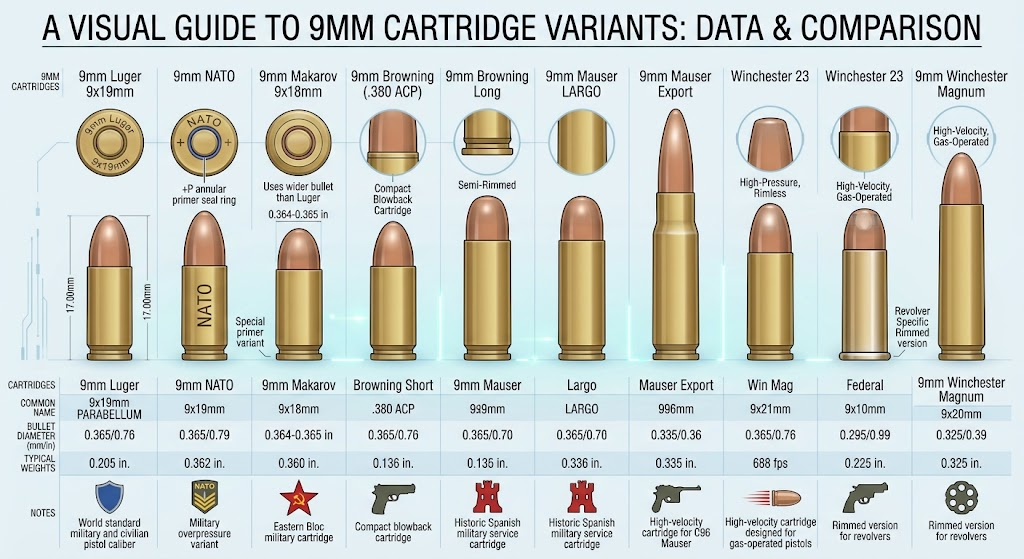
| 9mm Cartridge | Common Name | Bullet Diameter | Bullet Diameter in Inches | Typical Bullet Weights | Notes |
| 9mm Luger / 9×19mm | 9mm Parabellum, 9mm Luger | 9.02 mm | 0.355 in | 115 gr, 124 gr, 147 gr | World standard military and civilian pistol caliber. |
| 9mm NATO | 9mm NATO, 9×19mm +P | 9.02 mm | 0.355 in | 124 gr | Military overpressure variant of the 9mm Luger. |
| 9mm Makarov / 9×18mm | 9mm Makarov, 9×18 PM | 9.25–9.27 mm | 0.364–0.365 in | 95 gr | Eastern Bloc military cartridge; uses a wider bullet than 9mm Luger. |
| 9mm Browning Short / .380 ACP / 9×17mm | .380 Auto, 9mm Short, 9mm Kurz | 9.04 mm | 0.356 in | 85–95 gr | Compact blowback cartridge; shares the .355/.356 bullet family. |
| 9mm Largo / 9×23mm | 9mm Bergmann-Bayard | 9.02 mm | 0.355 in | 115–125 gr | Historic Spanish military service cartridge. |
| 9mm Browning Long / 9×20mm | 9×20mmSR | 9.09 mm | 0.358 in | 108–110 gr | Semi-rimmed cartridge used in early FN blowback pistols. |
| 9×21mm | 9mm IMI, 9mm Italian | 9.02–9.03 mm | 0.355–0.356 in | 115–124 gr | Developed for civilian markets prohibiting military calibers. |
| 9×23mm Winchester | 9×23 Win | 9.04 mm | 0.356 in | 115–147 gr | High-pressure rimless cartridge for competition and defense. |
| 9mm Steyr / 9×23mm Steyr | 9×23 Steyr | 9.02 mm | 0.355 in | 115 gr | Early Austrian military service cartridge. |
| 9mm Mauser Export / 9×25mm Mauser | 9mm Mauser | 9.02 mm | 0.355 in | 128 gr | High-velocity cartridge for C96 Mauser pistols and carbines. |
| 9mm Ultra / 9mm Police / 9×18mm Ultra | 9mm Police | 9.00 mm | 0.354 in | 86–95 gr | German police round intermediate between .380 ACP and 9mm Luger. |
| 9mm Federal | 9×19mmR | 9.02 mm | 0.355 in | 115–147 gr | Rimmed version of 9mm Luger designed specifically for revolvers. |
| 9mm Glisenti | 9mm Italian Service | 9.02 mm | 0.355 in | 123 gr | Lower-pressure Italian WWI and WWII service cartridge. |
| 9mm Winchester Magnum | 9mm Win Mag | 9.02 mm | 0.355 in | 115–147 gr | High-velocity cartridge designed for gas-operated pistols. |
Common 9mm Luger Bullet Size: 0.355 inches (9.01 mm) nominal bullet diameter.
Note: Actual physical bullet dimensions can vary by cartridge type, manufacturing tolerances, and bullet construction.
How Big Is a 9mm Bullet?
Evaluating 9mm bullet dimensions requires understanding the distinct components of ammunition.
- Bullet Diameter: This measures the maximum outer width of the unfired projectile itself. For the standard 9mm Luger, the bullet diameter measures 0.355 inches (9.02 mm).
- Bullet Length: The physical length of the projectile varies according to its weight and design (such as solid copper, jacketed hollow point, or full metal jacket), typically ranging from 0.45 to 0.60 inches.
- Bullet Weight: Expressed in grains (gr), weight dictates how heavy the projectile is, with common 9mm Luger weights ranging from 115 to 147 grains.
- Bullet vs. Cartridge: The bullet is only the projectile that travels through the air when fired. It sits inside the cartridge case, which holds the gunpowder and primer. The complete 9mm cartridge size includes the case length and overall cartridge length, which are significantly larger than the bullet alone.
9mm Bullet Diameter in Inches and Millimeters
The 9mm bullet diameter in inches and millimeters reflects standard international measurement conversions used by SAAMI (Sporting Arms and Ammunition Manufacturers’ Institute) and C.I.P. (Commission Internationale Permanente).
| Measurement Unit | Dimension | Description |
| Millimeters (Metric) | 9.01 mm to 9.02 mm | Standard metric designation for 9mm Luger bullets. |
| Inches (Imperial) | 0.355 in | Standard imperial designation in the .355-inch caliber family. |
The term “9mm” is a nominal descriptor. When converted mathematically, 9 millimeters equals approximately 0.3543 inches. Gunmakers and ammunition manufacturers standardized the US commercial designation to 0.355 inches to ensure proper engagement with barrel rifling lands and grooves.
9mm Bullet Weight
9mm bullet weight directly influences ballistics, recoil, and point of impact. Measured in grains (where 7,000 grains equal one pound), projectile mass varies depending on the intended application, whether target shooting, self-defense, or duty use.
| Bullet Weight (Grains) | Common Application | Typical Velocity Range |
| 90 gr | Light-load and specialty practice rounds | 1,100 to 1,250 fps |
| 100 gr | Specialty target and light loads | 1,150 to 1,200 fps |
| 115 gr | Standard range training and target practice | 1,150 to 1,200 fps |
| 124 gr | NATO standard and general duty loads | 1,100 to 1,180 fps |
| 125 gr | Competition and specialized target loads | 1,050 to 1,150 fps |
| 135 gr | Duty and personal defense loads | 1,000 to 1,100 fps |
| 147 gr | Subsonic suppressor use and heavy defense loads | 950 to 1,050 fps |
Bullet weight is distinct from bullet diameter; two cartridges can share the exact same 9mm bullet diameter (such as 0.355 inches) while utilizing vastly different projectile weights.
9mm Bullet Size vs 9mm Cartridge Size
Confusing 9mm bullet size with overall 9mm cartridge size is a common error. The complete ammunition assembly involves several distinct dimensional parameters:
- Bullet Diameter: Outer width of the projectile.
- Case Diameter: Outer width of the brass casing.
- Case Length: The length of armor or brass holding propellant.
- Overall Cartridge Length (OAL): Total length from the bullet tip to the base of the cartridge.
9mm Luger Dimensional Specifications Table
| Dimension Type | Measurement (Metric) | Measurement (Imperial) |
| Bullet Diameter | 9.02 mm | 0.3550 in |
| Bore Diameter (Land-to-Land) | 8.79 mm | 0.3460 in |
| Groove Diameter (Groove-to-Groove) | 9.02 mm | 0.3550 in |
| Case Length | 19.15 mm | 0.754 in |
| Base / Rim Diameter | 10.01 mm | 0.394 in |
| Maximum Overall Length (OAL) | 29.69 mm | 1.169 in |
Is Every 9mm Bullet the Same Size?
No. “9mm” is a general naming convention rather than a uniform specification. Different cartridges bearing “9mm” in their names were designed in different countries by different engineers, resulting in varying physical dimensions. For example:
- 9mm Luger (9x19mm): Utilizes a 0.355-inch (9.02 mm) bullet and a 19mm case.
- 9mm Makarov (9x18mm): Utilizes a larger 0.364 to 0.365-inch (9.25 to 9.27 mm) bullet and an 18mm case. Attempting to fire a 9mm Luger bullet in a Makarov, or vice versa, is dangerous and incompatible due to these dimensional disparities.
- .380 ACP (9x17mm / 9mm Browning Short): Uses the same 0.355-inch bullet diameter as the Luger, but features a shorter 17mm case and operates at much lower pressure.
Different 9mm cartridges are never interchangeable simply because their names contain “9mm.”
9mm Bullet Size vs Other Common Calibers
To understand how 9mm ammunition size compares to other handgun rounds, review the nominal bullet diameter comparison table below:
| Caliber / Cartridge Name | Nominal Bullet Diameter (Inches) | Nominal Bullet Diameter (Millimeters) |
| 9mm Luger | 0.355 in | 9.02 mm |
| .380 ACP | 0.355 in | 9.04 mm |
| .38 Special | 0.357 in | 9.07 mm |
| .357 Magnum | 0.357 in | 9.07 mm |
| .40 S&W | 0.400 in | 10.16 mm |
| .45 ACP | 0.451 in | 11.46 mm |
| 10mm Auto | 0.400 in | 10.16 mm |
Caliber naming conventions do not always match exact physical measurements. For instance, .38 Special and .357 Magnum actually utilize a 0.357-inch bullet, making them slightly wider than standard 9mm Luger projectiles.
9mm Bullet Size FAQs
- What is the diameter of a 9mm bullet?
The standard 9mm Luger bullet diameter is 9.02 mm. - How many inches is a 9mm bullet?
A standard 9mm Luger bullet measures 0.355 inches in diameter. - Is a 9mm bullet really 9mm?
Yes and no. While “9mm” is the nominal name, the actual measured diameter of a 9mm Luger bullet is 9.02 mm (0.355 inches), which is extremely close to 9 millimeters. - What size bullet does 9mm Luger use?
It uses a .355-inch caliber projectile. - What is the diameter of a 9mm Luger bullet?
The nominal diameter is 0.3550 inches (9.02 mm). - Is .380 ACP the same bullet size as 9mm Luger?
Yes, both share a 0.355-inch bullet diameter, but the .380 ACP case is shorter and weaker. - Is 9mm Makarov bullet size the same as 9mm Luger?
No. 9mm Makarov uses a wider 0.365-inch (9.27 mm) bullet. - What is the most common 9mm bullet weight?
The 115-grain and 124-grain bullets are the most common. - How much does a 9mm bullet weigh?
Typical weights range from 90 grains to 147 grains. - What is the difference between 9mm bullet size and cartridge size?
Bullet size refers solely to grain weight and projectile dimensions, whereas cartridge size includes the casing, powder, primer, and overall loaded length.