The term “9mm” does not refer to a single cartridge, but rather to an entire family of centerfire pistol rounds that utilize approximately 9mm diameter projectiles. In modern shooting, self-defense, and military discussions, “9mm” almost always refers specifically to the 9mm Luger (9×19mm Parabellum). However, dozens of distinct 9mm cartridge types exist, varying in case length, bullet diameter, chamber pressure, and performance. Because these cartridges are not interchangeable, loaded ammunition must always be matched to the exact firearm specification.
Types of 9mm Rounds
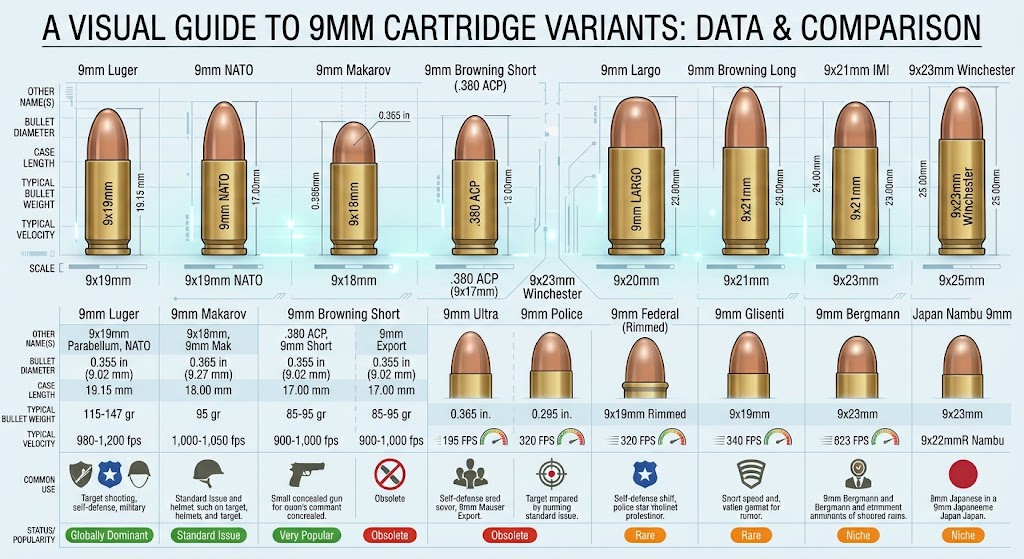
The table below outlines the major established 9mm cartridge types developed throughout firearms history.
| 9mm Cartridge | Other Name(s) | Bullet Diameter | Case Length | Typical Bullet Weight | Typical Velocity | Common Use | Status/Popularity |
| 9mm Luger | 9×19mm, 9mm Parabellum, 9mm NATO | 0.355 in (9.02 mm) | 19.15 mm | 115–147 gr | 980–1,200 fps | Self-defense, law enforcement, military, target shooting | Dominant globally; extremely popular |
| 9mm NATO | 9×19mm NATO | 0.355 in (9.02 mm) | 19.15 mm | 124 gr | 1,200–1,250 fps | Military service | Standard issue for NATO military forces |
| 9mm Makarov | 9×18mm, 9mm Mak | 0.365 in (9.27 mm) | 18.00 mm | 95 gr | 1,000–1,050 fps | Military, surplus, concealed carry | Very popular in Eastern Europe & surplus markets |
| 9mm Browning Short | .380 ACP, 9×17mm, 9mm Short, 9mm Kurz | 0.355 in (9.02 mm) | 17.00 mm | 85–95 gr | 900–1,000 fps | Concealed carry, micro-compact handguns | Extremely popular worldwide |
| 9mm Largo | 9×23mm Largo, 9mm Bergmann-Bayard | 0.355 in (9.02 mm) | 23.00 mm | 125–128 gr | 1,150–1,200 fps | Military surplus (Spain) | Obsolete/Niche surplus |
| 9mm Browning Long | 9×20mm SR | 0.358 in (9.09 mm) | 20.20 mm | 108–110 gr | 1,000–1,050 fps | Historical military service (Sweden, Belgium) | Obsolete |
| 9×21mm | 9×21mm IMI | 0.355 in (9.02 mm) | 21.00 mm | 115–147 gr | 1,100–1,200 fps | Civilian self-defense where 9×19mm is restricted | Popular in civilian markets like Italy/Brazil |
| 9×23mm Winchester | 9×23 Win | 0.355 in (9.02 mm) | 23.00 mm | 124–125 gr | 1,400–1,450 fps | Competition shooting | Niche / Limited production |
| 9mm Steyr | 9×23mm Steyr | 0.355 in (9.02 mm) | 23.00 mm | 115–116 gr | 1,150–1,200 fps | Historical military service (Austria, Hungary) | Obsolete / Vintage |
| 9mm Mauser Export | 9×25mm Mauser | 0.355 in (9.02 mm) | 25.00 mm | 128 gr | 1,350–1,400 fps | Historical export military/commercial | Obsolete |
| 9mm Ultra | 9×18mm Ultra | 0.355 in (9.02 mm) | 18.00 mm | 95–100 gr | 1,000–1,050 fps | Police service (West Germany) | Obsolete / Rare |
| 9mm Police | 9×18mm Police | 0.355 in (9.02 mm) | 18.00 mm | 95–100 gr | 1,000–1,050 fps | Law enforcement (Europe) | Obsolete |
| 9mm Federal | 9×19mm Rimmed | 0.355 in (9.02 mm) | 19.15 mm | 115 gr | 1,100–1,150 fps | Revolvers without moon clips | Discontinued / Rare |
| 9mm Glisenti | 9×19mm Glisenti | 0.355 in (9.02 mm) | 19.15 mm | 115–123 gr | 950–1,000 fps | Historical military (Italy) | Obsolete |
| 9mm Bergmann | 9mm Bergmann No. 6 / 9×23mm | 0.355 in (9.02 mm) | 23.00 mm | 125 gr | 1,100–1,150 fps | Early semi-automatic handguns | Obsolete |
| 9mm Japanese | 9×22mmR Nambu | 0.354 in (9.00 mm) | 22.00 mm | 100 gr | 950–1,000 fps | Historical military (Type 26 Revolver) | Obsolete |
Most Common 9mm Round: 9mm Luger / 9×19mm – It is the dominant modern 9mm handgun cartridge and is widely available.
What Does 9mm Mean?
The term “9mm” refers to the nominal diameter of the bullet or barrel bore (approximately 9 millimeters or 0.355 to 0.365 inches). However, knowing only that a cartridge is “9mm” does not tell you the overall dimensions, case length, or chamber pressure limits of the ammunition.
Different types of 9mm rounds, such as 9mm Luger, 9mm Makarov, 9mm Largo, and .380 ACP, are separate cartridges.
- Case Length Differences: 9mm Luger uses a 19mm case (9×19mm), while .380 ACP uses a 17mm case (9×17mm) and 9mm Largo uses a 23mm case (9×23mm).
- Bullet Diameter Differences: While 9mm Luger and .380 ACP use a 0.355-inch bullet, 9mm Makarov uses a noticeably wider 0.365-inch (9.27mm) projectile.
Attempting to chamber or fire the wrong 9mm cartridge in a firearm can cause feeding failures, failure to discharge, or dangerous mechanical failures due to pressure mismatches. Always load only the specific cartridge stamped on the firearm barrel.
9mm Luger vs Other 9mm Rounds
While many cartridges fall under the broad 9mm umbrella, 9mm Luger (9×19mm) serves as the baseline against which all other types of 9mm rounds are measured. It operates at high internal pressures to deliver balanced stopping power, high magazine capacity, and manageable recoil.
Other cartridges, like the .380 ACP, were designed for lower pressures to allow lightweight, direct blowback action handguns. Cartridges like 9mm Makarov were designed with proprietary bullet diameters for specific military platforms.
| Cartridge | Case Length | Overall Length | Bullet Diameter | Typical Pressure | Typical Velocity | Typical Applications |
| 9mm Luger | 19.15 mm | 29.69 mm (1.169 in) | 0.355 in | 35,000 psi | 1,100–1,200 fps | Concealed carry, duty use, sport shooting |
| .380 ACP | 17.00 mm | 24.99 mm (0.984 in) | 0.355 in | 21,500 psi | 900–1,000 fps | Micro-compact carry guns |
| 9×18mm Makarov | 18.00 mm | 24.64 mm (0.970 in) | 0.365 in | 24,000 psi | 1,000–1,050 fps | Surplus handguns, self-defense |
| 9mm Largo | 23.00 mm | 28.70 mm (1.130 in) | 0.355 in | 33,000 psi | 1,150–1,200 fps | Historical military pistols |
| 9×21mm IMI | 21.00 mm | 29.69 mm (1.169 in) | 0.355 in | 35,000 psi | 1,100–1,200 fps | Civilian carry in restricted countries |
Types of 9mm Ammunition
It is vital to distinguish 9mm cartridge types from 9mm ammunition types. A cartridge type (such as 9mm Luger) refers to the overall dimensions and design of the round, whereas ammunition types describe how the load is assembled, its pressure rating, or its velocity characteristics.
Common types of 9mm ammunition include:
- Standard Pressure Ammunition: Factory-loaded ammunition manufactured within SAAMI or C.I.P. standard pressure limits (e.g., 35,000 psi for 9mm Luger).
- +P Ammunition: Overpressure loads designed to provide increased velocity and energy. These run at higher pressures (e.g., 38,500 psi for 9mm Luger +P) and should only be fired in firearms rated specifically for +P use.
- Subsonic Ammunition: Rounds designed to stay below the speed of sound (approximately 1,125 fps) to prevent a sonic crack, making them optimal for suppressor use. Typically features heavier 147-grain bullets.
- Training / Target Ammunition: Economical loads usually built with Full Metal Jacket (FMJ) bullets designed for range practice.
- Self-Defense / Duty Ammunition: Premium loads featuring expanding projectiles (JHP) designed for reliable stopping power and controlled barrier penetration.
9mm Bullet Types
The bullet (projectile) mounted in a 9mm cartridge determines its behavior upon impact and target delivery. Below are the primary bullet designs used across various 9mm ammo types.
| Bullet Type | Full Name | General Characteristics | Common Applications |
| FMJ | Full Metal Jacket | Lead core encased in a soft metal shell; does not expand | Target practice, range training, plinking |
| JHP | Jacketed Hollow Point | Hollowed tip designed to expand upon hydraulic impact | Personal defense, law enforcement duty |
| JSP | Jacketed Soft Point | Exposed lead tip providing partial expansion and deeper penetration | Hunting, specialized defensive application |
| LRN | Lead Round Nose | Solid lead construction without a jacket; lower cost | Target shooting, vintage handguns |
| Hard Cast | Hard Cast Lead | High-hardness lead alloy that resists deformation and penetrates deep | Woods carry, defense against large wildlife |
| Frangible | Frangible Projectile | Compressed metal powder designed to disintegrate on hard targets | Indoor steel target training, shoot-house training |
9mm Round Sizes and Dimensions
Different 9mm cartridge types vary noticeably in physical dimensions. Case length dictates whether a cartridge will properly fit into a firearm’s chamber, while bullet diameter determines barrel groove engagement.
| Cartridge Designation | Case Length | Overall Length (OAL) | Bullet Diameter | Base Diameter | Rim Diameter |
| 9mm Luger (9×19mm) | 19.15 mm (0.754 in) | 29.69 mm (1.169 in) | 9.02 mm (0.355 in) | 9.93 mm (0.391 in) | 10.01 mm (0.394 in) |
| .380 ACP (9×17mm) | 17.00 mm (0.680 in) | 24.99 mm (0.984 in) | 9.02 mm (0.355 in) | 9.50 mm (0.374 in) | 9.50 mm (0.374 in) |
| 9×18mm Makarov | 18.00 mm (0.713 in) | 24.64 mm (0.970 in) | 9.27 mm (0.365 in) | 9.95 mm (0.392 in) | 9.95 mm (0.392 in) |
| 9mm Largo (9×23mm) | 23.00 mm (0.905 in) | 28.70 mm (1.130 in) | 9.02 mm (0.355 in) | 9.90 mm (0.390 in) | 10.00 mm (0.394 in) |
| 9×21mm IMI | 21.00 mm (0.827 in) | 29.69 mm (1.169 in) | 9.02 mm (0.355 in) | 9.93 mm (0.391 in) | 10.01 mm (0.394 in) |
9mm Round Velocity
Muzzle velocity varies significantly among standard 9mm cartridges depending on case capacity, powder charge, and bullet weight.
- Low Velocity (Sub-1,000 fps): Shorter cartridges like .380 ACP (900–980 fps) or heavy 9mm Luger 147-grain loads (950–980 fps) keep velocities relatively low for lower recoil or subsonic performance.
- Standard Velocity (1,000–1,200 fps): Standard 9mm Luger (115 gr at ~1,180 fps), 9mm NATO, and 9mm Makarov sit in this range, providing effective ballistic performance.
- High Velocity (1,300+ fps): High-capacity performance cartridges such as the 9×23mm Winchester push 124-grain bullets past 1,400 fps for competition and specialized roles.
How Many Types of 9mm Rounds Are There?
There is no single universally accepted count for the number of 9mm round types because the answer depends on how you categorize them:
- Cartridge Types: Historically, there are over 20 distinct 9mm cartridge designations (e.g., 9×19mm Luger, 9×18mm Makarov, 9×17mm .380 ACP, 9×23mm Largo). Many of these are obsolete, while a handful dominate modern shooting.
- Ammunition & Load Types: Across active cartridges like 9mm Luger, there are dozens of load variations, including standard pressure, +P, subsonic, and target loads.
- Bullet Types: There are over half a dozen primary bullet designs (FMJ, JHP, JSP, Hard Cast, Frangible, LRN) produced across various grain weights.
In summary, while there are dozens of historical 9mm cartridge designs, modern shooters primarily interact with a small group of active cartridges loaded in various bullet and performance configurations.
9mm Rounds FAQs
What are the different types of 9mm rounds?
Different types of 9mm rounds include various cartridge designs like 9mm Luger (9×19mm), .380 ACP (9×17mm), 9mm Makarov (9×18mm), and 9mm Largo (9×23mm), as well as different bullet types like Full Metal Jacket (FMJ) and Jacketed Hollow Point (JHP).
What is the most common 9mm round?
The most common 9mm round is the 9mm Luger (also known as 9×19mm Parabellum or 9mm NATO). It is the standard cartridge for modern handguns worldwide.
Is 9mm Luger the same as 9mm?
When people say “9mm,” they are almost always referring to 9mm Luger. However, technically “9mm” is a broad term that covers multiple different cartridge types.
Is 9mm Makarov the same as 9mm Luger?
No. 9mm Makarov (9×18mm) uses a shorter case (18mm) and a wider bullet diameter (0.365 in) compared to the 9mm Luger (19mm case, 0.355 in bullet). They are not interchangeable.
Is .380 ACP a 9mm round?
Yes, .380 ACP is functionally a 9mm cartridge, often designated as 9mm Browning Short or 9×17mm. It fires a 0.355-inch diameter bullet from a shorter 17mm case.
What is 9mm Largo?
9mm Largo (9×23mm Largo) is a historical Spanish military handgun cartridge featuring a 23mm case length. It is longer than 9mm Luger and operates at different pressures.
What is the difference between 9mm Luger and 9mm Makarov?
9mm Luger uses a 9×19mm case and a 0.355-inch bullet. 9mm Makarov uses a 9×18mm case and a wider 0.365-inch bullet, operating at lower pressure designed for direct blowback handguns.
What are the different types of 9mm ammunition?
Types of 9mm ammunition include standard pressure, +P (higher pressure), subsonic (lower velocity), target/range loads, and personal defense loads.
What is the most common 9mm bullet type?
The most common 9mm bullet type for practice is Full Metal Jacket (FMJ), while Jacketed Hollow Point (JHP) is the most common for self-defense and duty applications.
Are all 9mm rounds interchangeable?
No. Different 9mm cartridges (such as 9mm Luger, 9mm Makarov, and .380 ACP) have different dimensions and pressure limits. You must only fire the exact cartridge caliber specified on your firearm.