The comparison of 454 Casull vs 45 Colt examines a modern magnum powerhouse and one of the most famous historic cartridges in American firearms history. The main difference is that the .454 Casull operates at massively higher pressures to deliver extreme magnum energy, whereas the .45 Colt is a low-pressure, low-recoil cartridge designed in the black-powder era. Understanding where each cartridge performs better is critical for deciding if you need bone-crushing penetration for dangerous game or a comfortable, historic shooter for casual use.
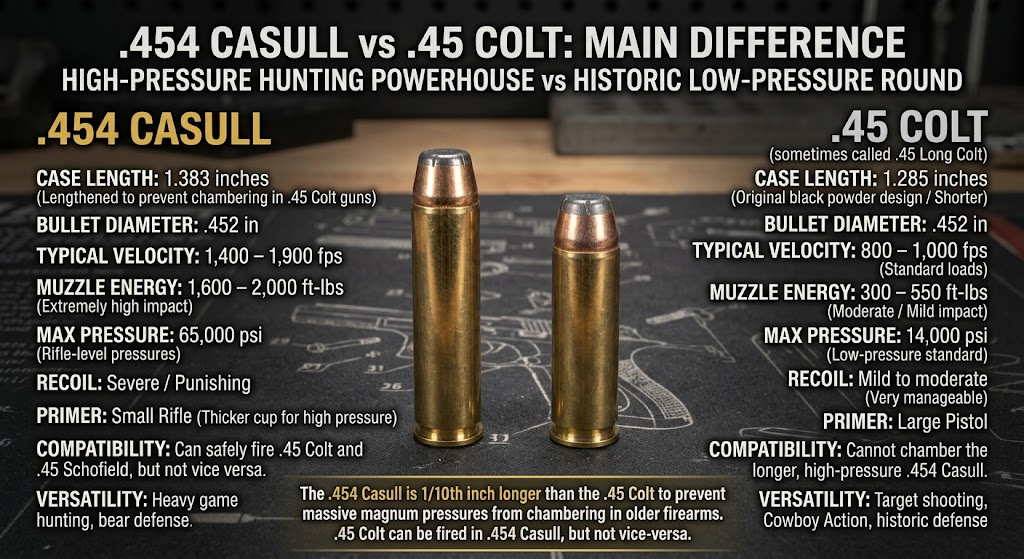
.454 Casull vs .45 Colt: Main Difference
The .454 Casull was directly born from the .45 Colt. Dick Casull took the traditional .45 Colt case, lengthened it slightly, and thickened the brass to withstand 65,000 psi of pressure—more than four times the standard pressure of the original .45 Colt. While a .454 Casull firearm can safely shoot .45 Colt ammunition, the main difference in their independent performance is a massive gap in velocity, kinetic energy, and recoil.
Below is a comparison table outlining the core specifications of both cartridges. Note: Actual velocity, energy, and recoil can vary significantly depending on bullet weight, ammunition, barrel length, firearm, and specific load.
| Specification | .454 Casull | .45 Colt (Standard Load) |
| Bullet Diameter | .452 inches | .452 inches |
| Typical Bullet Weights | 240, 260, 300, 360, 400 grains | 200, 225, 250, 255 grains |
| Muzzle Velocity | 1,400 – 1,900 fps | 750 – 1,000 fps |
| Muzzle Energy | 1,600 – 2,000 ft-lbs | 350 – 500 ft-lbs |
| Effective Range | 100 – 150 yards (Handgun) | 50 yards (Handgun) |
| Recoil | Severe / Punishing | Mild / Very Manageable |
| Typical Firearm Types | Heavy-frame revolvers, lever-action rifles | Single-action revolvers, lever-action rifles |
| Common Uses | Dangerous game defense, heavy hunting | Target shooting, Cowboy Action, medium game |
| Hunting Suitability | Elk, Moose, Grizzly Bear, African Game | Whitetail Deer (close range), Varmints |
.454 Casull Overview
Developed in 1957 by Dick Casull and Jack Fulmer, the .454 Casull was built to exceed the performance of every existing handgun cartridge. By utilizing a strengthened, lengthened case and a triplex powder load, it achieved rifle-like velocities from a revolver. Operating at a staggering 65,000 psi, it remains one of the premier choices for wilderness guides and hunters needing guaranteed stopping power against the largest predators.
.45 Colt Overview
Introduced in 1873 for the famous Colt Single Action Army (the “Peacemaker”), the .45 Colt—often called the .45 Long Colt—is a piece of living history. Originally a black-powder cartridge for the U.S. Cavalry, it transitioned to smokeless powder but is still kept to a low maximum pressure (14,000 psi) so it can be fired safely in antique revolvers. While specialty “Ruger-only” high-pressure loads exist for modern, heavy-built firearms, standard .45 Colt ammunition remains famous for its gentle recoil and subsonic speeds.
.454 Casull vs .45 Colt Ballistics
When analyzing 454 Casull vs 45 Colt ballistics using standard factory ammunition, the two cartridges exist in completely different performance categories despite firing the same caliber bullet.
Velocity Comparison
The .454 Casull easily pushes heavy bullets twice as fast as the standard .45 Colt. A classic 250-grain .45 Colt bullet typically leaves the muzzle at a slow, arcing 800 to 900 fps (feet per second). The .454 Casull can drive a bullet of the same weight at blistering speeds of 1,800 to 1,900 fps, creating a significantly flatter trajectory.
Energy Comparison
Because kinetic energy increases exponentially with velocity, the energy gap is massive. Standard .45 Colt ammunition produces a modest 350 to 500 ft-lbs of muzzle energy, which is highly effective against humans and small game but lacks deep penetration. The .454 Casull generates between 1,600 and 2,000 ft-lbs of energy, representing a 300% to 400% increase in stopping power over its historic parent cartridge.
Recoil Comparison
The .45 Colt is widely beloved because it is a joy to shoot. The recoil is a gentle, rolling push, making it perfect for beginners, recreational range days, and Cowboy Action Shooting competitions. In stark contrast, the .454 Casull produces violent, punishing recoil. The sharp muzzle whip and heavy concussion require strict grip fundamentals and can quickly cause shooter fatigue.
Range Comparison
The low velocity of the .45 Colt limits its practical range. In a handgun, its trajectory drops rapidly past 50 yards, making it a strictly close-range tool. The high velocity of the .454 Casull allows it to shoot flat and retain lethal energy, extending its effective hunting range on large game out to 150 yards in a handgun.
Bullet and Cartridge Dimensions
Both cartridges fire the same .452-inch diameter bullets (though historically, early .45 Colts used .454-inch bullets). The critical difference is in case length, a deliberate safety design.
- .45 Colt: Case length of 1.285 inches, overall length of 1.600 inches.
- .454 Casull: Case length of 1.383 inches, overall length of 1.765 inches.
Because the .454 Casull case is roughly 1/10th of an inch longer, it is physically impossible to chamber a 65,000-psi .454 Casull round into an antique 14,000-psi .45 Colt revolver, preventing catastrophic firearm failure.
Firearm Platforms
The massive pressure difference heavily dictates the engineering of the firearms, altering where each cartridge is commonly used.
Handgun Use
The .45 Colt is universally popular in single-action revolvers, from historic Colt originals to modern Ruger Vaqueros and Uberti replicas. These firearms are well-balanced, comfortable on the hip, and fast to draw. The .454 Casull requires heavy-frame, double-action revolvers (like the Ruger Super Redhawk) with thick cylinder walls to contain the explosion.
Lever-Action Rifle Use
Both cartridges are incredibly popular in lever-action rifles. A .45 Colt lever-action is a lightweight, low-recoil carbine perfect for target shooting, home defense, and close-range deer hunting in dense timber. A .454 Casull lever-action rifle provides a substantial boost in velocity, effectively turning the revolver cartridge into a legitimate 200-yard brush gun capable of stopping grizzly bears or moose.
Hunting Applications
The .45 Colt (in standard loadings) is generally limited to hunting whitetail deer, wild hogs, and varmints at ranges under 75 yards. The .454 Casull is built for the extreme. It is designed to shatter heavy bone and penetrate deeply into massive animals, making it fully capable of taking elk, moose, bison, and African plains game.
Advantages and Disadvantages of Each Cartridge
.454 Casull Advantages:
- Extreme, rifle-like stopping power from a portable handgun.
- Deep penetration required for stopping dangerous predator charges.
- Supreme versatility: .454 Casull firearms can safely fire .45 Colt ammunition.
.454 Casull Disadvantages:
- Recoil is severe and can induce flinching in inexperienced shooters.
- Ammunition is expensive and can be hard to find in local stores.
.45 Colt Advantages:
- Very mild recoil, making it highly enjoyable for high-volume range sessions.
- Immense selection of beautifully crafted single-action revolvers and historic lever guns.
- Excellent, affordable ammunition availability for target practice.
.45 Colt Disadvantages:
- Standard factory loads lack the energy for ethical hunting of game larger than deer.
- Steep trajectory heavily limits effective range.
Where .454 Casull is the Better Option
The .454 Casull is the better option for hunters, wilderness guides, and backcountry hikers who face the very real threat of large predators. It is also where the .454 Casull has an advantage for those who want a single heavy-frame revolver that can shoot full-power magnums for hunting, while still being able to load cheap .45 Colt for weekend range practice.
Where .45 Colt is the Better Option
The .45 Colt is the better option for recreational shooters, Cowboy Action competitors, and those who appreciate firearms history. Where the .45 Colt may be the better choice is for anyone who is recoil-sensitive, or for hunters who strictly hunt medium game like deer in dense woods where the extreme power and muzzle blast of a magnum are entirely unnecessary.
FAQ
What is the main difference between .454 Casull and .45 Colt?
The main difference is pressure and power. The .454 Casull uses a slightly longer, highly reinforced case to operate at pressures up to 65,000 psi, generating far more velocity and energy than the historic, low-pressure .45 Colt.
Is .454 Casull more powerful than .45 Colt?
Yes, vastly more powerful. Standard .454 Casull loads produce roughly three to four times the kinetic energy of standard .45 Colt factory ammunition.
Which has more recoil, .454 Casull or .45 Colt?
The .454 Casull has substantially more recoil. The .45 Colt is known for a very mild, pleasant recoil impulse, while the .454 Casull produces a violent, heavy snap that requires practice to manage safely.
Which has a longer effective range?
The .454 Casull has a much longer effective range due to its high muzzle velocity, allowing for ethical hunting shots out to 150 yards with a handgun. The .45 Colt drops rapidly and is best kept inside 50 yards for hunting.
Which is better for hunting?
The .45 Colt is sufficient for whitetail deer and feral hogs at close range. The .454 Casull is strictly better for large, tough game like elk, moose, bison, and grizzly bear where deep penetration is required.
Where is .45 Colt preferable to .454 Casull?
The .45 Colt is preferable where comfortable, high-volume shooting is the goal, such as at the firing range, in Cowboy Action Shooting competitions, or for introducing new shooters to big-bore revolvers.
Where does .454 Casull have the biggest advantage?
The .454 Casull has the biggest advantage where survival against dangerous predators is on the line, as it guarantees the tissue disruption and bone-breaking penetration that a standard .45 Colt cannot provide.