The comparison of 454 Casull vs 45-70 often arises when hunters are selecting the ultimate big-bore lever-action brush gun or a defense firearm for dangerous game. The main difference is that the .454 Casull is a high-pressure modern handgun cartridge that performs exceptionally well in lever-action rifles, whereas the .45-70 Government is a historic, massive rifle cartridge designed to fire significantly heavier bullets. Understanding where each cartridge performs better is essential for deciding whether you need the portability of a magnum revolver caliber or the unmatched heavy-game penetration of a dedicated rifle cartridge.
.454 Casull vs .45-70: Main Difference
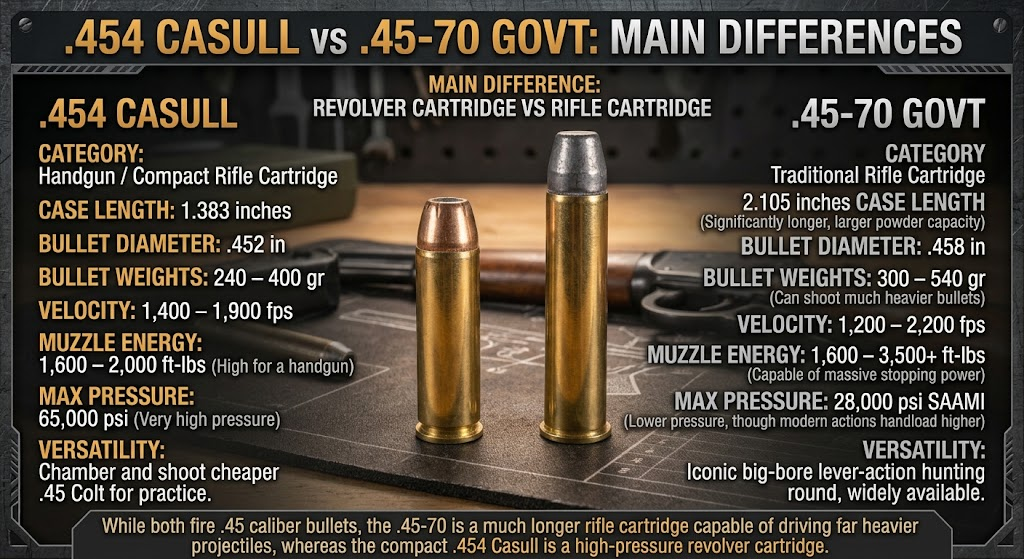
The main difference lies in their design origins and operating pressures. The .454 Casull uses high pressure (65,000 psi) in a short case to achieve magnum velocity, while the .45-70 relies on a massive case capacity at lower pressures (typically 28,000 psi in modern lever guns) to push massive, bone-crushing bullets.
Below is a comparison table outlining the core specifications of both cartridges. Note: Actual velocity, energy, and recoil can vary significantly depending on bullet weight, ammunition, barrel length, firearm, and specific load.
| Specification | .454 Casull | .45-70 Government |
| Bullet Diameter | .452 inches | .458 inches |
| Typical Bullet Weights | 240, 260, 300, 360, 400 grains | 300, 325, 405, 430, 500 grains |
| Muzzle Velocity | 1,400 – 1,900 fps (Handgun) / up to 2,200 fps (Rifle) | 1,500 – 2,200 fps (Rifle) |
| Muzzle Energy | 1,600 – 2,000 ft-lbs (Handgun) | 1,600 – 3,500+ ft-lbs (Rifle, modern loads) |
| Effective Range | 150 yards (Handgun) / 200 yards (Rifle) | 150 – 250 yards (Rifle) |
| Recoil | Severe in handguns / Moderate in rifles | Moderate to Severe in rifles |
| Typical Firearm Types | Heavy revolvers, lever-action rifles | Lever-action rifles, single-shot rifles |
| Common Uses | Dangerous game defense, medium to large game hunting | Large game hunting, dangerous game defense |
| Hunting Suitability | Elk, Moose, Grizzly Bear | Moose, Grizzly Bear, Bison, African Game |
.454 Casull Overview
Developed in 1957 by Dick Casull and Jack Fulmer, the .454 Casull was engineered as the ultimate handgun hunting cartridge. By lengthening and thickening the .45 Colt case, it was built to withstand an incredibly high maximum pressure of 65,000 psi. While born as a revolver cartridge, its ballistic efficiency has made it highly popular in compact lever-action rifles, offering shooters a hard-hitting companion to their sidearm.
.45-70 Overview
Adopted by the U.S. Military in 1873, the .45-70 Government is one of the oldest cartridges still in widespread use. Originally a black powder cartridge, modern smokeless powder loads have transformed it into a powerhouse. While older “Trapdoor” rifles require low-pressure ammunition, modern lever-action rifles (like the Marlin 1895) can handle high-pressure loads that turn the .45-70 into an absolute hammer capable of taking down any land mammal on Earth.
454 Casull vs 45-70 Ballistics
When evaluating 454 Casull vs 45-70 ballistics, the comparison usually centers on lever-action rifles, where the two directly compete as brush hunting tools.
Velocity Comparison
In a lever-action rifle, both cartridges achieve excellent velocities for big-bore calibers. The .454 Casull can push a 300-grain bullet out of a rifle barrel at over 2,000 fps (feet per second). The .45-70 can push a 300-grain bullet at similar speeds, but its true capability is seen with heavier bullets. A modern .45-70 load can drive a massive 405-grain bullet at 1,800 to 1,900 fps, a weight class the .454 Casull struggles to accommodate efficiently.
Energy Comparison
The .45-70 generates significantly more kinetic energy when loaded to modern lever-action pressures. While a .454 Casull rifle peaks around 2,200 to 2,400 ft-lbs of energy, modern .45-70 hunting loads can easily surpass 3,000 to 3,500 ft-lbs. This massive energy, combined with heavier bullets, gives the .45-70 unmatched penetrating power on dense muscle and heavy bone.
Recoil Comparison
Recoil depends entirely on the platform and load. Firing a .454 Casull from a revolver produces severe, punishing recoil. However, firing that same cartridge from a lever-action rifle results in surprisingly mild, highly manageable recoil. The .45-70 fired from a standard lever-action rifle produces a heavy, sustained push. With maximum-pressure 400+ grain loads, the .45-70 generates intense recoil that can be uncomfortable during extended range sessions.
Range Comparison
Neither cartridge is designed for long-range precision, as both fire blunt, flat-nosed bullets with poor ballistic coefficients. The .454 Casull is highly effective on game out to 150 yards in a handgun and up to 200 yards in a rifle. The .45-70 is generally considered a 150 to 200-yard cartridge, though skilled shooters using modern Hornady LEVERevolution ammunition can confidently stretch its effective range out to 250 yards.
Bullet and Cartridge Dimensions
The two cartridges utilize different bullet diameters and drastically different case lengths.
- .454 Casull: Fires a .452-inch bullet. Case length of 1.383 inches, overall length of 1.765 inches.
- .45-70 Government: Fires a .458-inch bullet. Case length of 2.105 inches, overall length of 2.550 inches.
The massive case volume of the .45-70 is what allows it to safely push half-ounce bullets at hunting velocities without exceeding its moderate pressure limits.
Firearm Platforms
The platform is often the deciding factor in where each cartridge is commonly used.
Handgun Use
The .454 Casull was built for handguns. Heavy-frame revolvers chambered in .454 Casull are standard choices for wilderness guides and hikers in bear country. The .45-70 is a rifle cartridge. While specialty manufacturers like Magnum Research build massive revolvers (the BFR) chambered in .45-70, they are generally too heavy, bulky, and unwieldy for practical daily carry on the hip or chest.
Lever-Action Rifle Use
This is where the two cartridges directly compete. A lever-action rifle chambered in .454 Casull is typically built on a shorter, lighter pistol-caliber action (like the Winchester 1892 or Rossi R92). This makes for an incredibly fast-handling, lightweight brush gun. A .45-70 lever-action (like the Marlin 1895 or Winchester 1886) requires a larger, heavier action to cycle the massive cartridge, resulting in a slightly heavier but infinitely more powerful rifle.
Hunting Applications
Both are exceptional brush cartridges. The .454 Casull lever-action is perfect for hunters stalking deer, black bear, and wild hogs in dense timber, where the .454 Casull has an advantage in quick target acquisition and fast follow-up shots. The .45-70 is the undisputed king of large-game brush hunting. It is relied upon globally for moose, bison, and stopping charging grizzly bears, thanks to its ability to drive 400 to 500-grain solid bullets straight through vital organs from any angle.
Advantages and Disadvantages of Each Cartridge
.454 Casull Advantages:
- Exceptional versatility in both packable revolvers and lightweight lever-action rifles.
- Allows hunters to carry a rifle and sidearm chambered in the same caliber.
- Mild recoil when fired from a rifle.
- Safely chambers and fires .45 Colt for cheap, low-recoil practice.
.454 Casull Disadvantages:
- Cannot match the bullet weight or raw energy of the .45-70.
- Handgun recoil is notoriously sharp and punishing.
.45-70 Government Advantages:
- Devastating stopping power and unmatched deep penetration on massive game.
- Fires significantly heavier .458 caliber bullets (up to 500+ grains).
- Vast selection of factory hunting ammunition ranging from mild to extreme.
.45-70 Government Disadvantages:
- Modern high-pressure loads produce heavy recoil in lightweight rifles.
- Primarily restricted to long guns; entirely impractical for standard defensive sidearms.
Where .454 Casull is the Better Option
The .454 Casull is the better option where a hunter wants a lightweight, fast-handling lever-action rifle paired with a matching revolver. It is also where the .454 Casull has an advantage for those who prioritize cross-compatibility with .45 Colt ammunition and want a highly portable setup for deer, hog, and black bear hunting in dense brush.
Where .45-70 is the Better Option
The .45-70 is the better option for hunters pursuing the largest, most dangerous game in North America, such as moose, bison, or grizzly bear. Where the .45-70 may be the better choice is in any scenario where absolute maximum penetration, heavy bullet weight, and stopping power are required to anchor a massive animal quickly and ethically.
FAQ
What is the main difference between .454 Casull and .45-70?
The main difference is that the .454 Casull is a high-pressure magnum revolver cartridge designed for handguns (and adapted to light rifles), while the .45-70 is a massive, historic rifle cartridge designed to fire much heavier bullets with significantly more kinetic energy.
Is .45-70 more powerful than .454 Casull?
Yes. When loaded to modern lever-action pressures, the .45-70 easily produces between 3,000 and 3,500+ foot-pounds of muzzle energy, far surpassing the maximum output of the .454 Casull.
Which has more recoil, .454 Casull or .45-70?
When fired from handguns, the .454 Casull has severe recoil. However, when both are fired from lever-action rifles, modern high-power .45-70 loads produce significantly more recoil than the .454 Casull.
Which has a longer effective range?
The .45-70 has a slightly longer effective range when paired with modern, aerodynamically improved bullets (like Hornady LEVERevolution), extending its lethality out to 200-250 yards on large game.
Which is better for hunting?
The .454 Casull is excellent for medium-to-large game like deer, hogs, and black bear, especially when portability is key. The .45-70 is strictly better for massive, heavy-boned game like moose, bison, or defense against grizzly bears.
Where is .454 Casull preferable to .45-70?
The .454 Casull is preferable where shooters want a lightweight, pistol-caliber lever gun that shares ammunition with their defensive sidearm, or where they want the option to practice with low-recoil .45 Colt rounds.
Where does .45-70 have the biggest advantage?
The .45-70 has the biggest advantage where terminal ballistics matter most—specifically in its ability to fire massive 400 to 500-grain bullets that guarantee deep, bone-crushing penetration on the world’s largest land animals.