The main difference between .17 HMR and .22 LR is the velocity and trajectory, which are driven by the .17 HMR’s larger case capacity and lighter bullet. While the .22 LR fires a heavier 30 to 40-grain projectile at subsonic or standard high velocities, the .17 HMR uses a necked-down magnum case to launch a tiny 17-grain bullet at over 2,500 feet per second. This massive speed advantage gives the .17 HMR a remarkably flat trajectory and roughly double the kinetic energy, making it a highly effective varmint cartridge out to 200 yards. Conversely, the .22 LR is much slower and drops rapidly past 75 yards, but its extremely low cost, negligible noise, and zero recoil make it the undisputed king of target practice and close-range small game hunting. Both cartridges are immensely popular, but their distinct physical dimensions and ballistic profiles serve very different shooting applications.
.17 HMR vs .22 LR
| Feature | .17 HMR | .22 LR |
| Full Name | .17 Hornady Magnum Rimfire | .22 Long Rifle |
| Cartridge Type | Rimfire | Rimfire |
| Bullet Weight | 15.5 to 20 grains | 30 to 40 grains |
| Bullet Diameter | 0.172 inches | 0.223 to 0.2255 inches |
| Case Length | 1.058 inches | 0.613 inches |
| Overall Cartridge Length | 1.349 inches | 1.000 inches |
| Typical Muzzle Velocity | 2,375 to 2,550 fps | 1,070 to 1,640 fps |
| Typical Muzzle Energy | 240 to 250 ft-lbs | 100 to 191 ft-lbs |
| Effective Range | 150 to 200 yards | 50 to 100 yards |
| Recoil | Extremely low | Extremely low |
| Ammunition Cost | $0.28 to $0.40 per round | $0.06 to $0.12 per round |
| Common Uses | Varmint hunting, long-range target shooting | Plinking, training, short-range small game |
| Source | SAAMI / Hornady | SAAMI / Federal Premium |
The Main Difference Between .17 HMR And .22 LR
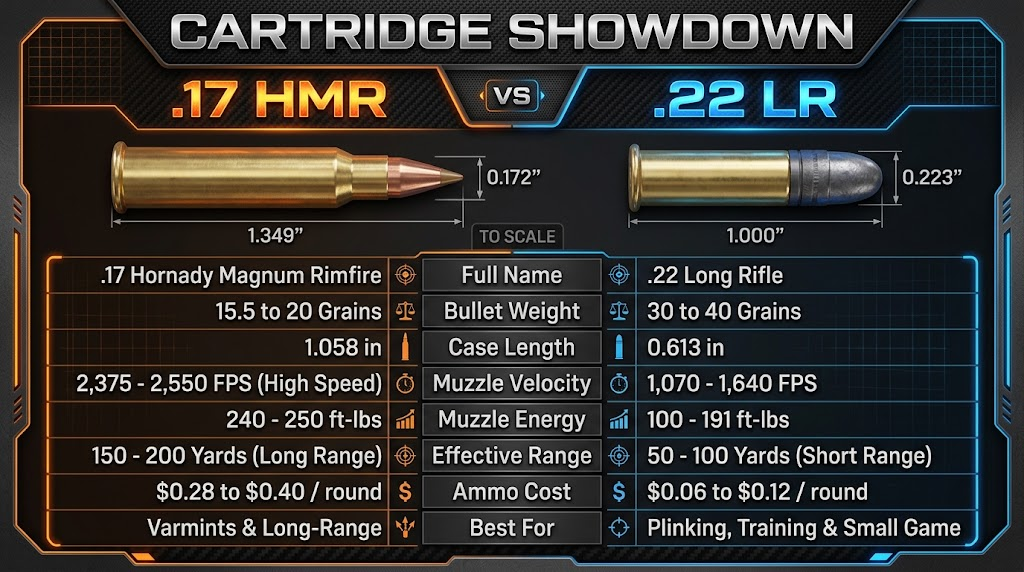
When comparing .17 HMR vs .22 LR, the most defining difference is the physical dimension of the cartridge and the bullet it fires. The .17 HMR was created by taking a .22 Winchester Magnum Rimfire case and necking it down to accept a much smaller .172-caliber projectile. Because this large magnum case holds a substantial amount of gunpowder and pushes a very light bullet, the .17 HMR achieves blistering velocities.
This dramatic increase in speed directly yields superior kinetic energy, a remarkably flat bullet trajectory, and an extended practical hunting range. While a .22 LR projectile experiences severe bullet drop beyond 75 yards, a .17 HMR bullet stays relatively flat and delivers lethal energy out to 150 or even 200 yards. However, these performance gains require compromises. The .17 HMR generates a louder muzzle blast and requires slightly more frequent barrel cleaning due to copper fouling from the high-velocity jacketed bullets. Ammunition cost is another primary differentiator, as .22 LR is typically a fraction of the cost of .17 HMR. Consequently, the .22 LR thrives in target shooting and close-range small game applications, while the .17 HMR excels in varmint hunting at extended distances.
.17 HMR vs .22 LR Dimensions
Cartridge dimensions dictate powder capacity, chamber compatibility, and barrel bore requirements. Although both are rimfire cartridges, their cases and projectiles are entirely different in size and shape.
Based on specifications published by the Sporting Arms and Ammunition Manufacturers’ Institute (SAAMI), the .17 HMR measures:
- Bullet diameter: 0.172 inches
- Case length: 1.058 inches
- Rim diameter: 0.294 inches
- Case base diameter: 0.238 inches
- Overall cartridge length: 1.349 inches
The .22 LR measures:
- Bullet diameter: 0.223 to 0.2255 inches
- Case length: 0.613 inches
- Rim diameter: 0.278 inches
- Case diameter: 0.226 inches
- Overall cartridge length: 1.000 inches
The .17 HMR case is significantly longer and features a distinct bottleneck design that tapers down to hold the smaller .172-inch bullet. A .17 HMR cartridge will physically not fit into a .22 LR chamber.
.17 HMR vs .22 LR Velocity
Velocity controls both trajectory and kinetic energy.The .17 HMR is fundamentally faster than the .22 LR because its longer casing accommodates a large powder charge while pushing a bullet that is half the weight of a standard .22 LR projectile.
Comparing representative factory loads tested from standard rifle barrels yields the following figures:
- Hornady V-MAX .17 HMR (17-grain polymer tip): 2,550 fps.
- CCI GamePoint .17 HMR (20-grain jacketed soft point): 2,375 fps.
- Federal AutoMatch .22 LR (40-grain lead round nose): 1,200 fps.
- CCI Standard Velocity .22 LR (40-grain lead round nose): 1,070 fps.
The .17 HMR routinely produces well over double the muzzle velocity of standard .22 LR ammunition. This massive speed advantage is the primary reason for the cartridge’s legendary flat trajectory.
.17 HMR vs .22 LR Energy
Muzzle energy measures the striking force of the bullet, which is a critical metric for hunting applications. Energy relies on both bullet weight and velocity. Even though the .17 HMR fires a much lighter bullet, its extreme velocity allows it to produce significantly greater kinetic energy than the heavier .22 LR.
Representative muzzle energy figures based on manufacturer specifications include:
- Hornady V-MAX .17 HMR (17-grain): 245 ft-lbs.
- CCI GamePoint .17 HMR (20-grain): 250 ft-lbs.
- Federal AutoMatch .22 LR (40-grain): 128 ft-lbs.
- CCI Standard Velocity .22 LR (40-grain): 102 ft-lbs.
This energy gap drastically alters practical performance in the field. A .17 HMR delivers roughly double the muzzle energy of a high-velocity .22 LR. At 100 yards, a .17 HMR bullet frequently retains more kinetic energy than a standard .22 LR bullet produces right at the muzzle.
.17 HMR vs .22 LR Range
When evaluating .17 HMR vs .22 LR range, shooters must clearly differentiate practical range, effective range, and maximum projectile travel. Maximum projectile travel denotes the absolute distance the bullet can fly if launched at an optimal upward angle. Both of these rimfire projectiles can travel over a mile under ideal circumstances, requiring a safe and reliable backstop for every shot. Maximum projectile travel is never equivalent to an effective shooting range.
Effective range specifies the maximum distance at which a bullet retains sufficient accuracy, velocity, and energy to ethically dispatch game. For the .22 LR, the effective hunting range maxes out around 50 to 75 yards on thin-skinned small game. Target shooters routinely push the .22 LR out to 100 yards, though the bullet experiences severe drop at that distance.
The .17 HMR retains functional velocity and striking energy much further downrange.Because it exits the muzzle at roughly 2,550 fps, gravity has less time to pull the bullet downward over a given distance.A shooter can zero a .17 HMR rifle at 100 yards and effectively strike small targets or varmints out to 150 or even 200 yards with predictable holdovers.
.17 HMR vs .22 LR Accuracy
Accuracy relies on the quality of the firearm and the consistency of the ammunition. Both cartridges are highly accurate, but they achieve precision in different ways.
In documented independent testing, the .22 LR is universally chosen for Olympic and benchrest target competitions because manufacturers like Eley and Lapua produce specialized, extreme-precision match ammunition. Fired from a premium bolt-action rifle, this ammunition can routinely stack five shots into groups measuring under 0.5 inches at 50 yards.
The .17 HMR is primarily produced as a field hunting cartridge, yet it is famous for its inherent out-of-the-box accuracy. Because all .17 HMR ammunition is manufactured with modern jacketed bullets rather than simple lead solids, it performs exceptionally well in standard consumer firearms. Independent tests generally show .17 HMR rifles delivering 1.0-inch groups or better at 100 yards utilizing factory ammunition. The .17 HMR’s higher velocity also makes it significantly less susceptible to wind drift at 100 yards compared to the slower .22 LR.
.17 HMR vs .22 LR Recoil
Both of these cartridges are celebrated for their exceptionally light recoil. Cartridge energy and the overall weight of the firearm dictate the perceived recoil impulse.
When discharged from a standard 6-pound rifle, a .22 LR produces approximately 0.2 foot-pounds of free recoil energy. A .17 HMR fired from a similar rifle generates roughly 0.3 to 0.4 foot-pounds. While the .17 HMR mathematically produces slightly more recoil force, the actual sensation felt by the shooter remains virtually non-existent. Both cartridges generate less than half a foot-pound of recoil in a long gun, making them entirely comfortable for shooters of all ages and sizes to fire all day without fatigue.
.17 HMR vs .22 LR Ammunition Cost
Ammunition cost heavily favors the .22 LR, which remains the most affordable factory ammunition available worldwide. Current retail prices determine how often a shooter can practice without financial strain. Normal retail pricing should always be distinguished from temporary clearance sales or bulk-purchase discounts.
As of September 2026, representative retail prices for common factory loads indicate:
- Federal AutoMatch .22 LR (40-grain, 325-round bulk box): $19.50 to $26.00 per box, equating to $0.06 to $0.08 per round.
- CCI Standard Velocity .22 LR (40-grain, 50-round box): $4.50 to $6.00 per box, equating to $0.09 to $0.12 per round.
- Hornady V-MAX .17 HMR (17-grain, 50-round box): $16.00 to $19.00 per box, equating to $0.32 to $0.38 per round.
- CCI GamePoint .17 HMR (20-grain, 50-round box): $17.00 to $20.00 per box, equating to $0.34 to $0.40 per round.
Practicing with a .17 HMR typically costs three to four times as much per trigger pull as practicing with a standard .22 LR.
.17 HMR vs .22 LR For Hunting
Hunting highlights the most practical differences between the two cartridges. The .22 LR serves as a phenomenal small game cartridge for harvesting squirrels, rabbits, and similar animals. At distances inside 50 yards, a standard 40-grain solid bullet or a 36-grain hollow point will cleanly anchor small game without ruining edible meat.
The .17 HMR provides a massive advantage over the .22 LR when targeting resilient varmints and pests, including groundhogs, prairie dogs, and coyotes.The ultra-high velocity ensures that the specialized polymer-tipped bullets fragment violently upon impact, delivering devastating terminal performance.Furthermore, the .17 HMR allows hunters to ethically take shots at 150 to 200 yards. However, the .17 HMR is often considered too destructive for small edible game like squirrels, as the explosive fragmentation can completely ruin the meat.
.17 HMR vs .22 LR For Target Shooting
For plinking, skills training, and recreational target shooting, the .22 LR is unmatched. The combination of practically zero recoil, low noise, and incredibly inexpensive ammunition makes it the ideal choice for high-volume range sessions. Formal competitive shooting disciplines are structured entirely around the .22 LR cartridge due to the wide availability of extreme-precision match ammunition.
The .17 HMR is incredibly fun for target shooting due to its laser-flat trajectory and resistance to wind drift, making it exceptionally easy to ring small steel targets at 100 or 150 yards. However, it is less ideal for high-volume training because the ammunition is simply too expensive. A shooter will quickly spend a significant amount of money during a casual afternoon of plinking with a .17 HMR compared to a .22 LR.
.17 HMR vs .22 LR For Beginners
For new shooters, the .22 LR stands as the absolute best choice. The complete absence of recoil and the very mild report prevent inexperienced shooters from developing a flinch response. A beginner can dedicate hours to mastering sight alignment, breathing, and trigger control without physical fatigue or heavy financial costs. Additionally, .22 LR rifles are highly affordable and available in every conceivable action type.
The .17 HMR is perfectly safe for a novice to fire, as its recoil is still virtually non-existent. However, the sharper, high-pitched muzzle blast can be startling to a brand new shooter, and the elevated cost of ammunition actively discourages the frequent practice necessary to build solid marksmanship habits. The most practical recommendation is to learn the fundamentals on a .22 LR platform and purchase a .17 HMR later if the individual specifically needs a dedicated varmint hunting rifle.
.17 HMR vs .22 LR Firearms
Firearm manufacturers support both cartridges with a vast array of platforms. For the .22 LR, consumers can select from bolt-action rifles, semi-automatic rifles, lever-action rifles, pump-action rifles, single-action revolvers, double-action revolvers, and semi-automatic pistols. Legendary models like the Ruger 10/22 ensure the .22 LR market remains massive.
Firearms chambered for the .17 HMR heavily feature bolt-action rifles from makers like Savage Arms, Ruger, and CZ. There are notably fewer semi-automatic rifles and pistols chambered in .17 HMR because the high operating pressures and distinct bottleneck cartridge shape complicate the engineering required for a reliable blowback action. Lever-action rifles and single-action revolvers are also available in .17 HMR, though bolt-actions remain the most popular format.
Can .17 HMR And .22 LR Use The Same Gun?
No, standard .17 HMR and .22 LR cartridges cannot safely be fired from the same gun chamber. The chamber dimensions and bore diameters specified for each cartridge are completely incompatible.
The .22 LR requires a barrel bored for a .22-caliber projectile. The .17 HMR requires a barrel specifically bored for a smaller .17-caliber projectile. Even if the chamber dimensions were identical, attempting to force a .22-caliber bullet down a .17-caliber barrel would cause a catastrophic explosion. You cannot swap between these two calibers without changing the entire barrel and chamber.
.17 HMR vs .22 LR Ammunition Compatibility
Ammunition compatibility is strictly determined by the exact cartridge name stamped on the barrel of the firearm.
- .17 HMR is not interchangeable with .22 LR.
- .22 LR is not interchangeable with .17 HMR.
If a shooter attempts to insert a .17 HMR into a standard .22 LR chamber, the bolt will not close because the cartridge is too long.If a shooter drops a .22 LR into a .17 HMR chamber, it will drop in but fit very loosely, and the bullet will be entirely too wide for the barrel. Firing incorrect ammunition is highly dangerous and can result in severe physical injury and the total destruction of the firearm. Always read the barrel stamping before loading any ammunition.
Pros And Cons
.17 HMR Pros And Cons
Pros:
- Extreme velocity provides a laser-flat trajectory over distance.
- Greater kinetic energy ensures reliable terminal performance on game.
- Extended practical range makes it highly effective for varmint hunting.
- High inherent accuracy with standard factory ammunition.Cons:
- Ammunition costs significantly more per round than .22 LR.
- Produces a sharper, louder report.
- Explosive bullet fragmentation can ruin edible meat on small game.
.22 LR Pros And Cons
Pros:
- Low ammunition cost enables affordable high-volume practice.
- Massive availability of firearms and ammunition worldwide.
- Extremely quiet operation and zero perceptible recoil.
- Perfect for hunting small edible game without meat destruction.Cons:
- Lower velocity limits kinetic energy and terminal performance.
- Severe bullet drop heavily restricts effective hunting range.
Manufacturer Data vs Independent Testing
When reviewing ballistics, readers must understand the difference between promotional manufacturer specifications and independent chronograph testing. Ammunition manufacturers typically measure velocity using specialized 24-inch laboratory test barrels. These extended barrels yield higher speeds than a consumer will achieve using a standard 16 or 18-inch field rifle.
Independent chronograph testing provides a highly realistic baseline for actual field performance. When reputable firearms publications test factory ammunition, the recorded velocities are frequently slower than the figures printed on the retail box. Likewise, ballistic calculator estimates utilize mathematical formulas based on standard atmospheric conditions, which can differ notably from user-submitted reports recorded in varying temperatures or altitudes. When reputable sources provide conflicting figures, controlled independent testing through a standard consumer firearm represents the most practical data source.
FAQs
What is the main difference between .17 HMR and .22 LR?
The main difference is the case size and bullet diameter. The .17 HMR uses a larger case to fire a tiny, lightweight bullet at over 2,500 feet per second, giving it a much flatter trajectory and more energy than the slower, heavier .22 LR.
Is .17 HMR more powerful than .22 LR?
Yes. The .17 HMR generates roughly double the kinetic energy of a standard .22 LR at the muzzle, making it vastly more powerful on impact.
Is .17 HMR faster than .22 LR?
Yes. The .17 HMR routinely achieves muzzle velocities over 2,500 feet per second, whereas most standard .22 LR ammunition operates between 1,070 and 1,260 feet per second.
Which has more range, .17 HMR or .22 LR?
The .17 HMR has a substantially longer effective range. While the .22 LR is excellent inside of 75 yards, the .17 HMR maintains sufficient velocity and energy to hunt varmints effectively out to 200 yards.
Which is more accurate, .17 HMR or .22 LR?
Both are highly accurate. The .17 HMR often produces better accuracy out of the box with standard factory ammunition, but the .22 LR dominates competitive target shooting due to the availability of specialized, extreme-precision match ammunition.
Which has less recoil?
Both cartridges produce virtually zero recoil. The difference is mathematically minimal and practically imperceptible to the shooter.
Which is cheaper to shoot?
The .22 LR is considerably cheaper. It typically costs between 6 and 12 cents per round, while the .17 HMR typically costs between 28 and 40 cents per round.
Is .17 HMR better for hunting?
It depends entirely on the game. For small edible animals like squirrels, the .22 LR is preferred because it will not destroy the meat. For larger varmints like groundhogs or coyotes at longer distances, the .17 HMR is vastly superior.
Can a .17 HMR shoot .22 LR?
No. A .22 LR bullet is too wide to fit down a .17 HMR barrel, and the cartridge dimensions are completely different.
Can a .22 LR shoot .17 HMR?
No. A .17 HMR cartridge is too long to physically fit into a .22 LR chamber.
Are .17 HMR and .22 LR interchangeable?
No. The ammunition is never interchangeable. You must only load the specific ammunition that is stamped on the barrel of your firearm.
Which is better for beginners?
The .22 LR is the best choice for beginners. The low noise, lack of recoil, and highly affordable ammunition allow a new shooter to practice fundamental marksmanship skills comfortably and frequently.