The key 300 Blackout case dimensions include a maximum case length of 1.368 inches (34.75 mm) and a maximum overall cartridge length of 2.260 inches (57.40 mm). The case features a 0.378-inch rim diameter, a 0.376-inch base diameter, a 0.360-inch shoulder diameter, and a maximum neck diameter of 0.334 inches. The neck length measures approximately 0.266 inches to securely hold .30-caliber projectiles. When reviewing these measurements, note that published dimensions may include nominal values, maximum limits, or specific tolerances depending on whether they originate from SAAMI, C.I.P., or individual manufacturer specifications. These exact dimensions allow the cartridge to seamlessly utilize standard 5.56 NATO magazines and AR-15 bolt faces.
300 Blackout Case Dimensions
| Case Dimension | Inches | Millimeters | Specification Type | Source | Notes |
| Case Length | 1.368 | 34.75 | Maximum | SAAMI / C.I.P. | Trim-to length is typically 1.358″ |
| Rim Diameter | 0.378 | 9.60 | Maximum | SAAMI | Matches the 5.56 / .223 bolt face |
| Base Diameter | 0.3759 | 9.55 | Nominal Maximum | SAAMI | Often simplified to 0.376″ in manufacturer data |
| Shoulder Diameter | 0.360 | 9.14 | Nominal | SAAMI | Expanded from the 5.56 parent case |
| Neck Diameter | 0.334 | 8.48 | Maximum | SAAMI | Must accommodate a 0.308-inch bullet |
| Neck Length | ~0.266 | 6.76 | Nominal | Derived | Ensures adequate neck tension for heavy projectiles |
| Shoulder Angle | 17.5° | N/A | Nominal | SAAMI | Shallower than the 5.56 NATO (23 degrees) |
| Overall Cartridge Length | 2.260 | 57.40 | Maximum | SAAMI | Constrained by standard AR-15 magazine internal limits |
| Case Capacity | ~23 to 26.5 gr H2O | ~1.49 to 1.72 cm³ | Measured Range | Industry / Mfg | Varies based on brass brand and wall thickness |
| Maximum Pressure | 55,000 psi | 380 MPa | Maximum Average | SAAMI | C.I.P. maximum is slightly higher at 56,565 psi |
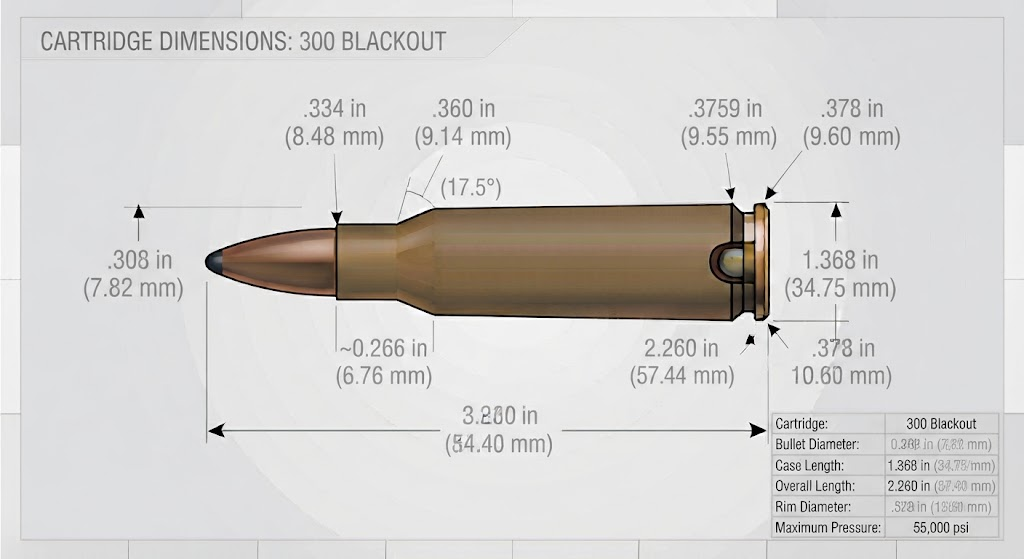
Understanding The 300 Blackout Case Dimensions
To fully grasp how the 300 AAC Blackout operates, it helps to understand what each specific measurement dictates inside the firearm:
- Case length: Measured from the base of the rim to the case mouth, this dictates how far the brass extends into the chamber.
- Rim diameter: The width of the extraction rim at the very bottom of the case. Because this perfectly matches the 5.56 NATO, the 300 Blackout requires no bolt face modifications.
- Base diameter: The width of the case body just above the extractor groove. It remains nearly identical to the .223 Remington to fit smoothly inside standard magazines.
- Shoulder diameter: The width of the case right before it tapers inward. The 300 Blackout shoulder is slightly wider than the 5.56 to match the shortened case body.
- Neck diameter: The outside diameter of the case mouth once a bullet is seated.
- Neck length: The straight portion of the case that grips the bullet. Proper neck tension is crucial, particularly for heavy 220-grain subsonic bullets.
- Shoulder geometry: The 17.5-degree angle that stops the cartridge in the chamber, establishing proper headspace.
- Overall cartridge length: The total length of the assembled round (brass plus bullet). This must not exceed 2.260 inches to feed reliably through AR-15 magazines.
- Case capacity: The internal volume of the case, typically measured in grains of water (H2O), dictating how much powder can be safely loaded.
300 Blackout Case Dimensions In Inches And Millimeters
A reliable 300 Blackout dimensions chart makes conversions simple. Here are the primary 300 Blackout dimensions in mm and inches, reflecting official maximum and nominal tolerances:
| Dimension | Inches | Millimeters |
| Maximum Case Length | 1.368″ | 34.75 mm |
| Base Diameter | 0.376″ | 9.55 mm |
| Rim Diameter | 0.378″ | 9.60 mm |
| Shoulder Diameter | 0.360″ | 9.14 mm |
| Neck Diameter | 0.334″ | 8.48 mm |
| Overall Cartridge Length | 2.260″ | 57.40 mm |
300 Blackout Case Length
The SAAMI maximum 300 Blackout case length is standardized at 1.368 inches (34.75 mm). Because brass flows forward under the intense pressure of firing (55,000 psi), fired and resized cases often stretch. If the case elongates past 1.368 inches, the case mouth can pinch against the end of the chamber, dangerously spiking internal pressure. For this reason, reloaders typically use a “trim-to” length of 1.358 inches to ensure consistent chamber fit and safe ammunition performance.
300 Blackout Base And Rim Dimensions
The 300 Blackout was intentionally designed to utilize the existing AR-15 ecosystem. Its 0.378-inch rim diameter and 0.376-inch base diameter are inherited directly from the .223 Remington / 5.56 NATO family. This means a standard AR-15 bolt face grips the 300 Blackout rim perfectly. The base diameter tapers only slightly toward the shoulder, allowing the rounds to stack smoothly in standard double-stack magazines without binding.
300 Blackout Shoulder And Neck Dimensions
Unlike the sharp 23-degree shoulder of the 5.56 NATO, the 300 Blackout uses a shallower 17.5-degree shoulder angle. The shoulder diameter sits at 0.360 inches, and it drops down to a neck diameter of 0.334 inches (maximum) to firmly hold a 0.308-inch projectile. The case geometry above the body is vital for two reasons: it aligns the heavier .30-caliber bullet concentrically with the bore, and it serves as the cartridge’s headspacing datum, preventing the round from sliding too deep into the chamber.
300 Blackout Case Capacity
While external dimensions are standardized, internal 300 Blackout case capacity is not uniform. Capacity typically ranges between 23 and 26.5 grains of water (H2O). This variance happens because different brass manufacturers use different case-wall thicknesses.
Brass factory-formed specifically for 300 Blackout often has thinner walls and slightly higher capacity (closer to 25 to 26 grains). Conversely, 300 Blackout brass converted from military 5.56 NATO cases usually features thicker walls, reducing internal capacity to around 23 to 24 grains. This difference in internal volume significantly alters pressure; a safe maximum powder charge in a high-capacity case can cause a dangerous overpressure event in a low-capacity case.
300 Blackout Case Dimensions vs 5.56 NATO
The 300 Blackout was built by shortening and widening the 5.56 case. Below is a dimensional comparison:
| Dimension | 300 Blackout | 5.56 NATO / .223 Remington | Source |
| Case Length | 1.368″ (34.75 mm) | 1.760″ (44.70 mm) | SAAMI |
| Rim Diameter | 0.378″ (9.60 mm) | 0.378″ (9.60 mm) | SAAMI |
| Base Diameter | 0.376″ (9.55 mm) | 0.377″ (9.57 mm) | SAAMI |
| Shoulder Diameter | 0.360″ (9.14 mm) | 0.354″ (8.99 mm) | SAAMI |
| Neck Diameter | 0.334″ (8.48 mm) | 0.253″ (6.43 mm) | SAAMI |
| Overall Cartridge Length | 2.260″ (57.40 mm) | 2.260″ (57.40 mm) | SAAMI |
| Case Capacity | ~23 to 26.5 gr H2O | ~28 to 30.5 gr H2O | Industry Data |
Note: The identical rim and overall cartridge lengths mean both cartridges use the same magazines and bolts. However, this dimensional overlap presents a serious safety risk: a 300 Blackout round can physically be forced into a 5.56 chamber, which will result in a catastrophic firearm destruction if fired. The cartridges are not interchangeable.
300 Blackout Case Dimensions vs 7.62x39mm
While both fire .30-caliber projectiles and offer similar kinetic energy, their case architectures are fundamentally different.
The 7.62x39mm relies on a highly tapered case body, a much wider base diameter (0.447 inches), and a larger rim. Because of this severe taper, 7.62x39mm requires highly curved magazines and a widened bolt face. The 300 Blackout uses a straight-wall approach with minimal taper, allowing it to feed reliably through perfectly straight AR-15 magazine wells without modified bolts. Additionally, the 7.62×39 uses a 0.311/0.312-inch bullet, while the 300 Blackout uses a standard 0.308-inch bullet. The two cartridges are completely incompatible.
300 Blackout Case Dimensions vs 300 Whisper
The 300 Whisper was developed by J.D. Jones as a proprietary “wildcat” cartridge. The 300 AAC Blackout case dimensions were essentially a formalized, SAAMI-standardized version of the 300 Whisper concept. General case geometry, length, base, and rim dimensions are nearly identical.
Because SAAMI finalized the 300 Blackout specifications with a slightly longer throat to accommodate a wider variety of ammunition, 300 Whisper ammunition can typically be fired safely in 300 Blackout chambers. However, because 300 Whisper lacks a unified SAAMI specification, tolerances can vary by manufacturer, and interchangeability is not universally guaranteed.
300 Blackout Cartridge And Chamber Dimensions
A firearm’s chamber must precisely mirror the cartridge. The 300 Blackout headspaces off the 17.5-degree case shoulder. When the bolt drives the cartridge forward, the case shoulder stops against the matching chamber shoulder. This prevents the round from seating too deeply. If a case is resized too far, creating “excessive headspace,” the firing pin may fail to detonate the primer, or the case could rupture upon firing. Proper chamber fit ensures reliable feeding from the magazine, safe firing pressures, and clean extraction.
300 Blackout Case Forming And Resizing
Because the 300 BLK case dimensions share the base and rim of the 5.56 NATO, manufacturers and experienced reloaders frequently form 300 Blackout brass from the 5.56 parent case. Conceptually, this involves severing the 5.56 case just below its original shoulder. The shortened brass is then lubricated and driven into a 300 Blackout sizing die, which forces the brass into the new 17.5-degree shoulder angle and opens the neck to accept a 0.308-inch bullet.
Manufacturer Specifications vs Actual Measurements
When researching 300 Blackout dimensions, it is critical to distinguish between maximum specifications and actual measurements. SAAMI dictates a maximum average pressure of 55,000 psi, while the European C.I.P. standard allows up to 56,565 psi.
Similarly, SAAMI maximum case length is 1.368 inches. If you measure a brand-new factory cartridge with calipers, you will often find it measures closer to 1.358 inches. Manufacturers intentionally produce brass slightly under the absolute maximum limit. This built-in tolerance guarantees that their ammunition will chamber easily and safely across a vast array of different rifle brands, accounting for minor chamber variations.
Common Questions
What are the 300 Blackout case dimensions?
Key dimensions include a 1.368-inch max case length, 0.378-inch rim diameter, 0.376-inch base diameter, 0.360-inch shoulder diameter, and a 0.334-inch max neck diameter.
What is the 300 Blackout case length?
The official SAAMI maximum case length for the 300 Blackout is 1.368 inches (34.75 mm).
What is the 300 Blackout base diameter?
The nominal base diameter is 0.3759 inches, identical to its parent case, the .223 Remington.
What is the 300 Blackout rim diameter?
The rim diameter is 0.378 inches, allowing it to utilize standard 5.56 NATO/AR-15 bolt faces.
What is the 300 Blackout shoulder diameter?
The shoulder diameter measures 0.360 inches, meeting the neck at a 17.5-degree angle.
What is the 300 Blackout neck diameter?
The maximum neck diameter is 0.334 inches.
What is the 300 Blackout case capacity?
Depending on the brass manufacturer and wall thickness, capacity ranges from roughly 23 to 26.5 grains of H2O.
Is 300 Blackout case length the same as 5.56?
No. The 300 Blackout case length is 1.368 inches, whereas the 5.56 NATO case length is 1.760 inches.
How does 300 Blackout case size compare with 5.56?
They share the exact same rim diameter and base diameter, as well as the same overall assembled cartridge length (2.260 inches). However, the 300 Blackout case is drastically shorter and features a much wider neck.
How does 300 Blackout compare with 7.62×39 case dimensions?
The 7.62×39 has a much wider base (0.447 inches), severe body taper, larger rim, and slightly longer case length. They are dimensionally incompatible.
Is 300 Blackout the same case as 300 Whisper?
They are nearly identical in case geometry, but the 300 Blackout was officially standardized by SAAMI, whereas the 300 Whisper is a proprietary wildcat cartridge.
What is the 300 Blackout overall cartridge length?
The maximum overall length (OAL) is 2.260 inches (57.40 mm), allowing it to fit standard AR-15 magazines.
What is the 300 Blackout maximum pressure?
The SAAMI maximum average pressure is 55,000 psi, while C.I.P. standards rate it slightly higher at 56,565 psi.