When selecting a rimfire rifle, the 22LR twist rate plays a crucial role in stabilizing your bullet for maximum accuracy. The most common .22 LR twist rate is 1:16, which perfectly stabilizes standard 36-grain and 40-grain projectiles. Twist rate relates directly to the length and weight of the bullet, dictating how fast the projectile must spin to maintain a true flight path. While 1:16 is the industry standard for most factory rifles, specialized heavy or subsonic rounds often require much faster twists, like 1:9, to prevent keyholing. Always remember that individual barrel dynamics, ammunition types, and bullet lengths can produce vastly different downrange results.
22LR Twist Rate Chart
| Twist Rate | Common .22 LR Bullet Weights | Typical Bullet Type | General Suitability |
| 1:9 | 60 grain | Extra-Heavy / Subsonic | Specialized heavy subsonic (e.g., Aguila SSS) |
| 1:12 | 45 – 50 grain | Heavy Subsonic / Solid | Suppressed shooting and heavy-for-caliber loads |
| 1:14 | 40 – 45 grain | Heavy Target / Subsonic | Niche intermediate twist for stabilized subsonics |
| 1:16 | 32 – 40 grain | Standard / High-Velocity | General purpose, target, hunting, and plinking |
Explaining the Chart
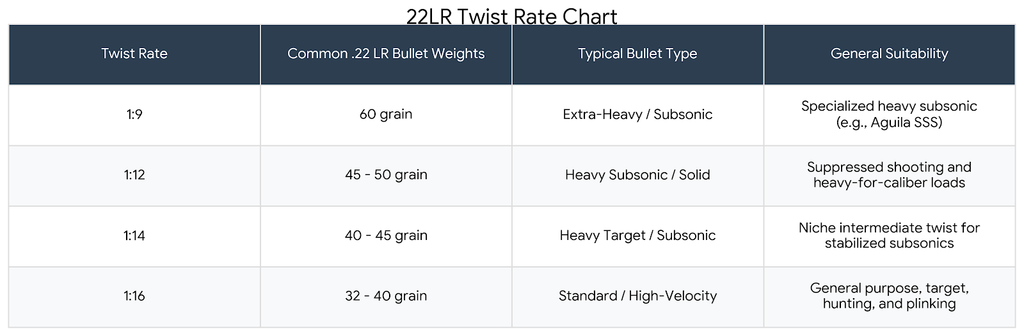
A .22 LR twist rate chart helps shooters match their barrel’s rifling to their ammunition. The numbers represent the ratio of barrel inches required for the bullet to complete one full rotation.
- What a 1:16 twist means: The bullet rotates one complete time for every 16 inches it travels down the barrel. This is the SAAMI standard and works flawlessly for the vast majority of .22 LR ammunition on the market.
- What a 1:12 twist means:The bullet spins faster, completing a rotation every 12 inches. It is increasingly popular for specialized suppressor-ready barrels shooting heavier 45-grain to 50-grain projectiles.
- What a 1:9 twist means: This is an exceptionally fast twist rate for rimfire, spinning the bullet one full rotation every 9 inches. It is primarily used to stabilize extremely long, heavy bullets like the 60-grain Aguila Sniper SubSonic (SSS).
Twist rate stabilizes the projectile using gyroscopic stability; the rapid spin prevents the bullet from yawing or tumbling end-over-end in flight. Interestingly, .22 LR commonly uses slower twists (like 1:16) than modern centerfire rifle cartridges (which often use fast twists like 1:7 or 1:9) because standard rimfire bullets are relatively short, light, and travel at lower velocities.
Because stability is dictated by the projectile’s bearing surface and overall physical footprint, bullet length can matter as much as weight. A lighter but unusually long bullet—such as monolithic copper solids—may require a faster twist than a standard lead bullet of the exact same weight.
22LR Twist Rate By Bullet Weight
| Bullet Weight | Typical .22 LR Load | Recommended Twist | Stability |
| 32 grain | CCI Stinger / Hyper-Velocity | 1:16 | Excellent |
| 36 grain | Bulk High-Velocity Hollow Point | 1:16 | Excellent |
| 38 grain | Subsonic Hollow Point | 1:16 | Excellent |
| 40 grain | Standard Velocity / Match Solid | 1:16 | Excellent |
| 45 grain | CCI Suppressor / Heavy Subsonic | 1:12 to 1:16 | Good to Excellent (1:12 preferred) |
| 50 grain | Cascade Subsonic / Custom Solid | 1:12 or 1:9 | Good (Requires faster twist to avoid yaw) |
Do not assume bullet weight alone determines the required twist rate. Because monolithic copper bullets and specialized shapes are longer than standard lead bullets of the same weight, they may require a faster twist to achieve optimal 22LR bullet stability.
What Is The Best Twist Rate For 22LR?
The best twist rate for 22LR is highly dependent on your ammunition choice, but for 95% of shooters, 1:16 is the optimal choice. It is the universally accepted standard for stabilizing the most common 32-grain to 40-grain projectiles. However, if your primary goal is shooting heavy subsonic loads suppressed, a 1:12 or 1:9 twist may be the “best” twist rate for your specific use case.
22LR 1:16 Twist Rate
The 22LR 1:16 twist is the gold standard for rimfire rifles. Adopted by SAAMI and utilized by major manufacturers like Ruger, CZ, and Savage, this twist rate imparts the perfect amount of spin on traditional 36-grain to 40-grain bullets. It offers an ideal balance, providing enough gyroscopic stability to ensure pinpoint accuracy at 50 to 100 yards without over-spinning and destabilizing lighter high-velocity rounds.
22LR 1:12 Twist Rate
A 22LR 1:12 twist is considered a “fast” rimfire twist and is gaining traction in the tactical and suppressed shooting communities. As shooters shift toward 45-grain and 50-grain subsonic loads to maximize terminal performance while keeping the report quiet, the 1:12 twist provides the necessary extra rotational velocity to keep these slightly longer bullets flying point-forward.
22LR 1:9 Twist Rate
The 22LR 1:9 twist is a highly specialized barrel configuration designed to solve a specific problem: stabilizing ultra-heavy 60-grain rimfire bullets. Bullets like the Aguila SSS are exceptionally long, and a standard 1:16 barrel will often fail to stabilize them, resulting in the bullet “keyholing” (hitting the target sideways). A 1:9 twist corrects this, making it a favorite for dedicated subsonic pest-control rifles.
22LR Twist Rate For 40 Grain Bullets
The best 22LR twist rate for 40 grain bullets is unequivocally 1:16. Since the 40-grain lead round nose is the historical standard for .22 LR target and match ammunition, the 1:16 twist was explicitly standardized around this projectile length and weight.
22LR Twist Rate For 38 Grain Bullets
The ideal 22LR twist rate for 38 grain bullets is 1:16. Many popular subsonic hollow points utilize a 38-grain bullet. Because this bullet is fractionally lighter and shorter than a 40-grain solid, it stabilizes beautifully in a standard 1:16 barrel, yielding excellent small-game accuracy.
22LR Twist Rate For 32 Grain Bullets
For hyper-velocity ammunition like the CCI Stinger, the best 22LR twist rate for 32 grain bullets is 1:16. Because 32-grain bullets are shorter and pushed at very high velocities (often exceeding 1,600 fps), they stabilize easily in standard barrels. While some custom benchrest shooters experiment with even slower twists (like 1:18) for ultra-light bullets, 1:16 remains the factory standard.
22LR Bullet Types
The type of projectile you shoot heavily influences stabilization:
- Standard lead round nose (40gr): The baseline bullet; perfectly suited for a 1:16 twist.
- Hollow point (36gr-38gr): Features a cavity for expansion. Performs flawlessly in 1:16 barrels.
- Match: Often 40gr, but manufactured with rigorous consistency. Some feature specific driving bands or slightly different ogives, but almost all are designed for 1:16 twists.
- Subsonic (40gr-60gr):Travels below the speed of sound. While 40gr subsonics work in 1:16, heavy 45gr+ subsonics may require a 1:12 or 1:9 twist due to their increased length.
- High-velocity (32gr-40gr): Driven faster, which actually aids in stabilization. These work perfectly in 1:16 barrels.
Bullet design and length profoundly affect stabilization. A lighter copper bullet will be longer than a lead bullet of the exact same weight, meaning it acts like a heavier bullet aerodynamically and may require a faster twist rate.
22LR Twist Rate And Bullet Stability
Gyroscopic stability is achieved through a delicate balance of twist rate, bullet length, bullet weight, velocity, the rifle barrel, and ammunition design.
When a bullet leaves the muzzle, it needs enough rotational speed to overcome the aerodynamic forces trying to flip it backward.
- Velocity: Higher velocity generates faster RPMs for a given twist rate. A bullet fired at high velocity might stabilize in a slow twist, while the same bullet fired at subsonic speeds might require a faster twist to achieve the same RPMs.
- Length:The longer the bullet, the faster the twist rate required to stabilize it.
Do not claim that every .22 LR bullet of the same weight requires exactly the same twist rate. Differences in bearing surface and material density (lead vs. copper) will alter the stability formula.
Barrel Length
A common misconception is that barrel length changes the actual twist rate. It does not.
Twist rate is a fixed mechanical specification cut into the rifling (e.g., one turn every 16 inches). Barrel length merely determines how long the bullet remains inside the rifling, which impacts velocity. A 16-inch barrel with a 1:16 twist spins the bullet exactly one time before it exits. A 24-inch barrel with a 1:16 twist spins the bullet one and a half times. Both barrels impart the exact same rate of spin relative to distance traveled. Do not confuse barrel length with twist rate.
Accuracy
Twist rate has a direct impact on 22LR accuracy. When a projectile is insufficiently stabilized (too slow of a twist), it will yaw in flight, opening up group sizes dramatically before eventually keyholing (striking the target sideways).
Conversely, if a bullet is excessively stabilized (spun far faster than necessary), any microscopic imperfections in the bullet’s center of mass are magnified. This can cause the bullet to wobble off its axis, degrading long-range accuracy. Therefore, one twist rate is never automatically more accurate with every .22 LR load. You must pair the twist rate to the projectile for peak precision.
Best Twist Rate By Use
| Use Case | Recommended Twist Rate | Typical Bullet Weight |
| General .22 LR | 1:16 | 36 – 40 grain |
| Target Shooting | 1:16 | 40 grain |
| Match Ammunition | 1:16 | 40 grain |
| Hunting | 1:16 | 36 – 40 grain |
| Lightweight Bullets | 1:16 | 32 – 36 grain |
| Heavier Bullets | 1:12 or 1:9 | 45 – 60 grain |
Pros And Cons
Slower Twist Rates
(Example: 1:16)
- Pros: Universally available; highly accurate with the vast majority of factory ammunition; prevents the over-spinning and destabilization of lightweight hyper-velocity loads.
- Cons: Cannot consistently stabilize ultra-heavy (45gr+) or unusually long specialized subsonic projectiles.
Faster Twist Rates
(Example: 1:9, 1:12)
- Pros: Safely and accurately stabilizes long, heavy projectiles (like the 60-grain Aguila SSS); ideal for dedicated suppressed setups where terminal energy relies on bullet mass rather than velocity.
- Cons: Can over-stabilize lightweight bullets, magnifying projectile imperfections and slightly degrading accuracy; less common and often requires a custom or aftermarket barrel.
22LR Twist Rate Chart: Which Twist Rate Is Best?
When reviewing the .22 LR twist rate chart, the final verdict is that 1:16 is commonly used for .22 LR and remains the best choice for the overwhelming majority of shooters. The rimfire cartridge was designed around 40-grain bullets, and the 1:16 twist flawlessly optimizes this weight class.
However, specialized shooting demands specialized gear. Here are the final recommendations:
- General shooting & Hunting: Stick with 1:16. It will reliably shoot everything from 32-grain Stingers to 40-grain solids.
- Target shooting & Match ammunition: Use 1:16. Elite match ammo is almost exclusively 40-grain.
- Lightweight bullets: Use 1:16. It provides plenty of stability without over-spinning.
- Heavier bullets: If you regularly shoot 45-grain to 60-grain subsonics, invest in a 1:12 or 1:9 twist barrel to prevent keyholing and ensure ethical impacts on game.
FAQs
What is the standard 22LR twist rate?
The industry standard 22LR twist rate is 1:16, meaning the bullet completes one full rotation every 16 inches of barrel length.
What is the best twist rate for 22LR?
For general use with 36-grain to 40-grain ammunition, the best twist rate for 22LR is 1:16. For heavy subsonics, 1:12 or 1:9 is best.
What does a 1:16 twist mean?
A 1:16 twist means that the rifling grooves inside the barrel force the bullet to make one complete 360-degree rotation every 16 inches of forward travel.
What is a 1:12 twist good for?
A 1:12 twist is excellent for stabilizing moderately heavy 22LR bullets, usually in the 45-grain to 50-grain range, making it highly effective for dedicated suppressed rifles.
What is a 1:9 twist good for?
A 1:9 twist is a specialized rate used almost exclusively to stabilize extremely long, heavy rimfire projectiles, most notably the 60-grain Aguila Sniper SubSonic (SSS).
What twist rate is best for 40 grain 22LR?
The 1:16 twist rate was designed specifically for standard 40-grain .22 LR bullets and provides optimal gyroscopic stability for them.
What twist rate is best for 32 grain 22LR?
A standard 1:16 twist barrel handles 32-grain lightweight bullets (like hyper-velocity hollow points) exceptionally well, providing excellent stability and accuracy.
Does 22LR bullet weight affect twist rate?
Yes. Heavier bullets typically require a faster twist rate (like 1:9 or 1:12) to stabilize, while lighter bullets perform best with standard twist rates (1:16).
Does bullet length affect 22LR twist rate?
Absolutely. Bullet length is actually the primary aerodynamic factor in stabilization. Longer bullets require a faster spin to remain stable in flight, regardless of their total weight.
Does barrel length affect twist rate?
No. Twist rate is the mechanical ratio of the rifling (e.g., 1 turn per 16 inches). Barrel length only dictates how much time the bullet spends inside the rifling, which influences velocity, not the rate of twist itself.
Can a 1:16 twist shoot heavier 22LR bullets?
A 1:16 twist can usually shoot 45-grain bullets with acceptable accuracy, but it will frequently fail to stabilize 60-grain bullets, causing them to tumble and “keyhole” on the target.
What is the most common 22LR twist rate?
The most common 22LR twist rate by far is 1:16. It is used by almost every major firearms manufacturer for factory rimfire rifles.
Does twist rate affect 22LR accuracy?
Yes. If the twist is too slow, the bullet will tumble. If the twist is unnecessarily fast, it can magnify weight imbalances within the bullet, potentially opening up group sizes at longer ranges. Proper matching is key to 22LR bullet stability.