The 45 ACP utilizes a 0.451-inch diameter bullet seated in a 0.898-inch straight-walled case, creating a maximum overall length of 1.275 inches. Typical bullet weights range from lightweight 185-grain defensive rounds to the traditional 230-grain full metal jacket. Muzzle velocities average between 830 and 1,000 fps, producing roughly 350 to 500 foot-pounds of muzzle energy from a standard 5-inch barrel. Standardized by SAAMI with a maximum operating pressure of 21,000 PSI, modern +P variants raise this limit to 23,000 PSI. Utilizing a standard 1:16 twist rate, standard 230-grain loads are naturally subsonic, making the cartridge a premier choice for suppressed semi-automatic handguns and pistol caliber carbines.
45 ACP Specs
| Specification | 45 ACP |
| Cartridge Name | .45 Automatic Colt Pistol (45 Auto) |
| Bullet Diameter | 0.451 inches |
| Bullet Weight | 185 grains to 230 grains |
| Case Length | 0.898 inches |
| Overall Length | 1.275 inches (maximum SAAMI) |
| Base Diameter | 0.476 inches |
| Neck Diameter | 0.473 inches |
| Rim Diameter | 0.480 inches |
| Shoulder Angle | None (Straight Wall) |
| Maximum Pressure | 21,000 PSI (Standard) / 23,000 PSI (+P) |
| Typical Twist Rate | 1:16 |
| Typical Barrel Length | 4 to 5 inches |
| Muzzle Velocity | 830 fps to 1,140 fps (varies by load) |
| Muzzle Energy | 350 to 500+ ft-lbs |
| Ballistic Coefficient | ~0.150 to 0.190 (G1) |
| Parent Case | None |
| Platform | Semi-Auto Pistol, Pistol Caliber Carbine |
| Supersonic Loads | Light +P loads (185gr) |
| Subsonic Loads | Standard 230-grain loads |
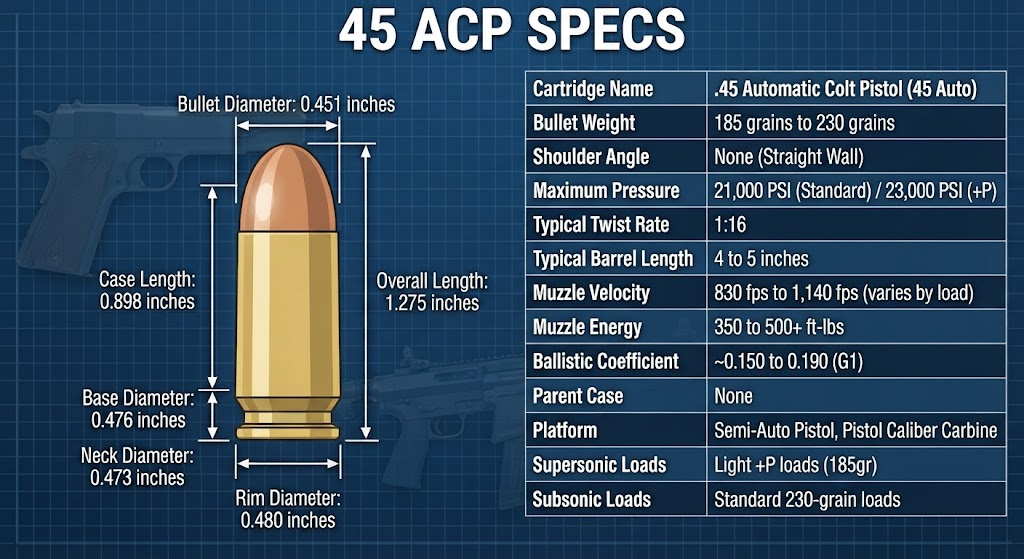
45 ACP Bullet Diameter
The 45 ACP bullet diameter is 0.451 inches for jacketed bullets, though lead cast bullets are often sized slightly larger at 0.452 inches to ensure proper engagement with the rifling. This massive frontal surface area creates a naturally large wound channel without relying entirely on hollow-point expansion.
45 ACP Case Length
The 45 ACP case length is officially 0.898 inches. Because it is a straight-walled rimless pistol cartridge, it headspaces directly on the case mouth rather than the rim.
45 ACP Overall Length
SAAMI established the 45 ACP overall length at a maximum of 1.275 inches. This specification dictates the dimensions of the grip and magazine well on 45-caliber firearms, which is why pistols like the 1911 or Glock 21 feature noticeably longer front-to-back grip frames than 9mm handguns.
45 ACP Bullet Weights
While 45 ACP bullet weight can span from 165 grains up to 255 grains, the overwhelming majority of factory ammunition relies on the 230-grain standard established over a century ago. Defensive shooters seeking higher velocities often drop down to 185-grain or 200-grain projectiles.
45 ACP Muzzle Velocity
The standard 45 ACP muzzle velocity is incredibly consistent. A 230-grain bullet fired from a 5-inch barrel typically leaves the muzzle at 830 to 850 fps. Lighter 185-grain +P loads can be pushed much faster, routinely breaking 1,000 to 1,140 fps.
45 ACP Muzzle Energy
Shooting a massive, heavy bullet at moderate speeds produces excellent 45 ACP muzzle energy, generally starting around 350 foot-pounds for standard target loads and peaking well over 500 foot-pounds with premium +P defensive ammunition.
45 ACP Maximum Pressure
The 45 ACP operates at a very low maximum pressure of just 21,000 PSI. This low-pressure environment results in a smooth, pushing recoil impulse rather than a sharp snap, and it drastically extends the service life of pistol barrels and internal components. Modern +P loads are rated slightly higher at 23,000 PSI.
45 ACP Twist Rate
A standard 45 ACP twist rate is 1:16 inches. This relatively slow twist is perfectly sufficient to stabilize the short, wide, and slow-moving projectiles.
45 ACP Barrel Length
The 45 ACP barrel length heavily dictates the size and concealability of the platform. The “Government” standard is a 5-inch barrel, which guarantees full powder burn and maximum velocity. “Commander” length 4.25-inch barrels and “Officer” length 3-inch to 3.5-inch barrels are highly popular for concealed carry, though they sacrifice measurable velocity.
45 ACP Ballistic Coefficient
Because pistol bullets are designed for short-range stopping power rather than long-range aerodynamic efficiency, the 45 ACP ballistic coefficient is quite poor. The blunt, round-nose 230-grain FMJ typically carries a G1 BC of approximately 0.190, causing it to drop rapidly past 50 yards.
Supersonic vs Subsonic
The 45 ACP is renowned globally for its natural subsonic characteristics. Because the standard 230-grain bullet is so heavy, it cannot be pushed past the speed of sound (roughly 1,125 fps at sea level) using standard pistol powders and safe pressures.
| Load Type | Typical Bullet Weight | Velocity | Muzzle Energy | Main Characteristic |
| Supersonic | 185 grains (+P) | ~1,140 fps | ~530 ft-lbs | High energy, sharp recoil, rapid expansion, loud |
| Subsonic | 230 grains | ~830 – 890 fps | ~350 – 400 ft-lbs | Standard performance, heavy mass, highly suppressor friendly |
Suppressing a 230-grain 45 ACP is highly effective because there is no miniature sonic boom as the bullet travels through the air. You do not need to buy specialized, expensive “subsonic” ammunition—standard 230-grain off-the-shelf target loads are already subsonic.
Factory Load Specifications
Reviewing 45 ACP cartridge specs through factory ammunition data highlights the vast difference in velocity between lightweight +P rounds and standard heavy ball ammo. (Velocities typically based on standard 5-inch test barrels).
- Federal American Eagle FMJ (Subsonic): 230 grain. Velocity: 890 fps. Muzzle Energy: 404 ft-lbs.
- Speer Gold Dot JHP (Subsonic): 230 grain. Velocity: 890 fps. Muzzle Energy: 404 ft-lbs.
- Winchester White Box FMJ (Subsonic): 230 grain. Velocity: 835 fps. Muzzle Energy: 356 ft-lbs.
- Hornady Critical Defense (Subsonic): 185 grain. Velocity: 1,000 fps. Muzzle Energy: 411 ft-lbs.
- Cor-Bon Jacketed Hollow Point +P (Supersonic): 185 grain. Velocity: 1,150 fps. Muzzle Energy: 543 ft-lbs.
Cartridge Dimensions
The 45 ACP dimensions feature a rimless, straight-walled case designed to stack efficiently inside standard pistol magazines.
| Dimension | Measurement |
| Bullet Diameter | 0.451 inches |
| Case Length | 0.898 inches |
| Overall Length | 1.275 inches |
| Base Diameter | 0.476 inches |
| Neck Diameter | 0.473 inches |
| Rim Diameter | 0.480 inches |
| Shoulder Angle | None (Straight Wall) |
Barrel Length
Because it utilizes fast-burning powders, the 45 ACP achieves peak efficiency very quickly, but it still suffers when barrel lengths are severely chopped for deep concealment.
- 3.0 to 3.5 inches (Sub-Compact): Frequently drops standard 230-grain velocity down to roughly 750 fps. At this speed, some older hollow-point designs fail to expand reliably.
- 4.0 to 4.25 inches (Compact): Typically averages around 800 fps. Provides an excellent balance of concealment and ballistic reliability.
- 5.0 inches (Full Size): The SAAMI standard length, pushing 230-grain bullets at their advertised 830 to 850 fps.
- 16 inches (PCC): Firing from a pistol caliber carbine maximizes the powder burn, often pushing standard 230-grain loads up to 950–1,000 fps, drastically increasing terminal energy.
Ballistics
The 45 ACP ballistics profile is strictly intended for short-range personal defense and combat. Because the bullet is massive and slow, it drops rapidly at extended distances. Trajectory data for a standard 230-grain FMJ load with a 25-yard zero:
- Muzzle: 830 fps | 352 ft-lbs | Drop: -0.5 in (bore height)
- 25-yard: 805 fps | 331 ft-lbs | Drop: 0.0 in (Zero)
- 50-yard: 785 fps | 315 ft-lbs | Drop: -2.3 in
- 100-yard: 745 fps | 284 ft-lbs | Drop: -14.8 in
Platform And Compatibility
The 45 ACP is deeply ingrained in American firearms culture, available in nearly every action type imaginable.
- 1911 Platform: The cartridge was literally invented for this pistol. It remains the gold standard for 45 ACP precision and trigger quality.
- Modern Polymer Pistols: Handguns like the Glock 21, Smith & Wesson M&P 45, and HK USP 45 offer drastically higher magazine capacities (10 to 15 rounds) compared to single-stack 1911s.
- Pistol Caliber Carbines (PCCs): Highly popular in platforms like the KRISS Vector, HK UMP, and AR-45 builds, serving as excellent suppressed home defense weapons.
45 ACP vs 9mm
This is the most debated cartridge comparison in handgun history, fundamentally contrasting light-and-fast against heavy-and-slow.
| Specification | 45 ACP | 9mm Luger |
| Bullet Diameter | 0.451 inches | 0.355 inches |
| Typical Bullet Weight | 230 grains | 115 – 147 grains |
| Muzzle Velocity (5″ Bbl) | ~830 fps (230gr) | ~1,150 fps (115gr) |
| Muzzle Energy | ~350 – 500 ft-lbs | ~350 – 400 ft-lbs |
| Maximum Pressure | 21,000 PSI | 35,000 PSI |
| Capacity (Full Size) | 8 to 13 rounds | 15 to 19 rounds |
| Supressor Host | Excellent (Naturally subsonic) | Good (Requires specialized 147gr loads) |
| Primary Advantage | Heavy mass, larger unexpanded hole | High capacity, fast follow-up shots |
The 9mm holds more rounds and snaps faster, while the 45 ACP produces a larger permanent cavity and pushes with a slower, heavier recoil impulse.
Pros And Cons
45 ACP Pros
- Excellent terminal performance. Even if a hollow point fails to expand, it still punches a massive 0.45-inch hole.
- Naturally subsonic with standard 230-grain loads, making it one of the absolute best pistol rounds to shoot through a suppressor.
- Operates at very low pressures, which causes less wear and tear on firearm internals and results in a smoother recoil impulse than high-pressure rounds.
- Massive ammunition variety and availability globally.
45 ACP Cons
- The physical diameter of the cartridge severely limits magazine capacity compared to modern 9mm handguns.
- The steep trajectory and heavy drop make it incredibly difficult to shoot accurately past 50 yards without significant holdovers.
- Firearms chambered in 45 ACP require larger grip frames, which can be difficult for shooters with smaller hands to control properly.
FAQs
What are the specifications of 45 ACP?
The 45 ACP pushes a 0.451-inch bullet from a 0.898-inch rimless case. Its maximum overall length is 1.275 inches, and it operates at a low SAAMI pressure of 21,000 PSI.
What is the bullet diameter of 45 ACP?
The exact 45 ACP bullet diameter is 0.451 inches for jacketed bullets and 0.452 inches for lead cast bullets.
What is the case length of 45 ACP?
The 45 ACP case length is exactly 0.898 inches.
What is the overall length of 45 ACP?
The maximum SAAMI 45 ACP overall length is 1.275 inches. This length limits how small the grip of a 45-caliber handgun can physically be designed.
What bullet weights are available for 45 ACP?
Standard factory ammo revolves heavily around the traditional 230-grain bullet. However, lighter 185-grain and 200-grain bullets are frequently used for higher-velocity defensive loads.
What is the muzzle velocity of 45 ACP?
The standard 45 ACP muzzle velocity for a 230-grain bullet is roughly 830 to 850 fps. Lighter 185-grain loads can reach 1,000 to 1,140 fps.
What is the muzzle energy of 45 ACP?
The 45 ACP muzzle energy typically ranges from 350 foot-pounds on target loads up to 500+ foot-pounds on premium defensive ammunition.
What is the maximum pressure of 45 ACP?
Standard pressure for the 45 ACP is just 21,000 PSI. Modern +P overpressure ammunition safely raises that limit to 23,000 PSI.
What is the twist rate for 45 ACP?
Standard barrels chambered for the 45 ACP generally use a 1:16 twist rate.
What is the heaviest 45 ACP bullet?
While 230 grains is the standard heavy load, some boutique manufacturers produce 255-grain hard cast lead bullets designed specifically for deep penetration on outdoor predators.
Is 45 ACP subsonic?
Yes, the vast majority of 45 ACP ammunition is naturally subsonic. Any standard 230-grain load fired at 830 fps is well below the speed of sound, making it a perfect suppressor host.
Is 45 ACP supersonic?
Rarely. Only lightweight 185-grain bullets loaded to +P pressures (or fired from long carbine barrels) will consistently break the 1,125 fps supersonic barrier.
What barrel length is best for 45 ACP?
A 5-inch barrel is considered the gold standard, providing the perfect balance of sight radius, reliability, and full powder burn.
Is 45 ACP compatible with an AR-15?
Yes, but you must build a dedicated Pistol Caliber Carbine (PCC). This requires a 45-caliber barrel, a 45 ACP blowback bolt, and a specialized lower receiver designed to accept 45-caliber magazines (often Glock 21 pattern).
How does 45 ACP compare with 9mm?
The 45 ACP is a low-pressure, heavy, slow-moving bullet that punches a larger hole and suppresses exceptionally well. The 9mm is a high-pressure, light, fast-moving bullet that offers nearly double the magazine capacity in similarly sized firearms.