Developed by Hornady as a high-performance big-bore intermediate cartridge, the .338 ARC specifications feature a standard bullet diameter of .338 inches and an overall cartridge length of 2.260 inches to fit standard AR-15 platforms.Factory loads range widely from 170-grain to 307-grain bullet weights, producing muzzle velocities spanning from a subsonic 1,050 fps up to a supersonic 2,075 fps.Resulting muzzle energies scale from approximately 752 ft-lbs for heavy subsonic payloads to over 1,600+ ft-lbs for supersonic options, functioning at maximum SAAMI pressure thresholds of roughly 30,000 PSI (subsonic) to 52,000 PSI (supersonic).It is purpose-built for suppressed tactical applications, short-barrel firearms, and close- to medium-range hunting.
.338 ARC Specs
| Specification | .338 ARC |
| Cartridge Name | .338 ARC (Advanced Rifle Cartridge) |
| Bullet Diameter | .338 in (8.58 mm) |
| Bullet Weight | 170 gr to 307 gr (depending on factory load) |
| Case Length | ~1.490 in (Derived from 6.5 Grendel case) |
| Overall Length | 2.260 in (Maximum SAAMI length for AR-15 compatibility) |
| Base Diameter | .441 in (6.5 Grendel / PPC family head) |
| Neck Diameter | Varies by load (~.365 in) |
| Shoulder Diameter | Varies by load (~.420 in) |
| Shoulder Angle | Standard ARC geometry |
| Rim Diameter | .441 in |
| Maximum Pressure | ~30,000 PSI (Subsonic) / ~52,000 PSI (Supersonic) |
| Typical Twist Rate | 1:8″ (Optimized for stabilizing heavy subsonics and supers) |
| Typical Barrel Length | 16 in (Standard benchmark for published factory velocities) |
| Muzzle Velocity | 1,050 fps (Subsonic) to 2,075 fps (Supersonic) |
| Muzzle Energy | ~752 ft-lbs (Subsonic) to ~1,625 ft-lbs (Supersonic variants) |
| Ballistic Coefficient | .375 G1 (307 gr Sub-X) |
| Parent Case | 6.5 Grendel |
| Platform | AR-15 / Micro-bolt action |
| Supersonic Loads | 170 gr MonoFlex, 175 gr HP Match, 215 gr FTX |
| Subsonic Loads | 307 gr SUB-X, 285 gr Frontier FMJ |
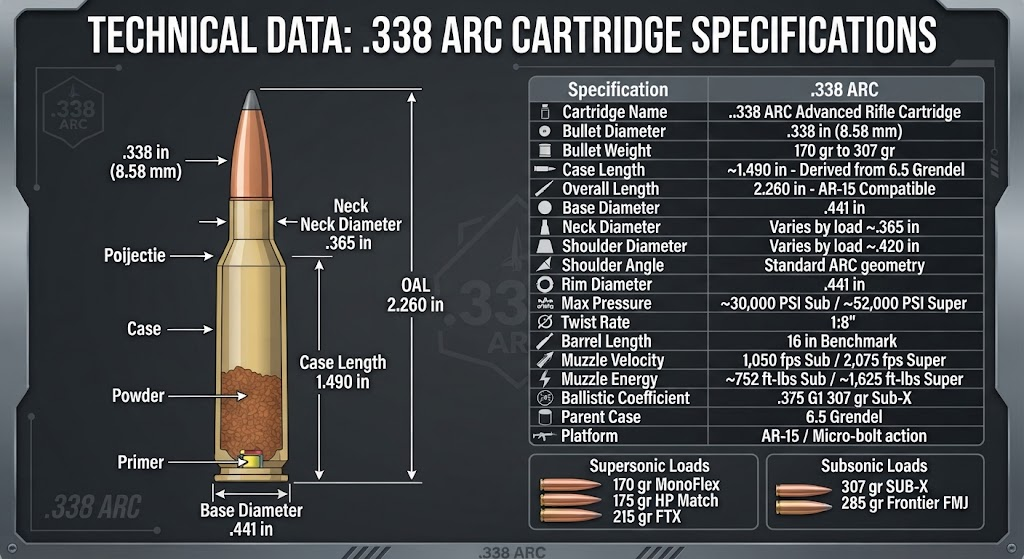
Explain The Specifications
.338 ARC Bullet Diameter
The .338 ARC bullet diameter measures .338 inches (8.58 mm). Adopting this classic bore size gives reloaders and shooters direct access to a massive inventory of heavy-payload projectiles historically reserved for large-caliber magnums like the .338 Winchester Magnum, allowing for exceptional frontal area and terminal mass transfer upon impact.
.338 ARC Case Length
The .338 ARC case length is optimized around a modified 6.5 Grendel geometry. This restricted volume footprint ensures that powder charges—especially in heavy subsonic configurations—occupy enough of the casing to promote consistent ignition, preventing the high standard deviations common in under-filled large-bore cases.
.338 ARC Overall Length
The .338 ARC overall length is constrained to a maximum of 2.260 inches.This critical dimension ensures seamless compatibility with standard AR-15 magazine wells and lower receivers without requiring heavy-frame AR-10 receivers.
.338 ARC Bullet Weights
.338 ARC bullet weights span a remarkably wide spectrum, ranging from light 170-grain supersonic hunting monolithic solids up to massive 307-grain subsonic projectiles. This spread allows the cartridge to transition effortlessly between high-velocity medium-game setups and silent, heavy-mass suppressed configurations.
.338 ARC Muzzle Velocity
.338 ARC muzzle velocity depends strictly on whether the ammunition is engineered for subsonic or supersonic flight.Subsonic loads cap out strictly near 1,050 fps to avoid the transonic crack barrier, while supersonic factory options achieve 2,075 fps out of a standard 16-inch test barrel.
.338 ARC Muzzle Energy
.338 ARC muzzle energy delivers heavy-hitting performance across all tiers. Subsonic loads yield approximately 752 ft-lbs of energy at the muzzle ( roughly 1.5 times the energy of standard .300 Blackout subsonic rounds), whereas supersonic iterations scale significantly higher for extended terminal effect.
.338 ARC Maximum Pressure
.338 ARC maximum pressure limits are rated differently based on load variants to ensure firearm longevity.Subsonic variants operate safely at lower pressure floors around 30,000 PSI, while high-velocity supersonic rounds push up to 52,000 PSI.
.338 ARC Twist Rate
The .338 ARC twist rate standard is 1:8 inches.This rate is tightly engineered to reliably stabilize exceptionally long, heavy-for-caliber projectiles like the 307-grain SUB-X while maintaining clean stability across lighter supersonic loads.
.338 ARC Ballistic Coefficient
The .338 ARC ballistic coefficient varies by projectile profile, with factory options like the 307-grain SUB-X registering a G1 BC of .375. This helps buck wind drift effectively within its designated engagement envelopes.
.338 ARC Barrel Length
.338 ARC barrel length specifications are typically benchmarked at 16 inches by Hornady for published velocity tables. However, because of its efficient powder capacity, the cartridge retains practical velocity profiles even when truncated down to short-barreled rifle (SBR) configurations.
Supersonic vs Subsonic
| Load Type | Bullet Weight | Velocity | Energy | Primary Purpose |
| Supersonic (Hornady HP Match / MonoFlex) | 170–175 gr | 2,075 fps | ~1,625 ft-lbs | Medium-game hunting and general-purpose carbine use |
| Subsonic (Hornady Sub-X / Frontier FMJ) | 285–307 gr | 1,050 fps | 752 ft-lbs | Suppressed close-range hunting and quiet tactical operations |
The heavy 307-grain Sub-X subsonic load maintains a velocity capped just beneath the speed of sound (~1,050 fps), relying strictly on massive physical mass (.338 diameter, 307 grains) and specially designed polymer flex-tips to expand reliably at impact velocities as low as 900 fps.Conversely, lighter supersonic variants shed structural weight to trade mass for high initial velocity, flattening trajectories out to 200 yards.
Factory Load Specifications
Current factory ammunition options provide specialized performance profiles, all tested via standard 16-inch test barrels:
- 170-grain MonoFlex (HornADY BLACK): Supersonic monolithic copper-alloy bullet engineered for lead-free medium-game hunting, traveling at an advertised 2,075 fps.
- 175-grain HP Match (Hornady BLACK): General-purpose supersonic match load hitting 2,075 fps muzzle velocity with 1,115 ft-lbs remaining at 200 yards.
- 215-grain FTX (Hornady BLACK): Intermediate supersonic hunting load operating at an advertised 1,900 fps.
- 285-grain FMJ (Frontier): Budget-friendly subsonic training and practice load clocking 1,050 fps.
- 307-grain SUB-X (Hornady Subsonic): Flagship expanding subsonic load featuring a G1 BC of .375, moving at 1,050 fps with 752 ft-lbs of energy.
Cartridge Dimensions
| Dimension | Measurement |
| Bullet Diameter | .338 in (8.58 mm) |
| Case Length | ~1.490 in |
| Overall Length | 2.260 in max |
| Base Diameter | .441 in |
| Neck Diameter | ~.365 in |
| Shoulder Diameter | ~.420 in |
| Rim Diameter | .441 in |
| Shoulder Angle | Standard ARC profile |
Platform And Compatibility
The cartridge was engineered from the ground up to integrate cleanly into the standard AR-15 architecture.Because it utilizes the 6.5 Grendel/ARC case head (.441-inch bolt face), building or converting an AR-15 to .338 ARC requires swapping the barrel and bolt to a Grendel Type II/ARC spec, alongside utilizing matching ARC-pattern magazines. Standard 5.56/.223 bolts are incompatible.
When running suppressed, shooters must ensure their suppressor is properly rated. Because of the larger bore dimensions, standard .30-caliber suppressors will not work safely;instead, users must pair the system with dedicated .338-caliber cans, versatile .45-caliber pistol/rifle suppressors (such as the SilencerCo Hybrid 46M), or select robust 9mm suppressors explicitly verified by the manufacturer for heavy-bore intermediate rifle pressures.
Ballistics
Representative downrange performance metrics for Hornady factory options out of a 16-inch test barrel:
- 175-grain HP Match (Supersonic, 200-yard zero):
- Muzzle Velocity / Energy:2,075 fps / ~1,670 ft-lbs
- 100-Yard Velocity / Energy: ~1,850 fps / ~1,330 ft-lbs
- 200-Yard Velocity / Energy:~1,640 fps / 1,115 ft-lbs
- Trajectory:+4.2 inches high at 100 yards, 0.0 at 200 yards, -16.3 inches low at 300 yards.
.338 ARC vs .300 Blackout
| Specification | .338 ARC | .300 Blackout |
| Bullet Diameter | .338 in | .308 in |
| Typical Subsonic Bullet Weight | 307 gr | 220 gr |
| Subsonic Velocity | 1,050 fps | ~1,000 fps |
| Subsonic Muzzle Energy | 752 ft-lbs | ~500 ft-lbs |
| Typical Supersonic Velocity | 2,075 fps | ~1,900–2,200 fps |
| Platform | AR-15 (ARC bolt/ mags) | AR-15 (Standard 5.56 bolt) |
| Primary Design Focus | Maximum suppressed subsonic energy and terminal expansion | Short-barrel tactical versatility and broad ecosystem |
.338 ARC Pros
- Delivers roughly 1.5 times the subsonic energy of standard .300 Blackout loads using heavy 307-grain expanding projectiles.
- Fits cleanly inside standard AR-15 lower receivers and compact micro-bolt actions.
- Geometrically impossible to chamber mistakenly in a standard 5.56 NATO rifle, eliminating catastrophic mix-up hazards.
- Highly optimized factory ammunition ecosystem backed directly by Hornady with specialized expanding subsonic bullets.
.338 ARC Cons
- Requires hardware changes including a 6.5 Grendel bolt face and specific ARC magazines.
- Demotes the use of standard .30-caliber suppressors; requires dedicated .338 or large-bore .45-cal suppressors.
- Ammunition availability and component support are narrower compared to legacy mature calibers like .300 Blackout.
FAQs
What are the specifications of .338 ARC?
The .338 ARC features a .338-inch bullet diameter, a 2.260-inch maximum overall length, a 6.5 Grendel-derived case head, and velocities ranging from 1,050 fps (subsonic) to 2,075 fps (supersonic).
What is the bullet diameter of .338 ARC?
The bullet diameter is exactly .338 inches (8.58 mm).
What is the case length of .338 ARC?
The case length measures approximately 1.490 inches.
What is the overall length of .338 ARC?
The maximum overall length is 2.260 inches, tailored to fit AR-15 magazines.
What bullet weights are available for .338 ARC?
Factory loads range from lightweight 170-grain supersonic options up to heavy 307-grain subsonic projectiles.
What is the muzzle velocity of .338 ARC?
Muzzle velocity is load-dependent, running at 1,050 fps for subsonics and up to 2,075 fps for supersonic factory rounds out of a 16-inch barrel.
What is the muzzle energy of .338 ARC?
Subsonic configurations generate around 752 ft-lbs of energy, while supersonic match and hunting loads scale past 1,600 ft-lbs.
What is the maximum pressure of .338 ARC?
It operates at max SAAMI pressure thresholds around 30,000 PSI for subsonics and 52,000 PSI for supersonics.
What is the twist rate for .338 ARC?
The recommended barrel twist rate is 1:8 inches.
What is the heaviest .338 ARC bullet?
The heaviest standard factory bullet is the 307-grain SUB-X.
Is .338 ARC subsonic?
Yes, it features dedicated factory subsonic offerings like the 307-grain Sub-X load engineered to stay safely below the sound barrier at 1,050 fps.
Is .338 ARC supersonic?
Yes, it includes high-velocity supersonic loads like the 175-grain HP Match moving at 2,075 fps.
What is .338 ARC designed for?
It is designed primarily for maximized suppressed subsonic performance, close-range hunting, and tactical applications in compact platforms.
Is .338 ARC compatible with an AR-15?
Yes, it fits the AR-15 platform, though it requires a barrel swap, a 6.5 Grendel bolt, and specific magazines.
How does .338 ARC compare with .300 Blackout?
While both fit in AR-15s, the .338 ARC utilizes a wider .338-inch projectile to deliver roughly 1.5 times the subsonic energy of comparable .300 Blackout loads.