The main pros of the Ruger Air Hawk are its handsome hardwood stock, surprisingly excellent two-stage adjustable trigger, and impressive magnum-level velocities, while the main cons are its hefty physical weight, stiff cocking effort, and the mediocre quality of the included factory scope. Manufactured by Umarex under license from Ruger, this spring-piston break-barrel air rifle provides a classic, robust shooting experience for backyard plinkers and small-game hunters. While it consistently delivers impressive sub-inch groups at 20 yards once you find its preferred pellet, the harsh bidirectional recoil of the heavy spring mechanism requires the shooter to master the “artillery hold” to achieve consistent precision. Because it pairs traditional wood-and-steel aesthetics with bright fiber-optic sights and an affordable price tag, it serves as an outstanding entry point into the world of adult airguns.
Ruger Air Hawk 177 Pellet Gun Review Pros And Cons
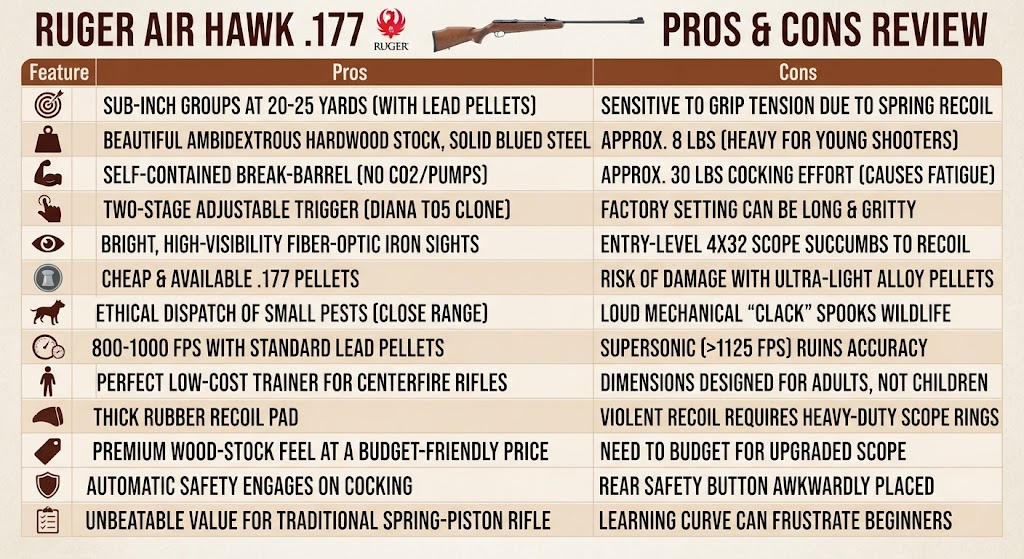
| Feature | Pros | Cons |
| Accuracy | Capable of shooting tight, sub-inch groups at 20 to 25 yards with the right lead pellets. | Spring-piston recoil makes it highly sensitive to how tightly you grip the rifle. |
| Build construction | Features a beautiful, ambidextrous hardwood stock and a solid blued steel barrel and receiver. | Weighs roughly 8 pounds with the scope, which is quite heavy for young shooters. |
| Action and cocking | Break-barrel mechanism is completely self-contained, requiring no CO2 cartridges or hand pumps. | Requires roughly 30 pounds of cocking effort, which can cause fatigue during long range sessions. |
| Trigger pull | Features a two-stage adjustable trigger (a clone of the highly regarded Diana T05 design). | The factory trigger setting can occasionally exhibit a long, slightly gritty first stage. |
| Sights and optics | Includes bright, high-visibility fiber-optic iron sights that are excellent in low light. | The included 4×32 scope is entry-level and frequently succumbs to the harsh spring recoil. |
| Ammunition versatility | Shoots standard .177 caliber pellets, which are incredibly cheap and available everywhere. | Firing ultra-light alloy pellets can cause the piston to slam too hard, risking internal damage. |
| Pest control performance | Delivers enough kinetic energy to ethically dispatch squirrels, rats, and pest birds at close range. | The loud mechanical “clack” of the spring action can quickly spook surrounding wildlife. |
| Muzzle velocity | Pushes standard lead pellets at roughly 800-1000 fps, and lightweight alloy pellets up to 1200 fps. | Pushing pellets past the speed of sound (1125 fps) destabilizes them and ruins accuracy. |
| Ergonomics | The traditional rifle dimensions make it act as a perfect, low-cost trainer for centerfire hunting rifles. | The thick grip and long length of pull are clearly designed for adults, not children. |
| Recoil management | The thick rubber recoil pad keeps the rifle securely anchored in the shoulder pocket. | The violent forward-and-backward recoil pulse requires heavy-duty scope rings with a stop pin. |
| Price/value | Offers a premium wood-stock feel and a great trigger at a highly budget-friendly price point. | You will almost certainly need to spend extra money upgrading to a higher-quality airgun scope. |
| Safety features | Incorporates an automatic safety that engages every time the barrel is broken open. | The safety button is located at the rear of the receiver, which some shooters find awkwardly placed. |
| Limitations | Unbeatable value for a traditional, hard-hitting spring-piston wood-stock air rifle. | The learning curve to shoot a magnum springer accurately can frustrate beginners used to firearms. |
Accuracy And The Artillery Hold
Accuracy with the Ruger Air Hawk is excellent, but it comes with a strict caveat: you cannot hold it like a standard firearm. Because the massive internal spring slams forward before the pellet leaves the barrel, the rifle jumps backward and then violently forward. If you grip the rifle tightly, your muscles will torque the barrel and ruin the shot. To achieve tight groups, shooters must use the “artillery hold”—resting the forearm of the rifle lightly on an open palm and letting the gun recoil freely. Once this technique is mastered, the Air Hawk can easily stack pellets on top of each other at 25 yards.
Build Construction And Aesthetics
Unlike modern budget airguns wrapped in cheap, hollow plastics, the Ruger Air Hawk feels like a real hunting rifle. It features a beautifully crafted, ambidextrous hardwood stock with checkering on the grip and forearm. The barrel and receiver are made of solid steel with a deep blued finish. Tipping the scales at roughly 8 pounds when scoped, it possesses the heft and balance of a traditional centerfire rifle, making it a fantastic off-season training tool for deer hunters.
Action And Cocking Effort
The rifle operates via a traditional spring-piston break-barrel mechanism. This means it is entirely self-sufficient; you do not need to buy CO2 cartridges or pump it multiple times per shot. A single break of the barrel compresses the spring. However, generating magnum-level velocities requires a heavy spring. The cocking effort is rated at approximately 30 pounds. While easily manageable for an average adult, teenagers or smaller shooters may find it exhausting to cock repeatedly during an afternoon of plinking.
Trigger System
The biggest surprise of the Ruger Air Hawk is its trigger. Most budget air rifles suffer from abysmal, heavy triggers that ruin accuracy. Umarex outfitted the Air Hawk with a direct clone of the famous German Diana T05 trigger. It is a two-stage adjustable unit that provides a predictable wall and a reasonably crisp break. While it might require a minor adjustment of the screw out of the box to find your preferred let-off point, it vastly outperforms almost every other trigger in its price bracket.
Sights, Optics, And Scope Creep
Out of the box, the rifle comes with fantastic fiber-optic iron sights—a red front sight and a fully adjustable green rear sight. These are brilliant for backyard plinking. Ruger also includes a basic 4×32 scope and mounting rings. However, the harsh bidirectional recoil of the spring piston is notorious for destroying cheap optics and causing the scope mounts to slide backward along the dovetail rail (known as scope creep). Shooters using optics must ensure the scope rings utilize the receiver’s drilled stop-pin hole to prevent movement, though upgrading to a dedicated “airgun-rated” scope is highly recommended.
Velocity And Pest Control Performance
Advertised at 1000 feet per second (fps) with lead pellets and 1200 fps with alloy pellets, the Air Hawk is a true magnum springer. For pest control (squirrels, rats, starlings), this rifle is devastating inside 30 yards. However, experienced airgunners strongly recommend avoiding ultra-light alloy pellets. If a pellet breaks the sound barrier, it tumbles and loses accuracy. Furthermore, light pellets do not provide enough air resistance to cushion the piston, which can cause the internal spring mechanism to slam aggressively and damage the rifle over time. Stick to high-quality 8-grain to 10-grain lead domed pellets for the best blend of accuracy and kinetic energy.
Price And Value
The value proposition of the Ruger Air Hawk is its strongest selling point. Retailing at a highly affordable price, it offers features usually reserved for much more expensive European airguns—namely, a solid wood stock and a T05-style adjustable trigger. Even if you factor in the cost of eventually replacing the factory scope, it remains one of the best bargains in the adult airgun market.
Main Drawbacks
The most notable disadvantages of the Ruger Air Hawk are its heavy physical weight, the strenuous cocking effort, and the steep learning curve required to shoot a spring-piston rifle accurately. It is simply too heavy and hard to cock for young children to use comfortably. Additionally, the included 4×32 scope leaves a lot to be desired in terms of glass clarity and durability under heavy recoil.
Final Verdict
Is the Ruger Air Hawk .177 pellet gun good?
Yes, it is a rugged, handsome, and highly accurate spring-piston air rifle that punches well above its price class.
This airgun is best suited for adult backyard plinkers, small-game hunters looking for an affordable pest control tool, and traditional firearms enthusiasts who want a heavy, realistic training rifle for cheap off-season practice.
However, young shooters who cannot manage a 30-pound cocking effort, or those who want to shoot sub-MOA precision groups without learning the specialized “artillery hold,” would be much better served by a recoilless PCP (Pre-Charged Pneumatic) air rifle or a standard .22 LR rimfire.
Frequently Asked Questions (FAQs)
1. Who actually makes the Ruger Air Hawk?
The Ruger Air Hawk is manufactured by Umarex, a well-known German airgun company, under an official licensing agreement to use the Ruger name and logo. The rifle itself is widely known to be a clone of the highly respected Diana 34 air rifle.
2. Can I shoot standard metal BBs out of the Air Hawk?
No. The Ruger Air Hawk features a rifled steel barrel designed exclusively for .177 caliber lead or alloy pellets. Shooting hard steel BBs will permanently destroy the rifling and ruin the gun’s accuracy.
3. Does the rifle require CO2 cartridges?
No. It is a spring-piston break-barrel air rifle. You simply pull the barrel downward to compress the internal spring, load a pellet, and close the barrel. It requires no external air tanks or CO2.
4. How loud is the Ruger Air Hawk?
It is not suppressed, meaning it produces a moderate mechanical “thwack” when the piston slams forward, accompanied by the pop of the compressed air. It is generally quiet enough for suburban backyard use, provided your neighbors are not immediately adjacent.
5. What is the “artillery hold”?
The artillery hold is a shooting technique for spring-piston airguns where you rest the forearm of the rifle flat on your open palm without gripping it tightly. This allows the rifle to slide freely back and forth during its unique double-recoil cycle, ensuring the pellet leaves the barrel consistently every time.
6. Why is my scope sliding backward on the rail?
Spring-piston air rifles generate harsh forward-and-backward recoil that causes scopes to slide (scope creep). To fix this, you must ensure your scope mount has a vertical “stop pin” that drops into the small hole located on the top of the rifle’s receiver rail.
7. Can I adjust the trigger pull?
Yes. The two-stage trigger features an adjustment screw that allows you to change the length of the first stage travel, helping you find a crisper breaking point.
8. Are alloy pellets better than lead pellets for this gun?
Generally, no. While alloy pellets boast higher velocities (up to 1200 fps), they often break the sound barrier, which destabilizes the pellet and ruins accuracy. Furthermore, they are often too light to properly cushion the heavy spring piston, which can cause internal damage over time.
9. Is this a good air rifle for a 10-year-old?
Typically, no. The rifle weighs 8 pounds and requires 30 pounds of force to cock the barrel for every single shot. It is physically scaled and sprung for adult shooters.
10. Do I need to clean the barrel often?
Air rifle barrels do not accumulate carbon or copper fouling like traditional firearms. You rarely need to clean the barrel unless accuracy drastically falls off. When you do clean it, use a specialized airgun bore snake or soft patches; never use harsh firearm solvents, as they can destroy the internal rubber piston seals.