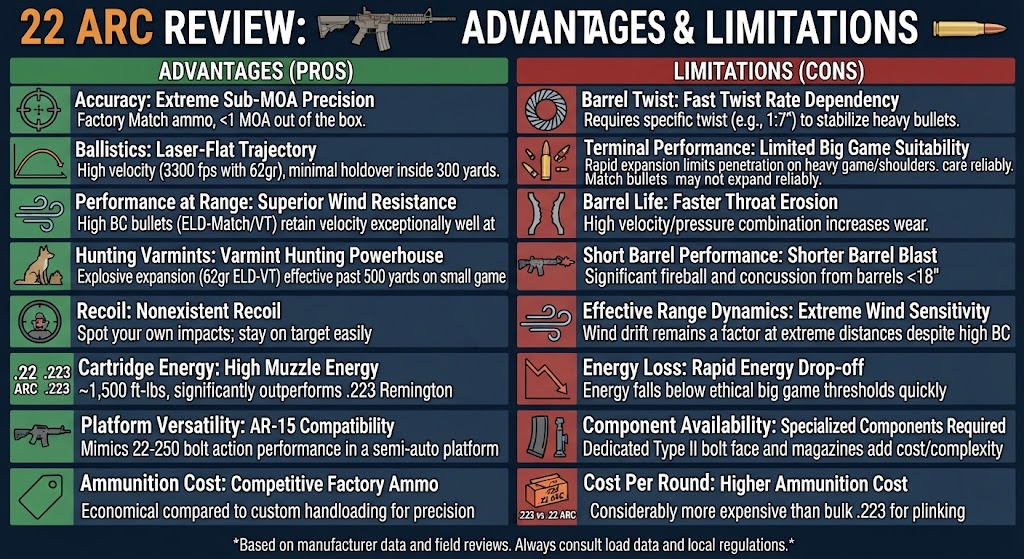
The main pros of the 22 ARC are its blazing fast velocity, exceptionally flat trajectory, and ability to mirror 22-250 Remington performance in a standard AR-15 platform, while the main cons are its accelerated barrel wear and requirement for a specialized bolt and magazine. Designed by Hornady to maximize the capabilities of modern heavy .22 caliber bullets, this cartridge offers varmint hunters and precision shooters a massive ballistic upgrade over the standard 5.56 NATO. While it consistently delivers pinpoint accuracy and explosive terminal performance on predators, it is strictly designed for small game and target applications rather than large animals. Because it pushes high ballistic coefficient projectiles at extreme speeds, its wind resistance and energy retention are phenomenal, making it a highly effective long-range tool for shooters willing to invest in the necessary rifle components.
Table of Contents [Click to open]
22 ARC Pros And Cons
| Feature | Pros | Cons |
| Accuracy | Capable of extreme sub-MOA precision right out of the box with factory match ammunition. | Highly dependent on a fast twist rate barrel to stabilize heavy bullets. |
| Bullet construction | Utilizes highly aerodynamic bullets like the ELD-VT and ELD Match for superior wind resistance. | Match bullets may fail to expand reliably on game, requiring careful bullet selection. |
| Expansion | Varmint loads like the 62-grain ELD-VT offer explosive expansion upon impact. | Rapid expansion limits penetration, making it unsuitable for large, thick-skinned game. |
| Weight retention | Heavy 88-grain match bullets retain momentum exceptionally well at distance. | Lighter varmint bullets shed weight instantly to maximize tissue damage on small targets. |
| Penetration | Adequate for predators and varmints from any reasonable angle. | Lacks the mass and structural integrity for deep penetration on heavy shoulder bones. |
| Hunting performance | An absolute powerhouse for coyotes, prairie dogs, and foxes at extended ranges. | Generally not recommended or legal in some areas for deer due to the small caliber size. |
| Muzzle velocity | Blazing fast speeds reaching 3,300 fps with 62-grain bullets for a laser-flat trajectory. | High velocity and pressure combination leads to significantly faster throat erosion. |
| Muzzle energy | Generates roughly 1,500 ft-lbs of energy, easily outclassing standard .223 Remington loads. | Energy drops below ethical big game hunting thresholds relatively quickly. |
| Trajectory | Shoots incredibly flat, taking the guesswork out of holdovers inside 300 yards. | Factory data relies on 24-inch test barrels, meaning shorter tactical barrels will see more drop. |
| Effective hunting range | Devastating on coyotes and varmints well past 500 yards. | Wind drift eventually becomes a factor at extreme ranges despite the high ballistic coefficient. |
| Performance from shorter barrels | Still outpaces the 5.56 NATO significantly even in 16-inch to 18-inch barrels. | Short barrels produce a massive fireball and concussive blast due to the large powder charge. |
| Recoil | Almost nonexistent, allowing shooters to stay in the scope and easily spot their own impacts. | None. |
| Price/value | Factory ammunition is competitively priced compared to custom handloading for precision. | Considerably more expensive than bulk .223 ammunition for high volume plinking. |
| Consistency | Hornady factory loads boast exceptionally tight extreme spreads and standard deviations. | Sourcing specialized magazines and bolts can be an annoying hidden cost for builders. |
| Best use | Long range varmint hunting, predator control, and precision rifle series competition. | A poor choice for high volume tactical training due to cost and barrel heat. |
| Limitations | Perfectly mimics 22-250 bolt action performance in a semi-automatic AR-15. | Requires a dedicated Type II bolt face and proprietary magazines to function reliably. |
Accuracy
The 22 ARC (Advanced Rifle Cartridge) is engineered for absolute precision. By utilizing modern chamber geometries and fast twist barrels, it consistently produces sub-MOA groups with factory ammunition. Shooters can expect excellent accuracy whether firing from a bolt action or a properly built AR-15 platform. The use of high ballistic coefficient bullets ensures that this accuracy holds up at extended ranges where wind would normally push lighter projectiles off target.
Bullet Construction And Expansion
Hornady designed this cartridge around modern, heavy-for-caliber projectiles. The 62-grain ELD-VT load features a polymer tip and a cavity designed for explosive expansion, making it devastating on varmints. Alternatively, the 75-grain and 88-grain ELD Match bullets are built with sleek, aerodynamic profiles to maximize target shooting performance. Shooters must choose the correct bullet construction, as match bullets are not intended to expand reliably on game.
Penetration And Weight Retention
For predator hunting, the 22 ARC offers exactly what hunters need in the form of rapid energy transfer and shallow penetration. Lighter varmint bullets are designed to fragment violently, minimizing the chance of an exit wound and preserving coyote pelts. However, this intentional lack of weight retention means the cartridge is a poor choice for large game, where deep penetration through thick bone is required to reach vital organs.
Hunting Performance
As a predator and varmint cartridge, the 22 ARC is truly top tier. It brings the legendary performance of the 22-250 Remington into the AR-15 platform. This allows coyote hunters to enjoy lightning-fast follow up shots on multiple targets. While it is technically capable of taking small deer with heavy, well-placed bullets where legally permitted, it is ultimately a specialized tool for coyotes, prairie dogs, and foxes.
Velocity And Energy
The velocity of this cartridge is its main selling point. Factory loads push a 62-grain bullet at a blistering 3,300 feet per second from a 24-inch barrel, generating around 1,500 foot-pounds of muzzle energy. Even when stepping up to the heavy 88-grain match bullets, velocities hover around 2,825 feet per second. This massive speed advantage over the standard .223 Remington translates directly into superior terminal performance and wind deflection.
Trajectory And Range
Thanks to the combination of high muzzle velocity and aerodynamically efficient bullets, the trajectory of the 22 ARC is incredibly flat. Inside of 300 yards, hunters can practically hold right on their target without worrying about complex elevation adjustments. For precision target shooters, the heavy match loads remain supersonic well beyond 1,000 yards, making it a highly capable long range cartridge.
Recoil
The recoil impulse of the 22 ARC is exceptionally mild. While it produces slightly more rearward push than a standard 5.56 NATO due to the larger powder charge, it is still soft enough that shooters can easily watch their own bullet trace through the optic. This low recoil makes it a fantastic option for new shooters and competitive precision rifle shooters who need to spot their impacts and adjust fire rapidly.
Price And Value
Hornady has positioned the 22 ARC to be relatively affordable for a precision match cartridge. It costs more than budget 5.56 NATO practice ammo, but it offers a massive ballistic upgrade that justifies the price for serious hunters and competitors. For those building an AR-15, the value is excellent because it provides magnum-level varmint performance without requiring an expensive AR-10 sized receiver.
Main Drawbacks
The most significant drawback of the 22 ARC is its accelerated barrel wear. Pushing a large volume of powder through a small .22 caliber bore creates intense heat, meaning precision barrel life will be noticeably shorter than standard calibers. Furthermore, AR-15 builders cannot simply swap a barrel to shoot it. The cartridge requires a specific 6.5 Grendel Type II bolt face and proprietary magazines to feed reliably, adding to the initial setup cost.
Final Verdict
Is 22 ARC good?
Yes, it is a phenomenal cartridge for shooters who want maximum long range performance from a lightweight AR-15 or micro-action rifle.
This caliber is best suited for dedicated predator hunters who need 22-250 ballistics in a semi-automatic platform, as well as precision target shooters who want to ring steel past 800 yards with minimal recoil.
However, high volume tactical shooters or those strictly hunting large big game would be better served by a cheaper practice caliber or a larger hunting cartridge.
Frequently Asked Questions (FAQs)
1. What is the parent case of the 22 ARC?
The cartridge is based on the 6.5 Grendel and 6mm ARC case, which has been necked down to accept .22 caliber projectiles while maintaining the same optimized shoulder angle.
2. Can I shoot 22 ARC out of my standard AR-15?
Yes, it fits in a standard AR-15 upper and lower receiver. However, you will need to install a dedicated 22 ARC barrel, a specific Type II bolt, and use proprietary magazines for it to function correctly.
3. How does the 22 ARC compare to the 22-250 Remington?
It effectively matches the velocity and ballistics of the classic 22-250 Remington but fits in a standard AR-15 action and utilizes modern fast twist rates to stabilize much heavier, more aerodynamic bullets.
4. What is the ideal barrel twist rate for this cartridge?
A 1:7 twist rate is the industry standard for the 22 ARC. This fast twist is necessary to properly stabilize the heavy 75-grain to 88-grain bullets that give the cartridge its long range capabilities.
5. Is the 22 ARC a good deer hunting cartridge?
While it is legal in some states and capable of taking small deer with careful shot placement, it is primarily designed as a varmint and predator cartridge. A larger caliber is generally recommended for ethical big game hunting.
6. What magazines do I need for a 22 ARC AR-15?
You must use dedicated 6.5 Grendel or 6mm ARC magazines. The wider case body of the 22 ARC will not feed reliably from standard 5.56 NATO magazines.
7. Does the 22 ARC burn out barrels quickly?
Yes. Because it is an overbore cartridge that pushes high pressure and heat through a very small bore, you can expect precision barrel life to be shorter than a standard 5.56 NATO barrel.
8. What bolt face does the 22 ARC use?
It uses the same bolt face as the 6.5 Grendel, commonly referred to as a Type II bolt, which features a 0.136 inch bolt face depth.
9. How much does a 22 ARC bullet drop at 500 yards?
Depending on the specific load, barrel length, and zero distance, a 62-grain bullet drops roughly 35 to 40 inches at 500 yards, making it one of the flattest shooting cartridges available for the AR-15.
10. Is the recoil of the 22 ARC manageable for youth shooters?
Absolutely. The recoil is incredibly mild, making it an excellent, low-flinch option for younger or smaller framed shooters who want to practice long range fundamentals or hunt predators comfortably.