The main pros of 360 Buckhammer are its excellent terminal performance on deer, flawless cycling in traditional lever action rifles, and full compliance with straight wall hunting regulations, while the main cons are its steep trajectory past 200 yards and absolute incompatibility with modern AR-15 platforms. Developed by Remington specifically to modernize the classic lever action brush gun, this cartridge delivers significantly more energy and velocity than the legendary .30-30 Winchester and the 350 Legend. While it consistently anchors medium game with authority at close to moderate ranges, its aerodynamic performance is restricted by the flat nosed bullets required for tubular magazines. Because it utilizes a rimmed case design, it feeds perfectly in Henry lever actions but completely rules out use in bolt actions or semi automatic rifles, making it a highly specialized but incredibly effective woods cartridge.
360 Buckhammer Pros And Cons
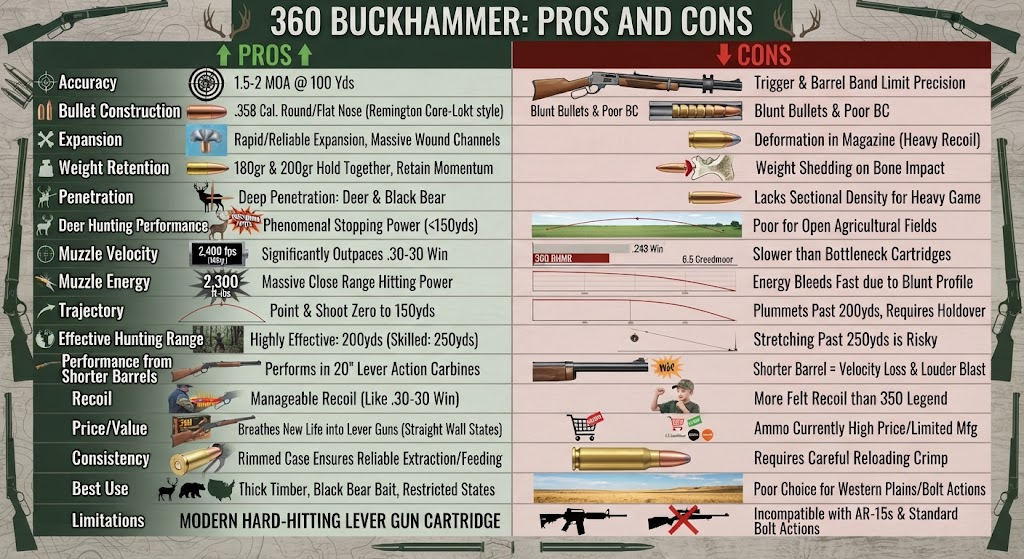
| Feature | Pros | Cons |
| Accuracy | Consistently produces 1.5 to 2 MOA groups at 100 yards out of quality lever action rifles. | Lever action triggers and barrel bands inherently limit precision benchrest accuracy. |
| Bullet construction | Utilizes proven .358 caliber round nose and flat nose bullets like the Remington Core-Lokt. | Tubular magazines dictate the use of blunt bullets with very poor ballistic coefficients. |
| Expansion | Rapid and reliable expansion at moderate velocities creates massive wound channels on deer. | Flat nose cup and core bullets can sometimes deform in the magazine tube under heavy recoil. |
| Weight retention | Heavy 180 grain and 200 grain bullets hold together well to retain their momentum. | Not a solid copper or bonded bullet, so some weight shedding will occur upon bone impact. |
| Penetration | Consistently drives deep into the vitals of deer and black bears from broadside angles. | Lacks the extreme sectional density needed for deep penetration on heavy, dangerous game. |
| Deer hunting performance | Phenomenal stopping power inside 150 yards, often resulting in immediate knockdowns. | The lack of pointed aerodynamic bullets limits its use over wide open agricultural fields. |
| Muzzle velocity | Pushes a 180 grain bullet at roughly 2,400 fps, outpacing the .30-30 Winchester significantly. | Still noticeably slower than bottleneck cartridges like the .243 Winchester or 6.5 Creedmoor. |
| Muzzle energy | Generates roughly 2,300 ft-lbs of energy, offering massive close range hitting power. | Energy bleeds off quickly as distance increases due to the air resistance on the blunt bullet. |
| Trajectory | Flat enough for a simple point and shoot hold out to 150 yards. | Plummets rapidly past 200 yards, requiring significant holdovers and exact range estimation. |
| Effective hunting range | Highly effective on medium game out to 200 yards, and potentially 250 yards for skilled shooters. | Stretching it past 250 yards is risky due to severe bullet drop and fading kinetic energy. |
| Performance from shorter barrels | Performs beautifully in quick pointing 20 inch lever action carbines. | Trimming the barrel further will result in noticeable velocity loss and a louder muzzle blast. |
| Recoil | Very manageable recoil that is incredibly similar to the classic .30-30 Winchester. | Produces more felt recoil than the 350 Legend, which may be noticeable to small youth hunters. |
| Price/value | Breathes new life into the lever action platform for hunters in straight wall restricted states. | Ammunition is currently produced by a limited number of manufacturers, keeping prices slightly high. |
| Consistency | The rimmed case ensures incredibly reliable extraction and feeding in lever action mechanisms. | Reloaders must be careful to properly crimp the straight wall case to prevent bullet setback. |
| Best use | Whitetail deer hunting in thick timber, black bear bait sites, and straight wall restricted states. | A poor choice for western plains hunting or shooters who prefer modern bolt action rifles. |
| Limitations | Unbeatable as a modern, hard hitting lever action cartridge for the midwestern woods. | The rimmed case makes it completely incompatible with AR-15s and standard bolt action rifles. |
Accuracy
The 360 Buckhammer offers excellent practical accuracy for its intended role as a brush gun. Fired from a modern Henry lever action rifle, hunters can easily expect 1.5 to 2 inch groups at 100 yards with factory Remington ammunition. While lever action rifles are rarely sub MOA precision tools due to their two piece stocks and barrel band designs, this level of accuracy is perfectly suited for putting a bullet in the vitals of a deer at moderate woodland distances.
Bullet Construction And Expansion
Because this cartridge is designed specifically for lever action rifles with tubular magazines, it must use flat nosed or round nosed bullets to prevent accidental primer ignition in the tube under recoil. Remington loads the 360 Buckhammer with their legendary Core-Lokt projectiles in 180 grain and 200 grain weights. These bullets feature a true .358 caliber diameter. Upon impact, the wide frontal area initiates rapid, massive expansion, transferring maximum kinetic energy into thin skinned game like deer and feral hogs.
Penetration And Weight Retention
The 360 Buckhammer relies on heavy bullet weights to achieve deep penetration. A 200 grain Core-Lokt bullet carries immense momentum. Even though it is a traditional cup and core bullet that expands violently, it retains enough mass to drive through the ribcage and vitals of black bears and large whitetail bucks. It consistently provides reliable exit wounds on broadside shots, which is a critical factor for blood tracking in dense vegetation.
Deer Hunting Performance
For hunters in straight wall restricted states like Ohio, Iowa, and Michigan, the 360 Buckhammer is a revelation. It was purpose built to provide lever action fans with a legal, modern cartridge that outperforms the old .30-30 Winchester. Inside 200 yards, it hits deer with absolute authority. The massive energy transfer and large .358 caliber hole routinely drop deer in their tracks or leave very short, heavy blood trails.
Velocity And Energy
The factory ballistics of the 360 Buckhammer are highly impressive for a straight wall cartridge. Remington rates the 180 grain load at a blistering 2,399 feet per second, yielding nearly 2,300 foot pounds of muzzle energy. The heavier 200 grain load leaves the muzzle at roughly 2,215 feet per second. This gives the 360 Buckhammer a distinct velocity and energy advantage over the competing 350 Legend, making it one of the most powerful straight wall deer cartridges available.
Trajectory And Range
Trajectory is the main limiting factor for the 360 Buckhammer. The blunt round nose bullets have very low ballistic coefficients, meaning they encounter massive air resistance and shed velocity quickly. If you zero your rifle at 150 yards, the 180 grain bullet will drop approximately 4 to 5 inches at 200 yards. Past 200 yards, the bullet drops off a cliff. While it retains enough energy to kill at 250 yards, the steep drop requires the hunter to know the exact distance to the target to avoid shooting under the animal.
Recoil
Recoil management is a strong point for the 360 Buckhammer. Despite delivering more energy than the .30-30 Winchester, the felt recoil is remarkably similar, making it a very pleasant rifle to shoot. It kicks slightly harder than a 350 Legend, but it is vastly softer on the shoulder than the punishing 450 Bushmaster. Most adult shooters and experienced youth hunters will have absolutely no problem practicing with this cartridge extensively without developing a flinch.
Price And Value
The 360 Buckhammer offers fantastic value for hunters who love traditional lever action rifles but are forced by state law to use straight wall cartridges. Instead of hunting with a single shot rifle or buying an AR-15, traditionalists can carry a beautiful Henry lever gun into the woods. While ammunition is currently dominated by Remington and Federal, prices remain competitive with other specialized hunting cartridges, though it is not as cheap or ubiquitous as the 350 Legend.
Main Drawbacks
The most significant disadvantage of the 360 Buckhammer is its rimmed case design. The prominent rim is perfect for the extractor of a lever action, but it makes the cartridge completely incompatible with AR-15 magazines and modern bolt action bolt faces. This strictly limits your rifle choices. Furthermore, the mandatory use of round nose bullets in tubular magazines permanently cripples the long range aerodynamic potential of the cartridge.
Final Verdict
Is 360 Buckhammer good?
Yes, it is a phenomenal and highly effective cartridge for its specific intended purpose.
This caliber is best suited for traditional lever action enthusiasts, black bear hunters over bait, and midwestern deer hunters who are restricted to straight wall cartridges. It perfectly marries modern ballistic performance with classic lever gun aesthetics, hitting harder and flying flatter than the legendary .30-30 Winchester.
However, hunters who prefer the modularity of the AR-15 platform, shooters who want a bolt action precision rifle, or those who hunt across wide open plains would be much better served by a rimless cartridge like the 350 Legend or a bottleneck cartridge like the .308 Winchester.
Frequently Asked Questions (FAQs)
1. Is the 360 Buckhammer a straight wall cartridge?
Yes. The 360 Buckhammer features a straight walled case with no shoulder, making it completely legal for hunting in states with straight wall cartridge restrictions.
2. What is the parent case of the 360 Buckhammer?
The cartridge is based on the legendary .30-30 Winchester case. The case has been blown out and straightened to accept a larger .358 caliber projectile while retaining the classic rimmed base.
3. What is the actual bullet diameter of the 360 Buckhammer?
It fires a true .358 caliber bullet, which is the exact same bullet diameter used in the classic .35 Remington cartridge.
4. How does the 360 Buckhammer compare to the 350 Legend?
The 360 Buckhammer is more powerful, firing a heavier and wider bullet at slightly higher velocities, resulting in more kinetic energy. However, the 350 Legend uses a rimless case, allowing it to function perfectly in modern AR-15 rifles, whereas the Buckhammer is strictly for lever actions and single shots.
5. Can I use pointed bullets in a 360 Buckhammer rifle?
No. Because the cartridge is chambered in rifles with tubular magazines, loading pointed bullets poses a serious safety risk. Under recoil, a pointed tip could act like a firing pin and ignite the primer of the cartridge in front of it, causing a catastrophic magazine explosion.
6. Does the 360 Buckhammer kick harder than a .30-30 Winchester?
The felt recoil is incredibly similar. While the 360 Buckhammer generates slightly more muzzle energy, most shooters cannot tell the difference in recoil between the two cartridges when fired from rifles of similar weight.
7. What is the maximum effective hunting range of the 360 Buckhammer?
For ethical hunting on deer and black bear, the maximum effective range is generally 200 to 250 yards. Beyond 250 yards, the blunt bullet drops too rapidly and loses the kinetic energy required for a clean, ethical kill.
8. Can I shoot 360 Buckhammer in an AR-15?
Absolutely not. The cartridge features a large rim at the base of the casing that will not fit into a standard AR-15 bolt face, nor will it feed reliably from a box magazine.
9. Who makes rifles chambered in 360 Buckhammer?
Henry Repeating Arms was the primary launch partner for the cartridge and offers a wide variety of beautifully crafted lever action and single shot rifles chambered in 360 Buckhammer. Other manufacturers are slowly adopting it for single shot platforms.
10. How much does a 180 grain 360 Buckhammer bullet drop at 200 yards?
If you zero your rifle to hit exactly at 150 yards, the standard 180 grain factory load will drop approximately 4.5 to 5 inches at 200 yards, requiring the hunter to hold slightly high on the vitals.