The .338 Advanced Rifle Cartridge produces roughly 6 to 10 foot-pounds of free recoil energy in a standard AR-15 platform, placing it in the mild to moderate recoil category.Developed by Hornady to squeeze heavy big-bore payload energy and optimized suppressor performance into a standard AR-15 format, its kick is smooth and remarkably controllable. The exact amount of .338 ARC recoil you experience will always vary depending on whether you are shooting light supersonic loads or ultra-heavy subsonic projectiles, as well as your specific rifle weight and muzzle device.
Table of Contents [Click to open]
.338 ARC Recoil Chart
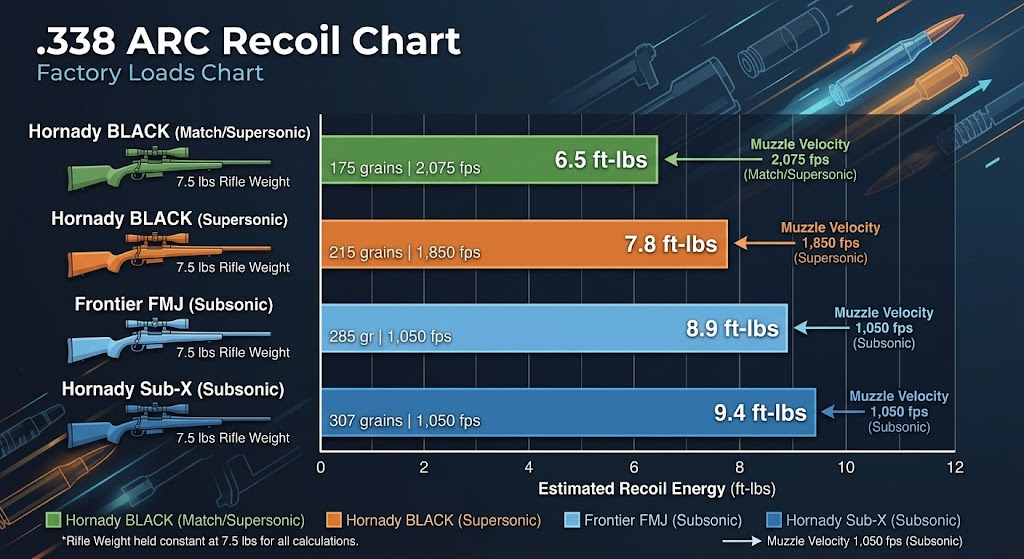
The following table displays estimated free recoil energy for popular .338 ARC factory loads. Because this cartridge is built specifically for standard AR-15s and micro-bolt actions, these calculations use a baseline 7.5-pound rifle weight for consistency.
| Factory Load | Bullet Weight | Muzzle Velocity | Rifle Weight | Estimated Recoil Energy |
| Hornady BLACK (Match/Supersonic) | 175 grains | 2,075 fps | 7.5 lbs | 6.5 ft-lbs |
| Hornady BLACK (Supersonic) | 215 grains | 1,850 fps | 7.5 lbs | 7.8 ft-lbs |
| Frontier FMJ (Subsonic) | 285 gr | 1,050 fps | 7.5 lbs | 8.9 ft-lbs |
| Hornady Sub-X (Subsonic) | 307 grains | 1,050 fps | 7.5 lbs | 9.4 ft-lbs |
How Much Recoil Does .338 ARC Have?
In practical terms, a heavy subsonic 307-grain .338 ARC load generates an average of 9 to 10 foot-pounds of free recoil energy and a recoil velocity of roughly 9.5 feet per second in a 7.5-pound rifle. Recoil energy dictates the physical rearward force delivered to your shoulder, while recoil velocity determines how fast that impact feels.
Because subsonic loads are strictly speed-capped below the threshold of sound (around 1,050 fps), they cannot rely on velocity to generate force.While the 307-grain bullet is massive for an AR-15 platform, the moderate powder charges keep the total recoil energy under 10 foot-pounds, resulting in a gentle, rolling push rather than a sharp jab.
What Does .338 ARC Recoil Feel Like?
During a hunt or a range session, the recoil of a .338 ARC is entirely manageable. Supersonic loads feel like a mild, crisp nudge comparable to a standard 5.56 NATO or 6mm ARC. Heavy subsonic loads produce a slightly heavier, slower push due to the massive weight of the projectile, but it lacks any sharp or punishing snap.
At the shooting range, the .338 ARC is comfortable to shoot for extended periods. Because the recoil energy stays safely under the 10 foot-pounds threshold, most shooters can easily spot their bullet impacts through an optic without losing sight of the target.
.338 ARC Recoil Compared To Other Cartridges
To understand how the .338 ARC fits into the intermediate cartridge landscape, it helps to compare it directly to other popular AR-15 and hunting options. The data below assumes a standard rifle weight of 7.5 pounds for all cartridges to ensure a fair comparison.
| Cartridge | Common Bullet Weight | Muzzle Velocity | Estimated Recoil Energy |
| .223 Rem / 5.56 NATO | 55 grains | 3,200 fps | 3.5 ft-lbs |
| 6mm ARC | 108 grains | 2,750 fps | 7.4 ft-lbs |
| .338 ARC (Supersonic) | 175 grains | 2,075 fps | 6.5 ft-lbs |
| 300 Blackout (Subsonic) | 220 grains | 1,020 fps | 4.3 ft-lbs |
| .338 ARC (Subsonic) | 307 grains | 1,050 fps | 9.4 ft-lbs |
| .308 Winchester | 150 grains | 2,820 fps | 17.5 ft-lbs |
What Affects .338 ARC Recoil?
While the recoil of a .338 ARC is inherently mild, several physical factors dictate how that energy translates to your shoulder.
- Ammunition Selection:Supersonic loads use lighter bullets (175 grains) at moderate speeds, whereas subsonic loads use massive projectiles (up to 307 grains). Pushing those heavier payloads increases the total rearward momentum.
- Rifle Weight: A heavier AR-15 build or a weighted precision micro-bolt rifle absorbs more rearward energy, dampening the felt kick.
- Suppressors:The .338 ARC is optimized for suppression.Attaching a .36-caliber suppressor adds physical weight to the muzzle and traps expanding gas, softening the recoil impulse significantly.
- Rifle Action: In semi-automatic AR-15 configurations, the moving bolt carrier group and buffer system soak up a portion of the mechanical cycle, keeping the felt recoil smooth.
How To Reduce .338 ARC Recoil
Because the .338 ARC generates less than 10 foot-pounds of free recoil energy, recoil mitigation devices are generally unnecessary for adult shooters.
However, because the cartridge is engineered specifically for suppressed shooting, threading on a quality suppressor is the ideal upgrade. It dampens the muzzle blast, adds forward weight to counteract muzzle rise, and makes an already mild-recoiling rifle even softer to shoot. If you are tuning an AR-15 gas system, matching the correct buffer weight ensures the action cycles smoothly without unnecessary rearward movement.
Is .338 ARC Recoil Too Much For Hunting?
The .338 ARC recoil is definitely not too much for hunting. In fact, its mild recoil profile is one of its greatest advantages, allowing hunters to deliver heavy terminal energy on hogs, deer, and medium game within 200 yards without flinching.
Because it delivers significantly more sub-sonic mass and energy than smaller alternatives like the .300 Blackout while keeping recoil well under control, it provides an exceptional balance of stealth, stopping power, and shooter comfort.
Frequently Asked Questions
Does the .338 ARC kick more than the .300 Blackout?
Yes, slightly. While both fit in a standard AR-15, the .338 ARC throws much heavier subsonic bullets (up to 307 grains compared to the .300 Blackout’s typical 220-grain maximum). This extra mass yields about 2 to 3 foot-pounds more recoil energy, though both remain very easy to shoot.
Can a beginner easily handle .338 ARC recoil?
Yes. With free recoil energy hovering around 6 to 9 foot-pounds depending on the load, the .338 ARC is exceptionally friendly for newer or recoil-sensitive shooters, producing a smooth push rather than a sharp snap.
Do I need a muzzle brake on a .338 ARC?
No. A muzzle brake is not necessary for recoil control given the cartridge’s mild nature, though some shooters use linear comps or flash hiders to manage muzzle blast.