The .444 Marlin produces approximately 23 to 25 foot-pounds of free recoil energy in a standard lever-action rifle, placing it firmly in the heavy recoil category. Introduced in 1964 as a powerhouse for the Marlin 336 action, it was designed to deliver massive knockdown power on large game at short ranges. The exact amount of .444 Marlin recoil you experience will always vary depending on your specific rifle weight, bullet weight, muzzle velocity, and powder load.
444 Marlin Recoil Chart
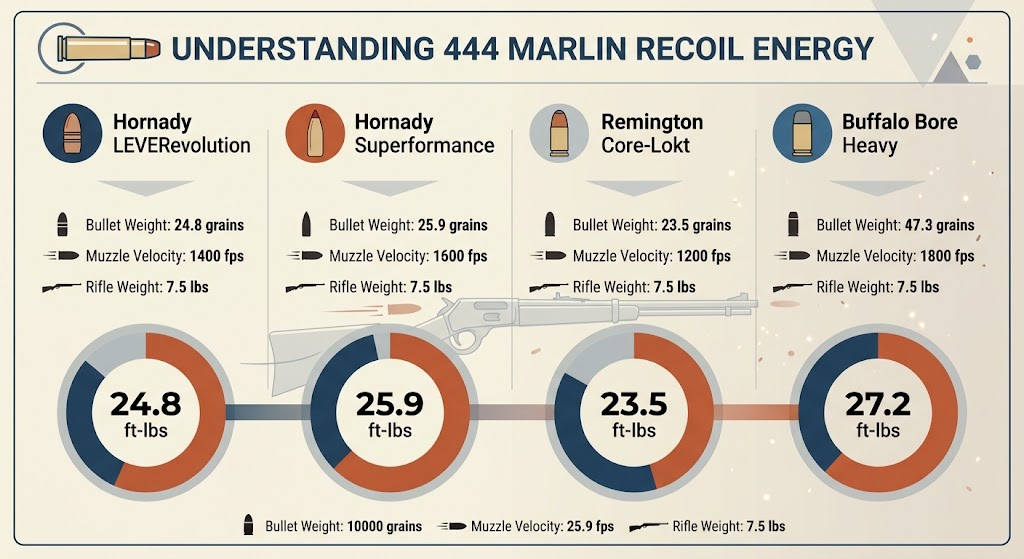
The following table displays estimated free recoil energy for popular .444 Marlin factory loads. Because this cartridge is almost exclusively chambered in traditional lever-action rifles and single-shot platforms, these calculations use a standard 7.5-pound rifle weight for a consistent comparison.
| Factory Load | Bullet Weight | Muzzle Velocity | Rifle Weight | Estimated Recoil Energy |
| Hornady LEVERevolution | 265 grains | 2,325 fps | 7.5 lbs | 24.8 ft-lbs |
| Hornady Superformance | 265 grains | 2,400 fps | 7.5 lbs | 25.9 ft-lbs |
| Remington Core-Lokt | 240 grains | 2,350 fps | 7.5 lbs | 23.5 ft-lbs |
| Buffalo Bore Heavy | 300 grains | 2,150 fps | 7.5 lbs | 27.2 ft-lbs |
How Much Recoil Does 444 Marlin Have?
In practical terms, a standard 265-grain .444 Marlin hunting load generates an average of 25 foot-pounds of free recoil energy and a recoil velocity of roughly 14.5 feet per second in a 7.5-pound rifle. Recoil energy dictates the physical rearward force delivered to the shoulder, while recoil velocity determines how fast that impact feels.
Because the .444 Marlin is designed to push heavy, wide-diameter bullets out of relatively lightweight, fast-handling rifles, it generates substantial rearward force. The recoil is significant enough that it requires proper shooting fundamentals to manage effectively and will quickly cause shoulder fatigue during extended range sessions.
What Does 444 Marlin Recoil Feel Like?
During a hunt, the physical sensation of the .444 Marlin recoil is a massive, heavy thump. The adrenaline of the moment often dulls the pain, but the sheer force of the recoil will almost certainly lift your muzzle high and push your torso backward. It is universally classified as a heavy recoiling cartridge.
At the shooting range, the feeling is punishing for shooters unaccustomed to big-bore rifles. The recoil impulse is less of a sharp, violent snap than a high-velocity magnum and more of a massive rearward shove. Firing a lightweight lever-action rifle from a bench rest will easily cause shoulder bruising after a box of ammunition if the rifle does not have an excellent recoil pad.
444 Marlin Recoil Compared To Other Cartridges
To understand where the .444 Marlin sits in the big-bore and standard cartridge landscape, we must compare it against other popular hunting chamberings. The data below assumes a standard rifle weight of 7.5 pounds for all cartridges to ensure a fair and accurate baseline.
| Cartridge | Common Bullet Weight | Muzzle Velocity | Estimated Recoil Energy |
| .30-30 Winchester | 150 grains | 2,390 fps | 14.1 ft-lbs |
| .308 Winchester | 150 grains | 2,820 fps | 17.5 ft-lbs |
| .30-06 Springfield | 180 grains | 2,700 fps | 21.5 ft-lbs |
| .444 Marlin | 265 grains | 2,325 fps | 24.8 ft-lbs |
| .45-70 Government | 300 grains | 1,850 fps | 23.5 ft-lbs |
| .300 Win Mag | 180 grains | 2,950 fps | 29.5 ft-lbs |
What Affects 444 Marlin Recoil?
Several distinct physical and mechanical factors dictate exactly how much kick your specific .444 Marlin rifle will produce.
- Rifle Weight: A heavier rifle absorbs more rearward momentum. A lever-action with a heavy octagonal barrel will kick noticeably less than a standard carbine model.
- Bullet Weight: The .444 Marlin shoots large projectiles, typically ranging from 240 to 300 grains. Pushing heavier bullets directly increases the opposite rearward force.
- Muzzle Velocity: Faster bullets generate more recoil. High-velocity loads like the Hornady Superformance generate noticeably more recoil than traditional flat-nose soft points.
- Powder Charge: The mass of the burning powder leaving the barrel adds to the total rearward thrust. The .444 Marlin utilizes large powder charges to propel its heavy bullets.
- Stock Design: Traditional lever-action rifles often feature straight-comb stocks and curved buttplates. This geometry can exacerbate felt recoil by driving the stock up into the cheek and concentrating the rearward force into a smaller area on the shoulder.
- Porting: Some factory models feature barrel porting at the muzzle, which redirects expanding gases upward to fight muzzle rise and slightly reduce rearward recoil.
How To Reduce 444 Marlin Recoil
If the factory recoil level is too punishing, you can apply several practical methods to tame the rifle.
The absolute best upgrade for any .444 Marlin is replacing the factory hard rubber or plastic buttplate with a premium, thick recoil pad. Because many older Marlin rifles lack modern recoil mitigation, installing a high-quality pad will dramatically increase the duration of the recoil impulse, making the felt impact much softer and preventing shoulder bruising.
If you are open to modifying the firearm, having a gunsmith professionally port the barrel (such as Mag-Na-Porting) will significantly reduce muzzle flip and shave off a portion of the free recoil energy without adding length to the gun. Alternatively, sticking to standard 240-grain loads instead of heavy 300-grain bear loads will keep the recoil at the lower end of the spectrum.
Is 444 Marlin Recoil Too Much For Hunting?
The .444 Marlin recoil is not too much for hunting large game in heavy timber or brush, provided the shooter is an experienced adult. It is considered an absolutely devastating cartridge for black bear, elk, feral hogs, and moose within 200 yards. For hunters who practice proper fundamentals, the recoil tradeoff is highly worthwhile for the massive terminal performance it delivers.
However, the .444 Marlin is absolutely not recommended for newer shooters, youth hunters, or anyone sensitive to heavy recoil. Handing a lightweight .444 Marlin to a novice is a guaranteed way to induce a severe flinch. For deer hunting at standard ranges, the .444 Marlin is massive overkill, and shooters are much better served by milder lever-action cartridges like the .30-30 Winchester or .35 Remington.
Frequently Asked Questions
Does the 444 Marlin kick more than a 45-70?
It depends entirely on the load. With standard, traditional pressure factory loads, the .444 Marlin and the .45-70 Government produce virtually identical recoil (around 24 to 25 foot-pounds). However, modern “Magnum” or “+P” .45-70 loads designed for modern strong actions will significantly out-recoil the .444 Marlin.
Is 444 Marlin recoil worse than .30-06?
Yes, it is noticeably heavier. In rifles of the exact same weight, a standard .444 Marlin hunting load will generate roughly 15 to 20 percent more free recoil energy than a standard .30-06 Springfield.
Can I shoot a .44 Magnum in a .444 Marlin rifle?
No. Even though they share the same bullet diameter (.429 caliber), the .444 Marlin case is entirely different and much longer. Firing a .44 Magnum in a .444 Marlin chamber is highly dangerous and can cause a catastrophic failure.