The .50 Browning Machine Gun produces anywhere from 45 to over 60 foot-pounds of free recoil energy in a standard rifle, placing it in a class of its own far beyond standard hunting cartridges. Developed originally as an anti-materiel heavy machine gun round, its kick is monumental, explosive, and capable of injuring an unprepared shooter. The exact amount of .50 BMG recoil you experience will always vary depending on your specific rifle weight, bullet weight, muzzle velocity, and whether a high-efficiency muzzle brake or suppressor is attached.
.50 BMG Recoil Chart
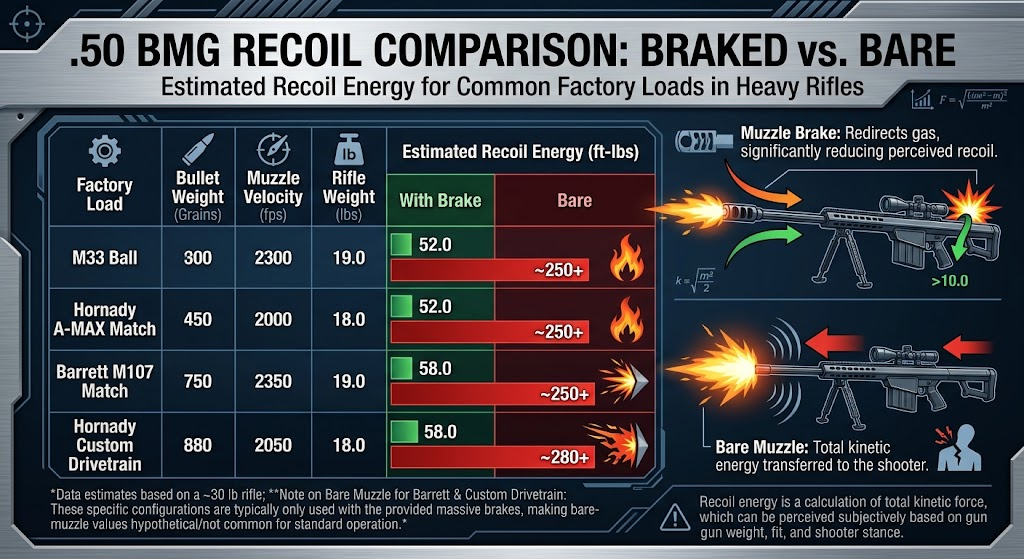
The following table displays estimated free recoil energy for popular .50 BMG factory loads. Because .50 BMG rifles are exceptionally heavy (often weighing between 25 and 35 pounds), these calculations account for that massive firearm weight, which is the primary reason the recoil energy is kept from reaching truly catastrophic levels.
| Factory Load | Bullet Weight | Muzzle Velocity | Rifle Weight | Estimated Recoil Energy (Braked vs Bare) |
| M33 Ball | 647 grains | 2,910 fps | 30.0 lbs | ~52.0 ft-lbs (With Brake) / ~250+ ft-lbs (Bare) |
| Hornady A-MAX Match | 750 grains | 2,820 fps | 30.0 lbs | ~58.0 ft-lbs (With Brake) / ~280+ ft-lbs (Bare) |
| Barrett M107 Match | 660 grains | 2,800 fps | 28.5 lbs | ~54.0 ft-lbs (With Brake) |
| Hornady Custom Drivetrain | 750 grains | 2,820 fps | 35.0 lbs | ~50.0 ft-lbs (With Brake) |
How Much Recoil Does .50 BMG Have?
In practical terms, a standard 750-grain .50 BMG load generates an average of 50 to 60 foot-pounds of free recoil energy when fired through a rifle equipped with a factory muzzle brake. However, if you were to fire that same round out of a bare barrel without a brake, the free recoil energy would skyrocket to an astonishing 250 to 300 foot-pounds—forces comparable to a literal car crash or artillery backblast.
Recoil velocity out of a braked 30-pound rifle is roughly 14 to 16 feet per second, but the sheer mass of the moving air column and the immense pressure wave make the physical experience unlike anything else in civilian shooting sports.
What Does .50 BMG Recoil Feel Like?
During a range session, firing a .50 BMG with a proper, large-port arrow brake feels like a heavy, solid shove—roughly comparable to a hard-kicking 12-gauge slug gun or a stout .300 Win Mag.
However, the psychological and physical environment is entirely unique. The colossal concussive blast hits your chest and face simultaneously, creating a sensation of extreme pressure. If you make the mistake of shooting a .50 BMG without its muzzle brake, the recoil will instantly break collarbones, detach retinas, or throw the shooter violently backward.
.50 BMG Recoil Compared To Other Cartridges
To understand how staggering the .50 BMG truly is, it helps to compare it against massive magnum cartridges. The data below assumes standard rifle weights for each respective class.
| Cartridge | Typical Rifle Weight | Common Bullet Weight | Muzzle Velocity | Estimated Recoil Energy |
| .308 Winchester | 8.0 lbs | 150 grains | 2,820 fps | 16.5 ft-lbs |
| 300 PRC | 9.0 lbs | 212 grains | 2,860 fps | 34.7 ft-lbs |
| .454 Casull (Revolver) | 3.5 lbs | 300 grains | 1,650 fps | 29.8 ft-lbs |
| .500 S&W Magnum | 4.0 lbs | 400 grains | 1,600 fps | 41.0 ft-lbs |
| .50 BMG (Braked) | 30.0 lbs | 750 grains | 2,820 fps | 58.0 ft-lbs |
| .50 BMG (Unbraked) | 30.0 lbs | 750 grains | 2,820 fps | ~280.0+ ft-lbs |
What Affects .50 BMG Recoil?
Because the physical parameters of the .50 BMG are so extreme, minor mechanical differences dictate whether the rifle is shootable or dangerous.
- Muzzle Brakes (The Deciding Factor): A high-efficiency dual-chamber or triple-chamber muzzle brake is mandatory. Brakes redirect massive volumes of expanding gas backward, physically pulling the 30-pound rifle forward and neutralizing up to 70% to 80% of the total recoil energy.
- Rifle Weight: Anti-materiel rifles are intentionally built heavy (25 to 35+ pounds) to use mass as a sponge for kinetic energy.
- Bullet Weight: Pushing massive 650-grain to 800-grain projectiles at near-Mach 3 speeds generates incredible momentum.
- Powder Charge: A .50 BMG case holds upwards of 230 to 250 grains of slow-burning powder. That massive cloud of expanding gas acts like a rocket jet, heavily driving both velocity and recoil.
How To Reduce .50 BMG Recoil
Mitigating .50 BMG recoil is not about comfort; it is a matter of basic safety and structural integrity.
The single non-negotiable requirement is an aggressive, factory-engineered muzzle brake. Removing the brake to thread on a standard suppressor requires specialized low-backpressure .50-caliber cans designed specifically to handle the immense gas volumes without blowing apart or failing to mitigate recoil.
Additionally, shooters rely on heavy chassis systems, integrated hydraulic buffer systems (found in semi-automatic platforms like the Barrett M107), and thick, specialized shoulder pads. Maintaining a rigid, squared-up shooting posture directly behind the rifle prevents the heavy stock from shifting and delivering a localized blow.
Is .50 BMG Recoil Too Much For Hunting?
The .50 BMG is fundamentally an anti-materiel, long-range military and target-shooting cartridge. It is virtually never used for ethical hunting because the bullet is designed to punch through armor and engine blocks rather than expand cleanly on biological tissue, and the rifles are far too heavy to carry through the backcountry.
For recreational shooters, the recoil is entirely manageable only because modern .50-caliber rifles are heavily engineered with massive brakes and immense weights. However, shooting an unbraked .50 BMG is universally considered too much for any human body to absorb safely.
Frequently Asked Questions
Can you shoot a .50 BMG without a muzzle brake?
Technically yes, but it is extremely dangerous. Firing an unbraked .50 BMG produces over 250 foot-pounds of free recoil energy, which will routinely cause severe physical trauma, fractured collarbones, and facial injuries from the scope eyepiece.
Why doesn’t the .50 BMG break your shoulder every time?
It doesn’t break your shoulder because .50 BMG rifles weigh 30 to 35 pounds and utilize aggressive muzzle brakes that vent high-pressure gases backward, effectively canceling out the vast majority of the rearward thrust before it reaches the shooter.
Does a .50 BMG kick harder than a .416 Barrett or .338 Lapua?
Yes. While the .338 Lapua Magnum and .416 Barrett are powerful long-range magnums, they generate roughly 20 to 35 foot-pounds of recoil, making the braked .50 BMG significantly heavier and more punishing to shoot over long sessions.