The main difference in the 350 Legend Vs 7.62×39 comparison is that the American round is a straight-walled hunting cartridge designed to maximize energy within restricted states, whereas the Soviet round is a bottlenecked military cartridge globally renowned for its use in the AK-47. While the 7.62x39mm offers unparalleled ammunition affordability and combat-proven reliability, the 350 Legend delivers superior kinetic energy and a wider bullet diameter for ethical medium-game hunting. Both cartridges function in the AR-15 platform, making them popular choices for shooters seeking low-recoil performance inside 200 yards.
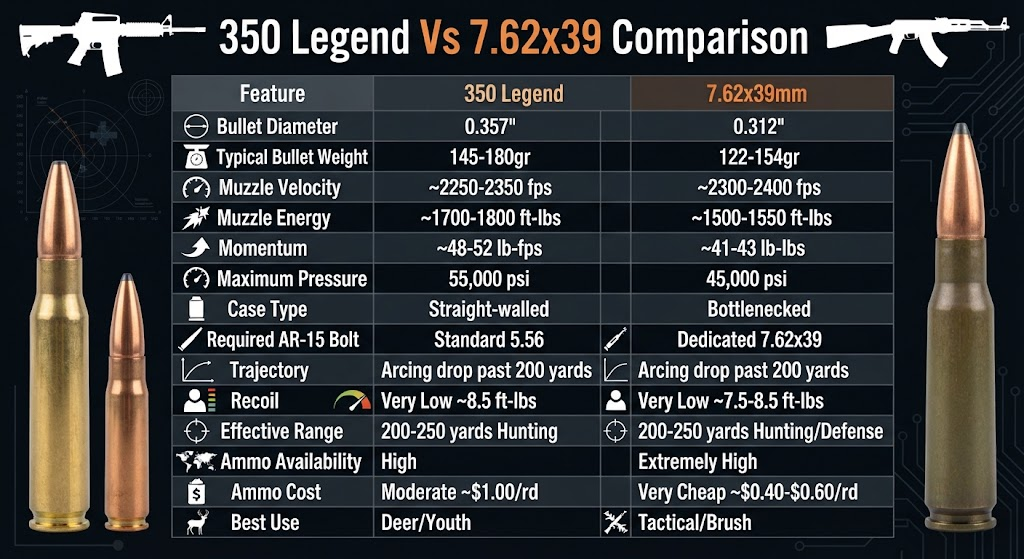
350 Legend Vs 7.62×39 Comparison
| Feature | 350 Legend | 7.62x39mm |
| Bullet Diameter | 0.357 inches (9.1 mm) | 0.312 inches (7.92 mm) |
| Typical Bullet Weight | 145 gr to 180 gr (typically 150 gr) | 122 gr to 154 gr (typically 123 gr) |
| Muzzle Velocity | ~2,250 to 2,350 fps (16 to 20-inch barrel) | ~2,300 to 2,400 fps (16-inch barrel) |
| Muzzle Energy | ~1,700 to 1,800 ft-lbs | ~1,500 to 1,550 ft-lbs |
| Momentum | ~48 to ~52 lb-fps | ~41 to ~43 lb-fps |
| Maximum Pressure | 55,000 psi (SAAMI) | 45,000 psi (SAAMI) / 51,000 psi (CIP) |
| Case Type | Straight-walled | Bottlenecked |
| Required AR-15 Bolt | Standard 5.56 NATO Bolt | Dedicated 7.62×39 Bolt |
| Trajectory | Arcing drop past 200 yards | Arcing drop past 200 yards |
| Recoil | Very Low (~8.5 ft-lbs) | Very Low (~7.5 to 8.5 ft-lbs) |
| Effective Range | 200 to 250 yards (Hunting) | 200 to 250 yards (Hunting/Defense) |
| Ammo Availability | High (Domestic commercial hunting) | Extremely High (Global military standard) |
| Ammo Cost | Moderate (~$1.00/rd) | Very Cheap (~$0.40 to $0.60/rd) |
| Best Use | Straight-wall deer hunting, youth rifles | Tactical training, cheap plinking, heavy brush defense |
The table above illustrates two entirely different approaches to intermediate cartridge design. The 7.62x39mm was introduced in 1943 for the SKS and later the AK-47, utilizing a heavily tapered, bottlenecked case that ensures flawless feeding and extraction in muddy, fouled military chambers.
The 350 Legend was introduced by Winchester in 2019 strictly to solve a domestic hunting regulation problem. Many Midwestern states restrict deer hunters to straight-walled cartridges to limit bullet travel distances. By modifying a .223 Remington case to hold a .357-caliber bullet, Winchester created a straight-walled cartridge that operates perfectly on a standard AR-15 bolt face, delivering modern hunting performance while remaining perfectly legal in states like Ohio, Iowa, and Michigan.
350 Legend Vs 7.62×39 Ballistics
To objectively evaluate their capabilities, we must examine standard commercial ammunition fired from typical 16-to-20-inch carbine barrels.
- Load A (350 Legend Hunting): Winchester 150-grain Deer Season XP. Muzzle velocity is 2,325 feet per second. Muzzle energy is 1,800 foot-pounds.
- Load B (350 Legend Heavy): Federal 180-grain Power-Shok. Muzzle velocity is 2,100 feet per second. Muzzle energy is 1,762 foot-pounds.
- Load C (7.62x39mm Standard Military): Tula 122-grain Full Metal Jacket (FMJ). Muzzle velocity is 2,396 feet per second. Muzzle energy is 1,555 foot-pounds.
- Load D (7.62x39mm Hunting): Hornady 123-grain SST. Muzzle velocity is 2,350 feet per second. Muzzle energy is 1,508 foot-pounds.
350 Legend Vs 7.62×39 Velocity
Both cartridges belong to the intermediate velocity class, generally leaving the muzzle between 2,200 and 2,400 feet per second.
Because the 7.62x39mm utilizes slightly lighter bullets (123 grains) and an efficient bottlenecked powder column, it usually maintains a slight velocity advantage over the 350 Legend. However, both cartridges suffer from poor aerodynamic efficiency. The blunt 350 Legend bullets and the short, flat-based 7.62x39mm bullets bleed velocity rapidly, which is why neither is recommended for shots beyond 250 yards.
350 Legend Vs 7.62×39 Muzzle Energy
Muzzle energy represents the raw kinetic work capacity of a projectile, and this is where the American hunting cartridge pulls ahead.
The 7.62x39mm generates roughly 1,500 foot-pounds of energy. While legendary for close-quarters combat and perfectly adequate for deer, it is on the lower end of the medium-game hunting spectrum.
The 350 Legend generates roughly 1,800 foot-pounds of energy. This 20% increase in kinetic energy, combined with a wider starting bullet diameter, allows the 350 Legend to hit targets noticeably harder, resulting in superior hydrostatic shock and wider permanent wound channels on game animals.
350 Legend Vs 7.62×39 Momentum
Momentum calculates mass in motion, which dictates a bullet’s ability to drive through thick bone and heavy shoulder muscles without deflecting.
Because the 350 Legend fires a heavier bullet (150 to 180 grains) at highly comparable speeds, it generates superior linear momentum. A 150-grain 350 Legend bullet traveling at 2,325 fps yields approximately 49.8 pound-feet per second of momentum, giving it a distinct penetration advantage over the lighter 123-grain 7.62x39mm (which yields roughly 41.3 lb-fps).
350 Legend Vs 7.62×39 Trajectory
Understanding external ballistics highlights the practical range limitations of both rounds. The calculations below assume a standard rifle sight height of 1.5 inches above the bore and a 100-yard zero.
| Distance | 350 Legend (150 gr at 2,325 fps) Drop | 7.62x39mm (123 gr at 2,350 fps) Drop |
| Muzzle | -1.5 inches | -1.5 inches |
| 100 Yards | 0.0 inches (Zero) | 0.0 inches (Zero) |
| 150 Yards | -2.8 inches | -2.5 inches |
| 200 Yards | -8.5 inches | -7.5 inches |
| 250 Yards | -17.5 inches | -15.2 inches |
The trajectory curves are functionally identical inside practical hunting ranges. Because the 7.62x39mm utilizes spitzer (pointed) bullets with slightly better aerodynamic profiles than the straight-walled 350 Legend, it shoots fractionally flatter past 200 yards, though the difference is only a matter of inches.
350 Legend Vs 7.62×39 Recoil
Both cartridges are famous for their incredibly mild, shooter-friendly recoil.
Fired from identical 7.5-pound carbines, the 7.62x39mm generates roughly 7.5 to 8.0 foot-pounds of free recoil energy, while the 350 Legend generates roughly 8.5 foot-pounds. Both are extremely pleasant to shoot all day, completely eliminate flinching, and are highly recommended for teaching youth hunters the fundamentals of centerfire marksmanship.
350 Legend Vs 7.62×39 Penetration & Expansion
For hunting applications, the 350 Legend is superior. It was designed from the ground up to fire modern, highly engineered soft-point and polymer-tipped bullets that expand violently on whitetail deer. Its larger 0.357-inch diameter ensures a massive blood trail even if the bullet fails to expand perfectly.
While excellent hunting ammunition exists for the 7.62x39mm (such as Hornady SST or federal soft points), the vast majority of affordable 7.62x39mm ammunition consists of military-style Full Metal Jacket (FMJ) rounds. FMJ rounds will poke small, clean holes straight through an animal without expanding, making them highly unethical for hunting.
350 Legend Vs 7.62×39 Self Defense
The 7.62x39mm is one of the most proven combat cartridges in human history. Its heavily tapered case ensures unparalleled reliability in dirty, fouled, or neglected weapons (like the AK-47), making it an elite choice for heavy brush defense and tactical applications where mechanical reliability is the absolute top priority.
The 350 Legend is highly lethal, but its straight-walled design makes it slightly less reliable when feeding rapidly in an AR-15 under heavy carbon fouling, relegating it primarily to hunting roles rather than combat.
Which Has More Stopping Power: 350 Legend Vs 7.62×39?
On medium game like deer and feral hogs, the 350 Legend possesses slightly more stopping power. It delivers 300 more foot-pounds of kinetic energy, utilizes heavier bullets, and features a wider frontal area that destroys more tissue upon impact.
Which Is More Powerful: 350 Legend Vs 7.62×39?
Based on raw kinetic energy and momentum, the 350 Legend is the more powerful cartridge, producing roughly 1,800 foot-pounds of energy compared to the 1,500 foot-pounds of the 7.62x39mm.
350 Legend Pros And Cons
Pros
- Perfectly legal for deer hunting in Midwestern straight-wall restricted states
- Uses a standard 5.56/.223 bolt face, requiring only a barrel and magazine swap in AR-15s
- Generates roughly 20% more kinetic energy than the 7.62x39mm
- Incredibly mild recoil makes it an ideal youth deer cartridge
Cons
- Straight-walled design is less aerodynamic and sheds velocity quickly
- Ammunition is more expensive than bulk military surplus
- Can occasionally suffer from feeding hangups in AR-15 magazines compared to bottlenecked cases
7.62x39mm Pros And Cons
Pros
- Legendary mechanical reliability; the heavy case taper ensures flawless extraction
- Ammunition is mass-produced globally, making it incredibly cheap for high-volume plinking
- Massive variety of available platforms (AK-47, SKS, Ruger Mini-30, AR-15 hybrids)
- Excellent barrier penetration for tactical and heavy brush applications
Cons
- Illegal for deer hunting in states that mandate straight-walled cartridges
- Requires a specialized, heavily modified bolt face and finicky curved magazines to run in an AR-15
- Cheap steel-cased surplus ammo is often corrosive or inaccurate
Final Comparison
| Category | Winner | Reason |
| Velocity | 7.62x39mm | Slightly lighter bullets and efficient bottleneck case yield higher speeds |
| Muzzle Energy | 350 Legend | Delivers ~1,800 ft-lbs compared to the Soviet round’s ~1,500 ft-lbs |
| Momentum | 350 Legend | Heavier 150-to-180-grain bullets carry superior linear driving mass |
| Penetration | Tie | 350 Legend excels on game; 7.62x39mm FMJ excels on tactical barriers |
| Expansion | 350 Legend | Purpose-built hunting bullets open reliably into massive wound cavities |
| Trajectory | 7.62x39mm | Spitzer bullets possess better aerodynamics for a fractionally flatter curve |
| Recoil Control | Tie | Both generate an exceptionally mild 7.5 to 8.5 ft-lbs of free recoil |
| Firearm Reliability | 7.62x39mm | Extreme case taper guarantees flawless extraction in dirty environments |
| AR-15 Compatibility | 350 Legend | Uses a standard 5.56 bolt; 7.62×39 requires specialized bolts and fragile magazines |
| Ammo Cost | 7.62x39mm | Global military surplus keeps steel-cased ammunition exceptionally cheap |
| Overall Performance | Depends on Role | 350 Legend for domestic hunting; 7.62x39mm for cheap training and tactical utility |
350 Legend Vs 7.62×39: Which Should You Choose?
Selecting the winner in the 350 Legend Vs 7.62×39 matchup depends entirely on whether you are building a dedicated hunting rifle or a high-volume plinking and defense carbine.
Choose the 350 Legend if your primary goal is hunting whitetail deer or feral hogs, particularly if you live in a straight-wall restricted state. It delivers superior kinetic energy, hits with a wider bullet, and integrates flawlessly into the AR-15 platform using a standard 5.56 bolt. It is arguably the best low-recoil deer cartridge on the modern market.
Choose the 7.62x39mm if you want an ultra-reliable, combat-proven cartridge for tactical training, home defense, or high-volume range days. Because global ammunition is so incredibly cheap, you can shoot twice as much for the same price. While it requires dedicated platforms (like an AK-47 or specialized AR-47 builds) to run reliably, its rugged performance in adverse conditions is unmatched.
FAQs
Is 350 Legend more powerful than 7.62×39?
Yes. The 350 Legend produces roughly 1,800 foot-pounds of muzzle energy, making it about 20% more powerful than the 7.62x39mm, which produces roughly 1,500 foot-pounds.
Can an AR-15 shoot both cartridges?
An AR-15 can be chambered for either cartridge, but they require different parts. The 350 Legend requires a dedicated barrel and magazine but uses a standard 5.56 NATO bolt. The 7.62x39mm requires a dedicated barrel, a specialized bolt with a wider face, and heavily curved “Frankenstein” magazines to accommodate its aggressive case taper.
Which cartridge has less recoil?
Both cartridges have incredibly light recoil, falling between 7.5 and 8.5 foot-pounds. The difference is imperceptible to the human shoulder, making both excellent for beginners.
Why do some states require straight-walled cartridges like the 350 Legend?
States with flat topography and dense populations (like Ohio and Iowa) ban high-velocity bottlenecked rifle cartridges because they can travel for miles if they miss a target. Straight-walled cartridges shed velocity rapidly and drop to the ground much faster, providing a safer hunting environment in flat terrain.
Is 7.62x39mm good for deer hunting?
Yes, it is highly effective on deer inside 150 yards, provided you use dedicated soft-point or polymer-tipped hunting ammunition (like Hornady SST). You should never hunt deer with military surplus Full Metal Jacket (FMJ) ammunition, as it will simply pass through the animal without causing adequate tissue damage.