The main difference between the cartridges is that the .50 BMG is a heavy-duty, combat-proven military machine gun and anti-material cartridge designed to obliterate hard targets and vehicles at extreme distances using massive mass, whereas the .408 CheyTac is a purpose-built, ultra-low-drag precision cartridge specifically engineered for anti-personnel sniper engagements past 2,000 yards with significantly less weight and recoil.
Both cartridges represent the absolute summit of extreme long-range (ELR) shooting, but they were born from entirely different mandates. The .50 Browning Machine Gun (.50 BMG or 12.7x99mm NATO) was developed during World War I by John Browning at the request of General John Pershing, scaling up the .30-06 cartridge for heavy anti-aircraft and anti-vehicle machine gun use. It entered military service in 1921 and eventually transitioned into legendary single-shot and semi-automatic anti-materiel sniper rifles like the Barrett M82. The .408 CheyTac (Cheyenne Tactical) was developed in 2001 by Dr. John Taylor and William Wordman. It was specifically engineered to fill the gap between the .300 Winchester Magnum and the heavy .50 BMG, aiming to create a man-portable sniper system capable of supersonic flight past 2,500 yards with extreme wind resistance.
.408 CheyTac vs .50 BMG Comparison
| Feature | .408 CheyTac | .50 BMG |
| Bullet Diameter | 0.408 inches (10.36 mm) | 0.510 inches (12.95 mm) |
| Typical Bullet Weight | 400 gr to 420 gr | 650 gr to 800 gr (typically 660 or 750 gr) |
| Muzzle Velocity | 2,900 to 3,000 fps (30-inch barrel) | 2,750 to 3,000 fps (29 to 32-inch barrel) |
| Muzzle Energy | ~7,500 to 8,000+ ft-lbs | ~12,000 to 15,000+ ft-lbs |
| Momentum | ~165 to ~175 lb-fps | ~260 to ~290 lb-fps |
| Maximum Pressure | 55,000 psi (SAAMI) | 65,000 psi (MIL-SPEC / SAAMI) |
| Case Capacity | ~150 grains of water | ~290 grains of water |
| Ballistic Coefficient | Extreme (0.940 to 1.050+ G1) | High to Very High (0.650 to 1.050 G1) |
| Effective Range | 2,000 to 3,000+ yards | 1,500 to 2,500+ yards (Anti-materiel out to 2,000+) |
| Recoil | Massive (~35 to 45 ft-lbs in a heavy rifle) | Brutal (~55 to 70+ ft-lbs in a heavy rifle) |
| System Weight | 25 to 32 lbs (Man-portable sniper rifle) | 30 to 38+ lbs (Heavy sniper/anti-materiel rifle) |
| Ammo Availability | Low (Specialty ELR production runs) | Moderate to High (Military surplus and commercial match) |
| Ammo Cost | Extremely Expensive ($4.00 to $8.00+/rd) | Expensive ($3.00 to $7.00+/rd) |
| Best Use | Extreme long-range target shooting, ELR sniper | Anti-materiel, vehicle disabling, extreme ELR military |
The table above illustrates the sheer scale of power involved. The .50 BMG is an absolute titan, holding nearly double the powder capacity of the .408 CheyTac (290 grains vs 150 grains of water) and operating at a higher 65,000 psi pressure ceiling. It throws massive 750-grain projectiles that generate up to 15,000 foot-pounds of energy. The .408 CheyTac achieves its terrifying efficiency not through sheer brute force, but through advanced aerodynamics utilizing optimized solid-machined bronze bullets with extreme Ballistic Coefficients that slip through the atmosphere with minimal drag.
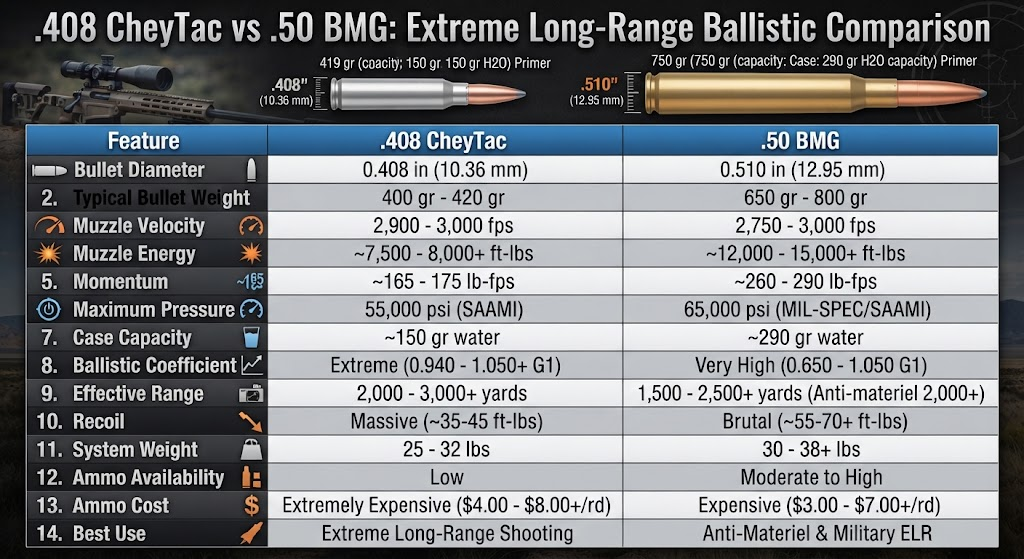
.408 CheyTac vs .50 BMG Ballistics
To objectively evaluate the ballistic capabilities, we must examine match-grade factory ammunition fired from heavy, professional ELR rifle platforms equipped with long 30-inch match barrels.
- Load A (.408 CheyTac Extreme Match): CheyTac USA 419-grain Solid Machined Match. Tested from a 30-inch barrel. Muzzle velocity is 2,900 feet per second. Muzzle energy is 7,823 foot-pounds. Ballistic Coefficient (G1) is 1.050.
- Load B (.408 CheyTac Tactical): Lost River Ballistics 400-grain Solid. Tested from a 30-inch barrel. Muzzle velocity is 3,000 feet per second. Muzzle energy is 7,994 foot-pounds. Ballistic Coefficient (G1) is 0.980.
- Load C (.50 BMG Military Standard): M33 Ball 660-grain FMJ. Tested from a 29-inch barrel. Muzzle velocity is 2,910 feet per second. Muzzle energy is 12,427 foot-pounds. Ballistic Coefficient (G1) is 0.670.
- Load D (.50 BMG Match Grade): Hornady 750-grain A-MAX Match. Tested from a 30-inch barrel. Muzzle velocity is 2,820 feet per second. Muzzle energy is 13,248 foot-pounds. Ballistic Coefficient (G1) is 1.050.
.408 CheyTac Vs .50 BMG Velocity
Both cartridges achieve blazing muzzle velocities hovering around 2,800 to 3,000 feet per second despite launching projectiles that weigh nearly an ounce or more.
When comparing raw speed at the muzzle, the .408 CheyTac often matches or slightly exceeds the velocity of heavy .50 BMG loads because its projectile is significantly lighter (400–420 grains vs 650–750 grains), allowing its powder charge to accelerate the bullet faster.
However, the true magic of the .408 CheyTac lies in retained velocity. Because its solid-machined bullets are exceptionally aerodynamic (with G1 Ballistic Coefficients exceeding 1.0), the .408 CheyTac sheds velocity much slower than standard military .50 BMG ball ammunition. By the time both bullets cross 1,500 yards, the .408 CheyTac is often traveling faster and stays supersonic significantly further into sub-zero, high-altitude environments than standard .50 BMG loads.
.408 CheyTac Vs .50 BMG Muzzle Energy
Muzzle energy represents the raw kinetic work capacity of a projectile, and this is where the .50 BMG reigns supreme as an undisputed monster.
A standard match-grade .408 CheyTac generates roughly 7,500 to 8,000 foot-pounds of muzzle energy. While this is nearly double the energy of a .300 Winchester Magnum, it is completely eclipsed by the .50 BMG.
A standard .50 BMG generates between 12,000 and 15,000+ foot-pounds of muzzle energy at the muzzle. This immense energy allows the .50 BMG to punch straight through engine blocks, brick walls, armored glass, and light military vehicles, delivering a destructive kinetic payload that a .408 CheyTac cannot physically match.
.408 CheyTac Vs .50 BMG Momentum
Momentum is a linear measurement calculating mass in motion, which dictates a projectile’s ability to drive through heavy structural barriers.
Because momentum relies heavily on bullet mass, the .50 BMG thoroughly dominates this category.
A 419-grain .408 CheyTac bullet traveling at 2,900 feet per second yields approximately 173.5 pound-feet per second of linear momentum.
A heavy 750-grain .50 BMG bullet traveling at 2,820 feet per second yields an astronomical 302.1 pound-feet per second of linear momentum.
The .50 BMG carries nearly double the physical mass-in-motion of the CheyTac, allowing it to shatter heavy steel and concrete structures with raw kinetic force.
.408 CheyTac Vs .50 BMG Trajectory
Understanding external ballistics highlights why the .408 CheyTac was engineered for anti-personnel precision, while the .50 BMG was designed for general anti-materiel use. The calculations below assume a high-profile ELR optic height of 2.5 inches above the bore and a 300-yard zero.
| Distance | .408 CheyTac (419 gr at 2,900 fps) Drop | .50 BMG (750 gr at 2,820 fps) Drop |
| Muzzle | -2.5 inches | -2.5 inches |
| 300 Yards | 0.0 inches (Zero) | 0.0 inches (Zero) |
| 600 Yards | -21.4 inches | -23.1 inches |
| 1000 Yards | -92.5 inches | -101.4 inches |
| 1500 Yards | -272.0 inches | -305.5 inches |
| 2000 Yards | -610.0 inches | -715.0 inches |
Both cartridges shoot with astonishingly flat trajectories out to 1,000 yards despite their massive size. However, as distances stretch past 1,500 and 2,000 yards, the extreme aerodynamic efficiency of the .408 CheyTac’s solid lathe-turned bullets results in significantly less drop and far superior resistance to crosswinds compared to standard military .50 BMG ammunition. While match-grade .50 BMG bullets with high BCs can match the CheyTac, standard military surplus M33 ball ammo falls behind rapidly at extreme distances.
.408 CheyTac Vs .50 BMG Recoil
Recoil management for both cartridges requires massive, highly efficient muzzle brakes and heavy rifle chassis systems.
The .50 BMG produces brutal, bone-jarring recoil. Fired from a 35-pound rifle, a standard .50 BMG load generates roughly 55 to 70+ foot-pounds of free recoil energy. The concussive blast is deafening, throwing a massive pressure wave that can kick up dust and debris for yards around the shooter.
The .408 CheyTac produces slightly less recoil, generating roughly 35 to 45 foot-pounds of free recoil energy in an equally heavy rifle chassis. While it is still a massive punch that requires proper shooting form, it is noticeably more manageable than the .50 BMG, allowing shooters to stay on target more easily through the scope.
.408 CheyTac Vs .50 BMG Penetration & Anti-Materiel Performance
When evaluating anti-materiel performance, the .50 BMG is in a class of its own. When loaded with Armor-Piercing Incendiary (API) or Raufoss Mk 211 multi-purpose rounds, the .50 BMG can defeat armored personnel carriers, ignite fuel supplies, and detonate unexploded ordnance behind cover.
The .408 CheyTac is not an anti-materiel cartridge. While its solid bronze bullets will punch deep through light barriers and body armor, it lacks the massive payload capacity required for incendiary or explosive military payloads. It is strictly an anti-personnel and extreme long-range precision target cartridge.
.408 CheyTac Vs .50 BMG Self Defense & Concealed Carry
Neither cartridge is remotely suitable for civilian self-defense, home defense, or concealed carry. Both require specialized, multi-million-dollar shooting ranges spanning multiple miles to operate safely, and both are chambered in heavy, 30+ pound weapon systems.
Which Has More Stopping Power: .408 CheyTac Vs .50 BMG?
On human-sized targets at extreme ranges (past 1,500 yards), the .408 CheyTac possesses exceptional precision stopping power because its superior aerodynamics allow it to deliver consistent, accurate hits where a .50 BMG may begin to tumble or lose supersonic stability.
However, against heavy vehicles, bunkers, and hard targets, the .50 BMG possesses unmatched anti-materiel stopping power.
Which Is More Powerful: .408 CheyTac Vs .50 BMG?
Based on raw muzzle energy, momentum, and explosive payload potential, the .50 BMG is vastly more powerful than the .408 CheyTac.
.408 CheyTac Pros And Cons
Pros
- Exceptional aerodynamic design with high BC bullets that stay supersonic past 2,500 yards
- Significantly lighter rifle systems and lower recoil compared to .50 BMG platforms
- Unmatched precision and wind-bucking capability for extreme long-range sniper engagements
- Easier to transport and deploy in a man-portable sniper package
Cons
- Extremely expensive specialized ammunition and reloading components
- Lacks the anti-materiel capability (armor-piercing/incendiary payloads) of the .50 BMG
- Very limited rifle platform availability compared to the ubiquitous .50 BMG market
.50 BMG Pros And Cons
Pros
- Legendary, combat-proven military anti-materiel capability (disables vehicles, radar, and barriers)
- Massive kinetic energy and momentum (12,000+ ft-lbs)
- Huge variety of rifle platforms (bolt-action, semi-automatic like the Barrett M82)
- Widespread military surplus and match ammunition availability
Cons
- Brutal, punishing recoil and massive muzzle blast require heavy rifle chassis and robust brakes
- Extremely heavy weapon systems (35+ lbs) make mobility challenging for single snipers
- Banned on many commercial shooting ranges due to extreme power and safety templates
Final Comparison
| Category | Winner | Reason |
| Velocity | Tie | Both achieve high initial muzzle speeds around 2,800 to 3,000 fps |
| Muzzle Energy | .50 BMG | Massive powder capacity yields 12,000 to 15,000+ ft-lbs of energy |
| Momentum | .50 BMG | Heavy 750-grain bullets carry double the physical mass-in-motion |
| Penetration | .50 BMG | Specialized military rounds (API/Raufoss) defeat armor and hardened materials |
| Expansion | .408 CheyTac | Solid match bullets are precision-engineered for extreme long-range accuracy |
| Trajectory | .408 CheyTac | Superior aerodynamic efficiency (high BC) retains speed better past 1,500 yards |
| Recoil Control | .408 CheyTac | Generates noticeably less felt recoil and concussion than the massive .50 BMG |
| Effective Range | .408 CheyTac | Purpose-built to maintain supersonic stability and precision past 2,500+ yards |
| Self Defense | Neither | Both are extreme long-range military and target calibers |
| Concealed Carry | Neither | Both require massive 30-pound weapon systems |
| Ammo Cost | .50 BMG | Greater commercial and surplus production offers slightly more pricing variety |
| Ammo Availability | .50 BMG | Widely available through military surplus and numerous commercial manufacturers |
| Overall Performance | Depends on Mission | .50 BMG for anti-materiel/vehicle destruction; .408 CheyTac for extreme long-range precision |
.408 CheyTac Vs .50 BMG: Which Should You Choose?
Selecting between the .408 CheyTac and the .50 BMG depends entirely on whether your extreme long-range mission requires destroying hard targets or hitting precision targets at extreme distances.
Choose the .408 CheyTac if your primary objective is extreme long-range (ELR) precision shooting, king-of-two-mile competitions, or anti-personnel sniper applications where hitting a small target at 2,500 yards in high winds is the ultimate goal. It offers elite aerodynamics, lighter rifle weights, and more manageable recoil.
Choose the .50 BMG if you want the undisputed heavyweight king of commercial anti-materiel power. Whether you want to collect a Barrett M82 semi-automatic, punch through heavy steel plates, or own a globally recognized military caliber with deep surplus ammunition supplies, the .50 BMG is an American legend.
FAQs
Is .408 CheyTac more powerful than .50 BMG?
No, the .50 BMG is significantly more powerful. It generates roughly 13,000 to 15,000 foot-pounds of muzzle energy, whereas the .408 CheyTac generates roughly 7,500 to 8,000 foot-pounds.
Which has more range?
In terms of precision accuracy and staying supersonic, the .408 CheyTac is purpose-built to out-range standard .50 BMG ball ammunition, maintaining clean supersonic flight past 2,500 to 3,000 yards.
Can .50 BMG shoot .408 CheyTac ammunition?
No. They are entirely different calibers with completely incompatible case dimensions, bolt faces, and barrel diameters.
Why was .408 CheyTac invented if .50 BMG already existed?
The .408 CheyTac was invented because military snipers wanted a man-portable rifle system that was significantly lighter than a 35-pound .50 BMG rifle, produced less recoil, and offered superior match-grade precision and wind resistance at extreme distances (2,000+ yards) without needing anti-materiel explosive payloads.
Which has more recoil?
The .50 BMG produces noticeably more recoil and a much harsher concussive blast than the .408 CheyTac, though both require massive muzzle brakes to be fired comfortably.
Which should you choose?
Choose the .408 CheyTac for extreme long-range precision target shooting and superior wind-bucking aerodynamics. Choose the .50 BMG for ultimate anti-materiel power, semi-automatic Barrett ownership, and historic military clout.