The main difference between the cartridges is that the .300 Savage is a legacy short-action cartridge designed in 1920 to mimic .30-06 performance in classic lever-action rifles, whereas the .308 Winchester is a modern, highly refined military and sporting cartridge operating at higher pressures to deliver superior ballistic efficiency, wider ammunition availability, and greater downrange energy.
Both cartridges fire the exact same .308-inch diameter projectiles and share a nearly identical heritage as short-action .30 caliber pioneers. The .300 Savage was introduced by the Savage Arms Company to replace the older .30-30 Winchester, specifically engineered with a short case and a sharp 22-degree shoulder so it could fit into lightweight, fast-handling lever-action rifles like the famous Savage Model 99.
The .308 Winchester was introduced in 1952 by Winchester, borrowing heavily from the experimental military T65 cartridge. Winchester took the core concept of the short .300 Savage case, straightened the body slightly, and optimized it to operate at higher modern pressures. While the .308 Winchester went on to become one of the most prolific short-action cartridges in global history, the .300 Savage remains a beloved, highly efficient classic in the woods.
300 Savage vs 308 Comparison
| Feature | .300 Savage | .308 Winchester |
| Bullet Diameter | 0.308 inches (7.82 mm) | 0.308 inches (7.82 mm) |
| Typical Bullet Weight | 150 gr to 180 gr (typically 150 gr) | 150 gr to 180 gr (typically 150 gr or 168 gr) |
| Muzzle Velocity | 2,600 to 2,650 fps (22-inch barrel) | 2,750 to 2,820 fps (24-inch barrel) |
| Muzzle Energy | 2,250 to 2,350 ft-lbs | 2,600 to 2,800 ft-lbs |
| Momentum | ~55 to ~58 lb-fps | ~60 to ~64 lb-fps |
| Maximum Pressure | 47,000 CUP (~52,000 psi equivalent) | 62,000 psi (SAAMI) |
| Case Length | 1.871 inches (47.5 mm) | 2.015 inches (51.2 mm) |
| Ballistic Coefficient | Moderate (0.350 to 0.420) | Moderate to High (0.380 to 0.530) |
| Penetration | 16 to 22 inches (Gelatin) | 18 to 24 inches (Gelatin) |
| Expansion | 0.60 to 0.70 inches | 0.60 to 0.75 inches |
| Trajectory | Flat out to 200 yards | Flat out to 300 yards |
| Recoil | Very Mild (~12 to 14 ft-lbs) | Moderate (~15 to 18 ft-lbs) |
| Effective Range | 300 to 400 yards (Hunting) | 500 to 800+ yards (Hunting and Target) |
| Ammo Availability | Low (Seasonal specialty runs) | Extremely High (Global commercial standard) |
| Ammo Cost | Expensive ($2.00 to $3.00+ per round) | Moderate ($0.80 to $2.00 per round) |
| Best Use | Vintage rifle hunting, traditional timber deer | Versatile big game hunting, precision target shooting |
The table above illustrates how a modern high-pressure design outperforms an older, lower-pressure classic. The .300 Savage was designed during an era when rifle steels could not safely contain the massive pressures modern metallurgy handles effortlessly today. Consequently, SAAMI limits the .300 Savage to a conservative pressure ceiling (roughly 52,000 psi equivalent).
The .308 Winchester takes full advantage of modern high-strength steel, operating at a robust 62,000 psi. Furthermore, the .308 case is roughly 3.7 millimeters longer than the .300 Savage case. This extra case length and higher pressure allow the .308 Winchester to pack significantly more powder behind the bullet, yielding higher velocities and superior energy retention downrange.
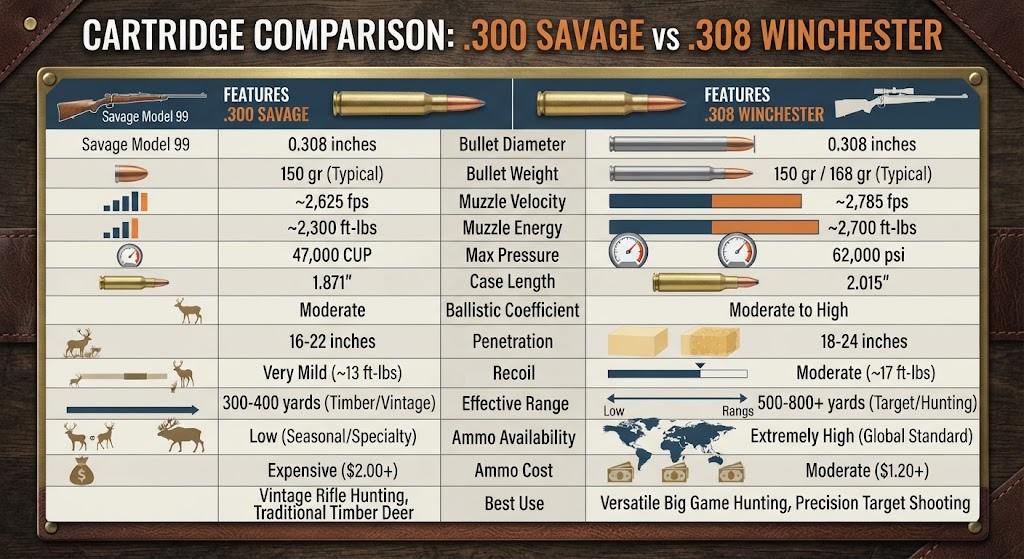
.300 Savage vs .308 Winchester Ballistics
To objectively evaluate the ballistic capabilities, we must examine real-world factory hunting ammunition. Because both cartridges utilize the exact same .308-inch bullets, comparing standard 150-grain and 180-grain commercial hunting loads provides a perfect benchmark.
- Load A (.300 Savage Standard Hunting): Remington 150-grain Core-Lokt Soft Point. Tested from a 22-inch barrel. Muzzle velocity is 2,630 feet per second. Muzzle energy is 2,304 foot-pounds. Ballistic Coefficient (G1) is 0.314.
- Load B (.300 Savage Heavy Hunting): Federal Premium 180-grain Soft Point. Tested from a 22-inch barrel. Muzzle velocity is 2,370 feet per second. Muzzle energy is 2,243 foot-pounds. Ballistic Coefficient (G1) is 0.383.
- Load C (.308 Winchester Standard Hunting): Federal Premium 150-grain Nosler Partition. Tested from a 24-inch barrel. Muzzle velocity is 2,820 feet per second. Muzzle energy is 2,648 foot-pounds. Ballistic Coefficient (G1) is 0.387.
- Load D (.308 Winchester Heavy Precision): Federal Premium Gold Medal 168-grain Sierra MatchKing. Tested from a 24-inch barrel. Muzzle velocity is 2,650 feet per second. Muzzle energy is 2,619 foot-pounds. Ballistic Coefficient (G1) is 0.462.
.300 Savage vs .308 Winchester Velocity
Velocity dictates how flat a projectile shoots across unknown distances and how effectively expanding bullets open upon impacting soft tissue.
When evaluating velocity, the .308 Winchester holds a clear and consistent advantage. Firing a standard 150-grain hunting bullet, the .308 Winchester easily achieves 2,820 feet per second from a 24-inch barrel. The .300 Savage, constrained by its smaller powder capacity and lower pressure limit, launches an identical 150-grain bullet at roughly 2,630 feet per second.
The .300 Savage is roughly 150 to 200 feet per second slower than the .308 Winchester across equivalent bullet weights. This means the .308 Winchester delivers a more aggressive impact velocity up close and maintains its supersonic speed further downrange.
.300 Savage vs .308 Winchester Muzzle Energy
Muzzle energy represents the raw kinetic work capacity of a projectile. Because the .308 Winchester drives identical bullet weights at higher velocities, it dominates the muzzle energy category.
A standard .300 Savage hunting load produces roughly 2,250 to 2,350 foot-pounds of energy at the muzzle. This is an exceptional amount of energy for medium game and easily exceeds older lever-action rounds like the .30-30 Winchester.
The .308 Winchester produces roughly 2,600 to 2,800 foot-pounds of energy at the muzzle. The .308 delivers roughly 300 to 400 additional foot-pounds of kinetic energy compared to the .300 Savage, giving it a noticeable advantage when taking on larger game animals like elk or heavy-boned boars.
.300 Savage vs .308 Winchester Momentum
Momentum correlates closely with a bullet’s ability to crush through dense bone, heavy winter hides, and thick muscle without being deflected or stopping prematurely.
Because momentum relies equally on bullet weight and velocity, the faster .308 Winchester holds a measurable advantage over the .300 Savage when firing identical projectiles.
A 150-grain .300 Savage bullet traveling at 2,630 feet per second yields approximately 56.4 pound-feet per second of linear momentum.
An identical 150-grain .308 Winchester bullet traveling at 2,820 feet per second yields approximately 60.4 pound-feet per second of linear momentum.
Both cartridges offer sufficient momentum for whitetail deer, but the .308 Winchester provides deeper, more reliable pass-through momentum when taking challenging quartering shots on heavier game.
.300 Savage vs .308 Winchester Trajectory
Understanding external ballistics separates a 200-yard timber rifle from an 800-yard precision rifle. The calculations below assume a standard rifle optic height of 1.5 inches above the bore and a zero distance of 200 yards. We will compare standard 150-grain hunting loads.
| Distance | .300 Savage (150 gr at 2,630 fps) Drop | .308 Winchester (150 gr at 2,820 fps) Drop |
| Muzzle | -1.5 inches | -1.5 inches |
| 100 Yards | +1.8 inches | +1.5 inches |
| 200 Yards | 0.0 inches (Zero) | 0.0 inches (Zero) |
| 300 Yards | -9.2 inches | -7.5 inches |
| 400 Yards | -26.5 inches | -21.4 inches |
| 500 Yards | -54.0 inches | -43.2 inches |
Inside 200 yards, both cartridges shoot remarkably flat, allowing hunters to hold dead-center on a deer’s vitals without calculating holdovers.
However, as distances stretch past 300 yards, the higher velocity and superior aerodynamic profiles available in the .308 Winchester take over. At 500 yards, the .300 Savage drops over 11 inches more than the .308 Winchester and suffers significantly more wind drift. The .300 Savage is inherently a traditional 300-yard maximum hunting cartridge, whereas the .308 Winchester is fully capable of pushing out to 600 or 800 yards with proper match loads.
.300 Savage vs .308 Winchester Recoil
Recoil management is critical for rapid follow-up shots and accurate placement.
Both cartridges are exceptionally mild, but the .300 Savage is famously gentle. Fired from a standard 7.5-pound hunting rifle, a full-power .300 Savage load generates roughly 12 to 14 foot-pounds of free recoil energy.
Fired from an identical rifle, the .308 Winchester generates roughly 15 to 18 foot-pounds of free recoil energy. While the .308 Winchester kicks slightly harder due to its higher velocity and powder charge, it is still considered one of the most manageable medium-bore rifle calibers in existence, easily tolerated by youth and adult hunters alike.
.300 Savage vs .308 Winchester Penetration & Expansion
Terminal penetration and expansion are virtually identical when both cartridges impact a target at similar velocities, as they utilize the exact same .308-inch diameter projectiles.
A standard soft-point hunting bullet fired from a .300 Savage will expand rapidly and penetrate 16 to 22 inches in soft tissue inside 200 yards. However, because the .300 Savage starts slower, its velocity drops below the threshold required for reliable hollow-point expansion much sooner than the .308 Winchester. The .308 Winchester retains its expanding velocity envelope significantly further downrange.
.300 Savage vs .308 Winchester Self Defense & Concealed Carry
Neither cartridge is suitable for standard urban home defense due to the extreme danger of over-penetration through walls and deafening muzzle blasts indoors. Both are powerful big-game hunting cartridges fired from long rifle platforms that cannot be concealed on the human body.
Which Has More Stopping Power: .300 Savage or .308 Winchester?
On whitetail deer at typical woodland ranges (inside 200 yards), their stopping power is functionally identical—both deliver devastating hydrostatic shock and reliable tissue destruction.
However, at extended distances or on larger game animals like elk and black bear, the .308 Winchester possesses superior stopping power due to its higher velocity, greater kinetic energy, and deeper penetration.
Which Is More Powerful: .300 Savage or .308 Winchester?
Based on raw physics, kinetic energy, and operating pressure, the .308 Winchester is vastly more powerful than the .300 Savage, delivering roughly 300 to 400 more foot-pounds of energy at the muzzle.
.300 Savage Pros and Cons
Pros
- Incredibly efficient cartridge design that achieves impressive velocity with modest powder charges
- Very mild recoil makes it a joy to shoot in vintage lightweight rifles
- Shorter overall length allows for slick, fast-cycling actions in classic firearms like the Savage Model 99
- Steep 22-degree shoulder promotes excellent inherent accuracy
Cons
- Ammunition is expensive, difficult to find on standard retail shelves, and limited to seasonal specialty runs
- Inferior downrange ballistics and trajectory compared to modern short-action cartridges
- Limited rifle platform choices, as very few modern manufacturers chamber new rifles in .300 Savage
.308 Winchester Pros and Cons
Pros
- The undisputed global standard for short-action precision shooting and versatile big-game hunting
- Ubiquitous ammunition availability in every sporting goods store worldwide at affordable prices
- Vast selection of rifle platforms, bullet weights, and specialized match/hunting loads
- Exceptional barrel life, inherent accuracy, and robust pressure handling capabilities
Cons
- Generates slightly more recoil and muzzle blast than the vintage .300 Savage
- While an exceptional all-rounder, it has been eclipsed in extreme long-range competition by specialized 6mm and 6.5mm cartridges
Final Comparison
| Category | Winner | Reason |
| Velocity | .308 Winchester | Higher operating pressure and larger powder capacity drive bullets 150-200 fps faster |
| Muzzle Energy | .308 Winchester | Generates roughly 300 to 400 more ft-lbs of kinetic energy |
| Momentum | .308 Winchester | Higher velocity applied to identical bullet weights yields superior momentum |
| Penetration | .308 Winchester | Higher impact velocities push expanding bullets deeper at extended ranges |
| Expansion | .308 Winchester | Maintains its expanding velocity threshold significantly further downrange |
| Trajectory | .308 Winchester | Flatter shooting curve and vastly superior wind resistance past 300 yards |
| Recoil Control | .300 Savage | Lower powder charge produces a slightly softer, milder recoil impulse |
| Effective Range | .308 Winchester | Superior retained energy and aerodynamics confidently extend shots out past 500 yards |
| Self Defense | Neither | Both present extreme over-penetration hazards in any residential setting |
| Concealed Carry | Neither | Both are full-size rifle cartridges entirely unsuitable for concealment |
| Ammo Cost | .308 Winchester | Massive commercial adoption guarantees significantly cheaper retail price tags |
| Ammo Availability | .308 Winchester | Found in massive quantities in every hardware and sporting goods store nationwide |
| Overall Performance | .308 Winchester | Modern engineering, superior power, and universal ammunition availability |
.300 Savage vs .308 Winchester: Which Should You Choose?
Selecting between the .300 Savage and the .308 Winchester is a choice between honoring a vintage classic and embracing modern ballistic efficiency.
Choose the .300 Savage if you are a traditionalist who inherits or owns a classic vintage rifle—such as a Savage Model 99 lever-action or an early bolt gun—and you love hunting white-tailed deer in thick timber where shots rarely exceed 200 yards. It is a historic, wonderfully mild-recoiling cartridge that gets the job done with old-school charm, provided you are willing to track down specialty ammunition or handload your own brass.
Choose the .308 Winchester for everything else. It is one of the most practical, versatile, and successful rifle cartridges ever created. It delivers more power, shoots flatter, bucks the wind better, and offers the unmatched convenience of finding cheap, high-performance ammunition in every gun shop on the planet. Whether you are hunting elk in the mountains or ringing steel at 800 yards, the .308 Winchester is the superior modern instrument.
FAQs
Is .300 Savage more powerful than .308 Winchester?
No, the .308 Winchester is significantly more powerful. It operates at a higher pressure limit and holds more powder, generating roughly 300 to 400 more foot-pounds of muzzle energy than the .300 Savage.
Which has more muzzle energy?
The .308 Winchester easily produces between 2,600 and 2,800 foot-pounds of muzzle energy, while the .300 Savage typically produces between 2,250 and 2,350 foot-pounds.
Which has more stopping power?
Inside 200 yards on whitetail deer, their stopping power is practically identical. Beyond 200 yards or on larger game like elk, the .308 Winchester possesses superior stopping power due to its higher retained energy and deeper penetration.
Which has more recoil?
The .308 Winchester produces slightly more recoil, generating roughly 15 to 18 foot-pounds of free recoil energy compared to the 12 to 14 foot-pounds of the .300 Savage. Both, however, are exceptionally mild.
Which has better penetration?
The .308 Winchester penetrates deeper at intermediate and long ranges because it maintains a higher impact velocity, which ensures proper bullet expansion and deep tissue displacement.
Which has a flatter trajectory?
The .308 Winchester shoots a noticeably flatter trajectory past 300 yards due to its higher initial velocity and superior aerodynamic load options, suffering significantly less bullet drop and wind drift.
Is .308 Winchester faster than .300 Savage?
Yes, the .308 Winchester is roughly 150 to 200 feet per second faster than the .300 Savage across equivalent bullet weights.
Can a .308 Winchester shoot .300 Savage?
No. They are completely different cartridges with different case lengths and shoulder geometries. Attempting to chamber or fire a .300 Savage in a .308 Winchester rifle is physically impossible and dangerous.
Which is cheaper and easier to find?
The .308 Winchester is vastly cheaper and easier to find. It is a global commercial standard found everywhere, whereas the .300 Savage is a niche vintage cartridge that carries expensive price tags and requires specialty hunting runs.
Which should you choose?
Choose the .300 Savage for hunting with vintage lever-action rifles in thick timber. Choose the .308 Winchester for universal ammunition availability, modern rifle platforms, and superior long-range performance.