The main difference between the cartridges is that the .243 Winchester is a classic hunting cartridge that typically utilizes barrels with slower twist rates designed for lightweight, highly explosive varmint and medium-game bullets, whereas the 6mm Creedmoor is a modern precision cartridge engineered specifically to be fired from fast-twist barrels that stabilize heavy, incredibly aerodynamic bullets for extreme long-range target shooting and hunting.
Both cartridges fire the exact same 6mm (0.243-inch) diameter projectiles. The .243 Winchester was introduced in 1955 by necking down the .308 Winchester case, and it quickly became the global gold standard for youth deer hunters and predator control. The 6mm Creedmoor was officially standardized by Hornady in 2017. Based on the widely successful 6.5 Creedmoor case necked down to 6mm, it was purpose-built to dominate the Precision Rifle Series (PRS) and long-range tactical competitions by addressing the mechanical limitations of the older .243 Winchester case design.
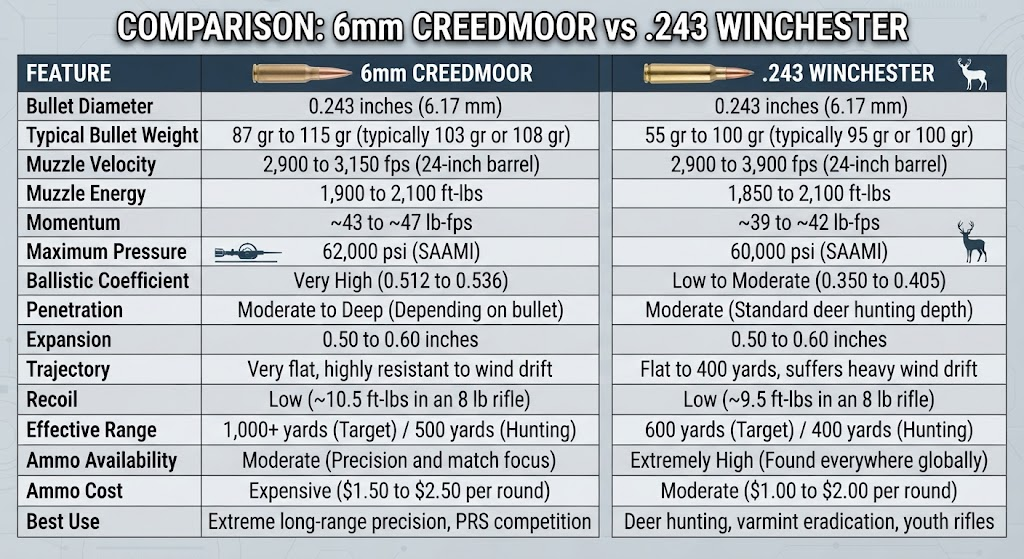
6mm Creedmoor vs 243 Comparison
| Feature | 6mm Creedmoor | .243 Winchester |
| Bullet Diameter | 0.243 inches (6.17 mm) | 0.243 inches (6.17 mm) |
| Typical Bullet Weight | 87 gr to 115 gr (typically 103 gr or 108 gr) | 55 gr to 100 gr (typically 95 gr or 100 gr) |
| Muzzle Velocity | 2,900 to 3,150 fps (24-inch barrel) | 2,900 to 3,900 fps (24-inch barrel) |
| Muzzle Energy | 1,900 to 2,100 ft-lbs | 1,850 to 2,100 ft-lbs |
| Momentum | ~43 to ~47 lb-fps | ~39 to ~42 lb-fps |
| Maximum Pressure | 62,000 psi (SAAMI) | 60,000 psi (SAAMI) |
| Ballistic Coefficient | Very High (0.512 to 0.536) | Low to Moderate (0.350 to 0.405) |
| Penetration | Moderate to Deep (Depending on bullet) | Moderate (Standard deer hunting depth) |
| Expansion | 0.50 to 0.60 inches | 0.50 to 0.60 inches |
| Trajectory | Very flat, highly resistant to wind drift | Flat to 400 yards, suffers heavy wind drift |
| Recoil | Low (~10.5 ft-lbs in an 8 lb rifle) | Low (~9.5 ft-lbs in an 8 lb rifle) |
| Effective Range | 1,000+ yards (Target) / 500 yards (Hunting) | 600 yards (Target) / 400 yards (Hunting) |
| Ammo Availability | Moderate (Precision and match focus) | Extremely High (Found everywhere globally) |
| Ammo Cost | Expensive ($1.50 to $2.50 per round) | Moderate ($1.00 to $2.00 per round) |
| Best Use | Extreme long-range precision, PRS competition | Deer hunting, varmint eradication, youth rifles |
The comparison table above outlines the core mechanical differences between the two cartridges, but the true defining factor separating them is rifling twist rate.
For decades, rifle manufacturers built .243 Winchester rifles with a 1-in-10-inch barrel twist rate. This twist rate perfectly stabilizes bullets weighing between 55 and 100 grains. However, it completely fails to stabilize the ultra-long, highly aerodynamic 105-grain to 115-grain match bullets required for extreme long-range shooting. When those heavy bullets are fired from a 1-in-10 barrel, they tumble through the air ineffectively.
The 6mm Creedmoor was explicitly designed around a 1-in-7 or 1-in-8-inch barrel twist rate. This fast rifling flawlessly stabilizes the heaviest, highest Ballistic Coefficient (BC) 6mm bullets on the market. Furthermore, the 6mm Creedmoor features a shorter case body with a longer neck and a 30-degree shoulder. This allows manufacturers to seat these massive bullets far out of the case mouth without exceeding the 2.825-inch maximum overall length required to fit into a short-action rifle magazine. If you try to seat a massive 115-grain bullet into a .243 Winchester case to fit the same magazine, you must push the bullet so deeply into the brass that it violently crushes the powder charge, creating dangerous pressure spikes.
6mm Creedmoor vs 243 Ballistics
To objectively evaluate the ballistic capabilities of the 6mm Creedmoor against the .243 Winchester, we must examine real-world factory ammunition across their most common applications in target shooting and hunting.
For a fair comparison reflecting their maximum potential, all loads listed below are recorded from standard 24-inch test barrels.
- Load A (6mm Creedmoor Precision Hunting): Hornady 103-grain ELD-X Precision Hunter. Tested from a 24-inch barrel. Muzzle velocity is 3,050 feet per second. Muzzle energy is 2,127 foot-pounds. Ballistic Coefficient (G1) is 0.512.
- Load B (6mm Creedmoor Heavy Match): Hornady 108-grain ELD Match. Tested from a 24-inch barrel. Muzzle velocity is 2,960 feet per second. Muzzle energy is 2,101 foot-pounds. Ballistic Coefficient (G1) is 0.536.
- Load C (.243 Winchester Standard Hunting): Federal Premium 95-grain Nosler Ballistic Tip. Tested from a 24-inch barrel. Muzzle velocity is 3,025 feet per second. Muzzle energy is 1,930 foot-pounds. Ballistic Coefficient (G1) is 0.379.
- Load D (.243 Winchester Classic Hunting): Winchester 100-grain Power-Point. Tested from a 24-inch barrel. Muzzle velocity is 2,960 feet per second. Muzzle energy is 1,945 foot-pounds. Ballistic Coefficient (G1) is 0.356.
6mm Creedmoor vs 243 Velocity
Velocity dictates how flat a projectile shoots across unknown distances and how effectively expanding bullets open upon impacting soft tissue.
When evaluating raw muzzle velocity, the .243 Winchester is actually the faster cartridge when utilizing lightweight bullets. Because the .243 Winchester case is slightly larger (holding roughly 54 grains of water capacity compared to the 52 grains of the 6mm Creedmoor), it can pack more powder behind a lightweight 55-grain or 75-grain varmint bullet. A 55-grain bullet fired from a .243 Winchester can effortlessly exceed 3,900 feet per second, acting like a hyper-velocity laser beam on coyotes and prairie dogs.
However, when launching heavy bullets, the velocity normalizes. The 6mm Creedmoor pushes a massive 103-grain ELD-X bullet at 3,050 feet per second, while the .243 Winchester pushes a lighter 95-grain hunting bullet at roughly the same speed (3,025 fps). Because the 6mm Creedmoor operates at a higher SAAMI maximum pressure limit (62,000 psi vs 60,000 psi), it extracts incredible efficiency from its slightly smaller powder column. More importantly, the highly aerodynamic bullets utilized by the 6mm Creedmoor retain their velocity downrange much better than the blunt bullets traditionally loaded in the .243 Winchester.
6mm Creedmoor vs 243 Muzzle Energy
Muzzle energy represents the kinetic work capacity of a projectile. Because both cartridges fire bullets of identical diameters at very similar velocities, their kinetic energy outputs are virtually indistinguishable in the field.
A standard 100-grain .243 Winchester hunting load produces roughly 1,900 to 1,950 foot-pounds of energy at the muzzle. This is an optimal amount of energy for ethically harvesting whitetail deer, mule deer, and pronghorn antelope, delivering enough hydrostatic shock to anchor medium game quickly.
The 6mm Creedmoor generally produces roughly 2,050 to 2,130 foot-pounds of energy at the muzzle depending on the specific load. This gives the 6mm Creedmoor a slight kinetic energy advantage of about 100 to 150 foot-pounds, which is mathematically measurable but makes virtually no practical difference when shooting a deer at 200 yards.
6mm Creedmoor vs 243 Momentum
Momentum is a linear measurement calculating mass in motion. In terminal ballistics, high momentum correlates closely with the ability of a bullet to crush through dense bone and heavy winter hides without being deflected.
Because momentum relies equally on bullet weight and velocity, the 6mm Creedmoor holds a distinct advantage due to its utilization of heavier projectiles.
A 100-grain .243 Winchester bullet traveling at 2,960 feet per second yields approximately 42.2 pound-feet per second of linear momentum.
A heavy 108-grain 6mm Creedmoor bullet traveling at 2,960 feet per second yields approximately 45.6 pound-feet per second of linear momentum.
While both momentum profiles are excellent for medium game, the heavier mass of the 6mm Creedmoor gives it superior straight-line penetration through thick shoulder structures.
6mm Creedmoor vs 243 Trajectory
Understanding external ballistics and bullet drop is critical for any shooter attempting to hit targets beyond 300 yards. The aerodynamic efficiency (Ballistic Coefficient) of the heavy bullets used in the 6mm Creedmoor is the primary reason the cartridge was invented.
The calculations below assume a standard rifle optic height of 1.5 inches above the bore and a zero distance of 200 yards. We will compare the 103-grain 6mm Creedmoor ELD-X against the 95-grain .243 Winchester Ballistic Tip.
| Distance | 6mm Creedmoor (103 gr at 3,050 fps) Drop | .243 Winchester (95 gr at 3,025 fps) Drop |
| Muzzle | -1.5 inches | -1.5 inches |
| 100 Yards | +1.3 inches | +1.4 inches |
| 200 Yards | 0.0 inches (Zero) | 0.0 inches (Zero) |
| 300 Yards | -5.7 inches | -6.2 inches |
| 400 Yards | -16.4 inches | -18.4 inches |
| 500 Yards | -33.1 inches | -38.1 inches |
At 500 yards, the 6mm Creedmoor demonstrates a noticeably flatter trajectory, dropping exactly 5 inches less than the .243 Winchester.
However, wind deflection is the true enemy of the long-range shooter. Assuming a direct 10 mile per hour crosswind, the 103-grain 6mm Creedmoor bullet will drift approximately 16.2 inches at 500 yards. The less aerodynamic 95-grain .243 Winchester bullet will drift over 23.5 inches at the exact same distance. This massive 7-inch difference in wind drift at 500 yards is precisely why competitive shooters abandoned the .243 Winchester in favor of the 6mm Creedmoor.
6mm Creedmoor vs 243 Recoil
Recoil management is a major factor in rapid and accurate shooting. A shooter who flinches in anticipation of heavy recoil will inevitably pull their shots.
Both cartridges are globally celebrated for their exceptionally mild recoil. Fired from a standard 8-pound bolt-action hunting rifle, a 100-grain .243 Winchester load generates roughly 9.5 foot-pounds of free recoil energy. The heavier 108-grain 6mm Creedmoor load generates roughly 10.5 foot-pounds of free recoil energy in an identical rifle.
This level of recoil is so comfortable that youth hunters can shoot either cartridge all day without suffering shoulder fatigue or developing a flinch. When utilizing a heavy 15-pound competition rifle outfitted with a muzzle brake, the recoil of the 6mm Creedmoor is practically non-existent, allowing the shooter to easily spot their own bullet trace and impact through their riflescope.
6mm Creedmoor vs 243 Penetration
Terminal penetration is rigorously evaluated to ensure the ethical harvesting of game animals. Both cartridges provide excellent penetration on deer and antelope when utilizing high-quality expanding bullets.
The .243 Winchester has seventy years of proven field data demonstrating reliable 14 to 18-inch penetration profiles on whitetail deer using standard 95-grain to 100-grain soft points.
The 6mm Creedmoor generally penetrates slightly deeper on heavy bone due to its heavier bullet mass and higher sectional density. A 103-grain ELD-X bullet retains its forward momentum remarkably well, easily punching through heavy shoulder muscles on large mule deer to reach vital cardiovascular organs.
6mm Creedmoor vs 243 Expansion
Bullet expansion dictates the diameter of the permanent wound channel inside the target. Wide expansion increases the likelihood of severing major arteries and causing rapid incapacitation.
Because both cartridges fire 0.243-inch diameter projectiles at roughly 3,000 feet per second, their expansion profiles are identical when utilizing similar bullet construction. A premium hunting bullet fired from either cartridge will typically open to roughly 0.50 to 0.60 inches in diameter, causing devastating hydrostatic shock and rapid blood loss.
6mm Creedmoor vs 243 Effective Range
The 6mm Creedmoor vs 243 effective range comparison clearly highlights their different operational envelopes based on bullet aerodynamics.
For deer hunting, both cartridges are highly effective out to 400 yards, maintaining the generally accepted minimum threshold of 1,000 foot-pounds of kinetic energy. The 6mm Creedmoor stretches this ethical hunting limit to roughly 500 yards due to its superior retained energy.
For extreme long-range target shooting on steel plates, the 6mm Creedmoor is vastly superior. The heavy, high-BC bullets allow the 6mm Creedmoor to remain supersonic and predictable out past 1,000 yards. The .243 Winchester, limited by slow twist barrels and blunt bullets, generally becomes wildly unpredictable in heavy crosswinds past 600 yards.
6mm Creedmoor vs 243 Self Defense
Neither the 6mm Creedmoor nor the .243 Winchester is suitable for standard urban home defense. Firing a high-velocity rifle inside a residential hallway will cause immediate and permanent hearing damage due to the concussive muzzle blast. Furthermore, a 3,000-fps hunting bullet will effortlessly pass completely through an intruder, multiple interior drywall partitions, exterior walls, and continue flying into neighboring properties. The danger posed to innocent bystanders in a suburban environment is extreme. Both cartridges are far better suited for hunting or precision target shooting.
6mm Creedmoor vs 243 Concealed Carry
Concealed carry with either the 6mm Creedmoor or the .243 Winchester is physically impossible. Both are centerfire rifle cartridges requiring large rifle actions and substantial barrel lengths to safely contain their operating pressures. There are no practical handguns manufactured that can chamber these rounds for concealed carry.
Which Has More Stopping Power: 6mm Creedmoor or 243?
On medium-sized game animals like whitetail deer, their stopping power is functionally identical. Both cartridges deliver roughly 2,000 foot-pounds of energy and rely on identical 6mm expanding projectiles to induce massive hydrostatic shock. For extremely small targets like prairie dogs, the .243 Winchester can provide slightly more explosive instantaneous stopping power if loaded with lightweight 55-grain hyper-velocity varmint bullets.
Which Is More Powerful: 6mm Creedmoor or 243?
Based on the raw data, the 6mm Creedmoor is slightly more powerful. It generates roughly 100 to 150 more foot-pounds of kinetic energy at the muzzle and boasts a consistent advantage in linear momentum due to its heavier bullet mass.
6mm Creedmoor Pros and Cons
Pros
- Purpose-built for fast twist barrels, perfectly stabilizing the heaviest, highest-BC 6mm bullets available.
- Exceptionally resistant to wind drift, making it a top-tier choice for 1,000-yard precision rifle competitions.
- Retains kinetic energy significantly better at extreme distances than traditional .243 hunting loads.
- Short case body allows for long, aerodynamic bullets to be seated perfectly within short-action magazine dimensions.
Cons
- Ammunition is generally more expensive and heavily focused on precision match-grade options rather than cheap hunting soft points.
- Barrel life is notoriously short; competitive shooters often burn out the throat of a 6mm Creedmoor barrel in 1,200 to 1,500 rounds.
.243 Winchester Pros and Cons
Pros
- The undisputed global standard for youth deer hunting and versatile predator control.
- Ammunition is found in massive quantities in every sporting goods store worldwide, offering incredibly cheap hunting options.
- Slightly larger case capacity allows it to push lightweight (55-grain) varmint bullets to extreme hyper-velocities.
- Rifles are available in every conceivable action type and price point.
Cons
- Legacy 1-in-10 barrel twist rates completely prevent the use of modern, heavy long-range match bullets.
- Suffers from severe wind deflection past 400 yards compared to modern precision cartridges.
Final Comparison
| Category | Winner | Reason |
| Velocity | Tie | .243 is faster with light bullets; 6mm CM matches it seamlessly with heavy bullets |
| Muzzle Energy | 6mm Creedmoor | Generates slightly more kinetic energy across equivalent heavy-bullet loads |
| Momentum | 6mm Creedmoor | Heavier 108-grain bullets carry superior linear driving mass |
| Penetration | 6mm Creedmoor | Higher momentum pushes heavy projectiles slightly deeper through dense resistance |
| Expansion | Tie | Both expand massively depending entirely on specific 6mm bullet construction |
| Trajectory | 6mm Creedmoor | High-BC bullets produce a significantly flatter curve and drastic wind resistance past 400 yards |
| Recoil Control | Tie | Both generate practically identical, exceptionally mild recoil (~10 ft-lbs) |
| Effective Range | 6mm Creedmoor | Superior retained energy and aerodynamics confidently extend shots to 1,000+ yards |
| Self Defense | Neither | Both present extreme over-penetration hazards in any residential setting |
| Concealed Carry | Neither | Both are centerfire rifle cartridges completely unsuitable for concealment on the body |
| Ammo Cost | .243 Winchester | Massive commercial history guarantees significantly cheaper retail price tags |
| Ammo Availability | .243 Winchester | Found in massive quantities in every sporting goods and hardware store nationwide |
| Overall Performance | Depends on Target | 6mm Creedmoor for extreme long-range precision; .243 for versatile hunting |
6mm Creedmoor vs 243: Which Should You Choose?
Choose the 6mm Creedmoor if your primary goal is long-range precision target shooting, competing in PRS matches, or hunting deer at extended distances across open windy plains. The 6mm Creedmoor is a highly refined aerodynamic tool that ignores crosswinds and rings steel plates at 1,000 yards with zero recoil. If you want maximum modern ballistic performance from a short-action receiver, it is the superior choice.
Choose the .243 Winchester if you want an incredibly versatile, do-everything hunting rifle for medium game and predator control. If you have no intention of shooting past 400 yards, the .243 Winchester provides identical stopping power on deer, allows you to shoot hyper-velocity lightweight bullets at coyotes, and offers the immense convenience of finding cheap ammunition in any hardware store in the country.
FAQs
Is 6mm Creedmoor more powerful than 243?
Yes, technically the 6mm Creedmoor is slightly more powerful when evaluating heavy bullet loads, generating roughly 100 to 150 more foot-pounds of muzzle energy and higher linear momentum than standard .243 Winchester hunting loads.
Which has more muzzle energy?
The 6mm Creedmoor generally produces roughly 2,050 to 2,130 foot-pounds of muzzle energy. The .243 Winchester produces roughly 1,850 to 2,000 foot-pounds of energy depending on the specific bullet weight.
Which has more stopping power?
On deer-sized game inside of 300 yards, they have completely identical stopping power, as both rely on 6mm expanding projectiles striking at roughly 3,000 feet per second.
Which has more recoil?
They generate almost identical free recoil energy, typically hovering between 9.5 and 10.5 foot-pounds in standard hunting rifles. Both are exceptionally mild and perfect for recoil-sensitive shooters.
Which has better penetration?
The 6mm Creedmoor penetrates slightly deeper on heavy resistance because it consistently utilizes heavier bullet weights (103-108 grains) compared to the traditional 95-grain bullets of the .243 Winchester.
Which expands more?
Because they fire the exact same diameter bullets at similar velocities, expansion relies entirely on bullet construction. Both will expand identically if loaded with similar polymer-tipped or soft-point bullets.
Which has a flatter trajectory?
The 6mm Creedmoor has a drastically flatter trajectory and significantly less wind drift at extreme ranges (past 400 yards) due to its highly aerodynamic heavy bullets.
Which is better for self defense?
Neither cartridge is suitable for civilian home defense due to extreme danger of over-penetration through residential walls and deafening muzzle blast indoors.
Which is better for concealed carry?
Neither. Both are large centerfire rifle cartridges fired from long, heavy rifles that cannot be concealed.
Is 6mm Creedmoor faster than 243?
If both are loaded with heavy 100-grain class bullets, their velocities are nearly identical. However, the .243 Winchester can be loaded with ultralight 55-grain bullets that reach significantly faster muzzle velocities (3,900+ fps) than standard 6mm Creedmoor loads.
Is 243 stronger than 6mm Creedmoor?
No. The 6mm Creedmoor is slightly stronger in terms of retained kinetic energy at long distances and sheer momentum due to heavy bullet mass.
Which is cheaper to shoot?
The .243 Winchester is significantly cheaper to shoot. Because it has been a global hunting standard since the 1950s, ammunition manufacturers produce highly affordable bulk soft-point ammunition.
Can a 6mm Creedmoor shoot 243?
No. They are completely different calibers with different case geometries. Attempting to fire a .243 Winchester in a 6mm Creedmoor chamber is extremely dangerous.
Which is easier to shoot?
Both are equally easy to shoot due to their practically non-existent recoil impulse, making them perfect calibers for new shooters to learn precision rifle fundamentals without developing a flinch.
Which should you choose?
Choose the 6mm Creedmoor for extreme long-range precision and aggressive wind resistance. Choose the .243 Winchester for ubiquitous ammunition availability, versatile deer hunting, and hyper-velocity predator control.