The main difference between the cartridges is that the 22 ARC utilizes lightweight .22 caliber projectiles at extreme hyper velocities to deliver explosive terminal performance on varmints and extremely flat trajectories at intermediate distances, whereas the 6mm ARC utilizes heavier, highly aerodynamic .243 caliber projectiles to maximize retained kinetic energy and resist wind deflection for medium game hunting and extreme long range precision. Both cartridges represent the absolute cutting edge of modern ammunition engineering from Hornady, specifically designed to push the physical limitations of the standard AR-15 platform to unprecedented levels.
By utilizing the same modified 6.5 Grendel case geometry, both cartridges require identical specialized bolt carrier groups and magazines, but they serve entirely different ballistic missions for the modern shooter.
The 22 Advanced Rifle Cartridge was explicitly engineered to replicate the legendary performance of the .22-250 Remington inside a compact semi-automatic platform, making it a dedicated predator and varmint hunting tool. Conversely, the 6mm Advanced Rifle Cartridge was developed in collaboration with the United States Department of Defense to provide operators with a barrier-blind, long-range combat cartridge that delivers medium game hunting lethality and extreme long-range target capabilities far beyond the reach of traditional intermediate cartridges.
22 ARC vs 6mm ARC Comparison
| Feature | 22 ARC | 6mm ARC |
| Bullet Diameter | 0.224 inches (5.70 mm) | 0.243 inches (6.17 mm) |
| Typical Bullet Weight | 62 gr to 88 gr (typically 62 gr or 88 gr) | 103 gr to 108 gr (typically 103 gr or 108 gr) |
| Muzzle Velocity | 2,820 to 3,300 fps (24-inch barrel) | 2,750 to 2,800 fps (24-inch barrel) |
| Muzzle Energy | 1,499 to 1,557 ft-lbs | 1,793 to 1,813 ft-lbs |
| Momentum | ~29 to ~35 lb-fps (depending on load) | ~40 to ~42 lb-fps (depending on load) |
| Maximum Pressure | 52,000 psi (SAAMI limitation for AR-15 bolts) | 52,000 psi (SAAMI limitation for AR-15 bolts) |
| Ballistic Coefficient | Moderate to High (0.395 to 0.525) | High to Very High (0.512 to 0.536) |
| Penetration | Shallow to Moderate (Highly explosive on varmints) | Deep and Reliable (Excellent on deer and antelope) |
| Expansion | Rapid fragmentation and explosive expansion | Controlled expansion and deep mushrooming |
| Trajectory | Incredibly flat inside 400 yards | Flat trajectory with extreme wind drift resistance |
| Recoil | Extremely Low (~4.5 ft-lbs in a standard AR-15) | Low (~7.5 ft-lbs in a standard AR-15) |
| Effective Range | 600 to 800 yards (Varmint and Target) | 800 to 1,000+ yards (Target and Medium Game) |
| Ammo Availability | Growing (New commercial introduction) | Moderate (Established specialty and hunting lines) |
| Ammo Cost | Expensive ($1.20 to $1.80 per round) | Expensive ($1.20 to $2.00 per round) |
| Best Use | Coyote hunting, prairie dogs, low-recoil target shooting | Precision long range rifle competition, deer hunting |
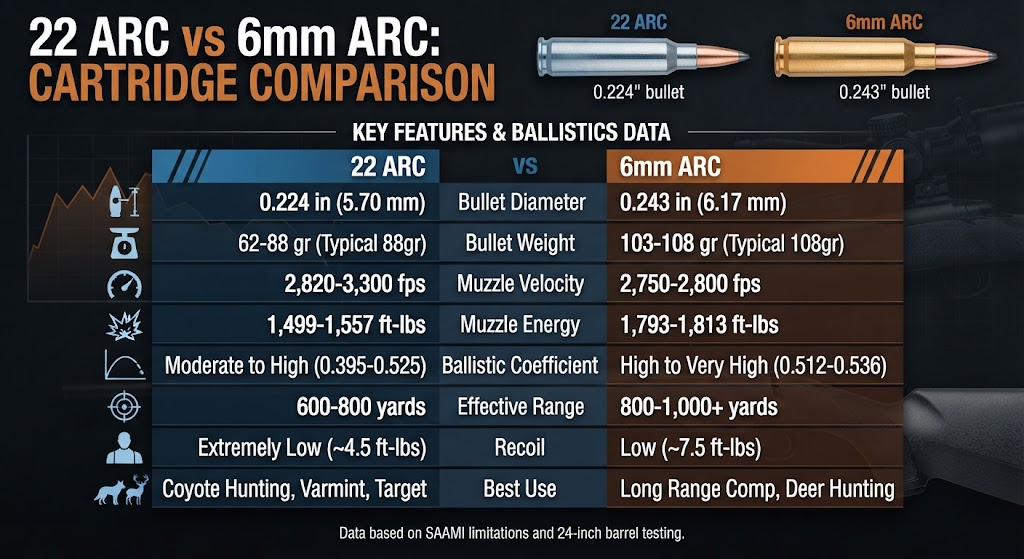
The table above details the mechanical foundation of two closely related but highly specialized cartridges. To convert a standard 5.56 NATO AR-15 to fire either the 22 ARC or the 6mm ARC, a shooter must purchase a new barrel, a specialized 6.5 Grendel Type 2 bolt face, and dedicated magazines. Because the parent case is much fatter than a standard intermediate cartridge, standard magazines will not feed these rounds properly, and the wider bolt face is an absolute necessity to grip the rim of the cartridge. Both cartridges operate at a strict maximum chamber pressure of 52,000 psi as mandated by the Sporting Arms and Ammunition Manufacturers Institute. This pressure ceiling is intentionally lower than standard 5.56 NATO pressures because the wider bolt face required for these fatter cases leaves less steel on the bolt lugs, making them susceptible to shearing if pressures exceed safe limits.
22 ARC vs 6mm ARC Ballistics
To objectively evaluate the ballistic capabilities of the 22 ARC against the 6mm ARC, we must examine real-world factory ammunition across their most common applications in target shooting and hunting. Hornady designed both cartridges, so comparing their flagship Match and Precision Hunter lines provides a perfect benchmark for performance.
The 22 ARC was officially announced in late 2023, and its entire design philosophy centers on maximizing the potential of heavy, high-ballistic-coefficient .22 caliber bullets without exceeding the overall length restrictions of the AR-15 magazine well. The 6mm ARC was released earlier in 2020 and has already established itself as a premier medium-game hunting cartridge in the semi-automatic rifle community.
For a completely fair comparison reflecting their maximum potential, all loads listed below are recorded from standard 24-inch test barrels. Shooters utilizing shorter 16-inch or 18-inch barrels commonly found on tactical carbines will experience proportionally lower velocities.
- Load A (22 ARC Varmint/Target): Hornady 62-grain ELD-VT (Very Low Drag Varmint Target). Tested from a 24-inch barrel. Muzzle velocity is 3,300 feet per second. Muzzle energy is 1,499 foot-pounds. Ballistic Coefficient is 0.395.
- Load B (22 ARC Heavy Match): Hornady 88-grain ELD Match. Tested from a 24-inch barrel. Muzzle velocity is 2,820 feet per second. Muzzle energy is 1,557 foot-pounds. Ballistic Coefficient is 0.525.
- Load C (6mm ARC Hunting): Hornady 103-grain ELD-X Precision Hunter. Tested from a 24-inch barrel. Muzzle velocity is 2,800 feet per second. Muzzle energy is 1,793 foot-pounds. Ballistic Coefficient is 0.512.
- Load D (6mm ARC Heavy Match): Hornady 108-grain ELD Match. Tested from a 24-inch barrel. Muzzle velocity is 2,750 feet per second. Muzzle energy is 1,813 foot-pounds. Ballistic Coefficient is 0.536.
Manufacturer-rated data provides a standardized baseline, but independent testing frequently shows minor variations based on gas system length, chamber tolerances, and barrel temperature during firing.
22 ARC vs 6mm ARC Velocity
Velocity is a critical metric for rifle ammunition because it dictates how flat a projectile shoots across unknown distances and how effectively expanding bullets open upon impacting soft tissue. High initial velocity also drastically reduces the time of flight to the target, which minimizes the lead required when shooting at moving targets like running coyotes.
When analyzing velocity, the 22 ARC holds a distinct advantage due to its significantly lighter projectile weights. The 22 ARC is a hyper-velocity cartridge when loaded with 62-grain varmint bullets. Exiting a 24-inch barrel at 3,300 feet per second, the 62-grain ELD-VT load acts like a laser beam. This extreme initial speed ensures that the bullet reaches its target almost instantaneously at closer ranges. Even when loaded with the massive 88-grain ELD Match bullet, the 22 ARC maintains a highly respectable 2,820 feet per second, which perfectly matches the velocity of many traditional full-size rifle cartridges.
The 6mm ARC cannot match the raw muzzle velocity of the 22 ARC because it pushes much heavier projectiles. A standard 108-grain 6mm ARC load exits a 24-inch barrel at approximately 2,750 feet per second, while the slightly lighter 103-grain hunting load reaches 2,800 feet per second. While the 6mm ARC starts slightly slower, its highly aerodynamic projectiles retain velocity incredibly well downrange. By the time both the 88-grain 22 ARC bullet and the 108-grain 6mm ARC bullet reach the 500-yard mark, their velocities are nearly identical because the heavier 6mm bullet resists atmospheric drag much more efficiently.
22 ARC vs 6mm ARC Muzzle Energy
Muzzle energy represents the kinetic work capacity of a projectile. The kinetic energy generated by a cartridge is a direct reflection of both the speed of the bullet and its physical mass. Because the 6mm ARC fires a projectile that is significantly heavier than the 22 ARC while maintaining excellent velocities, it dominates the kinetic energy category.
The 22 ARC produces roughly 1,500 to 1,560 foot-pounds of energy at the muzzle. This is an exceptional amount of energy for a .22 caliber cartridge, easily surpassing the standard 5.56 NATO and traditional .223 Remington loads. It provides devastating hydrostatic shock on small to medium-sized predators. However, many jurisdictions legally prohibit hunting deer with .22 caliber projectiles regardless of their energy levels, making the 22 ARC primarily a dedicated varmint and predator tool in those areas.
The 6mm ARC generates a massive 1,790 to 1,815 foot-pounds of energy at the muzzle. This places the 6mm ARC firmly into the medium game hunting category. The additional 250 to 300 foot-pounds of kinetic energy over the 22 ARC translates directly to wider wound channels, deeper penetration, and faster ethical kills on animals like whitetail deer, mule deer, and pronghorn antelope. At extended ranges, the heavy 6mm ARC bullet retains this energy advantage completely, ensuring lethal terminal performance at distances where the 22 ARC begins to lose its stopping power.
22 ARC vs 6mm ARC Momentum
Momentum is a linear measurement calculating mass in motion. In terminal ballistics, high momentum correlates closely with the ability of a bullet to crush through dense bone, heavy winter hides, and intermediate barriers without being deflected or stopping prematurely inside the target.
The 22 ARC generates moderate momentum due to its lightweight projectiles. A heavy 88-grain bullet traveling at 2,820 feet per second yields approximately 35 pound-feet per second of linear momentum. A lighter 62-grain bullet traveling at 3,300 feet per second yields roughly 29 pound-feet per second of linear momentum. While this is more than enough momentum to punch through the shoulder of a coyote, it can occasionally struggle to provide complete pass-through penetration on larger, heavier game animals.
The 6mm ARC holds a substantial advantage in penetration mechanics due to its heavier bullet mass. A 108-grain projectile traveling at 2,750 feet per second yields roughly 42 pound-feet per second of linear momentum. This heavy momentum allows the 6mm ARC to punch straight through intermediate barriers and heavy bone structures, making it vastly superior for hunters attempting quartering shots on large feral hogs or deer. The extra mass simply carries the bullet deeper into the vital cavity.
22 ARC vs 6mm ARC Trajectory
Understanding external ballistics and bullet drop is critical for any shooter attempting to hit targets beyond 300 yards. The trajectory of a bullet is dictated by its initial velocity, the pull of gravity, and the aerodynamic efficiency of the projectile as it cuts through the atmosphere. The aerodynamic efficiency is mathematically represented as a Ballistic Coefficient.
The calculations below assume a standard rifle optic height of 1.5 inches above the bore and a clearly stated zero distance of 200 yards, which is the standard zero for modern precision and hunting rifles. We will compare the heavy long-range match loads for both calibers to demonstrate their extreme distance capabilities.
| Distance | 22 ARC (88 gr ELD Match at 2,820 fps) Drop | 6mm ARC (108 gr ELD Match at 2,750 fps) Drop |
| Muzzle | -1.5 inches | -1.5 inches |
| 100 Yards | +1.6 inches | +1.8 inches |
| 200 Yards | 0.0 inches (Zero) | 0.0 inches (Zero) |
| 300 Yards | -7.2 inches | -7.8 inches |
| 400 Yards | -21.2 inches | -22.5 inches |
| 500 Yards | -43.6 inches | -45.5 inches |
At 500 yards, the trajectories are incredibly similar, with the 22 ARC dropping slightly less due to its higher initial muzzle velocity. The difference in drop is less than two inches at half a mile, which is virtually indistinguishable in practical field conditions.
However, gravity is predictable, while wind is not. The primary reason precision shooters choose heavy, high ballistic coefficient bullets is to defeat crosswinds. Assuming a direct 10 mile per hour crosswind, the 88-grain 22 ARC bullet will drift approximately 18.5 inches at 500 yards. The 108-grain 6mm ARC bullet will drift approximately 17.5 inches at the exact same distance. While the 22 ARC is highly impressive for a .22 caliber cartridge, the 6mm ARC remains slightly mathematically superior for long-distance marksmanship in windy environments due to its heavier mass and higher aerodynamic efficiency.
22 ARC vs 6mm ARC Recoil
Recoil management is a major factor in rapid and accurate shooting. The physical recoil generated by a firearm is heavily influenced by the weight of the rifle, the mass of the powder charge, and the weight of the bullet. Because both of these cartridges are commonly fired from gas-operated semi-automatic platforms that utilize buffer springs to absorb energy, felt recoil is exceptionally mild for both.
The 22 ARC produces incredibly low recoil. Fired from a standard 7.5-pound semi-automatic rifle, a heavy 88-grain load generates roughly 4.5 foot-pounds of free recoil energy. This recoil is so minimal that shooters can easily spot their own bullet impacts through a magnified scope without the crosshairs bouncing off the target. This characteristic makes the 22 ARC an exceptional training tool for introducing youth shooters to long-range marksmanship without inducing flinch habits.
The 6mm ARC generates slightly more recoil due to its heavier bullet weight. Fired from an identical 7.5-pound rifle, a standard 108-grain target load generates approximately 7.5 foot-pounds of free recoil energy. While this is a noticeable increase over the 22 ARC, it is still exceptionally soft compared to traditional hunting cartridges like the .308 Winchester. The recoil is comparable to a .243 Winchester or a 30-30 lever action rifle, making it perfectly manageable for extended range sessions and rapid follow-up shots in tactical competitions.
22 ARC vs 6mm ARC Penetration
Terminal penetration is rigorously evaluated to ensure the ethical harvesting of game animals and the effective neutralization of targets. A bullet must penetrate deep enough into soft tissue to reach critical cardiovascular structures regardless of the angle the target presents.
The 22 ARC provides shallow to moderate penetration depending entirely on the specific bullet construction selected by the shooter. Lightweight 62-grain varmint bullets are designed to fragment violently upon impacting soft tissue, causing devastating shallow wounds that anchor small predators instantly but fail to penetrate deeply. Heavy 88-grain match bullets will penetrate further but are not engineered with thick copper jackets to retain their weight in large game animals. The 22 ARC is not an optimal choice for deep penetration through heavy bone.
The 6mm ARC provides vastly superior penetration capabilities on medium game. Because the 103-grain to 108-grain bullets feature a higher sectional density and heavier mass, they track remarkably straight through heavy muscle without deflecting. A proper 6mm ARC hunting bullet like the ELD-X will consistently penetrate 16 to 22 inches in soft tissue, making it entirely capable of taking large feral hogs, mule deer, and antelope at reasonable distances with careful shot placement.
22 ARC vs 6mm ARC Expansion
Bullet expansion dictates the diameter of the permanent wound channel inside the target. Wide expansion increases the likelihood of severing major arteries and causing rapid incapacitation through catastrophic blood loss.
The 22 ARC relies on extreme hyper velocity to force expansion. When a 62-grain polymer-tipped varmint bullet impacts a target at over 3,000 feet per second, immense hydraulic pressure forces the thin copper jacket to peel back violently, often causing the bullet to explode into dozens of secondary projectiles. This explosive fragmentation is devastating on coyotes and prairie dogs but destroys entirely too much meat for civilian deer hunters.
The 6mm ARC utilizes heavier, robust bullets that expand in a controlled manner at moderate velocities. A standard 103-grain precision hunting bullet will initiate expansion immediately upon entering tissue, peeling back into a classic mushroom shape that measures roughly 0.50 to 0.60 inches across. Because the bullet is heavy, it retains its core lead weight and continues driving deep into the target while fully expanded, creating a massive permanent crush cavity that leads to very short tracking jobs in the field.
22 ARC vs 6mm ARC Effective Range
The effective range of a cartridge is determined by the intersection of three specific factors including velocity retention, bullet drop predictability, and the mechanical accuracy of the rifle platform. Both cartridges are highly accurate, but they serve different distance envelopes based on their terminal energy.
The 22 ARC is highly effective within 600 yards for varmint hunting applications. Beyond 600 yards, the kinetic energy drops to levels that may fail to humanely anchor large coyotes immediately. For precision target shooting on steel plates, the heavy 88-grain match ammunition allows the 22 ARC to remain supersonic and predictable out to roughly 1,000 yards, making it an incredibly fun and economical long-range plinker.
The 6mm ARC was expressly designed to maximize the effective range of the AR-15 platform. For hunting medium game like deer or antelope, the 6mm ARC maintains enough kinetic energy and velocity to reliably expand heavy hunting bullets out to 500 yards. For precision target shooting and military applications, the 6mm ARC remains supersonic and predictable out to 1,000 yards and beyond, allowing marksmen to ring steel plates at distances normally reserved for much larger short-action cartridges.
22 ARC vs 6mm ARC Self Defense
When discussing self defense with high-powered centerfire rifle cartridges, the conversation typically revolves around home defense and the inherent risks of over-penetration in urban or suburban residential environments.
The 22 ARC is a highly lethal cartridge, but it presents unique challenges for home defense. The extreme hyper velocity of the lightweight 62-grain bullets means they will fragment and disintegrate very rapidly upon hitting drywall or intermediate barriers, which is actually a massive benefit for reducing over-penetration risks. However, the extreme chamber pressures and unburnt powder generated by a short-barreled tactical rifle chambered in 22 ARC will create an absolutely blinding muzzle flash and a concussive blast that is deafening indoors.
The 6mm ARC is less optimal for urban home defense. The heavy 108-grain bullets are designed to retain their mass and penetrate deeply, meaning they present a severe over-penetration hazard in a residential environment. A missed shot with a 6mm ARC will easily pass through multiple interior walls, household appliances, and exterior siding, presenting a severe danger to neighbors and bystanders. Furthermore, reliable 6mm ARC magazines typically hold fewer rounds than standard intermediate cartridges, reducing overall defensive capacity. Both cartridges are far better suited for rural property defense or long-range tactical engagements than close-quarters home defense.
22 ARC vs 6mm ARC Concealed Carry
Concealed carry with either the 22 ARC or the 6mm ARC is impossible and entirely impractical. Both of these cartridges are centerfire rifle cartridges measuring roughly 2.26 inches in overall length. They require long receiver actions and buffer tube assemblies to safely contain their operating pressures and cycle their bolts. While extremely short pistol variants exist, they are still far too large, heavy, and awkward to be concealed on the human body in any practical daily carry holster. Their appropriate transport method involves a dedicated rifle bag, a vehicle rack, or a tactical sling worn over the body.
Which Has More Stopping Power: 22 ARC or 6mm ARC?
Stopping power is an ambiguous term often used to describe the ability of a cartridge to quickly incapacitate a biological target without requiring long tracking jobs into the brush. Stopping power is a combination of kinetic energy, tissue disruption, and penetration depth.
When comparing the two cartridges on medium game such as whitetail deer or feral hogs, the 6mm ARC holds a massive advantage in stopping power. The ability to launch 108-grain bullets provides a level of bone-shattering momentum and deep penetration that .22 caliber bullets simply cannot replicate. The 6mm ARC creates a wider, deeper permanent wound channel that causes rapid blood loss and immediate incapacitation.
On small predators and varmints like coyotes, the explosive high-velocity impact of the 22 ARC provides dramatic instantaneous stopping power. The extreme speed of the lightweight bullet creates a massive temporary stretch cavity within the small animal, resulting in immediate central nervous system shock and instant anchoring.
Which Is More Powerful: 22 ARC or 6mm ARC?
Power is defined quantitatively by kinetic energy and linear momentum. Based on the laws of physics, the 6mm ARC is objectively vastly more powerful than the 22 ARC.
The 22 ARC generates roughly 1,500 to 1,560 foot-pounds of muzzle energy. The 6mm ARC generates roughly 1,790 to 1,815 foot-pounds of muzzle energy. The 6mm ARC also generates significantly higher linear momentum due to its massive bullet weight advantage. In every measurable ballistic category related to physical force, the 6mm ARC delivers more raw power to the target.
22 ARC Pros and Cons
Pros
- Exceptional hyper velocity replicates the legendary performance of a .22-250 Remington in a semi-automatic platform
- Incredibly flat trajectory out to 400 yards makes aiming at small moving targets effortless
- Produces almost zero felt recoil, allowing shooters to easily spot their own bullet impacts through magnified optics
- Devastating terminal fragmentation makes it the ultimate dedicated predator and varmint hunting cartridge
Cons
- Requires a specialized bolt head and proprietary magazines that are completely incompatible with standard components
- Ammunition is expensive and currently limited to a few specific commercial offerings
- Lightweight bullets lack the mass required to ethically harvest medium game like deer or punch through heavy shoulder bones
- Many states legally prohibit the use of .22 caliber centerfire rifles for big game hunting regardless of energy levels
6mm ARC Pros and Cons
Pros
- Exceptional long range ballistics keep the heavy bullet supersonic out to 1,000 yards from a compact rifle platform
- High Ballistic Coefficient bullets aggressively resist wind deflection and retain kinetic energy highly efficiently
- Delivers true medium game hunting capabilities, making it a highly ethical deer and antelope hunting rifle
- Maintains a very soft recoil impulse, allowing for rapid follow-up shots and extended range sessions without fatigue
Cons
- Requires the same specialized bolt head and proprietary magazines as the 22 ARC, limiting compatibility
- Ammunition is expensive and primarily limited to specialty precision or hunting loads rather than cheap bulk target practice ammunition
- Thinner bolt face lugs required to fit the wider case head create a potential point of mechanical failure under extreme firing schedules
- Lower magazine capacity compared to traditional intermediate cartridges
Final Comparison
| Category | Winner | Reason |
| Velocity | 22 ARC | Lightweight 62-grain bullets effortlessly exceed 3,300 fps at the muzzle |
| Muzzle Energy | 6mm ARC | Massive bullet weight yields energy figures exceeding 1,800 ft-lbs |
| Momentum | 6mm ARC | 108-grain bullets carry immense linear driving mass and momentum |
| Penetration | 6mm ARC | High sectional density pushes heavy bullets deep through bone and muscle |
| Expansion | Tie | Both expand massively depending entirely on specific bullet construction |
| Trajectory | 22 ARC | Extreme velocity produces a flatter curve inside of 400 yards |
| Recoil Control | 22 ARC | Generates almost zero felt recoil, making it completely effortless to shoot rapidly |
| Effective Range | 6mm ARC | Superior retained energy confidently extends ethical shots out to 1,000 yards |
| Self Defense | Neither | Both present unique over-penetration or concussive blast hazards indoors |
| Concealed Carry | Neither | Both are centerfire rifle cartridges completely unsuitable for concealment |
| Ammo Cost | Tie | Both are premium modern cartridges with identical high retail pricing |
| Ammo Availability | 6mm ARC | Has been on the market longer, resulting in slightly better commercial distribution |
| Overall Performance | Depends on Target | 22 ARC for varmints and pure speed; 6mm ARC for deer and long-range wind resistance |
22 ARC vs 6mm ARC: Which Should You Choose?
Selecting between the 22 ARC and the 6mm ARC requires a practical assessment of your intended shooting distances, your primary targets, and the legal hunting regulations in your local jurisdiction.
Choose the 22 ARC if your primary goal is building the ultimate semi-automatic predator and varmint hunting rifle. The ability to launch highly explosive .22 caliber projectiles at 3,300 feet per second provides incredibly flat trajectories that make hitting small, fast-moving coyotes effortless. The complete lack of recoil allows you to watch the animal drop through your scope, and it serves as an incredibly fun and economical long-range steel plinker when loaded with heavy 88-grain match ammunition.
Choose the 6mm ARC if you prioritize medium game hunting and extreme long-range precision target shooting out to 1,000 yards. The exceptional wind resistance, deep penetration, and high retained energy make it a mathematically superior cartridge for anyone who needs their rifle to perform at maximum distances. If you plan to hunt deer or antelope, the 6mm ARC provides the heavy bullet mass and deep tissue penetration required for quick, ethical kills that the smaller 22 ARC simply cannot guarantee.
FAQs
Is 22 ARC more powerful than 6mm ARC?
No, the 6mm ARC is significantly more powerful. It utilizes a heavier bullet that generates much higher kinetic energy and linear momentum compared to the lightweight projectiles of the 22 ARC.
Which has more muzzle energy?
The 6mm ARC generates roughly 1,790 to 1,815 foot-pounds of muzzle energy, while the standard 22 ARC generates roughly 1,500 to 1,560 foot-pounds of energy.
Which has more stopping power?
For deer and medium game, the 6mm ARC provides vastly superior stopping power due to its ability to penetrate deep and crush heavy bone. For small varmints, the high-velocity explosive impact of the 22 ARC is highly effective.
Which has more recoil?
The 6mm ARC produces noticeably more recoil than the 22 ARC, generating roughly 7.5 foot-pounds of free recoil compared to the 4.5 foot-pounds of the 22 ARC. However, both are considered exceptionally mild and easy to shoot.
Which has better penetration?
The 6mm ARC has drastically better penetration on heavy game. Its extreme bullet mass allows the projectiles to punch through dense muscle and thick bone without deflecting.
Which expands more?
Both cartridges expand incredibly well when utilizing modern polymer-tipped bullets. Because the 6mm starts at a slightly larger diameter and carries more mass, it generally creates a wider final expanded profile.
Which has a flatter trajectory?
Inside of 400 yards, the 22 ARC shoots slightly flatter due to its extreme initial velocity. Beyond 500 yards, the superior aerodynamics of the heavy 6mm ARC bullets allow it to overtake the 22 ARC, resulting in significantly less wind drift at long ranges.
Which is better for self defense?
Neither cartridge is optimal for urban home defense. The 22 ARC produces deafening indoor concussive blasts from short barrels, and the 6mm ARC poses a severe over-penetration risk through residential walls.
Which is better for concealed carry?
Neither. Both are large centerfire rifle cartridges fired from long, heavy rifles that cannot be concealed.
Is 22 ARC faster than 6mm ARC?
Yes, the 22 ARC is much faster at the muzzle. A standard 62-grain 22 ARC bullet exits the barrel at over 3,300 fps, whereas a 6mm ARC bullet exits at roughly 2,800 fps.
Is 6mm ARC stronger than 22 ARC?
Yes. While both cartridges operate at the exact same SAAMI maximum pressure limit of 52,000 psi, the heavier bullet of the 6mm ARC generates more overall kinetic energy and momentum.
Which is cheaper to shoot?
Both cartridges are currently priced similarly as premium, high-performance rifle ammunition. Neither offers cheap bulk plinking ammunition commonly found in older military calibers.
Which has better ballistics?
The 22 ARC features better short-range hyper-velocity ballistics. The 6mm ARC features far superior long-range ballistics because its high Ballistic Coefficient projectiles aggressively resist wind deflection and retain lethal kinetic energy past 500 yards.
Which is easier to shoot?
The 22 ARC is easier to shoot due to its practically non-existent recoil impulse, making it the perfect caliber for new shooters to learn precision rifle fundamentals without developing a flinch.
Which should you choose?
Choose the 22 ARC for varmint hunting, predator control, and laser-flat short-range trajectories. Choose the 6mm ARC for long-range precision shooting, deer hunting, and maximum kinetic energy from a semi-automatic platform.