The main difference between the cartridges is that there is absolutely no physical or dimensional difference between them; 9×19 Parabellum and 9mm Luger are simply two different historical names for the exact same cartridge, though modern manufacturers often use the Parabellum or NATO designation to indicate military-spec higher-pressure loads, while Luger is typically used in the United States to denote standard-pressure commercial ammunition standardized by SAAMI. Designed by Austrian firearm designer Georg Luger in 1901 for the German weapons manufacturer Deutsche Waffen und Munitionsfabriken, the cartridge was originally named after the company’s Latin motto meaning “If you want peace, prepare for war.” Decades later, when the cartridge was standardized in the United States by the Sporting Arms and Ammunition Manufacturers Institute, the organization named it the 9mm Luger to honor its creator and avoid using foreign trademarked naming conventions. Today, the names are completely interchangeable regarding firearm chambering, but they often represent different pressure tiers in commercial retail environments.
9×19 Parabellum vs 9mm Luger Comparison
| Feature | 9×19 Parabellum (NATO/CIP Spec) | 9mm Luger (SAAMI Spec) |
| Bullet Diameter | 0.355 inches (9.02 mm) | 0.355 inches (9.02 mm) |
| Typical Bullet Weight | 115 to 124 grains (typically 124 grains) | 115 to 147 grains (typically 115 grains) |
| Muzzle Velocity | 1,180 to 1,250 fps (4-inch barrel) | 1,100 to 1,180 fps (4-inch barrel) |
| Muzzle Energy | 360 to 420 ft-lbs | 320 to 380 ft-lbs |
| Momentum | ~21 lb-fps (124 grains at 1,200 fps) | ~19 lb-fps (115 grains at 1,150 fps) |
| Maximum Pressure | 39,200 psi (CIP) / 36,500 psi (NATO) | 35,000 psi (Standard) / 38,500 psi (+P) |
| Ballistic Coefficient | Low (~0.140 to 0.160) | Low (~0.140 to 0.205) |
| Penetration | 12 to 18 inches (Gelatin) | 12 to 18 inches (Gelatin) |
| Expansion | 0.50 to 0.65 inches | 0.50 to 0.70 inches |
| Trajectory | Arcing, drops rapidly past 50 yards | Arcing, drops rapidly past 50 yards |
| Recoil | Low to Moderate (~4.5 ft-lbs) | Low (~4.0 ft-lbs in full-size pistols) |
| Effective Range | 0 to 50 yards (Handgun) | 0 to 50 yards (Handgun) |
| Ammo Availability | Extremely High (Global military standard) | Extremely High (Global civilian standard) |
| Ammo Cost | Cheap ($0.25 to $0.45 per round) | Cheap ($0.25 to $0.45 per round) |
| Best Use | Duty sidearms, military applications | Concealed carry, target shooting, defense |
The table above illustrates that while the physical dimensions of the brass case and projectile are identical, the governing bodies that regulate the cartridge (CIP in Europe and SAAMI in the United States) dictate slightly different maximum pressure specifications. When evaluating 9×19 Parabellum vs 9mm Luger, the true comparison is between military-grade, higher-pressure specifications (often labeled Parabellum or NATO) and standard commercial specifications (labeled Luger).
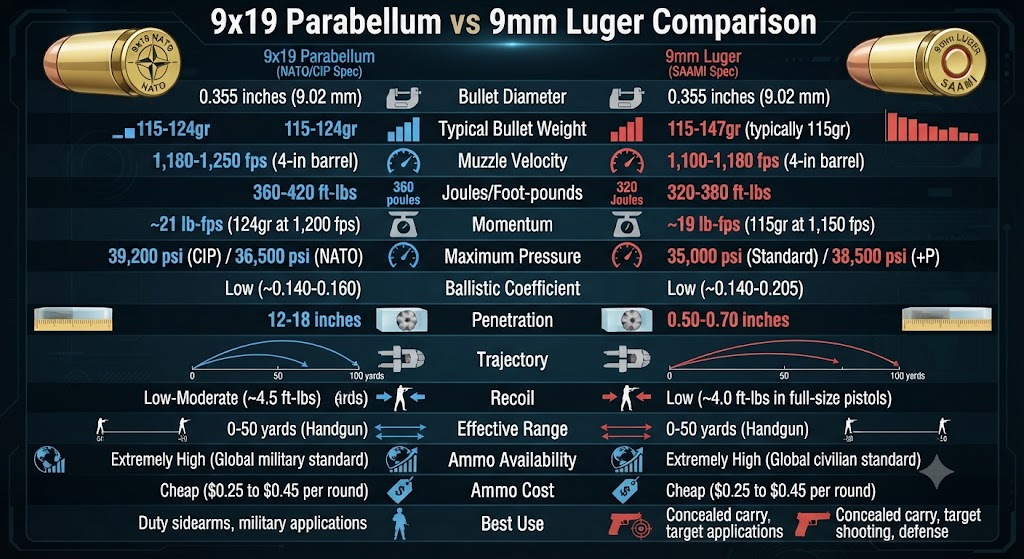
European CIP (Commission Internationale Permanente) standards test ammunition differently than American SAAMI standards. CIP sets the maximum pressure for the 9x19mm Parabellum at approximately 39,200 psi. In the United States, SAAMI limits standard 9mm Luger to 35,000 psi, while designating a separate +P (overpressure) category at 38,500 psi. Therefore, European Parabellum ammunition often behaves like American 9mm Luger +P ammunition out of the box.
9×19 Parabellum vs 9mm Luger Ballistics
To objectively evaluate the ballistic capabilities within the 9mm family, we must examine real-world factory ammunition representing the two naming conventions. We will compare a classic American 9mm Luger commercial target and defensive load against a European 9×19 Parabellum and NATO military-spec load.
For this comparison, we will examine premium defensive and duty loads fired from standard 4-inch test barrels, which accurately replicate the ballistics of duty pistols like the Glock 19 or SIG Sauer P320. We will not use universal test receivers, as they often artificially inflate velocity numbers compared to actual handguns.
- Load A (9mm Luger Standard Pressure): Federal Premium 115-grain Jacketed Hollow Point (JHP). Tested from a 4-inch barrel: Muzzle Velocity = 1,180 fps, Muzzle Energy = 355 ft-lbs, Ballistic Coefficient (G1) = 0.140.
- Load B (9mm Luger Heavy Subsonic): Speer Gold Dot 147-grain JHP. Tested from a 4-inch barrel: Muzzle Velocity = 985 fps, Muzzle Energy = 317 ft-lbs, Ballistic Coefficient (G1) = 0.205.
- Load C (9×19 Parabellum / NATO Spec): Winchester 124-grain NATO Full Metal Jacket (FMJ). Tested from a 4-inch barrel: Muzzle Velocity = 1,200 fps, Muzzle Energy = 396 ft-lbs, Ballistic Coefficient (G1) = 0.150.
- Load D (9mm Luger +P / Parabellum Equivalent): Federal Premium 124-grain HST +P JHP. Tested from a 4-inch barrel: Muzzle Velocity = 1,200 fps, Muzzle Energy = 396 ft-lbs, Ballistic Coefficient (G1) = 0.150.
Manufacturer-rated data is generally captured under controlled atmospheric conditions. Real-world velocities will vary slightly depending on your specific firearm chamber tolerances, barrel wear, and the type of rifling (polygonal versus traditional lands and grooves).
9×19 Parabellum vs 9mm Luger Velocity
Velocity is a critical metric for handgun ammunition. It determines how flat a projectile shoots and serves as the mechanical catalyst that forces fluid into the hollow point cavity to initiate expansion upon striking soft tissue.
When analyzing 9×19 Parabellum vs 9mm Luger velocity, the differences stem entirely from powder charges and bullet weights rather than case geometry.
Standard 9mm Luger commercial ammunition typically utilizes a 115-grain projectile. Because SAAMI restricts the maximum pressure to 35,000 psi, these lightweight bullets generally exit a 4-inch barrel between 1,100 and 1,180 feet per second. This is perfectly adequate for target shooting and reliable hollow-point expansion, ensuring the cartridge remains manageable and soft-shooting.
Military-spec 9×19 Parabellum (often packaged as 9mm NATO) standardizes around a heavier 124-grain projectile. To ensure reliable cycling in a wide variety of submachine guns (like the Heckler & Koch MP5) and duty pistols fighting through mud and grit, NATO specifications mandate higher operational pressures. Consequently, a 124-grain NATO or Parabellum round often clocks in at 1,200 to 1,250 feet per second from a 4-inch barrel.
To achieve this same velocity with a 124-grain bullet in the commercial American market, a shooter must purchase ammunition explicitly labeled as 9mm Luger +P to match the European Parabellum specifications.
9×19 Parabellum vs 9mm Luger Muzzle Energy
Muzzle energy represents the kinetic work capacity of a projectile. Because velocity plays a disproportionately large role in generating kinetic energy compared to raw bullet weight, higher-pressure Parabellum and +P loads demonstrate a clear numerical advantage.
Standard-pressure 9mm Luger energy figures typically hover in the lower end of the defensive spectrum. A 115-grain bullet traveling at 1,150 fps produces roughly 338 ft-lbs of muzzle energy. A heavy 147-grain bullet traveling at 990 fps yields approximately 320 ft-lbs. While this energy is sufficient to crush tissue directly in the bullet path, it is not enough to induce the high-velocity hydrostatic shock associated with rifle calibers.
The 9×19 Parabellum (or 9mm Luger +P) energy figures push the cartridge closer to the 400 ft-lb threshold. A 124-grain NATO spec bullet traveling at 1,200 fps generates roughly 396 ft-lbs of energy. Boutique ammunition manufacturers push the 9mm case to its absolute physical limits, offering 124-grain +P+ loads that reach 1,300 fps and generate an astounding 465 ft-lbs of energy. However, these extreme pressure loads accelerate firearm wear and should be used sparingly.
9×19 Parabellum vs 9mm Luger Momentum
Momentum measures the mass of an object in motion. In terminal ballistics, high momentum correlates closely with the bullet ability to crush through dense bone, heavy winter clothing, and intermediate barriers (such as auto glass or sheet metal) without being deflected or stopping prematurely.
Because both the 9×19 Parabellum and the 9mm Luger share the exact same projectile weight ranges (115 to 147 grains), their momentum profiles are highly similar, dictated only by their operating pressures.
A standard 115-grain 9mm Luger bullet traveling at 1,150 fps yields approximately 18.9 lb-fps of linear momentum.
A 124-grain 9×19 Parabellum (NATO spec) bullet traveling at 1,200 fps yields roughly 21.2 lb-fps of linear momentum.
A heavy 147-grain 9mm Luger bullet traveling at 1,000 fps yields roughly 21.0 lb-fps of momentum.
The data indicates that if a shooter desires maximum momentum for barrier penetration or deep straight-line tissue penetration, they should select heavier 124-grain or 147-grain projectiles regardless of what name is printed on the ammunition box.
9×19 Parabellum vs 9mm Luger Trajectory
Because this cartridge is utilized almost exclusively in short-barreled defensive handguns and pistol-caliber carbines, extreme long-range trajectory is rarely a primary concern. Handgun bullets are ballistically blunt and shed velocity rapidly.
Calculations below assume a standard pistol sight height of 0.75 inches above the bore and a zero distance of 25 yards. We will compare a standard 115-grain commercial Luger load against a 124-grain Parabellum and NATO load.
| Distance | 9mm Luger (115 gr at 1,150 fps) Drop | 9×19 Parabellum (124 gr at 1,200 fps) Drop |
| Muzzle | -0.75 inches | -0.75 inches |
| 10 yards | +0.1 inches | +0.2 inches |
| 25 Yards | 0.0 inches (Zero) | 0.0 inches (Zero) |
| 50 Yards | -1.5 inches | -1.2 inches |
| 75 Yards | -5.1 inches | -4.1 inches |
| 100 Yards | -11.0 inches | -9.0 inches |
Both iterations of the cartridge feature a trajectory that is remarkably flat out to 25 yards, which encompasses the vast majority of law enforcement and civilian defensive encounters. At 50 yards, bullet drop is still negligible enough that a center-mass hold will result in a solid hit. Beyond 50 yards, the blunt pistol projectiles begin to drop sharply. The slightly higher velocity of the 124-grain Parabellum NATO load gives it a marginally flatter trajectory at 100 yards, dropping 9 inches compared to the 11 inches of the standard 115-grain load.
9×19 Parabellum vs 9mm Luger Recoil
Recoil management is the single most significant factor in rapid, accurate defensive shooting. Recoil is heavily influenced by the weight of the firearm, the mass of the powder charge, and the weight of the bullet.
One of the primary reasons the 9mm (by either name) has universally replaced the .40 S&W and .45 ACP in law enforcement is its exceptionally manageable recoil impulse, which allows shooters of all statures to reacquire their sights and land rapid follow-up shots.
When evaluating 9×19 Parabellum vs 9mm Luger recoil, the difference in pressure is noticeable.
Fired from a standard 2-pound duty pistol (such as a Glock 17 or Beretta 92FS), a standard-pressure 115-grain 9mm Luger load generates roughly 3.8 to 4.0 foot-pounds of free recoil energy. This is incredibly mild, allowing for comfortable all-day practice sessions at the range.
Fired from the same 2-pound pistol, a hotter 124-grain 9×19 Parabellum (NATO spec) or 9mm Luger +P load generates roughly 4.8 to 5.2 foot-pounds of free recoil energy. While this is a noticeable 20% to 30% increase in felt recoil and muzzle flip, it remains substantially lower than the 7.0 to 8.0 foot-pounds of recoil generated by a standard .45 ACP.
In ultra-lightweight micro-compact concealed carry pistols weighing around 1 pound (such as the SIG P365 or Glock 43), the higher-pressure Parabellum and +P loads can become quite snappy and uncomfortable to shoot in high volumes, causing premature hand fatigue.
9×19 Parabellum vs 9mm Luger Penetration
Terminal penetration is rigorously evaluated using calibrated 10% ordnance gelatin, which simulates the density and resistance of human soft tissue. Following the infamous 1986 Miami shootout, the Federal Bureau of Investigation developed strict ballistic protocols. The standard dictates that a defensive bullet must penetrate a minimum of 12 inches and a maximum of 18 inches to reliably reach vital organs from any angle without posing a severe over-penetration risk to bystanders.
Because they are the same cartridge, 9×19 Parabellum and 9mm Luger share identical penetration capabilities when utilizing the same bullet construction.
Modern premium hollow points, regardless of whether they are standard pressure or +P, are engineered to pass the FBI protocol. A standard-pressure 9mm Luger 124-grain Federal HST will reliably penetrate 13.5 to 15.0 inches in bare gelatin and heavy clothing. A 124-grain 9mm Luger +P (Parabellum equivalent) HST will penetrate roughly 13.0 to 14.5 inches.
Interestingly, higher velocity does not always equate to deeper penetration with hollow point bullets. The increased velocity of the Parabellum and +P loads causes the hollow point to open faster and wider upon impact. This wider frontal area acts like a parachute in fluid, creating more drag and often resulting in slightly shallower penetration compared to standard-pressure loads.
If deep penetration is required (such as for wilderness defense against black bears), military-spec 9×19 Parabellum Full Metal Jacket (FMJ) ammunition or hard cast lead solids are the preferred choice, as they will not expand and can easily penetrate 24 to 30 inches of dense muscle and bone.
9×19 Parabellum vs 9mm Luger Expansion
Bullet expansion dictates the diameter of the permanent wound channel, increasing the likelihood of severing major arteries and causing rapid incapacitation through blood loss.
The 9mm has seen more advancement in bullet engineering over the last three decades than perhaps any other cartridge in existence. Starting with a diameter of 0.355 inches, modern defensive hollow points utilize skived copper jackets, bonded lead cores, and precise cavity geometries to ensure controlled expansion.
When examining 9×19 Parabellum vs 9mm Luger expansion, the higher velocity of the Parabellum and +P loads provides a slight mechanical advantage. Higher impact velocity forces fluid into the hollow cavity with greater hydraulic pressure, causing the bullet to peel back more aggressively.
A standard-pressure 124-grain 9mm Luger premium hollow point will typically expand to a final diameter of roughly 0.60 to 0.65 inches.
A high-pressure 124-grain 9×19 Parabellum or +P equivalent will often expand slightly wider, reaching 0.65 to 0.70 inches.
While the +P loads offer marginally wider expansion, the difference is often only a few hundredths of an inch. Modern ammunition manufacturers have perfected standard-pressure 9mm Luger loads to expand so reliably that the extra recoil and muzzle blast associated with +P ammunition is no longer deemed strictly necessary by many law enforcement agencies.
9×19 Parabellum vs 9mm Luger Effective Range
The effective range of a cartridge is determined by the intersection of three factors (velocity retention, bullet drop, and mechanical accuracy).
For defensive handgun use, the effective range of both the 9mm Luger and 9×19 Parabellum is practically limited to the shooter visual acuity and trigger control, which for most civilians and law enforcement is 0 to 25 yards.
Mechanically, the cartridge maintains sufficient velocity to guarantee hollow point expansion out to roughly 50 yards when fired from a 4-inch barrel. Beyond 50 yards, velocity drops below 1,000 fps, and many hollow point designs will fail to open, acting instead as a solid full metal jacket.
When fired from a shoulder-fired Pistol Caliber Carbine with a 16-inch barrel, the cartridge gains roughly 100 to 150 feet per second in velocity. This flattens the trajectory and extends the effective terminal range to roughly 75 to 100 yards, making it an excellent short-range defensive tool for home defense or property management.
9×19 Parabellum vs 9mm Luger Self Defense
When choosing a platform for home defense or daily carry, the 9mm is currently the undisputed global champion. Because 9×19 Parabellum and 9mm Luger represent the same cartridge, selecting between them for self-defense comes down to ammunition selection and recoil management.
The 0.355-inch diameter of the cartridge allows for exceptional double-stack magazine capacities. Standard duty pistols hold 17 rounds plus one in the chamber, and extended magazines easily hold 21 to 33 rounds. This gives the defender a massive tactical advantage compared to lower-capacity cartridges like the .45 ACP.
For home defense in a full-sized pistol (where recoil is easily absorbed by the weight of the gun), high-pressure 9×19 Parabellum (NATO) or 9mm Luger +P loads offer a slight edge in terminal ballistics and barrier penetration. If an attacker is behind an interior door or wearing heavy winter clothing, the extra momentum helps ensure the bullet reaches vital organs.
If the defender is using a smaller, lighter handgun, standard-pressure 9mm Luger ammunition is highly recommended. The mild recoil impulse allows for rapid, accurate strings of fire, which is statistically more important for stopping a threat than a fractional increase in bullet expansion.
9×19 Parabellum vs 9mm Luger Concealed Carry
Concealing the 9mm has become remarkably easy over the last decade. Advancements in magazine geometry have resulted in a new class of micro-compact pistols, which hold 10 to 15 rounds of 9mm in a package that is barely an inch wide.
When evaluating 9×19 Parabellum vs 9mm Luger for concealed carry in these tiny handguns, standard-pressure 9mm Luger is almost always the superior choice. Firing high-pressure Parabellum or +P ammunition from a 15-ounce micro-compact pistol produces violent, snappy recoil. This recoil increases the time required to get the sights back on target for a second shot and can cause the shooter grip to shift dynamically during rapid fire.
Furthermore, out of ultra-short 3-inch barrels commonly found on concealed carry pistols, much of the extra powder in a high-pressure Parabellum load burns outside the muzzle, creating a massive, blinding muzzle flash and deafening report without actually increasing the velocity of the bullet significantly. Standard-pressure 9mm Luger loads optimized for short barrels (such as the Speer Gold Dot Short Barrel line) are vastly more efficient and controllable for civilian concealed carry.
Which Has More Stopping Power: 9×19 Parabellum or 9mm Luger?
Stopping power is an ambiguous, non-scientific term, but it generally refers to a cartridge ability to quickly incapacitate a biological threat through blood loss or central nervous system disruption.
Because they are the same cartridge, their stopping power is identical when loaded to the same specifications. However, if we compare standard-pressure 9mm Luger against high-pressure 9×19 Parabellum (or 9mm Luger +P), the high-pressure Parabellum loads hold a marginal theoretical advantage. The higher velocity provides a slight increase in expanded bullet diameter and a minor increase in kinetic energy.
Despite this, decades of law enforcement data and trauma surgeon reports indicate that the physiological difference in stopping power between a standard 9mm Luger and a 9mm +P is statistically indistinguishable in real-world human targets. Shot placement (the ability to put the bullet directly into the heart, lungs, or central nervous system) is infinitely more critical than a 50 ft-lb difference in muzzle energy.
Which Is More Powerful: 9×19 Parabellum or 9mm Luger?
Power is defined quantitatively by kinetic energy and linear momentum.
By definition, military-spec 9×19 Parabellum and commercial 9mm Luger +P is more powerful than standard-pressure 9mm Luger. European CIP standards and NATO specifications operate the cartridge at roughly 39,200 psi, driving a 124-grain bullet to 1,200 fps. Standard American SAAMI 9mm Luger operates at 35,000 psi, driving bullets slower and generating less overall kinetic energy.
9×19 Parabellum Pros and Cons
Pros
- High-pressure military specifications guarantee reliable cycling in submachine guns, pistol-caliber carbines, and duty pistols running in adverse conditions
- Increased velocity provides slightly wider hollow-point expansion and superior barrier penetration
- Ubiquitous global military availability makes 9mm NATO FMJ extremely cheap to purchase in bulk for training
- Maximum kinetic energy output for the cartridge footprint
Cons
- Increased operating pressure accelerates wear and tear on handgun recoil springs, locking blocks, and frame rails
- Noticeably sharper recoil and muzzle flip compared to standard-pressure loads
- Excessive muzzle blast and flash when fired from short-barreled concealed carry handguns
9mm Luger Pros and Cons
Pros
- Exceptionally mild recoil allows for rapid, accurate follow-up shots, even in lightweight micro-compact pistols
- Lower operating pressures (35,000 psi) extend the service life of firearms significantly
- Massive variety of standard-pressure defensive ammunition that perfectly passes FBI penetration protocols without punishing the shooter
- The most heavily produced centerfire cartridge in the world, ensuring low costs and universal availability
Cons
- Slightly lower velocity means it does not expand quite as aggressively as high-pressure +P variants
- May struggle to cycle heavily sprung submachine guns or extremely dirty firearms that require high pressure to operate the slide
Final Comparison
| Category | Winner | Reason |
| Velocity | 9×19 Parabellum | Higher operating pressures (39,200 psi) drive bullets faster |
| Muzzle Energy | 9×19 Parabellum | Increased velocity yields energy figures approaching 400 ft-lbs |
| Momentum | Tie | Both utilize the exact same bullet weights (115g to 147gr) |
| Penetration | 9mm Luger | Slightly lower expansion often leads to marginally deeper straight-line penetration |
| Expansion | 9×19 Parabellum | Higher hydraulic impact velocity forces wider hollow point expansion |
| Trajectory | 9×19 Parabellum | Extra velocity keeps the bullet slightly flatter at 100 yards |
| Recoil Control | 9mm Luger | Standard pressure yields extremely soft, manageable recoil |
| Effective Range | Tie | Both are strictly 50-yard defensive handgun tools |
| Self Defense | Tie | Both are the global gold standard for personal protection |
| Concealed Carry | 9mm Luger | Standard pressure is much easier to control in micro-compact pistols |
| Ammo Cost | Tie | Both represent the cheapest centerfire ammunition on the market |
| Ammo Availability | Tie | Universally available on every continent |
| Overall Performance | Depends on Firearm | Parabellum for duty and military; Luger for concealed carry |
9×19 Parabellum vs 9mm Luger: Which Should You Choose?
Selecting between 9×19 Parabellum and 9mm Luger is less about choosing a caliber and more about selecting the appropriate pressure tier for your specific firearm and mission.
Choose 9×19 Parabellum (or 9mm Luger +P) if you carry a full-size duty pistol (like a Glock 17, Beretta 92, or SIG P320), utilize a pistol-caliber carbine, or require maximum kinetic energy and barrier penetration for law enforcement or security applications. The weight of full-size firearms easily absorbs the extra pressure, allowing you to harness the absolute maximum ballistic potential of the cartridge.
Choose 9mm Luger (standard pressure) if your primary weapon is a lightweight, subcompact, or micro-compact concealed carry pistol. The standard-pressure loads provide elite terminal ballistics that easily pass FBI standards, but they do so without punishing your hands, blinding you with muzzle flash, or slowing down your critical follow-up shots.
FAQs
Is 9×19 Parabellum more powerful than 9mm Luger?
Technically, yes. While they are physically the same cartridge, ammunition labeled 9×19 Parabellum or 9mm NATO is typically loaded to higher European CIP pressures (39,200 psi), making it more powerful than standard American SAAMI 9mm Luger (35,000 psi).
Which has more muzzle energy?
9×19 Parabellum (and 9mm Luger +P) generates higher muzzle energy, typically hovering around 380 to 410 ft-lbs, compared to standard 9mm Luger, which generates around 320 to 350 ft-lbs.
Which has more stopping power?
They have identical practical stopping power. While Parabellum loads offer slightly higher velocity, real-world law enforcement statistics show no distinct advantage in physiological incapacitation over standard-pressure 9mm Luger loads placed accurately.
Which has more recoil?
High-pressure 9×19 Parabellum (or +P) loads produce noticeably more recoil, muzzle flip, and muzzle blast than standard-pressure 9mm Luger loads.
Which has better penetration?
Both easily pass the 12 to 18-inch FBI penetration protocol. Standard 9mm Luger sometimes penetrates slightly deeper because its lower velocity prevents the hollow point from acting like a massive parachute in soft tissue.
Which expands more?
Because of its higher impact velocity, premium hollow points loaded to 9×19 Parabellum or +P pressures will generally expand slightly wider than standard-pressure loads.
Which has a flatter trajectory?
The 9×19 Parabellum has a marginally flatter trajectory at 100 yards due to its higher velocity, though the difference inside of 25 yards is completely unnoticeable.
Which is better for self defense?
Both are the absolute global standard for self-defense. The 9mm offers the perfect balance of manageable recoil, high magazine capacity, and lethal terminal ballistics.
Which is better for concealed carry?
Standard-pressure 9mm Luger is highly recommended for concealed carry, as it is much easier to control and shoot rapidly out of tiny, lightweight micro-compact pistols.
Is 9×19 Parabellum faster than 9mm Luger?
Yes, due to its higher operating pressure, 9×19 Parabellum ammunition generally exits the barrel 50 to 100 feet per second faster than standard 9mm Luger.
Is 9mm Luger stronger than 9×19 Parabellum?
No, 9mm Luger is loaded to a lower standard pressure limit (35,000 psi) compared to Parabellum and NATO loads.
Which is cheaper to shoot?
Both are extremely cheap. Bulk 115-grain 9mm Luger and 124-grain 9mm NATO FMJ are the most affordable centerfire pistol rounds available globally.
Can a 9mm Luger shoot 9×19 Parabellum?
Yes. They are physically the exact same cartridge. Any modern firearm chambered in 9mm Luger can safely chamber and fire 9x19mm Parabellum, though a steady diet of high-pressure NATO ammo will accelerate wear on the gun.
Which is easier to shoot?
Standard-pressure 9mm Luger is drastically easier to shoot due to its mild recoil, making it ideal for beginners and high-volume training sessions.
Which should you choose?
Choose standard 9mm Luger for concealed carry and high-volume range practice. Choose high-pressure 9×19 Parabellum (or 9mm +P) for full-sized duty sidearms and pistol-caliber carbines requiring maximum energy.