The main difference between the .17 HMR and the .223 is that the .17 HMR is a lightweight, rimfire cartridge designed for highly accurate, short to medium range pest control with practically zero recoil and cheap ammunition, whereas the .223 Remington is a high pressure, centerfire intermediate cartridge that delivers vastly superior kinetic energy, extreme velocity, and much deeper penetration for taking larger varmints and predators at extended ranges.
.17 HMR vs .223 Comparison Table
To accurately compare these two incredibly popular varmint cartridges, we must examine their physical dimensions and baseline ballistic performance. The data below represents standard premium factory loads, comparing the 17 grain V-MAX load for the .17 HMR against a standard 55 grain V-MAX load for the .223 Remington fired from standard 20 inch rifle barrels.
| Specification | .17 HMR (Hornady Magnum Rimfire) | .223 Remington |
| Cartridge Type | Rimfire Rifle | Centerfire Rifle |
| Parent Case | .22 WMR (Necked down, 2002) | .222 Remington (1957) |
| Bullet Diameter | .172 inches (4.37 mm) | .224 inches (5.7 mm) |
| Case Length | 1.058 inches | 1.760 inches |
| Overall Length | 1.349 inches | 2.260 inches |
| Typical Bullet Weights | 15 grains to 20 grains | 35 grains to 77 grains |
| Muzzle Velocity (20 inch bbl) | 2,550 fps (17gr V-MAX) | 3,240 fps (55gr V-MAX) |
| Muzzle Energy (20 inch bbl) | 245 foot-pounds | 1,282 foot-pounds |
| Maximum Pressure | 26,000 psi (SAAMI) | 55,000 psi (SAAMI) |
| Effective Range | 150 to 200 yards | 400 to 600 yards |
| Trajectory | Flat (For a rimfire) | Extremely Flat |
| Bullet Drop (200 yds) | Approx. 8.5 inches | Approx. 2.5 inches |
| Wind Drift | High (Ultra-lightweight bullet) | Moderate |
| Recoil | Practically Zero | Very Mild (Approx. 4.0 foot-pounds) |
| Barrel Length Performance | Excels in 18 to 20 inch barrels | Excels in 16 to 20 inch barrels |
| Suppressor Performance | Good | Good |
| Short Barrel Performance | Rare in handguns | Moderate velocity loss |
| Accuracy | High (Exceptional for rimfire) | Elite (Match grade potential) |
| Penetration | Shallow (Explosive fragmentation) | Moderate to Deep |
| Expansion | Devastating on tiny game | Highly Reliable |
| Hunting Performance | Elite (Prairie dogs, squirrels) | Elite (Coyotes, hogs, varmints) |
| Home Defense | Not Recommended | Elite (Vast variety of defensive loads) |
| Tactical Use | None | Global Military and Police Standard |
| AR-15 Compatibility | Yes (Dedicated rimfire uppers) | Native |
| Action Size | Rimfire Action | Mini Action / AR-15 |
| Ammunition Cost | Very Low | Low to Moderate |
| Ammo Availability | Ubiquitous | Ubiquitous |
| Reloading | No (Rimfire cannot be reloaded) | Yes (Highly popular) |
| Best Uses | High volume pest control, training | Predator hunting, general purpose |
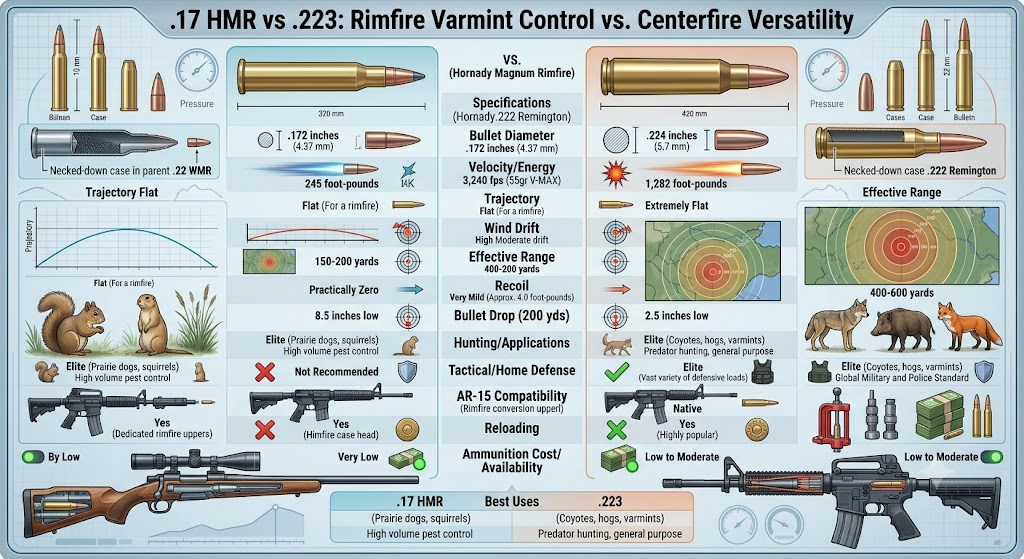
Understanding the Numbers
The technical differences between these cartridges highlight the vast divide between rimfire and centerfire capabilities.
The .17 HMR (Hornady Magnum Rimfire) was introduced in 2002. Hornady took the .22 WMR (.22 Magnum) rimfire case and necked it down to accept a tiny .172 caliber bullet. Because it is a rimfire cartridge, the brass must be thin enough for the firing pin to crush the rim and ignite the priming compound. This mechanical limitation restricts the .17 HMR to a maximum pressure of 26,000 psi, and the spent cases cannot be reloaded.
The .223 Remington is a centerfire cartridge developed in 1957 that serves as the parent dimension for the military 5.56 NATO. It utilizes a thick brass web and a replaceable Boxer primer, allowing it to safely contain a massive 55,000 psi of chamber pressure. This high pressure, combined with a much larger case capacity, allows the .223 Remington to completely outclass the .17 HMR in every ballistic metric.
Velocity Comparison
Velocity is the engine that drives a flat trajectory and explosive terminal performance.
The .17 HMR is incredibly fast by rimfire standards. By pushing an ultra-light 17 grain polymer-tipped bullet, it achieves a muzzle velocity of 2,550 feet per second.
However, the centerfire .223 Remington operates in an entirely different speed class. A standard 55 grain V-MAX bullet leaves a 20-inch barrel at approximately 3,240 feet per second. If loaded with ultra-light 35 or 40-grain varmint bullets, the .223 Remington can easily exceed 3,600 feet per second.
Muzzle Energy Comparison
Muzzle energy measures the absolute kinetic force transferred to a target upon impact.
Because kinetic energy relies on both mass and velocity, the .223 Remington completely dominates. The .223 Remington (55gr) generates roughly 1,282 foot-pounds of energy at the muzzle. The .17 HMR (17gr) generates a mere 245 foot-pounds of energy.
The .223 Remington delivers over five times the raw kinetic power of the .17 HMR. This massive energy gap is why the .223 Remington is trusted for coyotes and feral hogs, while the .17 HMR is strictly relegated to ground squirrels and prairie dogs.
Trajectory Comparison
A flat trajectory minimizes the margin of error when estimating range for a hunter in the field.
Because the .223 Remington launches at a much higher initial velocity and utilizes slightly more aerodynamic bullets, it shoots significantly flatter than the .17 HMR. The .223 reaches the target faster, giving gravity less time to pull the projectile downward. While the .17 HMR holds a relatively flat arc out to 150 yards, it begins to drop steeply after that.
Bullet Drop Comparison
Assuming a standard 100-yard zero for both rifles, the mathematical bullet drop at extended distances illustrates the aerodynamic superiority of the centerfire cartridge.
At 200 yards, the .223 Remington drops approximately 2.5 inches. The .17 HMR drops roughly 8.5 inches at the exact same distance.
If pushed to 300 yards, the .223 Remington drops roughly 12 inches. The .17 HMR drops a staggering 32 inches, making ethical hits on small targets nearly impossible without precise holdovers and perfect conditions.
Wind Drift Comparison
Wind deflection is the absolute greatest enemy of the small-caliber shooter. Wind drift is mitigated strictly by a bullet’s velocity and its aerodynamic profile.
The 17 grain bullet of the .17 HMR is so incredibly light that even a mild breeze will push it significantly off course. At 150 yards in a 10 mph crosswind, the .17 HMR will drift over 7 inches.
The 55 grain bullet of the .223 Remington, while still relatively light, carries more than triple the mass of the .17 HMR and travels faster. In that same 10 mph crosswind at 150 yards, the .223 Remington will drift only about 2.5 inches, giving the hunter a much higher hit probability in open fields.
Recoil Comparison
Recoil dictates a shooter’s ability to spot their own impacts through a rifle scope and fire rapid follow-up shots.
The .17 HMR generates practically zero recoil. Fired from a standard bolt-action rifle, it produces roughly 0.2 foot-pounds of free recoil. It feels like a very light tap against the shoulder, making it the perfect training cartridge for young beginners.
The .223 Remington generates roughly 4.0 foot-pounds of free recoil. While it produces significantly more recoil than the rimfire cartridge, it is still considered exceptionally mild and pleasant to shoot, even for long sessions at the range.
Stopping Power Comparison
Stopping power on game animals requires massive energy transfer and deep tissue disruption.
The .17 HMR relies on extreme velocity (for its size) to cause the tiny 17 grain bullet to detonate upon impact, turning the projectile into shrapnel instantly. This provides excellent stopping power on tiny pests like groundhogs, but it lacks the mass to ethically stop larger predators.
The .223 Remington delivers vastly superior stopping power. The hydrostatic shock generated by a 55-grain bullet impacting at over 3,000 feet per second creates massive internal trauma that anchors coyotes, feral hogs, and even whitetail deer (where legal) with much more authority.
Penetration Comparison
Penetration is critical for ensuring the bullet reaches the vital organs of heavily muscled animals on quartering angles.
The .17 HMR offers very shallow penetration because its highly frangible bullet is designed to explode on contact to prevent ricochets.
The .223 Remington can be loaded with solid copper or heavy bonded soft point bullets that will penetrate deeply through thick shoulder bones and muscle, making it a highly versatile and ethical choice for hunting medium game.
Expansion Comparison
To accurately test bullet expansion, the ballistics industry relies on calibrated ordinance gel.
Both cartridges expand violently when loaded with polymer-tipped V-MAX ammunition. The .17 HMR creates a massive but very shallow temporary wound cavity. The .223 Remington creates an exponentially larger wound cavity that pushes much deeper into the target block before the bullet fragments.
Accuracy Comparison
Both cartridges are capable of elite mechanical accuracy.
The .17 HMR is widely considered one of the most inherently accurate rimfire cartridges ever produced. Standard factory rifles routinely shoot 1 MOA groups at 100 yards, which is exceptional for rimfire ammunition.
The .223 Remington is a legendary match cartridge. Because it utilizes centerfire primers for more consistent ignition and can be precision handloaded, the .223 Remington holds a distinct mechanical advantage for extreme precision shooting.
Effective Range Comparison
The effective range of a rifle is severely limited by bullet drop, wind deflection, and retained energy.
For the .17 HMR, 150 to 200 yards is generally considered the absolute maximum effective range for reliable, predictable performance on small pests.
The .223 Remington stretches the AR-15 platform or a bolt-action rifle into a highly capable 400 to 600-yard target rifle. For hunters, the .223 provides the necessary velocity and energy to ethically harvest coyotes out to 300 or 400 yards.
Suppressor Performance Comparison
Suppressing a weapon protects the shooter’s hearing and provides a massive tactical advantage.
Both cartridges are strictly supersonic when used for hunting or target shooting. Pushing gas through a titanium or steel suppressor will tame the concussive blast and reduce the visual muzzle flash, but neither cartridge can be made completely silent. The supersonic acoustic crack of the bullet breaking the sound barrier will always remain.
Short Barrel Performance Comparison
Modern tactical and hunting applications frequently require maneuverable short-barreled rifles (SBRs).
The .223 Remington relies heavily on barrel length to generate velocity. When chopped down to 10.5 or 12.5 inches, it loses massive amounts of speed, neutering its terminal performance and effective range, while producing a massive fireball.
The .17 HMR achieves its maximum velocity in roughly 18 to 20 inches of barrel. While it is rarely found in highly compact platforms, chopping a rimfire barrel typically results in less dramatic velocity loss than chopping a high-capacity centerfire cartridge.
Home Defense Comparison
Inside the home, a defender must balance stopping power against over-penetration and auditory safety.
The .17 HMR should never be relied upon for primary home defense. While lethal, it fires a tiny, lightweight bullet that lacks the necessary mass and kinetic energy to reliably stop a determined human threat instantly.
The .223 Remington is considered an elite home defense cartridge when fired from an AR-15 loaded with 55-grain ballistic tips or hollow points. The lightweight, high-velocity bullets fragment violently upon hitting drywall, drastically reducing the risk of over-penetration compared to heavy pistol bullets, while delivering devastating terminal ballistics.
Hunting Comparison
These cartridges were built for entirely different hunting environments.
The .17 HMR is the ultimate farm and ranch cartridge. It is light, fast-handling, and utterly devastating on raccoons, skunks, and prairie dogs inside 150 yards, while its explosive bullets minimize the danger of ricochets in agricultural areas.
The .223 Remington is the superior choice for dedicated predator hunters. The massive kinetic energy and flat trajectory ensure you can ethically harvest a coyote or fox across a wide pasture where the rimfire cartridge would fall severely short.
Tactical and Duty Use Comparison
The .223 Remington (5.56 NATO) is the undisputed global standard for modern militaries and law enforcement agencies. Its logistical dominance is unparalleled.
The .17 HMR has zero tactical or duty footprint. It was engineered purely for the commercial civilian sporting market to satisfy the demands of pest control and target shooters.
Action Length and Rifle Compatibility
The .17 HMR fits perfectly into incredibly small, lightweight, and affordable rimfire bolt-action and lever-action rifles.
The .223 Remington requires a slightly larger mini-action centerfire receiver or a standard AR-15 platform. Rifles chambered in .223 are typically slightly heavier and significantly more expensive to manufacture than simple rimfire actions.
Ammo Cost Comparison
To become proficient with a precision rifle, you must practice frequently.
The .17 HMR is highly affordable. Because it is a mass-produced rimfire cartridge, you can buy boxes of 50 rounds for a fraction of the cost of centerfire ammunition, making high-volume prairie dog shoots very economical.
The .223 Remington is the cheapest centerfire rifle ammunition on the planet. You can buy bulk 55-grain FMJ practice ammunition inexpensively, but premium hunting rounds will always cost significantly more per round than the rimfire .17 HMR.
Ammo Availability Comparison
Walk into any sporting goods store, rural hardware store, or gas station in North America, and you will find both .17 HMR and .223 Remington sitting on the shelf. They are two of the most universally adopted rifle cartridges on the market today.
Reloading Comparison
This is a fundamental divide between the two cartridges.
The .17 HMR is a rimfire cartridge. It is permanently destroyed upon firing and absolutely cannot be reloaded.
The .223 Remington is highly economical to reload, with infinite load data, cheap brass, and abundant powder choices. A handloader can carefully tune their powder charges to achieve extreme precision, making the .223 Remington highly economical to shoot if you save your brass.
Pros and Cons
.17 HMR
Pros
- Ammunition is highly affordable and universally available.
- Incredibly flat trajectory inside 150 yards for a rimfire cartridge.
- Extreme velocity ensures explosive fragmentation on small pests.
- Practically zero recoil allows shooters to easily spot their own hits.
- Perfect for high-volume shooting where ricochets are a concern.
Cons
- Cannot be reloaded.
- Ultra-light bullet is highly susceptible to wind drift.
- Lacks the kinetic energy to ethically harvest coyotes or medium game.
.223 Remington
Pros
- The absolute gold standard for the AR-15 platform.
- Generates over five times the kinetic energy of the .17 HMR.
- Highly economical to reload with massive component availability.
- Elite for close-quarters home defense and predator hunting.
- Extremely mild recoil impulse for a centerfire rifle.
Cons
- Ammunition is more expensive than rimfire cartridges.
- Trajectory drops significantly past 300 yards.
- Requires a heavier, larger rifle platform.
Final Verdict
Choosing between the .17 HMR and the .223 Remington comes down entirely to the size of your target and the distance of your typical shots.
- For Pest Control and High-Volume Shooting: Choose the .17 HMR. The incredibly low cost of rimfire factory ammunition allows you to shoot hundreds of rounds a day without breaking the bank, and its explosive terminal performance prevents dangerous ricochets on the farm.
- For the Dedicated Predator Hunter: Choose the .223 Remington. It provides the massive kinetic energy, heavy bullet mass, and flat trajectory necessary to reliably anchor coyotes and foxes at 300 yards.
- For Home Defense and Tactical Training: Choose the .223 Remington. Chambered in a modern AR-15, it provides devastating stopping power, high magazine capacity, and massive logistical support.
- For the Handloader: Choose the .223 Remington. The ability to meticulously craft your own precision centerfire ammunition makes it a highly rewarding and economical cartridge to reload at home.
FAQ
Is the .223 Remington more powerful than the .17 HMR?
Yes, massively. Because it is a high-pressure centerfire cartridge, the .223 Remington pushes a much heavier bullet at vastly superior speeds, generating over five times the kinetic energy of the .17 HMR.
Can a .17 HMR kill a coyote?
While a .17 HMR can kill a coyote at very close ranges with perfect headshot placement, it is universally considered underpowered for predators. The tiny 17 grain bullet lacks the kinetic energy and penetration to reliably and ethically anchor a coyote, making the .223 Remington a much better choice.
Can I shoot .17 HMR in an AR-15?
Yes, but it requires a dedicated .17 HMR complete upper receiver and specialized magazines that convert the AR-15 into a blowback-operated rimfire rifle. You cannot fire .17 HMR out of a standard 5.56/.223 upper receiver.
Is the .223 Remington good for deer hunting?
Where legally permitted, the .223 Remington can harvest whitetail deer at close to medium ranges when loaded with premium, heavy bonded or copper expanding bullets. However, it requires precise shot placement, and many hunters prefer stepping up to larger calibers like the .243 Winchester or .308 Winchester for deer.
Can I reload .17 HMR?
No. The .17 Hornady Magnum Rimfire is a rimfire cartridge. The priming compound is spun directly into the rim of the brass case, which is permanently crushed by the firing pin upon ignition. It cannot be safely reprimed or reloaded.