The main difference between the cartridges is that the .22 Hornet is a reloadable, centerfire cartridge that delivers significantly higher velocity, kinetic energy, and effective range for predator hunting, whereas the .17 HMR is a mass-produced rimfire cartridge designed to offer hyper-velocity, flat-shooting performance for small varmints at a much lower cost per round.
.22 Hornet vs .17 HMR Comparison
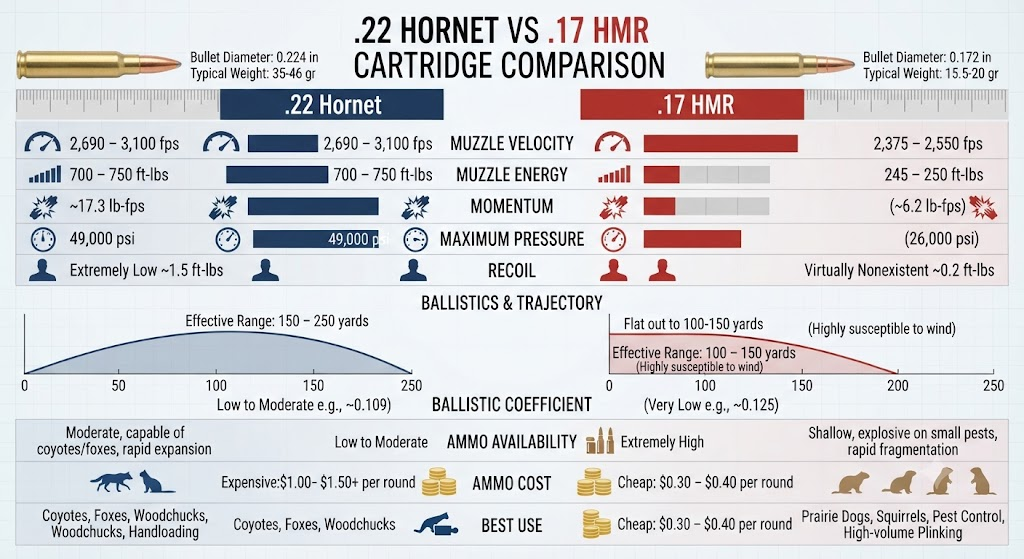
| Feature | .22 Hornet | .17 HMR |
| Bullet Diameter | 0.224 in (5.7 mm) / older rifles .223 in | 0.172 in (4.37 mm) |
| Typical Bullet Weight | 35 gr – 46 gr (typically 35 gr or 45 gr) | 15.5 gr – 20 gr (typically 17 gr) |
| Muzzle Velocity | 2,690 – 3,100 fps (24-inch barrel) | 2,375 – 2,550 fps (24-inch barrel) |
| Muzzle Energy | 700 – 750 ft-lbs | 245 – 250 ft-lbs |
| Momentum | ~17.3 lb-fps (45 gr at 2,690 fps) | ~6.2 lb-fps (17 gr at 2,550 fps) |
| Maximum Pressure | 49,000 psi (SAAMI) | 26,000 psi (SAAMI) |
| Ballistic Coefficient | Low to Moderate (e.g., ~0.109 for 35 gr V-MAX) | Very Low (e.g., ~0.125 for 17 gr V-MAX) |
| Penetration | Moderate (capable of harvesting coyotes/foxes) | Shallow (designed for rapid fragmentation on small pests) |
| Expansion | Rapid and violent with hollow points / V-MAX | Explosive on small game, minimal penetration |
| Trajectory | Flat out to 150-200 yards | Flat out to 100-150 yards (highly susceptible to wind) |
| Recoil | Extremely low (~1.5 ft-lbs) | Virtually nonexistent (~0.2 ft-lbs) |
| Effective Range | 150 – 250 yards | 100 – 150 yards |
| Ammo Availability | Low to Moderate (often seasonal or specialty) | Extremely High (available in most sporting goods stores) |
| Ammo Cost | Expensive ($1.00 – $1.50+ per round) | Cheap ($0.30 – $0.40 per round) |
| Best Use | Coyotes, foxes, woodchucks, handloading | Prairie dogs, squirrels, pest control, high-volume plinking |
The .22 Hornet and the .17 Hornady Magnum Rimfire (HMR) represent two entirely different approaches to the varmint hunting cartridge. The .22 Hornet is a piece of firearms history, originating in the 1920s through the wildcatting efforts of Townsend Whelen and Captain G.L. Wotkyns at the Springfield Armory. It bridges the gap between rimfire cartridges and full-sized centerfire varmint rounds like the .223 Remington, offering a reloadable brass case that operates at a SAAMI maximum pressure of 49,000 psi.
The .17 HMR, conversely, is a thoroughly modern rimfire cartridge introduced by Hornady in 2002. It was created by necking down a .22 Winchester Magnum Rimfire (WMR) case to accept a .172-caliber projectile. Operating at 26,000 psi, it revolutionized the rimfire market by offering a non-reloadable, highly affordable round that shoots flatter and faster than any .22 LR or .22 WMR on the market.
.22 Hornet vs .17 HMR Ballistics
To objectively evaluate the ballistic capabilities of the centerfire .22 Hornet against the rimfire .17 HMR, we must examine real-world factory loads tested under standard 24-inch test barrels. The difference in case capacity, ignition type, and maximum pressure creates a vast performance gap.
- Load A (.22 Hornet): Hornady 35-grain V-MAX. Tested from a 24-inch barrel: Muzzle Velocity = 3,100 fps, Muzzle Energy = 747 ft-lbs, Ballistic Coefficient (G1) = 0.109.
- Load B (.22 Hornet): Federal 45-grain Soft Point (SP). Tested from a 24-inch barrel: Muzzle Velocity = 2,690 fps, Muzzle Energy = 723 ft-lbs, Ballistic Coefficient (G1) = 0.108.
- Load C (.17 HMR): Hornady 17-grain V-MAX. Tested from a 24-inch barrel: Muzzle Velocity = 2,550 fps, Muzzle Energy = 245 ft-lbs, Ballistic Coefficient (G1) = 0.125.
- Load D (.17 HMR): CCI 20-grain GamePoint (JSP). Tested from a 24-inch barrel: Muzzle Velocity = 2,375 fps, Muzzle Energy = 250 ft-lbs, Ballistic Coefficient (G1) = 0.115.
The data reveals that the .22 Hornet generates roughly three times the kinetic energy of the .17 HMR due to its centerfire powder capacity and heavier bullets.
.22 Hornet vs .17 HMR Velocity
Velocity is a critical factor for varmint cartridges because it dictates trajectory flatness and the explosive expansion of lightweight projectiles upon impact.
- .22 Hornet Velocity: While older factory loads utilizing 45-grain bullets hover around 2,690 fps, modern lightweight polymer-tipped ammunition has transformed the Hornet. Hornady’s 35-grain V-MAX load reaches a blistering 3,100 fps out of a 24-inch barrel. This velocity ensures devastating terminal performance on small predators like foxes and coyotes.
- .17 HMR Velocity: The .17 HMR is universally standardized around a 17-grain bullet at 2,550 fps or a heavier 20-grain bullet at 2,375 fps. For a rimfire cartridge, 2,550 fps is a spectacular achievement, offering hyper-velocity performance that outclasses the .22 WMR in sheer speed, though it cannot match the centerfire .22 Hornet.
.22 Hornet vs .17 HMR Muzzle Energy
Muzzle energy quantifies the destructive potential and effective ethical range of a cartridge on live targets.
- .22 Hornet Energy: Producing between 700 and 750 ft-lbs of muzzle energy, the .22 Hornet sits firmly in the “small predator” class. It carries enough retained energy at 100 and 150 yards to ethically harvest coyotes, bobcats, and foxes with proper shot placement.
- .17 HMR Energy: Producing roughly 245 to 250 ft-lbs of muzzle energy, the .17 HMR is strictly a small-varmint cartridge. While it excels on prairie dogs, ground squirrels, and rabbits, it lacks the kinetic energy required for reliable, ethical kills on large coyotes, especially at distances beyond 50 yards where its energy drops below 150 ft-lbs.
.22 Hornet vs .17 HMR Momentum
Momentum measures the mass in motion and influences how well a bullet penetrates and overcomes resistance.
- .22 Hornet Momentum: A 45-grain bullet traveling at 2,690 fps yields roughly 17.3 lb-fps of momentum.
- .17 HMR Momentum: A 17-grain bullet traveling at 2,550 fps yields roughly 6.2 lb-fps of momentum.
The .22 Hornet possesses nearly three times the linear momentum of the .17 HMR. This explains why a .22 Hornet will reliably drive through the shoulder bone of a coyote, whereas a tiny 17-grain .17 HMR bullet will often fragment on the surface, causing a gruesome but non-lethal surface wound on larger animals.
.22 Hornet vs .17 HMR Trajectory
Both cartridges are lauded for their flat trajectories compared to standard .22 Long Rifle rimfires, but wind drift is a major differentiating factor. Below is a bullet drop comparison assuming a standard scope height of 1.5 inches above the bore and a zero distance of 100 yards.
| Distance | .22 Hornet (35 gr at 3,100 fps) Drop | .17 HMR (17 gr at 2,550 fps) Drop |
| Muzzle | -1.5 inches | -1.5 inches |
| 50 Yards | -0.1 inches | -0.1 inches |
| 100 Yards | 0.0 inches (Zero) | 0.0 inches (Zero) |
| 150 Yards | -1.2 inches | -2.6 inches |
| 200 Yards | -4.5 inches | -8.5 inches |
| 250 Yards | -10.8 inches | -19.2 inches |
While the .17 HMR shoots incredibly flat for a rimfire out to 150 yards, it begins to drop rapidly as it sheds its light velocity. More importantly, wind deflection is the true enemy of the .17 HMR. A mild 10 mph crosswind will push the 17-grain .17 HMR bullet roughly 8 inches off target at 150 yards. The faster, heavier 35-grain .22 Hornet will experience approximately half of that wind drift.
.22 Hornet vs .17 HMR Recoil
Both cartridges are essentially recoilless, making them ideal for new shooters, youth, and hunters who need to watch their impacts through their rifle optics.
- .22 Hornet Recoil: A typical 7-pound bolt-action rifle chambered in .22 Hornet generates roughly 1.5 foot-pounds of free recoil energy. The muzzle report is noticeably louder than a rimfire, featuring a sharp centerfire “crack.”
- .17 HMR Recoil: A 7-pound rifle chambered in .17 HMR generates approximately 0.2 foot-pounds of free recoil. It is entirely devoid of recoil, feeling indistinguishable from a standard .22 LR, though it features a sharper supersonic crack.
.22 Hornet vs .17 HMR Penetration
Penetration capabilities dictate the size of the game each cartridge can effectively hunt.
- .22 Hornet Penetration: Using 45-grain soft point (SP) bullets, the .22 Hornet offers excellent penetration on medium-sized predators. The bullet holds together well enough to penetrate thick muscle and bone on a coyote out to 150 yards.
- .17 HMR Penetration: The .17 HMR is purposely designed for minimal penetration. The 17-grain V-MAX bullet is built with a thin jacket and a polymer tip meant to cause explosive fragmentation within the first 1 to 2 inches of soft tissue. While CCI offers a 20-grain GamePoint designed for deeper penetration, it is still a 20-grain rimfire bullet and cannot match the centerfire Hornet’s driving force.
.22 Hornet vs .17 HMR Expansion
Expansion in small calibers is heavily reliant on high impact velocities.
- .22 Hornet Expansion: At 3,100 fps, polymer-tipped bullets like the Hornady V-MAX expand violently and instantly upon contact. Soft point bullets expand more controllably, mushrooming to roughly .35 caliber while retaining mass.
- .17 HMR Expansion: The .17 HMR relies entirely on explosive fragmentation rather than controlled expansion. Upon impacting a prairie dog or ground squirrel, the 17-grain bullet acts like a microscopic grenade, turning the animal’s vitals into secondary projectiles.
.22 Hornet vs .17 HMR Effective Range
- .22 Hornet Effective Range: For small targets like woodchucks, the .22 Hornet is highly effective out to 250 yards. For larger predators like coyotes, its ethical range is generally capped around 150 to 200 yards, where velocity drops below the threshold for reliable expansion and shock.
- .17 HMR Effective Range: The .17 HMR is highly effective on small pests out to 150 yards. Beyond 150 yards, a combination of severe wind drift, rapid bullet drop, and falling kinetic energy makes ethical hits on live game highly unpredictable.
.22 Hornet vs .17 HMR Self Defense
Neither the .22 Hornet nor the .17 HMR is designed, marketed, or recommended for self-defense.
- Platform Limitations: Both are primarily chambered in bolt-action rifles, single-shot rifles, or heavy varmint platforms, which are completely impractical for home defense or defensive carry.
- Ammunition Unreliability: The .17 HMR is a rimfire cartridge. Rimfire ignition is inherently less reliable than centerfire ignition, and a failure to fire during a defensive scenario is catastrophic. Furthermore, the 17-grain bullet lacks the mass to penetrate deeply enough to reliably stop a human threat.
- The Verdict: If forced to use one in a life-or-death emergency, the centerfire .22 Hornet is vastly superior due to its centerfire reliability, higher energy (700+ ft-lbs), and deeper penetration, but it remains vastly inferior to standard defensive handgun calibers like 9mm or .45 ACP, or intermediate rifle calibers like 5.56mm NATO.
.22 Hornet vs .17 HMR Concealed Carry
Concealed carry with either of these cartridges is effectively impossible and highly ill-advised.
- Lack of Handguns: There are virtually no practical concealed carry handguns chambered in .22 Hornet. There have been a few novelty revolvers (like the Taurus Raging Hornet) and single-shot pistols (like the Thompson/Center Contender), but they are massive, heavy hunting handguns.
- .17 HMR Revolvers: While a few companies make .17 HMR revolvers, the cartridge loses tremendous velocity out of a short pistol barrel. A .17 HMR fired from a 2-inch or 4-inch revolver barrel suffers from extreme unburnt powder blast and produces energy levels lower than a standard .22 Long Rifle, making it a terrible choice for concealed carry.
Which Has More Stopping Power: .22 Hornet or .17 HMR?
“Stopping power” in the context of varmint and predator hunting refers to the ability to anchor an animal immediately without tracking. The .22 Hornet possesses significantly more stopping power.
Generating over 700 ft-lbs of muzzle energy and utilizing bullets that weigh more than twice as much as the .17 HMR, the .22 Hornet delivers hydrostatic shock and tissue destruction that the rimfire simply cannot replicate. A coyote shot in the vitals with a .22 Hornet will drop quickly; a coyote shot with a .17 HMR is highly likely to escape wounded.
Which Is More Powerful: .22 Hornet or .17 HMR?
Power is defined quantitatively by kinetic energy. The .22 Hornet is roughly three times more powerful than the .17 HMR.
- .22 Hornet: ~740 ft-lbs of energy.
- .17 HMR: ~245 ft-lbs of energy.
The centerfire powder charge of the .22 Hornet operates at 49,000 psi, driving a heavier bullet much faster than the 26,000 psi rimfire .17 HMR.
.22 Hornet Pros and Cons
Pros
- Centerfire reliability and significantly higher kinetic energy (700+ ft-lbs)
- Ethically capable of taking medium predators like coyotes and foxes out to 200 yards
- Reloadable brass case allows handloaders to tune accuracy and lower the cost per round
- Classic, nostalgic history with a cult following among traditional varmint hunters
Cons
- Factory ammunition is expensive (often exceeding $1.00 to $1.50 per round) and can be hard to find on local shelves
- The thin, sloping brass case is notoriously delicate and easy to crush during the handloading resizing process
- Cannot compete with the velocity and range of modern centerfires like the .223 Remington
.17 HMR Pros and Cons
Pros
- Extremely cheap factory ammunition ($0.30 to $0.40 per round) ideal for high-volume pest control
- Hyper-velocity flat trajectory makes hitting small targets inside 125 yards effortless
- Zero recoil and low noise, making it perfect for youth shooters or properties with noise constraints
- Ammunition is mass-produced and found in almost every sporting goods store worldwide
Cons
- Rimfire primer ignition is inherently less reliable than centerfire
- Tiny 17-grain bullet is highly susceptible to wind deflection
- Lacks the mass and energy for ethical kills on coyotes or larger predators
- Cases cannot be reloaded
Final Comparison
| Category | Winner | Reason |
| Velocity | .22 Hornet | Drives a 35-grain bullet over 3,100 fps, outrunning the .17 HMR |
| Muzzle Energy | .22 Hornet | Generates roughly 3x the kinetic energy of the .17 HMR |
| Momentum | .22 Hornet | Heavier 45-grain bullets push through resistance better |
| Penetration | .22 Hornet | Sufficient mass to penetrate coyote bone and dense muscle |
| Expansion | Tie | Both utilize V-MAX technology for explosive varmint expansion |
| Trajectory | .22 Hornet | Faster velocity and heavier bullets resist drop and wind better |
| Bullet Drop (200 yds) | .22 Hornet | Drops only ~4.5 inches vs ~8.5 inches for the .17 HMR |
| Recoil | .17 HMR | Practically zero recoil, though both are exceptionally mild |
| Effective Range | .22 Hornet | Extends ethical varmint limits out to 200–250 yards |
| Self Defense | .22 Hornet | (If forced) Centerfire reliability and deeper penetration |
| Concealed Carry | Neither | Neither has viable, practical concealed carry platforms |
| Ammo Cost | .17 HMR | Mass-produced rimfire is drastically cheaper than centerfire |
| Ammo Availability | .17 HMR | Ubiquitous on retail shelves globally |
| Overall Performance | Depends on Load | .22 Hornet for coyotes/range; .17 HMR for budget prairie dogs |
.22 Hornet vs .17 HMR: Which Should You Choose?
Selecting between the .22 Hornet and the .17 HMR comes down to the size of the game you are hunting and your budget for ammunition.
- Choose the .22 Hornet if you are hunting coyotes, foxes, or large woodchucks, need an effective range out to 200 yards, prefer to reload your own ammunition, and want the reliability and power of a centerfire cartridge.
- Choose the .17 HMR if your primary targets are prairie dogs, ground squirrels, and small pests within 125 yards, you want to shoot high volumes of ammunition affordably without reloading, and you require a quiet, zero-recoil rimfire rifle.
The .17 HMR rules the rimfire pest-control market, while the .22 Hornet remains a nostalgic, highly effective stepping stone into centerfire predator hunting.
FAQs
Is .22 Hornet more powerful than .17 HMR?
Yes, the .22 Hornet is significantly more powerful. Being a centerfire cartridge, it generates over 700 ft-lbs of muzzle energy, whereas the rimfire .17 HMR generates approximately 245 ft-lbs.
Which has more muzzle energy?
The .22 Hornet produces roughly three times the muzzle energy of the .17 HMR (700+ ft-lbs vs 245 ft-lbs).
Which has more stopping power?
The .22 Hornet possesses vastly more stopping power. It uses a heavier bullet (35–45 grains) and hits with much higher energy, making it capable of ethically stopping coyotes, which the .17 HMR struggles to do.
Which has more recoil?
The .22 Hornet has slightly more recoil (~1.5 ft-lbs) than the .17 HMR (~0.2 ft-lbs), but both cartridges are considered to have negligible, virtually zero recoil.
Which has better penetration?
The .22 Hornet penetrates much deeper due to its heavier bullet mass (45-grain soft points) and higher momentum. The .17 HMR is designed to fragment rapidly and offers very shallow penetration.
Which expands more?
Both utilize polymer-tipped bullets (like the V-MAX) that expand explosively. However, the .22 Hornet creates a much larger temporary and permanent wound cavity due to its higher velocity and mass.
Which has a flatter trajectory?
The .22 Hornet has a flatter trajectory and is significantly less affected by wind drift out to 200 yards compared to the ultra-light 17-grain .17 HMR bullet.
Which is better for self defense?
Neither is designed for self-defense. However, the centerfire .22 Hornet is far more reliable and powerful if pressed into an emergency defensive role.
Which is better for concealed carry?
Neither. Both are primarily rifle cartridges, and the few handguns chambered for them are massive hunting revolvers or single-shot pistols unsuitable for concealment.
Is .22 Hornet faster than .17 HMR?
Yes. Modern .22 Hornet loads utilizing 35-grain bullets can exceed 3,100 fps, outrunning the 2,550 fps of the .17 HMR.
Is .17 HMR stronger than .22 Hornet?
No. The .17 HMR is a rimfire cartridge and is physically smaller, weaker, and less capable of handling high pressures (26,000 psi) compared to the centerfire .22 Hornet (49,000 psi).
Which is cheaper to shoot?
The .17 HMR is drastically cheaper to shoot. Factory rimfire ammunition costs a fraction of centerfire .22 Hornet ammunition.
Can you reload .17 HMR?
No, the .17 HMR is a rimfire cartridge and cannot be reloaded. The .22 Hornet is a centerfire cartridge and is highly popular among handloaders.
Which is easier to shoot?
Both are incredibly easy to shoot due to low recoil, but the .17 HMR is slightly quieter and requires less hearing protection in open environments, making it a favorite for teaching youth shooters.
Which should you choose?
Choose the .22 Hornet for predator hunting (coyotes/foxes) out to 200 yards. Choose the .17 HMR for budget-friendly, high-volume pest control (squirrels/prairie dogs) inside 125 yards.