The main difference between the cartridges is that the .300 Blackout is an intermediate, short-range cartridge optimized for compact suppressed AR-15 platforms, whereas the .300 Winchester Magnum is a high-velocity, heavy-powder magnum designed for long-range target shooting and large game hunting across expansive distances.
.300 Blackout vs .300 Winchester Magnum Comparison
| Feature | .300 Blackout | .300 Winchester Magnum |
| Bullet Diameter | 0.308 in (7.82 mm) | 0.308 in (7.82 mm) |
| Typical Bullet Weight | 110 gr – 220 gr (typically 110 gr / 220 gr) | 150 gr – 220 gr (typically 180 gr / 200 gr) |
| Muzzle Velocity | 2,250 – 2,350 fps (Supersonic, 9–16 in) / ~1,050 fps (Subsonic) | 2,850 – 3,100 fps (24–26 in barrel) |
| Muzzle Energy | 1,200 – 1,350 ft-lbs (Supersonic) / ~530 ft-lbs (Subsonic) | 3,500 – 4,000+ ft-lbs |
| Momentum | ~50 lb-fps (Supersonic 110 gr) / ~68 lb-fps (Subsonic 220 gr) | ~80.0 lb-fps (200 gr at 2,850 fps) |
| Maximum Pressure | 55,000 psi (SAAMI) | 64,000 psi (SAAMI) |
| Effective Range | 300 – 400 yds (Supersonic) / 100 – 150 yds (Subsonic) | 800 – 1,000+ yards |
| Action Length Required | Intermediate / AR-15 Platform | Magnum Long Action |
| Recoil Energy | Low (~4–6 ft-lbs) | Heavy (~22–28 ft-lbs in standard hunting rifles) |
| Ammo Availability | High (Widely produced globally) | Extremely High (Global standard magnum hunting round) |
| Ammo Cost | Moderate ($0.60 – $1.50 per round) | Expensive ($1.75 – $3.50+ per round) |
| Best Use | CQB, suppressed personal defense, short-barrel AR-15s | Big game hunting, elk/moose, long-range shooting |
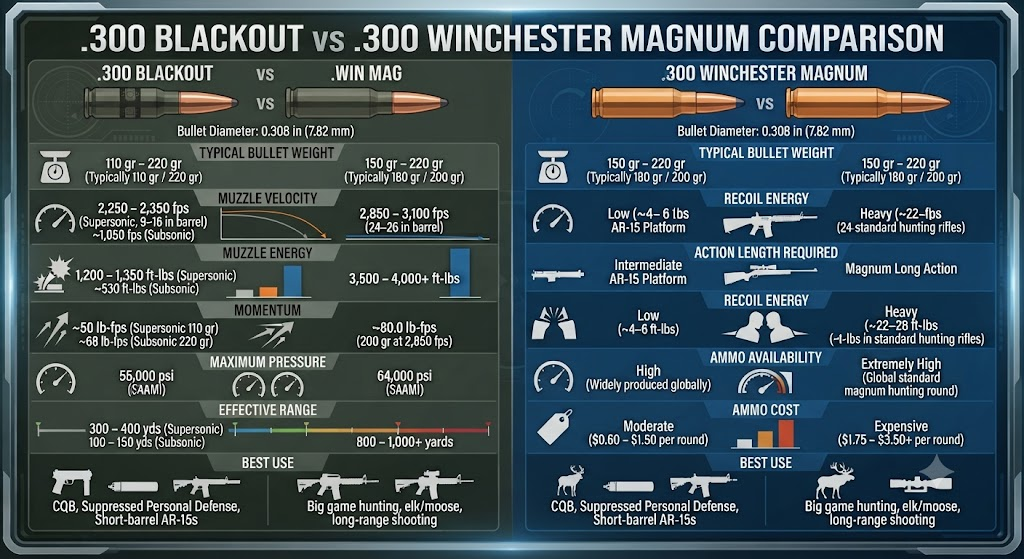
.300 Blackout vs .300 Win Mag Ballistics
The .300 AAC Blackout (introduced in 2011) was engineered to burn its entire powder charge in barrels as short as 9 inches, delivering a versatile platform that transitions seamlessly between supersonic intermediate loads and ultra-quiet subsonic rounds from a standard AR-15. Operating at 55,000 psi, it prioritizes maneuverability and suppression over raw power.
Conversely, the .300 Winchester Magnum (.300 Win Mag), introduced in 1963, is a belted magnum case designed to burn massive amounts of slow-burning powder behind a .308-caliber projectile. Operating at 64,000 psi, it accelerates heavy bullets to high velocities, making it a historic benchmark for big-game hunting and military long-range sniping.
Representative factory loads highlight their divergent performance metrics:
- Load A (.300 BLK Supersonic): Hornady 110-grain V-MAX. Tested from a 16-inch barrel: Muzzle Velocity = 2,350 fps, Muzzle Energy = 1,348 ft-lbs.
- Load B (.300 BLK Subsonic): Hornady 208-grain Sub-X JHP. Tested from a 9-inch barrel: Muzzle Velocity = 1,020 fps, Muzzle Energy = 480 ft-lbs.
- Load C (.300 Win Mag): Federal Premium 180-grain Nosler Partition. Tested from a 24-inch test barrel: Muzzle Velocity = 2,960 fps, Muzzle Energy = 3,501 ft-lbs.
- Load D (.300 Win Mag): Hornady 200-grain ELD-X Precision Hunter. Tested from a 24-inch barrel: Muzzle Velocity = 2,850 fps, Muzzle Energy = 3,607 ft-lbs.
Velocity and Energy Comparison
- Muzzle Energy Contrast: The .300 Blackout generates roughly 1,300 ft-lbs of muzzle energy in supersonic configuration—placing it in the intermediate carbine category alongside 7.62x39mm. The .300 Win Mag produces nearly triple that output, generating 3,500 to 4,000+ ft-lbs of kinetic energy at the muzzle.
- Downrange Retention: At 500 yards, a supersonic .300 Blackout bullet has shed velocity and energy significantly, dropping below 700 ft-lbs. In contrast, the .300 Win Mag carries over 2,200 ft-lbs of energy at 500 yards, ensuring deep tissue disruption and ethical big-game harvesting performance at extreme distances.
Trajectory and Bullet Drop
Calculations assume a standard scope height of 1.5 inches above the bore and a zero distance of 100 yards for .300 Blackout supersonic and 200 yards for .300 Win Mag.
| Distance | .300 BLK (110 gr at 2,350 fps Supersonic) Drop | .300 Win Mag (200 gr at 2,850 fps) Drop |
| Muzzle | -1.5 inches | -1.5 inches |
| 100 Yards | 0.0 inches (Zero) | +1.4 inches |
| 200 Yards | -8.5 inches | 0.0 inches (Zero) |
| 300 Yards | -26.4 inches | -5.8 inches |
| 400 Yards | -58.2 inches | -16.2 inches |
| 500 Yards | -108.4 inches | -32.5 inches |
The .300 Win Mag fires flat and fast, maintaining an effective trajectory past 500 to 800 yards. The .300 Blackout experiences a sharp trajectory arc, dropping rapidly past 200 yards due to limited powder capacity and lower ballistic coefficients.
Recoil and Platform Dynamics
- Platform Weight and Handling: The .300 Blackout operates within lightweight, compact AR-15 carbines or PDWs weighing 6 to 7 pounds. The .300 Win Mag requires a long-action rifle (often a heavy bolt-action hunting rifle or semi-auto chassis) weighing 8 to 10+ pounds to absorb heavy operating pressures.
- Recoil Impulse: The .300 Blackout produces light, gentle recoil (4–6 ft-lbs). The .300 Win Mag delivers stout, sharp recoil (22–28 ft-lbs), often requiring a muzzle brake or suppressor to prevent shooter fatigue during extended practice sessions.
.300 Blackout Pros and Cons
Pros
- Drop-in compatibility with standard AR-15 lower receivers and magazines
- Exceptional suppression capability with heavy subsonic loads
- Lightweight, highly maneuverable weapon footprint for close quarters
- Mild recoil profile allows rapid follow-up shots
Cons
- Severe velocity and energy loss past 300 yards
- Inadequate kinetic energy for large-bodied big game at extended ranges
- Subsonic terminal ballistics depend heavily on specialized expanding bullet designs
.300 Win Mag Pros and Cons
Pros
- Devastating kinetic energy and terminal performance on large game out to 800+ yards
- Flat trajectory and high resistance to crosswinds at long distances
- Widespread global ammunition availability across sporting goods stores
- Proven historical track record for both military sniper applications and big game hunting
Cons
- Heavy, punishing recoil energy requiring disciplined marksmanship
- Longer, heavier rifle platforms are necessary to handle magnum actions
- Expensive ammunition for high-volume practice sessions
- Excessive muzzle blast and report, especially in shorter barrels
Final Comparison
| Category | Winner | Reason |
| Velocity | .300 Win Mag | Heavy magnum powder charge drives bullets past 2,900 fps |
| Muzzle Energy | .300 Win Mag | Generates 3,500–4,000+ ft-lbs vs ~1,300 ft-lbs for .300 BLK |
| Long-Range Ballistics | .300 Win Mag | Flat trajectory and high energy retention past 500 yards |
| Platform Versatility & Size | .300 BLK | Integrates into compact, lightweight AR-15 carbines |
| Suppressed Performance | .300 BLK | Perfectly optimized for quiet subsonic operation |
| Recoil Control | .300 BLK | Exceptionally mild recoil for comfortable shooting |
| Ammo Availability | .300 Win Mag | Widely distributed standard global magnum hunting caliber |
| Ammo Cost | .300 BLK | Cheaper per round for training and recreational shooting |
| Overall Performance | Depends on Application | .300 BLK wins on compact CQB and suppression; .300 Win Mag wins on power and range |
.300 Blackout vs .300 Win Mag: Which Should You Choose?
- Choose the .300 Blackout if you want a compact, suppressed AR-15 platform optimized for close-quarters engagement, home defense, or short-to-medium range tactical utility.
- Choose the .300 Win Mag if you need an ethical, hard-hitting big-game hunting rifle or long-range precision platform capable of taking game or targets at distances exceeding 500 yards.
FAQs
Is .300 Blackout more powerful than .300 Win Mag?
No, the .300 Win Mag is vastly more powerful, generating nearly triple the muzzle energy (3,500–4,000+ ft-lbs) compared to the .300 Blackout (1,200–1,350 ft-lbs).
Which has more muzzle energy?
The .300 Winchester Magnum produces substantially higher muzzle energy due to its large belted magnum powder capacity.
Which is better for long-range shooting?
The .300 Win Mag is engineered specifically for long-range accuracy and energy retention out to 800–1,000+ yards.
Which has more recoil?
The .300 Win Mag produces heavy, sharp recoil (22–28 ft-lbs), whereas the .300 Blackout produces very light, minimal recoil (4–6 ft-lbs).
Which fits in an AR-15?
The .300 Blackout drops directly into a standard AR-15 platform, while the .300 Win Mag requires a large-frame magnum bolt-action or specialized semi-auto rifle.
Which is better for suppressed shooting?
The .300 Blackout is widely considered one of the best suppressed intermediate cartridges, particularly when firing heavy subsonic rounds.
Which is better for big-game hunting?
The .300 Win Mag is exceptional for large big game (elk, moose, bear, caribou) at extended ranges, whereas the .300 Blackout is restricted to deer-sized game at close ranges.
Which has better ammunition availability?
Both have strong market presence, but .300 Win Mag is found globally as a standard hunting round, while .300 Blackout is ubiquitous in tactical and sporting channels.
Which is cheaper to shoot?
The .300 Blackout is notably cheaper to shoot for practice and high-volume training compared to high-cost magnum ammunition.
Is .300 Blackout effective past 300 yards?
Supersonic .300 Blackout rounds drop rapidly past 300 yards and lose significant energy, making it poorly suited for long-range shooting.
Which has a flatter trajectory?
The .300 Win Mag features a much flatter trajectory with minimal bullet drop across intermediate and extended distances.
Which requires a heavier rifle?
The .300 Win Mag requires a heavier rifle platform to manage its substantial recoil energy and magnum pressures.
Which is easier to shoot accurately?
Most shooters find the .300 Blackout much easier to shoot accurately without flinching due to its exceptionally mild recoil impulse.
Which should you choose?
Choose the .300 Blackout for a compact, suppressed AR-15 personal defense weapon, or choose the .300 Win Mag for long-range precision shooting and heavy big-game hunting.