The main difference between the cartridges is that the .357 SIG relies on high velocity, lightweight 9mm-diameter projectiles to flatten trajectories and maximize energy transfer, whereas the .45 ACP utilizes heavy, large-diameter bullets traveling at subsonic or low supersonic velocities to create wide permanent wound channels through mass and frontal area.
Table of Contents [Click to open]
.357 Sig vs .45 Acp Comparison
| Feature | .357 SIG | .45 ACP |
| Bullet Diameter | 0.355 in (9.02 mm) | 0.451 in (11.46 mm) |
| Typical Bullet Weight | 115 gr – 147 gr (typically 125 gr) | 185 gr – 230 gr (typically 230 gr) |
| Muzzle Velocity | 1,300 – 1,475 fps (4-inch barrel) | 830 – 950 fps (5-inch barrel) |
| Muzzle Energy | 500 – 600 ft-lbs | 350 – 460 ft-lbs |
| Momentum | ~24.5 lb-fps (125 gr at 1,350 fps) | ~30.0 lb-fps (230 gr at 850 fps) |
| Maximum Pressure | 40,000 psi (SAAMI) | 21,000 psi (SAAMI) / 23,000 psi (+P) |
| Ballistic Coefficient | Lower (e.g., ~0.120–0.150 for 125 gr JHP) | Moderate (e.g., ~0.155–0.190 for 230 gr JHP) |
| Penetration | 13 – 18 inches (Gelatin) | 12 – 15 inches (Gelatin) |
| Expansion | 0.52 – 0.65 inches | 0.60 – 0.91 inches |
| Trajectory | Flat out to 100 yards | Looping, drops faster past 50 yards |
| Recoil | Sharp, snappy, high muzzle flip | Push, heavy, broad linear recoil |
| Effective Range | Out to 100+ yards | Out to 50–75 yards |
| Ammo Availability | Moderate to Low (specialty stock) | High (widely available globally) |
| Ammo Cost | Expensive ($0.45 – $0.70 per round) | Moderate to High ($0.35 – $0.55 per round) |
| Best Use | Law enforcement, barrier penetration, open carry | Home defense, concealed carry, suppression |
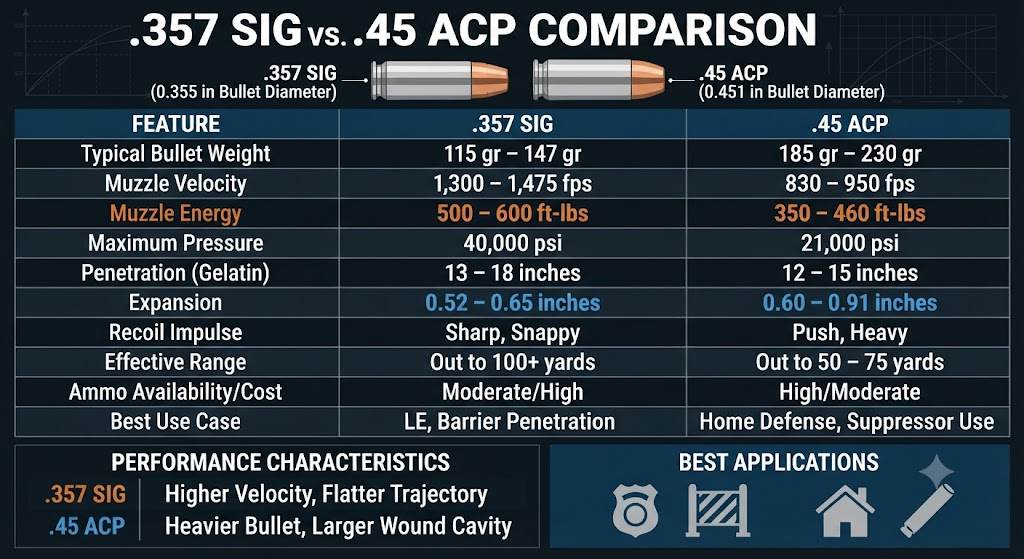
357 SIG vs 45 ACP Ballistics
The ballistic profiles of the .357 SIG and .45 ACP represent two divergent philosophies in cartridge engineering. The .357 SIG was co-developed in 1994 by SIG Sauer and Federal Cartridge to replicate the proven street performance of the classic 125-grain .357 Magnum revolver cartridge within a bottlenecked semi-automatic pistol platform.Operating at a high maximum average pressure of 40,000 psi (SAAMI), it accelerates a standard 9mm bullet diameter to rifle-like handgun velocities.
In contrast, the .45 ACP was introduced by John Browning alongside the Colt Model 1905 and adopted by the U.S. Army in 1911. Operating at a modest 21,000 psi SAAMI pressure limit, it achieves terminal effectiveness through heavy bullet mass, high sectional density, and a broad initial frontal area.
To evaluate these differences objectively, we examine representative factory loads from major manufacturers tested under standardized barrel lengths:
- Load A (.357 SIG): Federal Premium 125-grain HST Jacketed Hollow Point (JHP). Tested from a 4.5-inch Glock 31 barrel: Muzzle Velocity = 1,387 fps, Muzzle Energy = 533 ft-lbs, Gel Penetration = 18.0 inches, Expanded Diameter = 0.61 inches.
- Load B (.357 SIG): Underwood Ammo 125-grain Total Metal Jacket (TMJ). Tested from a 4-inch barrel: Muzzle Velocity = 1,475 fps, Muzzle Energy = 604 ft-lbs.
- Load C (.45 ACP): Federal Premium 230-grain HST JHP (Standard Pressure). Tested from a 4-inch to 5-inch barrel: Muzzle Velocity = 890 fps, Muzzle Energy = 404 ft-lbs, Gel Penetration = 14.5 inches, Expanded Diameter = 0.88 inches.
- Load D (.45 ACP +P): Hornady 220-grain FlexLock Critical Duty +P. Tested from a 5-inch test barrel: Muzzle Velocity = 975 fps, Muzzle Energy = 464 ft-lbs, Gel Penetration = 14.2 inches, Expanded Diameter = 0.84 inches.
Manufacturer-rated data is generally captured from universal receiver test barrels measuring 4 to 5 inches, whereas independent testing (such as chronographed real-world defensive pistol tests) frequently shows slight variations based on locking mechanisms and exact bore tolerances.
357 SIG vs 45 ACP Velocity
Velocity is the primary metric where the .357 SIG dominates the .45 ACP. The bottlenecked case of the .357 SIG allows a larger volume of high-energy pistol powder to accelerate a lighter projectile through a 4-inch or 4.5-inch barrel.
- 357 SIG Velocity Range: Standard 115-grain to 125-grain loads consistently exit a 4-inch service barrel between 1,300 and 1,475 feet per second (fps). For example, Buffalo Bore’s 125-grain JHP achieves 1,425 fps, while lightweight specialty rounds like the Cor-Pow’r Ball 100-grain load reach 1,600 fps.
- 45 ACP Velocity Range: Standard 185-grain to 230-grain loads leave a 5-inch barrel at subsonic or low trans-sonic speeds, typically ranging from 830 fps to 950 fps. Even specialized +P loadings, such as Buffalo Bore’s 185-grain JHP +P, top out around 1,150 fps.
The higher velocity of the .357 SIG provides a shorter time of flight to target, reducing the amount of lead required for moving targets and flattening trajectory curves significantly over distance.
357 SIG vs 45 ACP Muzzle Energy
Muzzle energy, calculated using bullet weight and velocity squared, heavily favors the .357 SIG when comparing service-weight defensive loads.
- 357 SIG Energy Figures:A standard Federal 125-grain load generates approximately 506 to 533 ft-lbs of muzzle energy from a duty-length barrel.High-performance boutique loads like Underwood 125-grain TMJ generate up to 604 ft-lbs.
- 45 ACP Energy Figures:A standard Federal 230-grain HST generates approximately 404 ft-lbs of muzzle energy, while standard hardball 230-grain FMJ produces roughly 350 to 365 ft-lbs. Hornady’s 220-grain Critical Duty +P elevates this figure to 464 ft-lbs, closing the gap but still falling short of standard .357 SIG energy outputs.
While high muzzle energy translates to increased kinetic work capacity, it does not substitute for appropriate bullet construction and shot placement.
357 SIG vs 45 ACP Momentum
Momentum ($p = m times v$) measures an object’s mass in motion and correlates closely with heavy target push and steel plate reactivity.
- .357 SIG Momentum: Using a 125-grain bullet traveling at 1,387 fps (Federal HST), the momentum is calculated at approximately 24.7 lb-fps.
- .45 ACP Momentum: Using a heavier 230-grain bullet traveling at 890 fps (Federal HST), the momentum is calculated at approximately 29.2 lb-fps.
Despite having lower muzzle energy, the heavy 230-grain .45 ACP bullet carries greater momentum than the lighter .357 SIG projectile. This higher momentum value accounts for the distinct, heavy push felt when firing a .45 ACP.
357 SIG vs 45 ACP Trajectory
Bullet drop calculations assume a standard sight height of 1.5 inches above the bore and a zero distance of 25 yards, which is standard for defensive handguns.
| Distance | .357 SIG (125 gr at 1,350 fps) Drop | .45 ACP (230 gr at 850 fps) Drop |
| Muzzle | -1.5 inches | -1.5 inches |
| 25 Yards | 0.0 inches (Zero) | 0.0 inches (Zero) |
| 50 Yards | -0.4 inches | -1.8 inches |
| 75 Yards | -2.1 inches | -5.6 inches |
| 100 Yards | -5.5 inches | -12.4 inches |
The .357 SIG maintains a flatter trajectory due to its high muzzle velocity and superior velocity retention downrange. Beyond 50 yards, the .45 ACP experiences marked bullet drop, requiring intentional holdovers for accurate extended-range engagements.
357 SIG vs 45 ACP Recoil
Recoil is governed by conservation of momentum, incorporating bullet weight, powder charge mass, muzzle velocity, and the reciprocating mass of the firearm.
- Recoil Energy: A standard 9mm or .357 SIG service pistol weighing 30 ounces generates roughly 5.5 to 7.0 foot-pounds of free recoil energy. A standard government-model 1911 in .45 ACP weighing 38 ounces generates roughly 4.0 to 5.5 foot-pounds of free recoil energy, though lighter polymer .45 pistols can push this higher.
- Felt Recoil Impulse: Even though the calculated recoil energy of the .357 SIG can be numerically similar to or slightly higher than a heavy .45 ACP, the nature of the recoil is fundamentally different. The .357 SIG exhibits a sharp, snappy, high-velocity whip with pronounced muzzle flip caused by high operating pressures (40,000 psi). The .45 ACP delivers a slow, heavy, linear push that many shooters find easier to manage for rapid strings of fire.
357 SIG vs 45 ACP Penetration
Independent ballistic testing in 10% ordnance gelatin and synthetic media (such as Lucky Gunner Labs testing protocols) establishes baseline terminal performance ranges.
- .357 SIG Penetration: Premium defensive loads like the Federal 125-grain HST penetrate between 16.0 and 18.0 inches in calibrated gelatin through four-layer heavy clothing barriers. The high velocity ensures that even when encountering dense muscle tissue or bone, the bullet reliably meets or exceeds the FBI standard range of 12 to 18 inches.
- .45 ACP Penetration:Standard-pressure 230-grain JHP loads (such as Federal HST or Speer Gold Dot) penetrate between 13.0 and 15.0 inches in gelatin tests. The heavier bullet punches deep while relying on its massive initial diameter rather than extreme velocity to disrupt tissue.
357 SIG vs 45 ACP Expansion
Bullet expansion dictates the size of the permanent wound channel.
- .357 SIG Expansion: Starting with a 0.355-inch projectile, premium hollow points expand to an average diameter of 0.52 to 0.61 inches (roughly 150% to 170% of original caliber size) while retaining over 95% of their initial bullet weight.
- .45 ACP Expansion: Starting with a wide 0.451-inch projectile, premium hollow points expand to an enormous 0.65 to 0.91 inches (often approaching nearly an inch across with loads like Hornady Critical Duty or Federal HST). Because the .45 ACP begins with a 0.451-inch diameter, even moderate expansion creates a permanent crush cavity substantially wider than standard small-bore calibers.
357 SIG vs 45 ACP Effective Range
- .357 SIG Effective Range: Effective out to 100 yards and beyond for trained shooters. The flat trajectory minimizes holdover requirements at intermediate distances (50 to 75 yards), making it viable for rural carry, perimeter defense, and tactical applications where shots may exceed standard room distances.
- .45 ACP Effective Range: Highly effective out to 50 yards. Beyond 50 yards, significant projectile drop and slower velocity reduce hit probability and energy retention, restricting its primary practical envelope to close-quarters self-defense.
357 SIG vs 45 ACP Self Defense
When selecting a cartridge for self-defense, practical considerations dictate performance:
- Recoil and Follow-Up Shots: The .45 ACP provides a linear recoil impulse that allows many shooters to track sights swiftly. The .357 SIG requires disciplined grip control to mitigate sharp muzzle snap and muzzle flip during rapid strings of fire.
- Platform Size and Capacity:Because the .357 SIG utilizes a case head dimension identical to the .40 S&W, pistols chambered in .357 SIG typically match the high magazine capacities and frame dimensions of compact and full-size service pistols (e.g., Glock 31, Glock 32). The .45 ACP requires wider grip frames to accommodate large cartridges, often resulting in lower overall magazine capacity in equivalent-sized handguns.
- Barrier Penetration:The .357 SIG excels at defeating intermediate barriers such as auto glass, sheet metal, and heavy timber without plugging its hollow-point cavity, a capability inherited from its magnum heritage.
357 SIG vs 45 ACP Concealed Carry
- Concealing .357 SIG: Handguns in .357 SIG are typically built on standard service frames (such as the Glock 32 compact). They offer excellent magazine capacity-to-size ratios, holding 13+1 rounds in a compact footprint, though the snappy recoil requires dedicated practice in smaller frame handguns.
- Concealing .45 ACP: Slim single-stack 1911s and modern subcompact polymer .45s (such as the Glock 30 or Glock 36) make carrying a .45 ACP practical, but standard double-stack models are thick and heavy. Ammunition weight is also higher; carrying 15 rounds of heavy .45 ACP adds significantly more belt weight than carrying 15 rounds of .357 SIG.
.357 SIG Pros and Cons
Pros
- Exceptional muzzle velocity and flat trajectory
- Superior barrier penetration through automotive glass and sheet metal
- Matches standard service-size magazine capacities (identical case head to .40 S&W)
- High energy transfer upon impact
Cons
- Sharp, snappy recoil impulse and high muzzle flip
- High ammunition cost and limited retail availability compared to 9mm or .45 ACP
- Accelerated wear on firearm recoil springs, locking blocks, and frame rails due to high operating pressures (40,000 psi)
- Muzzle blast and flash are pronounced in short barrels
.45 ACP Pros and Cons
Pros
- Massive initial bullet diameter creates a large permanent wound channel without relying on extreme velocity
- Manageable, linear push recoil impulse that facilitates rapid sight recovery
- Historically proven track record in close-quarters combat and law enforcement
- Subsonic design makes standard-pressure loads ideal for use with firearm suppressors
Cons
- Looping trajectory with notable bullet drop past 50 yards
- Thicker grip frames and lower magazine capacity in standard handguns
- Lower velocity reduces the likelihood of extreme hollow-point expansion in low-velocity compact barrels
- Heavier weight for ammunition supply during carry
Which Has More Stopping Power: 357 SIG or 45 ACP?
“Stopping power” is not a single scientifically established measurement, nor do terminal ballistics guarantee an immediate physiological incapacitation. Practical terminal performance depends on shot placement, gelatin penetration depth (12 to 18 inches), bullet expansion, bullet construction, velocity, and initial bullet diameter.
The .357 SIG achieves its terminal effect through high velocity, deep barrier-penetrating capability, and dependable energy spikes. The .45 ACP achieves its terminal effect through a massive initial frontal diameter and wide permanent crush cavity. Neither cartridge guarantees a one-shot stop. Evidence-based evaluation shows that both calibers are fully capable of stopping a threat when delivered with accurate shot placement, utilizing entirely different physical mechanisms to accomplish the task.
Which Is More Powerful: 357 SIG or 45 ACP?
Power, defined quantitatively via muzzle energy and velocity, heavily favors the .357 SIG. Generating 500 to 600 ft-lbs of muzzle energy at velocities exceeding 1,350 fps, the .357 SIG outperforms the .45 ACP in sheer kinetic energy output. However, if power is defined by bullet momentum and mass, the .45 ACP holds an advantage.
Final Comparison
| Category | Winner | Reason |
| Velocity | .357 SIG | Operates at 40,000 psi to drive lightweight bullets over 1,400 fps |
| Muzzle Energy | .357 SIG | Consistently delivers 500–600 ft-lbs from standard service barrels |
| Momentum | .45 ACP | Heavy 230-grain bullets carry superior linear momentum |
| Penetration | .357 SIG | High velocity ensures deep, reliable penetration through tough barriers |
| Expansion | .45 ACP | Massive starting diameter (0.451 in) yields wider expanded profiles |
| Trajectory | .357 SIG | Flatter shooting curve requires less holdover at extended distances |
| Bullet Drop | .357 SIG | Retains velocity better, exhibiting significantly less drop past 50 yards |
| Recoil | .45 ACP | Linear push recoil is generally softer and easier to control than snappy .357 flip |
| Effective Range | .357 SIG | Reliable ballistics out to 100+ yards |
| Self Defense | Depends on Load | .357 SIG for barrier defeat; .45 ACP for wide crush cavity and soft recoil |
| Concealed Carry | .357 SIG | Higher magazine capacity in compact service frames |
| Ammo Cost | .45 ACP | Mass-produced in larger quantities globally, lowering average cost |
| Ammo Availability | .45 ACP | Found in virtually every sporting goods store and gun shop |
| Overall Performance | Depends on Load | .357 SIG wins on velocity and range; .45 ACP wins on mass and shootability |
357 SIG vs 45 ACP: Which Should You Choose?
Selecting between the .357 SIG and .45 ACP requires balancing ballistic priorities with practical weapon handling.
- Choose the .357 SIG if you prioritize maximum muzzle velocity, flat trajectory out to 100 yards, superior barrier-penetrating capability, and higher magazine capacity in a standard service-sized pistol frame.
- Choose the .45 ACP if you prefer a large-diameter projectile, a manageable linear recoil impulse, excellent suppression capability, and widespread ammunition availability.
Neither round represents a universal winner; rather, they serve distinct operational philosophies that reward the shooter willing to train with their specific mechanical characteristics.
FAQs
Is .357 SIG more powerful than .45 ACP?
Yes, in terms of muzzle velocity and kinetic energy, the .357 SIG generates higher numerical values (500–600 ft-lbs vs. 350–460 ft-lbs).
Which has more muzzle energy?
The .357 SIG has more muzzle energy when comparing standard factory service loads.
Which has more stopping power?
Neither cartridge possesses magical stopping power. Terminal performance depends entirely on shot placement, adequate penetration (12–18 inches), and reliable expansion.
Which has more recoil?
The .357 SIG produces a sharper, snappier recoil impulse with higher muzzle flip, while the .45 ACP produces a heavier, linear push. Felt recoil depends heavily on the weight and design of the host firearm.
Which has better penetration?
The .357 SIG typically penetrates deeper (16–18 inches) in ballistic gelatin due to its high velocity, while standard .45 ACP hovers between 13 and 15 inches.
Which expands more?
The .45 ACP expands to a wider final diameter (often 0.75 to 0.90 inches) because it starts with a much larger 0.451-inch bullet diameter.
Which has a flatter trajectory?
The .357 SIG has a significantly flatter trajectory, dropping much less over 50 to 100 yards due to its high velocity.
Which is better for self defense?
Both are exceptional self-defense calibers. The .357 SIG excels in velocity, barrier penetration, and trajectory, whereas the .45 ACP excels in large initial bullet diameter and soft linear recoil.
Which is better for concealed carry?
The .357 SIG offers higher magazine capacity in compact handguns, while the .45 ACP offers single-stack slimness in specialized carry pistols.
Is .357 SIG faster than .45 ACP?
Yes, .357 SIG bullets travel roughly 400 to 500 fps faster than standard .45 ACP loads from equivalent barrel lengths.
Is .45 ACP stronger than .357 SIG?
In terms of bullet mass, momentum, and initial diameter, the .45 ACP is “stronger”, but in terms of velocity and energy, the .357 SIG outclasses it.
Which is cheaper to shoot?
The .45 ACP is generally less expensive and far more widely available at retail outlets than the specialty .357 SIG cartridge.
Which has better ballistics?
The .357 SIG features superior velocity, energy retention, and trajectory, whereas the .45 ACP features superior frontal diameter and sectional mass.
Which is easier to shoot?
Most shooters find the .45 ACP easier to shoot accurately under rapid fire due to its softer, linear push recoil compared to the snappy whip of the .357 SIG.
Which should you choose?
Choose the .357 SIG for velocity, flat trajectory, and barrier penetration, or choose the .45 ACP for heavy bullet mass, wide wound channels, and manageable recoil.