The main difference between the 9mm and the 44 Magnum is their intended application, power scale, and platform design. The 9mm is a high-capacity, moderate-pressure semi-automatic handgun cartridge designed for concealable self-defense, high-volume law enforcement, and military duty use, while the 44 Magnum is an ultra-powerful, high-pressure magnum cartridge engineered primarily for heavy-framed revolvers and carbines to deliver devastating terminal ballistics for big-game hunting and dangerous wilderness defense.
9mm vs 44 Magnum Comparison Table
To accurately compare these two wildly different pistol cartridges, we must examine their physical dimensions, pressure limits, and baseline ballistic performance. The data below represents standard premium factory loads, comparing a standard 115-grain full metal jacket load for the 9mm against a heavy 240-grain hollow point hunting load for the 44 Magnum fired from standard handgun barrels.
| Specification | 9mm (9x19mm Parabellum) | 44 Magnum |
| Cartridge Type | Semi-Automatic Handgun | Revolver / Carbine Magnum |
| Parent Case | 9mm Borchardt (1902) | .44 Special (Lengthened, 1955) |
| Bullet Diameter | .355 inches (9.0 mm) | .429 inches (10.9 mm) |
| Case Length | 0.754 inches | 1.285 inches |
| Overall Length | 1.169 inches | 1.610 inches |
| Typical Bullet Weights | 115 grains to 147 grains | 180 grains to 300+ grains |
| Muzzle Velocity (Handgun bbl) | 1,180 fps (115gr Standard) | 1,450 fps (240gr JHP out of 6″ bbl) |
| Muzzle Energy (Handgun bbl) | 356 foot-pounds | 1,121 foot-pounds |
| Maximum Pressure | 35,000 psi (SAAMI) | 36,000 psi (SAAMI) |
| Effective Range | 50 yards | 100 to 150 yards |
| Trajectory | Flat | Arced (Flat for a magnum) |
| Bullet Drop (50 yds) | Approximately 2.0 inches | Approximately 1.0 inches |
| Wind Drift | Moderate | Moderate |
| Recoil | Mild (Approx. 4 to 5 foot-pounds) | Heavy / Brutal (Approx. 15 to 20+ foot-pounds) |
| Platform Compatibility | Semi-automatic pistols, PCCs | Double-action revolvers, lever-action rifles |
| Magazine Compatibility | Double-stack box magazines | Tubular magazines or revolver cylinders |
| Suppressor Performance | Elite (Naturally subsonic with 147gr) | Good |
| Short Barrel Performance | Excellent powder burn | Moderate velocity loss and massive fireball |
| Accuracy | High | High |
| Penetration | Moderate to Deep (FBI protocol compliant) | Extreme (Deep bone-crushing penetration) |
| Expansion | Reliable with modern hollow points | Devastating on large game |
| Hunting Performance | Marginal (Small game / emergency only) | Elite (Deer, hogs, black bear, elk) |
| Home Defense | Elite (High capacity, low over-penetration risk) | Not Recommended (Excessive power and wall penetration) |
| Tactical Use | Global Military and Police Standard | None |
| Ammunition Cost | Very Low | High |
| Ammo Availability | Ubiquitous | Good |
| Best Uses | Concealed carry, home defense, duty use | Big-game hunting, wilderness protection against predators |
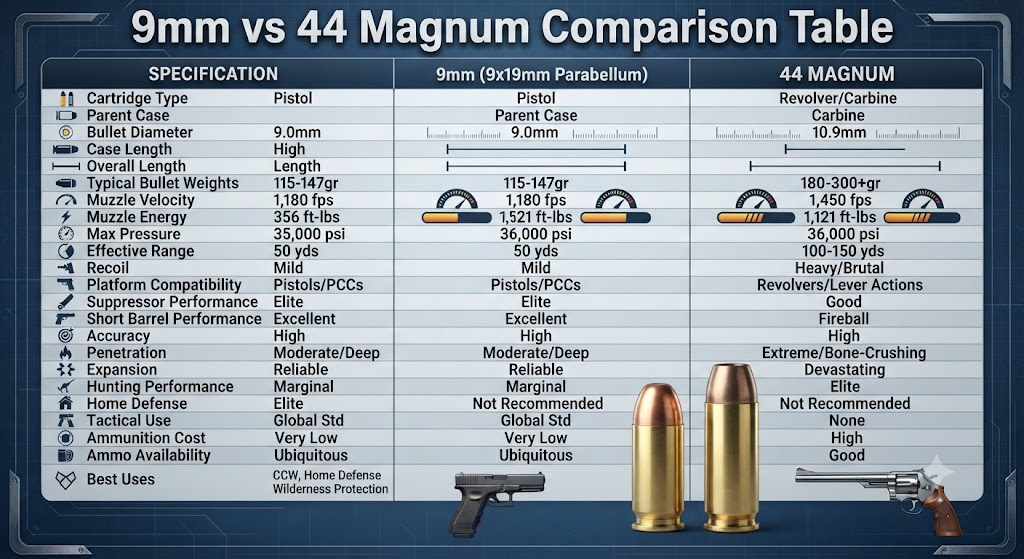
Understanding the Engineering
The technical differences between these cartridges represent two distinct philosophies of hand-held ballistics.
The 9mm was designed by Georg Luger in 1901. It uses a short, tapered, rimless case operating at a modern high pressure limit of 35,000 psi. This high operating pressure allows the tiny case to generate lethal velocities while remaining compact enough to stack in high-capacity, double-column magazines inside lightweight, concealable semi-automatic pistols.
The 44 Magnum was introduced in 1955 by Elmer Keith, Remington, and Smith & Wesson. Keith discovered that by lengthening the old .44 Special case and loading it with heavy charges of slow-burning powder, he could achieve rifle-like velocities out of a heavy revolver. Operating at an identical 36,000 psi pressure ceiling, the 44 Magnum requires a massive, heavy-framed steel revolver to safely absorb the extreme recoil forces without shaking itself apart.
Velocity Comparison
Velocity dictates the trajectory flatness and terminal performance of a projectile.
When fired from standard handguns, the 44 Magnum holds a massive speed advantage. A heavy 240-grain 44 Magnum hunting bullet leaves a 6-inch revolver barrel at approximately 1,450 feet per second.
A standard 115-grain 9mm bullet leaves a 4-inch pistol barrel at roughly 1,180 feet per second. While the 9mm is fast for a compact defensive round, the 44 Magnum drives a bullet that is more than twice as heavy at significantly higher speeds.
Muzzle Energy Comparison
Muzzle energy measures the absolute kinetic force transferred to a target upon impact.
This is where the 44 Magnum operates in an entirely different league. A standard 44 Magnum load generates a staggering 1,121 foot-pounds of muzzle energy out of a handgun barrel.
A standard 9mm generates roughly 356 foot-pounds of energy. The 44 Magnum delivers more than triple the raw kinetic power of the 9mm, approaching the energy output of intermediate rifle cartridges.
Trajectory Comparison
A flat trajectory makes hitting targets at unknown distances much easier.
Because the 44 Magnum drives a heavy bullet at 1,450 feet per second, it shoots exceptionally flat out to 100 yards, making it a legitimate handgun hunting caliber for distant targets. The 9mm is optimized strictly for close-quarters engagements, experiencing a rapid drop past 50 yards.
Recoil Comparison
Recoil directly dictates a shooter’s ability to fire rapid, accurate follow-up shots.
The 9mm generates a mild, snappy recoil impulse that is easily managed by shooters of all sizes, allowing for rapid strings of accurate fire.
The 44 Magnum produces heavy, punishing recoil. In a standard-weight steel revolver, it generates roughly 15 to 20+ foot-pounds of free recoil, producing a violent upward muzzle flip that requires strong grip fundamentals and practice to control.
Stopping Power and Penetration
For defense or hunting, penetration and tissue disruption determine effectiveness.
The 9mm relies on modern jacketed hollow-point bullets that expand reliably within human soft tissue, meeting strict FBI penetration standards (12 to 18 inches) while minimizing the risk of over-penetration in a home defense scenario.
The 44 Magnum offers extreme, bone-crushing penetration. It is designed to punch straight through the heavy shoulder blades and thick hide of large game like wild hogs or black bears, delivering deep tissue disruption that stops heavy animals instantly.
Platform and Capacity
The 9mm is exclusively a semi-automatic cartridge. It feeds from detachable box magazines holding anywhere from 10 to 30+ rounds, offering massive defensive firepower.
The 44 Magnum is primarily a revolver cartridge (holding 5 to 6 rounds in a cylinder) or fed via tubular magazines in lever-action carbines, offering significantly lower ammunition capacity.
Pros and Cons
9mm
Pros
- High magazine capacity in compact, concealable pistols.
- Mild, manageable recoil for rapid and accurate follow-up shots.
- Universally available ammunition at very low cost.
- Elite home defense choice with minimal risk of dangerous over-penetration.
- Global military and law enforcement standard.
Cons
- Lacks the kinetic energy and mass required for big-game hunting or heavy predator defense.
- Marginally lower stopping power against large dangerous animals compared to heavy magnums.
44 Magnum
Pros
- Devastating stopping power and deep penetration for large game and dangerous predators.
- Flat-shooting trajectory out to 100+ yards from revolvers and carbines.
- Excellent handgun hunting cartridge for deer, hogs, and black bears.
- Can chamber and fire lower-recoiling .44 Special ammunition for practice.
Cons
- Heavy, punishing recoil makes rapid follow-up shots difficult for beginners.
- Ammunition is expensive and significantly heavier to carry.
- Low ammunition capacity (typically 5 to 6 rounds in revolvers).
- Terrible choice for indoor home defense due to extreme muzzle blast and over-penetration.
Final Verdict
Choosing between the 9mm and the 44 Magnum comes down to your primary environment: civilized self-defense or deep-wilderness protection.
- For Concealed Carry and Home Defense: Choose the 9mm. Its high capacity, manageable recoil, cheap practice ammunition, and safe penetration profiles make it the undisputed king of personal defense.
- For Wilderness Defense and Handgun Hunting: Choose the 44 Magnum. If you are venturing into bear country or want to harvest big game with a handgun, the massive kinetic energy and deep bone-crushing penetration of the 44 Magnum are mandatory.
FAQ
Is the 44 Magnum more powerful than the 9mm?
Yes, overwhelmingly so. The 44 Magnum generates over 1,100 foot-pounds of muzzle energy, whereas the 9mm generates about 350 foot-pounds. The 44 Magnum delivers more than three times the kinetic energy of the 9mm.
Can I shoot 44 Magnum in a 9mm pistol?
Absolutely not. The physical dimensions are entirely incompatible. Attempting to force a 44 Magnum cartridge into a 9mm firearm is impossible, and attempting to fire it would result in a catastrophic explosion.
Is the 9mm good for bear defense?
While any gun is better than no gun, the 9mm is widely considered inadequate for protection against large, aggressive bears. Its low energy and limited penetration pale in comparison to dedicated wilderness magnums like the 44 Magnum.
Can I shoot .44 Special in a 44 Magnum revolver?
Yes. Every standard 44 Magnum revolver or lever-action rifle can safely chamber and fire the shorter, lower-pressure .44 Special cartridge, making it an excellent, low-recoil way to practice at the range.