The main difference between the 300 prc and the 338 win mag is their underlying ballistic philosophy and effective range. The 300 prc is a modern precision cartridge designed to push incredibly long, highly aerodynamic .30 caliber bullets to extreme distances for target shooting and long range hunting, while the 338 win mag is a classic belted magnum designed to deliver massive kinetic energy and deep penetration with wider, heavier bullets on the largest North American big game at traditional hunting distances.
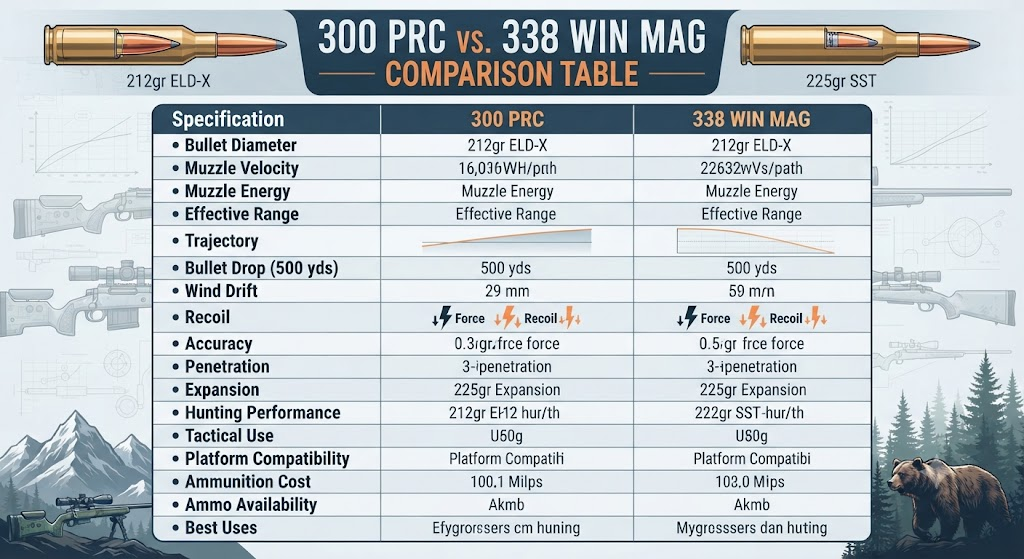
300 prc vs 338 win mag Comparison Table
To accurately compare these two powerhouse magnum rifle cartridges, we must examine their physical dimensions, pressure limits, and baseline ballistic performance. The data below represents standard premium factory loads. For the 300 prc, we reference the Hornady 212 grain ELD-X Precision Hunter. For the 338 win mag, we reference a standard 225 grain Hornady SST Superformance load.
| Specification | 300 prc | 338 win mag |
| Cartridge Type | Centerfire Rifle | Centerfire Rifle |
| Parent Case | .375 Ruger | .375 H&H Magnum |
| Bullet Diameter | .308 inches (7.62 mm) | .338 inches (8.6 mm) |
| Case Length | 2.580 inches | 2.500 inches |
| Overall Length | 3.700 inches | 3.340 inches |
| Typical Bullet Weights | 212 grains to 225 grains | 200 grains to 250 grains |
| Muzzle Velocity (24 inch bbl) | 2,860 fps (212gr ELD-X) | 2,800 fps (225gr SST) |
| Muzzle Energy (24 inch bbl) | 3,850 foot pounds | 3,918 foot pounds |
| Maximum Pressure | 65,000 psi (SAAMI) | 64,000 psi (SAAMI) |
| Effective Range | 1,500+ yards | 600 to 800 yards |
| Trajectory | Extremely Flat | Flat (Inside 400 yds) |
| Bullet Drop (500 yds) | Approximately 35 inches | Approximately 41 inches |
| Wind Drift | Exceptionally Low (High BC) | Moderate |
| Recoil | Heavy (Approx. 30 foot pounds) | Heavy (Approx. 35 foot pounds) |
| Barrel Length Performance | Excels in 24 to 26 inch barrels | Excels in 22 to 24 inch barrels |
| Suppressor Performance | Good | Good |
| Short Barrel Performance | Massive velocity loss | Moderate velocity loss |
| Accuracy | Elite (Match grade potential) | High |
| Penetration | Deep | Extreme (Heavy mass) |
| Expansion | Reliable at extreme distances | Devastating |
| Hunting Performance | Elite (Elk, moose, sheep at long range) | Elite (Grizzly, moose, elk in heavy timber) |
| Tactical Use | Extreme Long Range Sniper | Limited Special Operations |
| Platform Compatibility | Magnum Length Bolt Action | Standard Long Action Bolt Rifle |
| Ammunition Cost | High | High |
| Ammo Availability | Specialty or Online | Good |
| Best Uses | Precision rifle competition, open country hunting | Dangerous game, large heavy boned animals |
Understanding the Engineering
The technical differences between these cartridges highlight the evolution of modern rifle chamber design.
The 338 win mag was introduced by Winchester in 1958. It is a traditional belted magnum based on a shortened .375 H&H case. The belt at the base of the cartridge was originally designed to control headspace. Winchester intentionally designed the cartridge with an overall length of 3.340 inches so it would fit perfectly into standard standard long action rifles like the Winchester Model 70. It quickly became the gold standard for hunting Alaskan moose and brown bears.
The 300 prc (Precision Rifle Cartridge) was developed by Hornady in 2018. Hornady eliminated the obsolete belt and used the .375 Ruger parent case. The genius of the 300 prc lies in its overall length. Measuring 3.700 inches, the cartridge requires a specialized magnum length action. This extra room allows manufacturers to seat massive, incredibly long, high ballistic coefficient bullets entirely outside of the powder column. This maximizes powder capacity and ensures the bullet perfectly engages the rifling for elite accuracy.
Velocity Comparison
Velocity dictates the trajectory flatness and the reliable expansion of hunting bullets at extended ranges.
When examining premium hunting ammunition, both cartridges are remarkably fast for their size. The 300 prc pushes a 212 grain bullet at approximately 2,860 feet per second. The 338 win mag pushes a slightly heavier 225 grain bullet at roughly 2,800 feet per second. At the muzzle, their speeds are nearly identical.
However, because the 300 prc fires a highly aerodynamic bullet, it retains its velocity much more efficiently. At 500 yards, the 300 prc is traveling significantly faster than the blunt 338 win mag bullet.
Muzzle Energy Comparison
Muzzle energy measures the absolute kinetic force transferred to a target upon impact.
Both of these cartridges are absolute sledgehammers. The 338 win mag generates approximately 3,918 foot pounds of kinetic energy at the muzzle. The 300 prc generates roughly 3,850 foot pounds.
Inside 300 yards, the 338 win mag hits with slightly more raw authority due to its wider diameter and heavy bullet mass. However, once the bullets pass the 500 yard mark, the superior aerodynamics of the 300 prc allow it to retain vastly more energy than the rapid shedding 338 win mag.
Trajectory Comparison
A flat trajectory minimizes the margin of error when estimating range for a hunter in the field.
Because both cartridges start at similar velocities, their trajectories are very comparable inside 300 yards. They both shoot impressively flat for large magnum calibers. As distances increase, the 300 prc pulls away dramatically. The sleek, needle like .30 caliber bullets of the PRC cheat gravity and air resistance far better than the traditional hunting bullets used in the 338 win mag.
Bullet Drop Comparison
Assuming a standard 100 yard zero for both rifles, the mathematical bullet drop illustrates the superior long range reach of the modern PRC cartridge.
At 500 yards, the 300 prc drops roughly 35 inches. The 338 win mag drops approximately 41 inches.
At 1,000 yards, the gap becomes massive. The 300 prc requires roughly 240 inches of vertical adjustment, while the 338 win mag drops over 320 inches and drops into transonic speeds, making it wildly unpredictable.
Wind Drift Comparison
Wind deflection is the absolute greatest enemy of the precision shooter. Wind drift is mitigated strictly by a bullet’s velocity and its aerodynamic profile.
This is the exact category the 300 prc was engineered to dominate. The 212 grain ELD-X bullet has a phenomenal G1 Ballistic Coefficient of .673. The traditional 225 grain SST bullet in the 338 win mag has a G1 Ballistic Coefficient of .515.
At 500 yards in a 10 mph crosswind, the heavy, sleek 300 prc bullet will drift noticeably less than the wider 338 win mag projectile. For hunters facing unpredictable mountain crosswinds across wide canyons, the 300 prc provides a massive margin of error advantage.
Recoil Comparison
Recoil dictates a shooter’s ability to spot their own impacts through a rifle scope and heavily influences shooter fatigue.
Neither of these cartridges is pleasant to shoot without a muzzle brake. They are both heavy hitting magnums. The 338 win mag typically generates about 35 foot pounds of free recoil in a standard weight hunting rifle. The 300 prc generates roughly 30 foot pounds.
The 338 win mag produces a heavy, violent shove. The 300 prc is slightly more manageable, but both strongly require a heavy rifle, a quality recoil pad, or a mechanical muzzle device to shoot comfortably for extended periods.
Stopping Power Comparison
Stopping power on big game requires massive energy transfer and deep tissue disruption.
The 300 prc delivers elite stopping power on elk, moose, and sheep at extreme distances. The high velocity hydrostatic shock creates massive internal trauma.
The 338 win mag is legendary for its stopping power on dangerous game. The larger .338 diameter bullet expands wider and crushes a massive permanent wound channel. For stopping a charging grizzly bear or dropping a massive bull moose in thick timber, the 338 win mag is considered by many Alaskan guides to be the ultimate insurance policy.
Penetration Comparison
Penetration is critical for ensuring the bullet reaches the vital organs of heavily muscled animals on quartering angles.
Both cartridges offer extreme penetration. The heavy .338 caliber bullets are famous for punching straight through heavy shoulder bones and exiting the other side of large animals. The 300 prc utilizes long bullets with massive sectional density, allowing them to plow deeply into soft tissue. For the absolute heaviest bone crushing requirements, the 338 win mag holds a slight practical edge.
Expansion Comparison
To accurately test bullet expansion, the ballistics industry relies on calibrated ordinance gel.
The 338 win mag utilizes traditional soft point or bonded hunting bullets that mushroom violently upon high velocity impact. Because it sheds velocity quickly, these bullets can sometimes fail to expand if the target is past 600 yards.
The 300 prc is frequently loaded with modern polymer tipped match hunting bullets. Because the cartridge retains its velocity so well, these bullets will reliably force their expansion cavities open at distances far exceeding the capabilities of traditional 338 win mag ammunition.
Accuracy Comparison
Both cartridges are capable of elite mechanical accuracy, but the 300 prc holds a distinct design advantage.
The 338 win mag is a belted cartridge with a short neck, which can sometimes lead to slight concentricity issues during chambering. It is highly accurate for hunting, but it is rarely used in precision benchrest competitions.
The 300 prc was designed with a beltless case, a perfectly angled shoulder, and strict chamber tolerances. It inherently aligns the bullet perfectly with the bore. Off the shelf rifles chambered in 300 prc routinely shoot tiny, sub MOA groups at 1,000 yards.
Effective Range Comparison
The effective range of a magnum rifle is limited by bullet drop, wind deflection, and retained energy.
The 338 win mag is a highly effective 600 to 800 yard hunting cartridge. Beyond that distance, the bullet sheds energy rapidly and wind drift becomes very difficult to manage.
The 300 prc is a proven 1,500 yard target cartridge. For hunting, a skilled marksman can ethically harvest large game past 800 yards with perfect wind calls and accurate rangefinders, as the bullet retains well over 1,500 foot pounds of energy at that distance.
Suppressor Performance Comparison
Both cartridges are strictly supersonic and push immense volumes of expanding powder gases. Adding a large volume titanium suppressor will tame the concussive blast and significantly reduce the heavy recoil. However, neither cartridge can be made completely silent. The supersonic crack of the massive bullets breaking the sound barrier will always remain loud.
Short Barrel Performance Comparison
Neither cartridge is designed for short barrels. They both require massive columns of slow burning magnum powder to achieve their advertised velocities.
If you cut a 338 win mag or a 300 prc barrel down to 18 or 20 inches, a massive amount of unburnt powder blasts out of the muzzle. This results in severe velocity loss, a blinding fireball, and a deafening concussive blast. They both require a minimum of 22 to 24 inches of barrel steel to function as designed, with 26 inches being optimal for the 300 prc.
Platform Compatibility
This is a massive logistical difference between the two cartridges.
The 338 win mag fits perfectly into a standard long action bolt rifle. This is the same action length used for the .30-06 Springfield or the .300 Winchester Magnum. This makes finding compatible rifle chassis and components incredibly easy.
The 300 prc requires a specialized magnum length action to accommodate its massive 3.700 inch overall length. If you attempt to force a 300 prc into a standard long action, the incredibly long bullets will not fit inside the magazine box.
Ammo Cost Comparison
To become proficient with a magnum rifle, you must practice frequently.
Neither cartridge is cheap to shoot. They both require massive amounts of raw brass, heavy bullets, and large powder charges to manufacture. Standard practice ammunition for both calibers is typically priced at a premium, often costing three to four dollars per round.
Ammo Availability Comparison
Walk into any hunting lodge in Alaska or rural hardware store in the American West, and you will almost certainly find boxes of 338 win mag sitting on the shelf. It has been a staple of North American hunting since 1958.
The 300 prc is a modern specialty cartridge. While it has gained massive popularity, it is still primarily found at large sporting goods retailers or through specialized online ammunition vendors. It is not as universally stocked as the classic Winchester magnum.
Reloading Comparison
Both cartridges are absolute favorites in the precision reloading community.
The 338 win mag is straightforward to reload, with decades of proven load data available. However, handloaders must be careful not to overwork the brass just above the belt to prevent case separation.
The 300 prc is a handloader’s dream for extreme long range precision. The beltless case headspaces off the shoulder perfectly, and the market is flooded with high quality brass and the most aerodynamic .30 caliber bullets ever designed.
Pros and Cons
300 prc
Pros
- Exceptionally high Ballistic Coefficient bullets defeat wind drift.
- Elite stopping power and deep penetration at extreme long ranges.
- Modern beltless case design provides supreme inherent accuracy.
- Heavy bullets are seated completely outside the powder column.
Cons
- Requires a specialized, extra long magnum rifle action.
- Ammunition is expensive and sometimes difficult to find locally.
- Overkill for hunting medium game at standard distances.
338 win mag
Pros
- Legendary stopping power on dangerous and heavy boned game.
- Massive bullet diameter crushes wide, permanent wound channels.
- Fits perfectly into standard long action hunting rifles.
- Ammunition is universally available in big game hunting regions.
Cons
- Generates heavy, punishing recoil.
- Traditional bullet designs shed velocity and energy rapidly past 600 yards.
- Belted case design can slightly hinder reloading longevity.
Final Verdict
Choosing between the 300 prc and the 338 win mag comes down to deciding whether you need modern extreme long range precision or classic heavy timber knockdown power.
- For the Extreme Long Range Hunter: Choose the 300 prc. It provides the blistering retained velocity and aerodynamic efficiency necessary to anchor elk and sheep across wide open canyons where the wind would blow a traditional bullet entirely off target.
- For Alaskan Dangerous Game: Choose the 338 win mag. There is no substitute for heavy frontal area. The massive .338 caliber bullet delivers the kinetic energy and deep penetration required to stop a charging grizzly bear or anchor a moose instantly.
- For the Precision Rifle Competitor: Choose the 300 prc. The modern chamber design, strict tolerances, and beltless case make it an inherently superior cartridge for ringing steel targets at 1,500 yards.
- For the Traditional Elk Hunter: Choose the 338 win mag. If your typical shots are inside 400 yards in the dark timber, the 338 win mag provides absolute certainty and immense blood trails, and ammunition can be found in practically any rural hunting town.
FAQ
Is the 338 win mag more powerful than the 300 prc?
At the muzzle, the 338 win mag is slightly more powerful, generating nearly 4,000 foot pounds of kinetic energy due to its massive bullet diameter and weight. However, because the 300 prc utilizes much more aerodynamic bullets, it retains its energy far better. By the time the bullets reach 500 yards, the 300 prc is hitting with significantly more kinetic energy than the 338 win mag.
Can I shoot a 300 prc in a 300 win mag rifle?
Absolutely not. The chamber dimensions are entirely different. The 300 prc uses a wider, beltless case and is significantly longer. Attempting to force a 300 prc cartridge into a 300 win mag chamber is impossible, and attempting to fire it would result in a catastrophic firearm failure.
Why did Hornady create the 300 prc?
Hornady created the 300 prc to fix the design flaws of older .30 caliber magnums like the .300 Winchester Magnum. Older magnums force manufacturers to seat long, modern bullets deeply into the powder column to fit inside standard length magazines. The 300 prc uses a longer action, allowing those massive bullets to sit forward, maximizing powder capacity and chamber alignment.
Does the 338 win mag kick hard?
Yes. Firing a heavy 225 or 250 grain bullet out of a standard weight hunting rifle generates a very heavy recoil impulse. It produces roughly 35 foot pounds of free recoil, which is a sharp, heavy blow to the shoulder that requires strong shooting fundamentals or a muzzle brake to manage comfortably.