The main difference between the .17 HM2 (Mach 2) and the .17 HMR is that the .17 HMR is based on the longer .22 WMR case to provide maximum rimfire velocity and an effective hunting range out to 200 yards, while the .17 HM2 is based on the shorter .22 LR (Stinger) case, offering a cheaper, quieter, and highly accurate alternative that easily fits into standard .22 LR length actions for precise pest control inside 125 yards.
.17 HM2 vs .17 HMR Comparison Table
To accurately compare these two highly specialized rimfire cartridges, we must examine their physical dimensions and baseline ballistic performance. The data below represents standard premium factory loads, comparing the 17-grain V-MAX load for the .17 HMR against the 17-grain V-MAX load for the .17 HM2 fired from standard rifle barrels.
| Specification | .17 HMR (Hornady Magnum Rimfire) | .17 HM2 (Mach 2) |
| Cartridge Type | Rimfire Rifle | Rimfire Rifle |
| Parent Case | .22 WMR (.22 Magnum) | .22 LR (CCI Stinger case) |
| Bullet Diameter | .172 inches (4.37 mm) | .172 inches (4.37 mm) |
| Case Length | 1.058 inches | 0.714 inches |
| Overall Length | 1.349 inches | 1.000 inches |
| Typical Bullet Weights | 15 grains to 20 grains | 15 grains to 17 grains |
| Muzzle Velocity (Rifle bbl) | 2,550 fps (17gr V-MAX) | 2,100 fps (17gr V-MAX) |
| Muzzle Energy (Rifle bbl) | 245 foot-pounds | 166 foot-pounds |
| Maximum Pressure | 26,000 psi (SAAMI) | 24,000 psi (SAAMI) |
| Effective Range | 150 to 200 yards | 100 to 125 yards |
| Trajectory | Flat | Flat (Inside 100 yds) |
| Bullet Drop (150 yds) | Approx. 2.6 inches | Approx. 4.5 inches |
| Wind Drift | High (Ultra-lightweight bullet) | Very High (Slower velocity) |
| Recoil | Practically Zero | Practically Zero |
| Barrel Length Performance | Excels in 18 to 20-inch barrels | Excels in 16 to 18-inch barrels |
| Suppressor Performance | Good | Good |
| Accuracy | High (Exceptional for rimfire) | High (Exceptional for rimfire) |
| Penetration | Shallow (Explosive fragmentation) | Shallow (Explosive fragmentation) |
| Expansion | Devastating on tiny game | Highly Reliable |
| Hunting Performance | Elite (Prairie dogs, woodchucks) | Elite (Squirrels, small pests) |
| Home Defense | Not Recommended | Not Recommended |
| Action Size | Magnum Rimfire Action | Standard .22 LR Action |
| Ammunition Cost | Moderate (For rimfire) | Low to Moderate |
| Ammo Availability | Ubiquitous | Specialty / Rare |
| Reloading | No (Rimfire cannot be reloaded) | No (Rimfire cannot be reloaded) |
| Best Uses | High-volume long-range pest control | Short-range precision squirrel hunting |
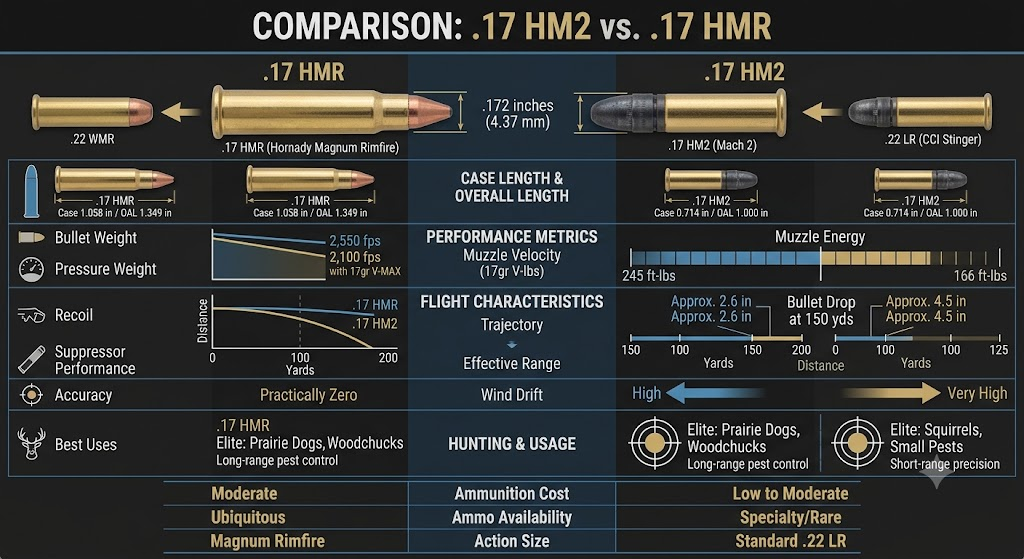
Understanding the Numbers
The technical differences between these cartridges reflect two different approaches to modernizing the rimfire platform.
Hornady introduced the .17 HMR in 2002 by necking down the powerful .22 WMR (.22 Magnum) case to accept a tiny .172 caliber bullet. The goal was to create the fastest, flattest-shooting rimfire cartridge possible. It was a massive commercial success, offering explosive terminal ballistics on pests out to 200 yards.
Following that success, Hornady introduced the .17 HM2 (Mach 2) in 2004. Instead of using the magnum case, they necked down the slightly longer .22 Long Rifle CCI Stinger case. The genius of this design was that the overall length (1.000 inches) perfectly matched a standard .22 LR cartridge. This meant that firearms manufacturers could convert their existing, highly popular .22 LR rifles to .17 HM2 with a simple barrel swap, without needing to re-engineer the entire action or magazine system for the longer magnum length.
Velocity Comparison
Velocity is the primary mechanism that allows these tiny bullets to perform effectively.
When firing identical 17-grain polymer-tipped bullets, the .17 HMR holds a distinct advantage. Pushing the bullet with the larger magnum powder charge, the .17 HMR leaves the muzzle at approximately 2,550 feet per second.
The .17 HM2, utilizing the smaller .22 LR parent case, pushes the same 17-grain bullet at roughly 2,100 feet per second. While 450 fps slower than its bigger brother, the HM2 still safely exceeds the speed of sound and travels substantially faster than practically any standard .22 LR load on the market.
Muzzle Energy Comparison
Muzzle energy dictates the kinetic force the bullet strikes with upon impact.
Because kinetic energy relies heavily on velocity, the .17 HMR generates significantly more raw power. The 17-grain .17 HMR generates 245 foot-pounds of energy at the muzzle. The .17 HM2 generates 166 foot-pounds of energy.
Against tiny game like ground squirrels, this energy difference is largely irrelevant—both will dispatch the animal instantly. However, on slightly larger pests like heavy woodchucks or close-range coyotes, the extra 80 foot-pounds of the .17 HMR provides a crucial margin of ethical lethality.
Trajectory Comparison
A flat trajectory minimizes the need for drastic holdover adjustments in the field, which is critical when aiming at microscopic targets like a squirrel’s head.
Because both cartridges fire the exact same aerodynamic .172 caliber bullets, velocity is the only determining factor for their trajectories. The .17 HMR shoots noticeably flatter past 100 yards because it reaches the target much faster, giving gravity less time to act on the projectile.
Inside 100 yards, both cartridges shoot incredibly flat, requiring almost no holdover adjustments from a standard 50-yard zero.
Bullet Drop Comparison
Assuming a 50-yard zero for both rifles, the mathematical bullet drop out to 150 yards illustrates where the .17 HM2 begins to lose its mechanical advantage.
- 100 Yards: The .17 HMR drops roughly 0.2 inches. The .17 HM2 drops roughly 0.7 inches.
- 150 Yards: The .17 HMR drops roughly 2.6 inches. The .17 HM2 drops roughly 4.5 inches.
If you are shooting pests consistently past 125 yards, the flatter arc of the .17 HMR makes range estimation vastly more forgiving.
Wind Drift Comparison
Wind deflection is the absolute greatest enemy of the .17 caliber bullet. Because these projectiles weigh only 17 grains, even a mild breeze will blow them off a small target.
Since both cartridges use identical bullets, the faster .17 HMR spends less time exposed to crosswinds. At 100 yards in a 10 mph crosswind, the .17 HMR will drift roughly 3.3 inches, while the slower .17 HM2 will drift approximately 4.5 inches.
Recoil Comparison
Recoil is practically non-existent for both cartridges.
Whether you are shooting the HMR or the HM2, the recoil impulse is so light that you can easily watch your bullet impact the target through the rifle scope. They generate a fraction of a foot-pound of free recoil, making both cartridges phenomenal training tools for young or recoil-sensitive shooters.
Stopping Power and Expansion
For varmint hunting, stopping power refers to explosive fragmentation rather than deep penetration.
Both cartridges utilize highly frangible bullets designed to rapidly expand and fragment upon impact, which prevents the bullet from exiting the animal and ricocheting across fields. The .17 HMR performs beautifully on pests, but the 2,550 fps impact velocity can be overly destructive on small edible game.
This is where the .17 HM2 shines. Because it impacts at a slower velocity, the bullet still expands reliably but does not cause the catastrophic meat damage that the .17 HMR does. Many hunters consider the .17 HM2 to be the absolute ultimate squirrel hunting cartridge for this exact reason.
Accuracy Comparison
Both cartridges are capable of stunning mechanical accuracy.
Because they use modern, jacketed, polymer-tipped bullets rather than the traditional heeled lead bullets used in the .22 LR, they possess a higher degree of aerodynamic consistency. Standard factory rifles chambered in either caliber will frequently shoot 1 MOA (Minute of Angle) groups at 50 to 100 yards, making them far more accurate than typical bulk .22 LR ammunition.
Effective Range Comparison
The effective range of a sub-caliber varmint rifle is dictated by bullet drop, wind drift, and retained energy.
The .17 HMR is widely considered a highly effective 150 to 200-yard cartridge. Beyond 200 yards, the velocity bleeds off rapidly, making wind calls incredibly difficult.
The .17 HM2 is a dedicated 100 to 125-yard cartridge. It was designed to bridge the gap between the 50-yard limitations of standard .22 LR and the 200-yard capabilities of the .17 HMR.
Suppressor Performance Comparison
Both cartridges are entirely supersonic. Pushing gas through a titanium or steel suppressor will tame the concussive blast and reduce the visual muzzle flash, but neither cartridge can be made completely silent. The supersonic acoustic crack of the bullet breaking the sound barrier will always remain loud.
Action Length and Rifle Compatibility
This is the primary logistical difference between the two platforms.
The .17 HMR requires a magnum-length rimfire action, identical to the .22 WMR. Rifles chambered in .17 HMR require specifically designed magazines and longer bolt throws.
The .17 HM2 fits perfectly into standard .22 LR length actions. Historically, you could easily convert a highly popular rifle like the Ruger 10/22 into a .17 HM2 simply by swapping the barrel and installing a heavier bolt handle to delay the blowback timing.
Ammo Cost and Availability Comparison
This category represents the tragic commercial reality of the .17 HM2.
The .17 HMR is a massive commercial success. You can walk into any sporting goods store in the world and find boxes of .17 HMR sitting on the shelf. Because it is produced in such high volumes, the price is generally very reasonable.
The .17 HM2 has become a niche, commercially obsolete cartridge. Very few firearms manufacturers still produce new rifles chambered in it. Consequently, ammunition manufacturers only produce .17 HM2 in small, seasonal batches. When you can find it, it is often cheaper than .17 HMR, but during supply chain shortages, .17 HM2 completely disappears from the market.
Reloading Comparison
Both the .17 HMR and the .17 HM2 are rimfire cartridges. The priming compound is spun directly into the rim of the brass case, which is permanently crushed by the firing pin upon ignition. Neither cartridge can be safely reprimed or reloaded.
Pros and Cons
.17 HMR
Pros
- Shoots significantly flatter for long-range varmint hunting.
- Ammunition is universally available and highly affordable.
- Extreme velocity ensures explosive fragmentation on pests.
- Highly effective out to 200 yards.
Cons
- Too destructive for hunting small, edible game like squirrels.
- Requires a specialized magnum-length rimfire action.
- Ultra-light bullet is highly susceptible to wind drift at maximum ranges.
.17 HM2
Pros
- The absolute ultimate cartridge for precision squirrel hunting.
- Delivers flat trajectories inside 100 yards without excessive meat damage.
- Fits perfectly into standard, compact .22 LR rifle actions.
- Slightly quieter report than the full-power .17 HMR.
Cons
- Commercially obsolete, making ammunition very difficult to find locally.
- Drops significantly more than the HMR past 125 yards.
- Very limited selection of newly manufactured firearms.
Final Verdict
Choosing between the .17 HMR and the .17 HM2 comes down entirely to the availability of ammunition and whether you intend to eat what you hunt.
- For Precision Squirrel Hunting: Choose the .17 HM2. If you can reliably source the ammunition, it provides the perfect balance of laser-flat accuracy inside 100 yards without the catastrophic meat damage caused by the faster magnum cartridge.
- For Prairie Dogs and Woodchucks: Choose the .17 HMR. It provides the blistering velocity and flat trajectory necessary to anchor larger pests at 200 yards, which the HM2 simply cannot do ethically.
- For the Practical Shooter: Choose the .17 HMR. The universal availability of .17 HMR ammunition ensures you will always be able to shoot your rifle, whereas owning a .17 HM2 often involves scouring the internet for seasonal batches of rare ammunition.
FAQ
Is the .17 HMR more powerful than the .17 HM2?
Yes. Because it uses the longer, magnum-sized .22 WMR case, the .17 HMR holds significantly more powder and drives the exact same 17-grain bullets roughly 450 feet per second faster, generating substantially more kinetic energy than the .17 HM2.
Can I shoot .17 HM2 in a .17 HMR rifle?
Absolutely not. The .17 HM2 uses a much shorter case than the .17 HMR. Attempting to fire a .17 HM2 cartridge in a .17 HMR chamber will result in a dangerous lack of headspace, causing the brass case to rupture violently upon ignition.
Why is the .17 HM2 so hard to find?
The .17 HM2 suffered commercially because it was introduced shortly after the wildly successful .17 HMR. Shooters largely preferred the extra velocity of the HMR, and semi-automatic rifles converted to .17 HM2 occasionally suffered from split cases due to blowback timing issues. As a result, few manufacturers still support it.
What does HM2 stand for?
HM2 stands for Hornady Mach 2. Hornady named it this because the tiny 17-grain bullet leaves the muzzle at exactly 2,100 feet per second, which is roughly twice the speed of sound (Mach 2).
Is the .17 HM2 good for coyotes?
No. The .17 HM2 lacks the kinetic energy, bullet mass, and penetration necessary to reliably anchor a coyote, especially at distances past 50 yards. It is strictly a small pest and squirrel cartridge.