The main difference between the 35 Whelen and the 9.3×62 is that the 35 Whelen is an American cartridge based on the .30-06 Springfield case that utilizes a .358 caliber bullet for excellent medium bore performance across North America, while the 9.3×62 is a European cartridge firing a slightly wider and heavier .366 caliber bullet that is universally recognized and legally permitted for hunting dangerous game in Africa. When looking at the 35 whelen vs 9 3×62 debate, you are comparing two of the absolute best non magnum heavy hitters in the firearms world. In this comprehensive guide, we compare velocity, muzzle energy, recoil, trajectory, bullet drop, penetration, expansion, effective range, hunting capability, and ammunition availability to help you confidently decide which of these legendary medium bore cartridges belongs in your rifle.
9.3×62 vs 35 whelen Comparison Table
To accurately compare these two powerhouse cartridges, we must examine their physical dimensions and baseline ballistic performance. The data below represents standard premium factory loads from Hornady, comparing the popular 200 grain load for the Whelen against the traditional 286 grain load for the Mauser.
| Specification | .35 Whelen | 9.3x62mm (Mauser) |
| Cartridge Type | Centerfire Rifle | Centerfire Rifle |
| Parent Case | .30-06 Springfield (1922) | None (Otto Bock Original, 1905) |
| Bullet Diameter | .358 in (9.1 mm) | .366 in (9.3 mm) |
| Case Length | 2.494 in | 2.441 in (62.0 mm) |
| Overall Length | 3.340 in | 3.291 in (83.6 mm) |
| Typical Bullet Weights | 200 gr to 250 gr | 250 gr to 286 gr |
| Muzzle Velocity (24 inch bbl) | 2,910 fps (200gr Superformance) | 2,360 fps (286gr InterLock) |
| Muzzle Energy (24 inch bbl) | 3,760 foot pounds | 3,537 foot pounds |
| Maximum Pressure | 52,000 CUP (SAAMI) | 56,500 psi (CIP) |
| Effective Range | 400 to 500 yds | 300 to 400 yds |
| Trajectory | Flat | Arced |
| Bullet Drop (300 yds) | Approx. 8.6 inches | Approx. 21.1 inches |
| Wind Drift | Moderate | Moderate to High (Heavy bullet) |
| Recoil | Heavy (Approx. 25 foot pounds) | Heavy (Approx. 28 foot pounds) |
| Barrel Length Performance | Excels in 22 to 24 inch barrels | Excels in 22 to 24 inch barrels |
| Suppressor Performance | Good | Good |
| Short Barrel Performance | Good (Fast burning powders) | Good |
| Action Size | Standard Long Action | Standard Long Action |
| Accuracy | High | High |
| Penetration | Excellent | Extreme (Preferred for dangerous game) |
| Expansion | Highly Reliable | Highly Reliable |
| Hunting Performance | Elite (Elk, Moose, Bear) | Elite (Moose, Bear, African Game) |
| Home Defense | Not Recommended | Not Recommended |
| Tactical Use | None | None |
| AR-15 Compatibility | No | No |
| Magazine Compatibility | Fits Standard Long Action Box | Fits Standard Long Action Box |
| Ammunition Cost | High | High |
| Ammo Availability | Moderate (North America) | Moderate (Global) |
| Reloading | Elite (Can use cheap .30-06 brass) | Good |
| Best Uses | North American heavy timber hunting | African plains game and brown bear |
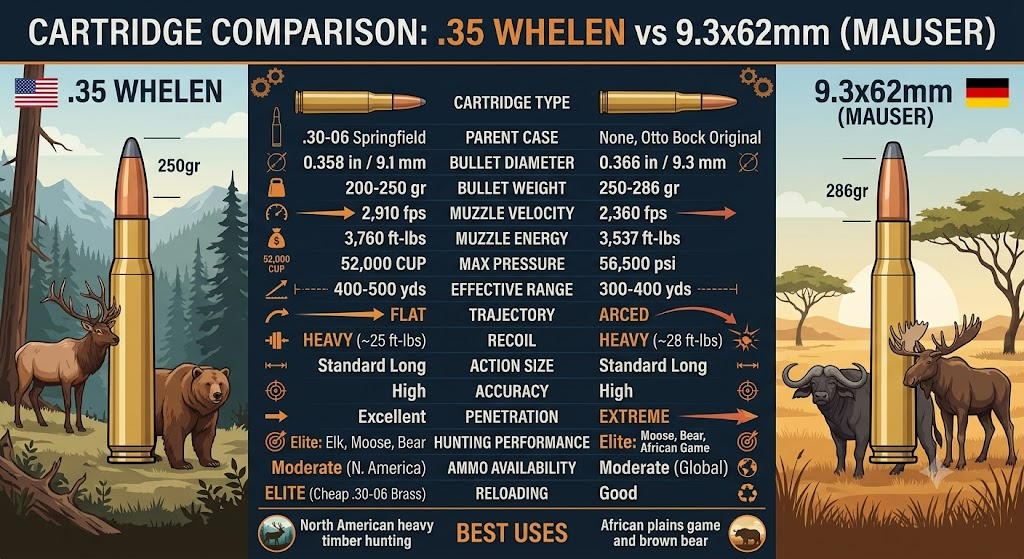
Understanding the Numbers
The technical differences between these cartridges are rooted in their geographic origins. The 9.3×62 was designed in 1905 by German gunmaker Otto Bock specifically for European settlers and farmers in Africa who needed a reliable, affordable cartridge to protect their farms from elephants, lions, and buffalo. It was engineered to fit perfectly into the affordable Mauser 98 standard length action, providing nearly the same power as expensive British double rifle cartridges.
The .35 Whelen was developed in 1922 by Colonel Townsend Whelen and James Howe. They simply took the abundant .30-06 Springfield case and expanded the neck to accept a .358 caliber bullet. This created a “poor man’s magnum” for American hunters that delivered devastating kinetic energy on elk and moose while fitting into standard, affordable American bolt action rifles.
Velocity Comparison
Velocity determines how flat a bullet shoots and how reliably it expands upon impact.
Muzzle Velocity Data (24 inch barrel):
- .35 Whelen (Hornady 200gr Superformance): 2,910 fps
- .35 Whelen (Standard 250gr SP): 2,400 fps
- 9.3×62 (Hornady 286gr InterLock): 2,360 fps
The .35 Whelen is generally the faster cartridge because it commonly fires lighter bullets. When loaded with modern 200 grain ammunition, the .35 Whelen achieves velocities approaching 3,000 feet per second. The 9.3×62 is built around much heavier projectiles, traditionally 286 grains. Because it pushes significantly more lead, its velocity is physically limited to around 2,360 feet per second.
Muzzle Energy Comparison
Muzzle energy measures the kinetic force transferred to the target upon impact.
Muzzle Energy Data (24 inch barrel):
- .35 Whelen (200gr Superformance): 3,760 foot pounds
- 9.3×62 (286gr InterLock): 3,537 foot pounds
Both cartridges deliver bone crushing kinetic energy. While the specific Hornady Superformance load gives the .35 Whelen a slight mathematical edge on paper, both cartridges consistently generate between 3,500 and 3,800 foot pounds of energy. This places both of them firmly in the same power class as the .338 Winchester Magnum and the .375 H&H Magnum at close ranges.
Trajectory Comparison
A flat trajectory minimizes the margin of error when estimating range in the field.
Because the .35 Whelen drives lighter bullets much faster, it shoots significantly flatter than the 9.3×62. A hunter using a 200 grain .35 Whelen can treat it much like a standard .30-06, holding directly on the vitals of an elk out to 300 yards. The 9.3×62, lobbing a heavy 286 grain bullet, arches noticeably more and requires careful holdover estimation past 200 yards.
Bullet Drop Comparison
Assuming a 200 yard zero, the mathematical drop at 300 yards illustrates the trajectory differences clearly.
- .35 Whelen (200gr Superformance): Drops approximately 8.6 inches at 300 yards.
- 9.3×62 (286gr InterLock): Drops approximately 21.1 inches at 300 yards.
The .35 Whelen drops less than half the distance of the 9.3×62 at 300 yards. This provides the American cartridge with a massive ballistic advantage for hunting in open country or across wide canyons.
Wind Drift Comparison
Wind deflection is mitigated by a bullet’s velocity and its ballistic coefficient.
Neither of these cartridges utilizes highly aerodynamic bullets. They rely on heavy, flat base bullets with low ballistic coefficients. Because the .35 Whelen reaches the target much faster, it spends less time exposed to crosswinds. At 300 yards, the .35 Whelen will drift noticeably less than the slower moving 9.3×62.
Recoil Comparison
You cannot generate over 3,500 foot pounds of kinetic energy without paying the price in physical recoil.
Both cartridges produce heavy recoil that will test the fundamentals of the average shooter. In a standard 8 pound hunting rifle, the .35 Whelen generates roughly 24 to 26 foot pounds of free recoil.
The 9.3×62 pushes a heavier bullet, which physics dictates will result in heavier rearward force. The Mauser cartridge typically generates 28 to 30 foot pounds of free recoil. While neither cartridge is as punishing as a true magnum, they both deliver a stiff, heavy push to the shoulder.
Stopping Power Comparison
For hunting, stopping power refers to the ability to physically destroy vital organs and anchor massive animals quickly.
Both cartridges provide elite stopping power. The .35 Whelen relies on slightly higher velocity to create massive hydrostatic shock and wide wound channels. The 9.3×62 relies on the sheer momentum of its heavy .366 caliber bullet to crush heavy bone and cause catastrophic tissue damage. On North American game, the animal will never know the difference. On dangerous African game, the heavier mass of the 9.3×62 is widely preferred.
Penetration Comparison
Deep penetration is required to punch through the heavy shoulder bones of bull elk, moose, or Cape buffalo.
Sectional Density measures a bullet’s weight relative to its diameter. A higher sectional density allows the bullet to penetrate deeper without losing momentum.
- A 250 grain .358 bullet (.35 Whelen) has a sectional density of .279.
- A 286 grain .366 bullet (9.3×62) has a sectional density of .305.
The 9.3×62 is globally legendary for its penetration. The high sectional density of the 286 grain bullet allows it to punch straight through the thickest skulls and heaviest shoulders of African dangerous game. While the .35 Whelen penetrates exceptionally well, it cannot match the sheer plowing force of the heavier 9.3×62.
Expansion Comparison
If a bullet fails to expand, it slips through the lungs without causing enough tissue damage for a rapid kill.
Both cartridges utilize large diameter bullets that punch a massive hole even before they begin to expand. The .35 Whelen guarantees reliable expansion out to slightly further distances because its higher velocity keeps the bullet above the critical expansion threshold longer. The 9.3×62 uses heavy bullets that expand moderately but reliably at moderate velocities, ensuring they do not fragment prematurely on thick hides.
Accuracy Comparison
Both cartridges are capable of elite mechanical accuracy.
Because both fit into standard long action rifles and headspace on the shoulder rather than a belt, they align perfectly with the bore. Hunters routinely report sub MOA groups with both cartridges when using premium factory ammunition or carefully tuned handloads.
Effective Range Comparison
The .35 Whelen, owing to its higher velocity and flatter trajectory, is a highly effective 400 yard hunting cartridge in the hands of a skilled marksman.
The 9.3×62 is a dedicated medium range thumper. Its steep trajectory and rapidly decreasing velocity limit its ethical effective hunting range to roughly 250 to 300 yards. It was designed to drop dangerous animals up close, not for precision shooting across valleys.
Suppressor Performance Comparison
Suppressors are highly recommended for both of these cartridges to mitigate their heavy recoil and loud muzzle blast.
Both cartridges are entirely supersonic and push massive volumes of gas. They perform identically well when suppressed. Adding a quality titanium suppressor will tame the recoil of both cartridges down to levels similar to a standard .308 Winchester, making them incredibly pleasant to shoot.
Short Barrel Performance Comparison
Brush guns are meant to be fast and maneuverable in dense timber.
Both cartridges perform exceptionally well in 20 to 22 inch barrels. Because they utilize medium burn rate powders and heavy bullets, they do not suffer from the massive velocity loss that plagues overbore magnums in short barrels. A 20 inch barrel .35 Whelen or 9.3×62 makes for an ultimate, quick handling timber rifle.
Home Defense Comparison
Neither cartridge should ever be used for home defense. Both fire high mass projectiles with immense kinetic energy. If fired indoors, the extreme over penetration will easily punch through the target, multiple interior walls, and exterior siding, posing a lethal threat to bystanders and neighbors. Use a dedicated pistol or shotgun for home defense.
Hunting Comparison
These cartridges were built specifically for harvesting the largest game on the planet.
- Elk and Moose: Both are absolutely devastating. The .35 Whelen is arguably better for elk simply because it shoots flatter for cross canyon shots.
- Brown Bear: Both are premier choices for Alaskan brown bear guides. The 9.3×62 gets a slight nod due to its heavier bullet mass for stopping charges.
- African Dangerous Game: The 9.3×62 is universally recognized across Africa. Many African nations strictly require a minimum caliber of 9.2mm or .375 for hunting dangerous game like buffalo and elephant. The 9.3×62 meets this legal requirement, whereas the .358 caliber Whelen is legally prohibited for dangerous game in many jurisdictions.
Tactical and Duty Use Comparison
Neither cartridge has any application in modern law enforcement or military roles. They are dedicated big game hunting cartridges. Militaries globally use intermediate cartridges like 5.56 NATO or long range precision cartridges like .338 Lapua Magnum, leaving these heavy medium bores entirely to the sporting market.
Action Length and Rifle Compatibility
This is a massive logistical advantage for both cartridges.
Unlike heavy magnums that require expensive, specialized magnum length actions, both the .35 Whelen and the 9.3×62 were engineered to fit perfectly into a standard long action receiver. This is the exact same action size used for the .30-06 Springfield or the .270 Winchester. This allows hunters to utilize lightweight, perfectly balanced rifles without carrying the extra bulk of a magnum action.
Ammo Cost Comparison
Both cartridges are considered premium hunting rounds, and ammunition is priced accordingly.
You will not find cheap target practice ammunition for either caliber. Boxes of 20 rounds typically cost double or triple the price of standard .30-06 ammunition. Because they are specialty items, manufacturers only load them with high end premium bullets, driving the cost up significantly.
Ammo Availability Comparison
Availability depends entirely on your geography.
In North America, the .35 Whelen is much easier to find. Most large sporting goods stores and rural outfitters will stock at least one or two boxes of .35 Whelen during hunting season.
In Europe and Africa, the 9.3×62 is as common as the .30-06 is in America. It is available in every gun store. However, finding 9.3×62 ammunition in a small rural hardware store in the United States is practically impossible, requiring hunters to order their ammunition online.
Reloading Comparison
Both cartridges are absolute favorites in the reloading community.
The .35 Whelen is arguably one of the easiest and cheapest medium bore cartridges to reload. Because it is based on the .30-06 Springfield, a handloader can pick up free, ubiquitous .30-06 brass at the range and easily expand the neck to .358 caliber using a sizing die.
The 9.3×62 is also easy to reload, but you must purchase dedicated 9.3×62 brass cases, which are significantly more expensive. However, bullet selection for both calibers is excellent, with premium manufacturers offering a wide variety of heavy projectiles.
Pros and Cons
.35 Whelen
Pros
- Generates magnum level kinetic energy from a standard length action.
- Shoots significantly flatter than the 9.3×62 for longer range shots.
- Readily available in North American sporting goods stores.
- Cases can be easily formed from cheap .30-06 Springfield brass.
- Slightly milder recoil than the 9.3×62.
Cons
- Legally prohibited for dangerous game hunting in many African countries.
- Lacks the extreme sectional density of the heavier European bullets.
- Factory ammunition choices are somewhat limited compared to smaller calibers.
9.3×62
Pros
- Fully legal and universally respected for African dangerous game.
- Massive 286 grain bullets provide unmatched, straight line penetration.
- Fits perfectly in standard long action rifles.
- Elite stopping power on heavy boned animals like brown bears.
Cons
- Trajectory drops significantly past 200 yards.
- Ammunition is difficult to find locally in the United States.
- Generates heavy recoil that requires strong fundamentals to manage.
Final Verdict
Choosing between the .35 Whelen and the 9.3×62 comes down entirely to what continent you plan to hunt on.
- For the North American Hunter: Choose the .35 Whelen. It provides all the kinetic energy necessary to drop an Alaskan moose or brown bear, shoots flatter for cross canyon elk shots, and ammunition is much easier to find across the United States.
- For the African Safari: Choose the 9.3×62. It is a legendary global standard. It meets the strict legal caliber requirements for dangerous game across Africa, and ammunition will be readily available in any African hunting camp.
- For the Handloader: Choose the .35 Whelen. The ability to use practically free .30-06 brass cases and abundant .358 caliber bullets makes it a highly economical heavy hitter to reload.
- For Maximum Penetration: Choose the 9.3×62. The extremely high sectional density of the 286 grain bullet simply penetrates deeper through heavy bone than the lighter American bullets.
FAQ
Is the 35 Whelen a magnum?
No. The .35 Whelen is not technically a magnum cartridge because it is based on the standard .30-06 Springfield case and operates at standard pressures. However, because it fires a heavy .358 caliber bullet, it generates muzzle energy that closely matches true belted magnums like the .338 Winchester Magnum.
Can you shoot dangerous game with a 9.3×62?
Yes. The 9.3×62 was designed specifically for dangerous game and has been used successfully on elephants, lions, and Cape buffalo for over a century. It is widely considered the absolute minimum safe caliber for African dangerous game hunting.
Why is the 35 Whelen not allowed in Africa for dangerous game?
Many African countries established minimum caliber laws for dangerous game to prevent wounding animals. The minimum is typically set at 9.2mm or .375 caliber. Because the .35 Whelen utilizes a 9.1mm (.358 inch) bullet, it falls just below the legal threshold, despite having nearly identical kinetic energy to the legal 9.3×62.
Does the 9.3×62 kick hard?
Yes. Firing a massive 286 grain bullet out of a standard weight hunting rifle generates roughly 28 to 30 foot pounds of free recoil. It is a heavy, stout push that is noticeably stronger than a standard .30-06, but slightly milder than a true .375 H&H Magnum.
Can I make 35 Whelen brass from 30-06?
Yes. This is one of the greatest benefits of the cartridge. By running a standard .30-06 Springfield brass case through a .35 Whelen sizing die with a tapered expander ball, you can easily neck up the brass to safely load .35 Whelen ammunition.
What is the effective range of the 35 Whelen?
With modern premium ammunition, a skilled marksman can ethically harvest large game with the .35 Whelen out to 400 yards. At that distance, the heavy bullet still retains enough kinetic energy and velocity to reliably expand and penetrate deeply.